IN THE SUPREME COURT OF BRITISH COLUMBIA
|
Citation: |
Council of Canadians with Disabilities v. British Columbia (Attorney General), |
|
|
2026 BCSC 1416 |
Date: 20260728
Docket: S168364
Registry: Vancouver
Between:
Council of Canadians with Disabilities
Plaintiff
And
Attorney General of British Columbia
Defendant
And
Health Justice
Intervener
Restriction on publication: A publication ban made on April 15, 2025 pursuant to the Court’s inherent jurisdiction restricts the publication, broadcasting or transmission in any way the names, identities or any information that would tend to identify the following witnesses: A.Z., B.Y., C.X., D.W., E.W., F.V., G.U., I.S., A.A., B.A., A.B., A.C., B.C., C.C., E.C., F.C., A.D., A.E., A.F., A.H., A.I., A.J., A.K., B.K., A.L., and B.L.
Further, the identity of the individual referred to in this proceeding as D.C. is protected by a publication ban made on September 12, 2016.
These publication bans apply indefinitely unless otherwise ordered.
Before: The Honourable Justice Blake
Reasons for Judgment
|
Counsel for the Plaintiff: |
P. Williams C. Bildfell R. Abrahams K. Love D. Sabelli M. Rozee L. Billard, Articled Student |
|
Counsel for the Defendant: |
C. Jones, K.C. A. Sharon H. Ahmed H. Richardson |
|
Counsel for the Intervener: |
D. Eeg
|
|
Place and Date of Trial: |
Vancouver, B.C. May 29–30, June 2–6, 9–12, 16–20, 23–27, October 27–31, November 3–7, and 20, 2025 January 29 and 30, 2026 |
|
Place and Date of Judgment: |
Vancouver, B.C. July 28, 2026
|
Table of contents
III. SCOPE OF THE CONSTITUTIONAL CHALLENGE
V. THE PLAINTIFF AND PUBLIC INTEREST STANDING
VI. THE INTERVENER HEALTH JUSTICE
VII. THE IMPUGNED PROVISIONS AND SECTIONS 31(1) and 8(a) MHA
VIII. CAPACITY, INFORMED CONSENT AND THE MHA
B. History of the Consent Act and the Representation Agreement Act
X. MENTAL HEALTH TREATMENT IN BRITISH COLUMBIA
A. Current Regime in British Columbia
C. Current Data on Involuntary Admissions and Detention
E. Legislative Consultation, Oversight and Amendments
XI. MENTAL HEALTH TREATMENT ACROSS CANADA
B. Treatment Decisions by Capable Involuntary Patients
C. Treatment of Incapable Patients
D. Applications for Orders to Treat Involuntary Patients
E. Delay Pending Review or Appeal Concerning Capacity
A. Objections to the Hearsay and Opinion Evidence of Family Members
1. Applicable Analytical Framework
2. Objections to Evidence of CCD
3. Objections to Evidence of the AGBC
B. Objections to the Expert Evidence
1. Applicable Analytical Framework
XIII. TESTIMONY OF LAY WITNESSES
C. Topics Addressed By The Lay Witnesses.
XIV. STATE OF EMERGENCY IN BRITISH COLUMBIA
XV. THE EXPERT OPINION EVIDENCE
A. Areas Of Agreement Among the Experts
1. Voluntary Treatment Preferrable
4. Psychotropic Medications and Neuromodulation
5. Guiding Principles for the Medical Assessment of Capacity
6. Capacity to Consent to Treatment
7. Involving Patients in Treatment Decisions
9. Risks of Involuntary Treatment
B. Areas Of Disagreement Among the Experts
1. The Prevalence of the Capable Refuser
2. The DUP For Involuntary Patients in BC
4. The Risks Associated with Involuntary Treatment
5. The Stigma Associated with Involuntary Treatment
6. Oversight and Procedural Justice
B. Context and Purpose of Involuntary Admission and Detention Provisions
1. Prior Judicial Interpretations of the Purpose of the MHA
2. Context and Relevant Legal Norms
3. Interpretation of s. 8(a) of the MHA
C. Interpretation of the Impugned Provisions
D. This Claim Requires Consideration of the Charter Challenge
XVII. SECTION 7: LIFE, LIBERTY AND SECURITY OF THE PERSON
A. Applicable Analytical Framework
1. Deprivation of Life, Liberty or Security of the Person
2. Principles of Fundamental Justice
1. Is there a Deprivation of the s. 7 Rights?
2. Is the Deprivation in Accordance with the Principles of Fundamental Justice?
A. Applicable Analytical Framework
1. Does the Legislation Create a Distinction Based on an Enumerated or Analogous Ground?
3. Is the Legislation saved by s. 15(2) because they are Ameliorative Provisions?
A. Applicable Analytical Framework
1. Are the Limits on Charter Rights Prescribed by Law?
2. Is the Purpose of the Legislation Pressing and Substantial?.
3. Is the Legislation Proportionate to its Purpose?
C. Conclusions on the Constitutional Issues
A. Applicable Analytical Framework
A. Schedule I: Relevant Portions of the Legislation
C. Schedule III: Cross Canada Comparison of Mental Health Legislation
D. Schedule IV: Expert Witnesses: Qualifications and Brief Summaries of Their Evidence
I. SUMMARY
[1] In BC, the provision of mental health services is governed by the Mental Health Act, R.S.B.C. 1996, c. 288 [MHA]. Under the MHA, patients may be admitted to a provincial mental health facility on a voluntary or involuntary basis. A patient may be admitted as an involuntary patient if they are found to be a “person with a mental disorder” and if the required process set out in s. 22 of the MHA is satisfied. There are also other ways a person may become an involuntary patient under the MHA. The director of the facility must ensure that each patient — voluntarily or involuntarily admitted — is provided with professional service, care and treatment appropriate to their condition. In addition, for involuntary patients, s. 8(a) of the MHA states that a director may sign a form consenting to their psychiatric treatment.
[2] The Health Care (Consent) and Care Facility (Admission) Act, R.S.B.C. 1996, c. 181 [Consent Act] and the Representation Agreement Act, R.S.B.C. 1996, c. 405 [RAA] are two separate pieces of legislation that address how British Columbians may consent to medical treatment, and how others (on their behalf) may also have the legal authority to do so. However, these statutes do not apply to the provision of psychiatric treatment when a patient is involuntarily admitted under the MHA.
[3] The plaintiff, the Council of Canadians with Disabilities (“CCD”), does not challenge BC’s involuntary admission regime. Nor does it dispute the importance of psychiatric treatment. Rather, CCD challenges only the portion of BC’s legislative regime that removes the presumption of capacity for patients who are involuntarily admitted, and that purport to give the director of a mental health facility the authority to consent to psychiatric treatment on behalf of a person who has been involuntarily admitted and detained. CCD says BC’s legislative scheme authorizing psychiatric treatment on behalf of a patient who is involuntarily admitted violates the Canadian Charter of Rights and Freedoms [Charter]; specifically, the legislative scheme violates the s.7 right to life, liberty and security of the person of involuntarily admitted patients, and their s. 15 equality rights. CCD argues that these violations cannot be justified under s. 1 of the Charter.
[4] CCD initially sought to challenge five discrete sections of the MHA, the Consent Act, and the RAA, specifically:
a) s. 31(1) of the MHA (through which, for involuntarily admitted patients, treatment authorized by the director was deemed to be given with the consent of the patient);
b) ss. 2(b) and (c) of the Consent Act; and
c) ss. 11(1)(b) and (c) of the RAA.
Due to the unanticipated repeal of s. 31(1) of the MHA in the last days of this trial, the section of the MHA CCD challenged changed at the end of closing argument. The focus turned squarely to s. 8(a) of the MHA, which deals with the powers and duties of directors of provincial mental health facilities and psychiatric or observation units. I explain in greater detail in para. [42] and paras. [169] — [171] why, notwithstanding the repeal, I still at times refer to BC’s regime for involuntary admission, detention and treatment as the “deemed consent regime”.
[5] The experts who testified at trial agreed that most involuntary patients are willing to accept treatment voluntarily. Of those involuntary patients who initially refuse treatment, most ultimately agree to receive treatment, without receiving any psychiatric treatment on an involuntary basis. However, under BC’s deemed consent regime, capable involuntary patients may be given psychiatric treatment, even if they do not consent to that treatment.
[6] The right to determine what shall, or shall not, be done with one’s own body, and to be free from non-consensual medical treatment, is deeply rooted in our common law. However, if a patient is involuntarily admitted under the MHA, this right is eliminated for both incapable patients, and for those capable patients who refuse the proposed psychiatric treatment. This means in BC there is a regime under which involuntarily admitted patients, whether capable or not (or whether they have previously appointed a representative to act on their behalf or expressed their wishes in a legally binding advance directive), are deemed to consent to the psychiatric treatment their treating doctors determine appropriate for them. This is true even if the capable involuntarily admitted patient refuses to consent to the proposed psychiatric treatment.
[7] BC is an outlier in Canada in this regard. It is the only jurisdiction in Canada whose mental health legislation:
a) has no statutory requirement or framework to assess an involuntary patient’s capacity to make decisions about their psychiatric treatment;
b) grants the detaining facility a unilateral power to treat a capable involuntary patient against their will; and
c) has no independent oversight of a physician’s assessment that an involuntary patient is incapable of making psychiatric treatment decisions.
[8] In closing argument the parties disagreed on whether s. 31(1) of the MHA authorized this deemed consent regime (which the defendant says is more properly described as “BC’s MHA Involuntary Treatment Regime”). CCD said s. 31(1) authorized the regime; the defendant said s. 8(a) authorizes it. In brief, s. 31(1) provided “treatment authorized by the director is deemed to be given with the consent of the patient”. Section 8(a) provides that a director must ensure each patient admitted to a facility is “provided with professional service, care and treatment appropriate to the patient’s condition” and, for those purposes, “a director may sign consent to treatment forms” for patients admitted under certain sections of the MHA on an involuntary basis. This case is unprecedented in that the legal issue raised unexpectedly changed late in closing arguments when counsel for the Attorney General of British Columbia (the “AGBC” or the “Attorney”), announced the government’s intention to repeal s. 31(1) of the MHA. This repeal of s. 31(1) occurred on December 3, 2025.
[9] As a result of the repeal of s. 31(1), I no longer need to consider whether s. 31(1) authorized BC’s MHA Involuntary Treatment Regime. Rather, I must determine whether s. 8(a) is sufficient on its own to authorize psychiatric treatment to all involuntarily admitted patients. If it is, then I must consider whether s. 8(a) is Charter compliant.
[10] I have determined that the MHA, including s. 8(a), does not empower a director to authorize forced psychiatric treatment on behalf of involuntarily admitted patients. Put simply, it does not authorize BC’s deemed consent regime. I find that s. 8(a), on its own, was never intended to authorize treatment for involuntary patients; it was never intended to be the section pursuant to which consent to psychiatric treatment was able to be deemed by a director to be on behalf of an involuntarily admitted patient.
[11] However, in the event I am wrong, and with the agreement of the parties, I find it appropriate to proceed with a full Charter analysis on the basis that s. 8(a) of the MHA does empower a director to authorize psychiatric treatment on behalf of involuntary patients. On that basis, I must determine if s. 8(a) of the MHA, ss. 2(b) and (c) of the Consent Act, and ss. 11(1)(b) and (c) of the RAA violate s. 7 or s. 15 of the Charter, and if they do, whether these violations are justified under s. 1 of the Charter. With respect to s. 8(a), CCD focuses on the second half of that provision, what they characterize as the “form signing power”.
[12] I had the benefit of hearing from 14 experts (who tendered 22 expert reports) all of whom have devoted their professional careers to the treatment of mental health disorders. I had the privilege of hearing from numerous lay witnesses with lived experience with involuntary mental health treatment, and from family members with experience supporting their loved ones with such lived experience. In these reasons for judgment, I set out both the evidence and the legal arguments that have satisfied me that the plaintiff succeeds in its challenge.
[13] Specifically, I find that the second half of s. 8(a) of the MHA, ss. 2(b) and (c) of the Consent Act, and ss. 11(1)(b) and (c) of the RAA are unconstitutional in that they unjustifiably infringe upon the rights to life, liberty and security of the person of those British Columbians who are involuntarily apprehended for mental health treatment, and they unjustifiably infringe their equality rights.
[14] There are two stages to the analysis of whether a piece of legislation breaches s. 7 of the Charter. First, a person making a claim challenging a law under s. 7 must establish that the impugned legislation deprives a person of the right to life, liberty, or security of the person. Second, if there has been a deprivation of one of these rights, then the person making the claim must demonstrate that the deprivation is not in accordance with the principles of fundamental justice.
[15] In the reasons that follow, I find CCD has established that the impugned legislative provisions operate to eliminate the health care consent rights of all involuntarily admitted patients who do not consent to the proposed psychiatric treatment, regardless of their capacity, regardless of whether they previously appointed a representative, regardless of whether they have a substitute decision-maker (“SDM”) or a temporary substitute decision-maker (“TSDM”) willing to act on their behalf, and regardless of whether they previously made a legally binding advance directive. I accept that CCD has established this engages the right to life, the right to liberty, and the right to security of the person.
[16] Under the second stage of the s. 7 analysis, I find CCD has established that these rights have been deprived contrary to the principles of fundamental justice. Rather than targeting certain narrowly defined circumstances in which an interference with the rights to life, liberty or security of the person is truly necessary to advance the purpose of BC’s MHA Involuntary Treatment Regime, the second half of s. 8(a) of the MHA, ss. 2(b) and (c) of the Consent Act, and ss. 11(1)(b) and (c) of the RAA operate to create a legislative scheme in which a director is automatically granted a blanket power to provide any psychiatric treatment they determine appropriate to any involuntary patient in any situation.
[17] There is also a two-step test for assessing a s. 15(1) claim. To establish a breach of the equality rights in s. 15(1) of the Charter, CCD must show that the impugned provisions in the Consent Act and the RAA, and the second half of s. 8(a) of the MHA, either on their face or in their impact, create a distinction based on mental disability, and impose a burden or deny a benefit in a manner that has the effect of reinforcing, perpetuating, or exacerbating disadvantage.
[18] I am satisfied that CCD has established that the second half of s. 8(a) of the MHA, ss. 2(b) and (c) of the Consent Act, and ss. 11(1)(b) and (c) of the RAA create a distinction and treat people with mental disabilities, who have been involuntarily detained under the MHA, differently. CCD has established that the impugned legislation denies involuntarily admitted patients the benefit all other patients in BC have — the ability, if they are capable, to direct their health care — and perpetuates the stereotype that individuals suffering from a mental disorder lack capacity. Not only are these provisions arbitrary, they also deny the benefit all British Columbians have to consent or refuse health care in a manner that reinforces, perpetuates, and exacerbates historical disadvantage experienced by individuals with a mental disorder.
[19] Neither of the infringements I have found are justified under s. 1 of the Charter. I accept the purpose of the impugned legislation is pressing and substantial, and the legislation in question is rationally connected to that purpose. However, there are less drastic means to achieve that legislative purpose: every other province and territory has mental health legislation that impairs the health care consent rights of involuntarily admitted patients in a significantly less drastic manner. The impugned legislation is neither minimally impairing, nor are its effects proportionate to the purpose of the legislation. For these reasons, and despite affording proper due deference to the Legislature, I conclude that the second half of s. 8(a) of the MHA, ss.2(b) and (c) of the Consent Act and ss. 11(1)(b) and (c) of the RAA are unconstitutional in that they unjustifiably infringe ss. 7 and 15 of the Charter and are, to that extent, of no force or effect.
[20] Accordingly, I declare that the MHA, including s. 8(a), does not empower directors to authorize Forced Psychiatric Treatment (as that term is defined below).
[21] I also declare that ss. 2(b) and (c) of the Consent Act and ss. 11(1)(b) and (c) of the RAA unjustifiably infringe ss. 7 and 15 of the Charter and are, to that extent, of no force or effect. As I have concluded that the MHA, including s. 8(a), does not empower directors to authorize Forced Psychiatric Treatment, I make no declaration with respect to s. 8(a) of the MHA.
[22] The declarations I have issued will be suspended for a period of six months to provide the Legislative Assembly the opportunity to consider the legislative response to these reasons for judgment and take whatever steps it sees fit to draft Charter-compliant legislation.
II. INTRODUCTION
[23] An adult’s right to make decisions about their own body, including their medical care, is critical to their dignity and autonomy. The right to determine what shall, or shall not, be done with one’s own body, and to be free from non-consensual medical treatment, is deeply rooted in our common law. Every capable adult has the right to refuse unwanted medical treatment, even if serious consequences may result from such a refusal. This common law right to bodily integrity and personal autonomy is so entrenched in our legal system it has been described as “fundamental” and “deserving of the highest order of protection”.
[24] Many, if not most, British Columbians have experience with mental illness. They may have, or be perceived to have, a mental disorder, or otherwise struggle with their mental health. They may have supported a loved one with mental illness. They may have a partner who experiences depression, a friend who struggles with an eating disorder, or a child who is diagnosed with a mental illness. They may experience the deep frustration of dealing with a loved one with a substance use disorder, or the fear of encountering someone on the street in the throes of a psychotic delusion. Each of their experiences are unique.
[25] The treatment of those in our society who struggle with mental illness can generate strong opinions. The issue before me is not whether BC should have an involuntary admission regime for those individuals who are unable to recognize that their mental illness is impeding their ability to appreciate their need for treatment. It must. Rather, the issue before me is much more limited: whether BC’s legislative approach to psychiatric treatment for involuntarily admitted patients — the deemed consent regime — is constitutional. Ultimately, this case is about the recognition and protection of health care consent rights even for those individuals who have been involuntarily admitted under the MHA.
[26] The issue of how we, as a society, choose to treat those individuals who are experiencing mental illness, and particularly those individuals who have been involuntarily apprehended as they are a danger either to themselves or to others, is complicated. Individuals suffering from serious mental disorders are highly vulnerable and are frequently at risk of being betrayed by that fundamental human trait — the ability to clearly think and reason.
[27] In BC, the provision of mental health services is governed by the MHA. The admission and detention of patients is governed by Part 3 of the MHA. Section 20 of the MHA deals with voluntary admissions, and s. 22 of the MHA deals with involuntary admissions. A person may be admitted as an involuntary patient if they meet the statutory definition found in s. 22 of the MHA. Specifically, s. 22 requires that a physician or nurse practitioner examines the person, determines they are a “person with a mental disorder”, and completes a certificate setting out that in their opinion, the person:
a) is a person with a mental disorder;
b) requires treatment in or through a designated facility;
c) requires care, supervision, and control in a designated facility to prevent their “substantial mental or physical deterioration”, or for their protection or the protection of others; and
d) cannot be admitted as a voluntary patient.
I address additional terminology unique to the MHA in Section IV: Terminology.
[28] Thousands of British Columbians are involuntarily admitted under the MHA every year. In 2005/2006, 8,892 patients were involuntarily admitted with a mental health diagnosis under the MHA. By 2023/2024, that number had risen to 16,569 patients. CCD does not challenge the provisions of the MHA that allow for the involuntary admission and detention of patients with a mental disorder.
[29] While a capable involuntarily admitted patient can consent to their psychiatric treatment, this case is centered on those individuals who do not. For those individuals, once they are involuntarily admitted — unless they are found capable and they actually consent to the proposed psychiatric treatment — they no longer have the right to determine their own treatment. If an involuntarily admitted patient is found to be capable, their only option is to consent to the proposed psychiatric treatment. If they do not, then the psychiatric treatment will proceed in any event if the director finds it to be appropriate in the circumstances, and it will be deemed to be given with their consent.
[30] Involuntarily admitted patients no longer have the right others enjoy as capable adults: to give, refuse, or revoke consent to psychiatric treatment (although they retain that right with respect to all other medical treatment). That is so whether they have legal capacity at the time of their admission, or have previously taken steps while they are capable to appoint a representative to make their treatment decisions, draft an advance directive, or have an SDM willing to make such treatment decisions on their behalf. Rather, once involuntarily detained, these individuals lose their right to refuse the psychiatric treatment prescribed for them by the director of the facility in which they are detained. That is the central issue that is at the heart of this constitutional challenge.
[31] The Legislative Assembly has enacted three pieces of legislation that intersect to govern how BC addresses treatment of individuals suffering from a mental disorder who have been involuntarily admitted to a designated facility. The MHA is the legislation that governs the delivery of mental health services in BC. The Consent Act and the RAA are two separate statutes that address how British Columbians may consent to medical treatment, and how others (on their behalf) may have the legal authority to do so.
[32] CCD filed their notice of civil claim on September 12, 2016, and initially sought to challenge five discrete sections of the MHA, the Consent Act, and the RAA, specifically:
b) ss. 2(b) and (c) of the Consent Act; and
c) ss. 11(1)(b) and (c) of the RAA.
In this notice of civil claim, CCD referred to these five sections as the “Impugned Provisions”. Throughout these reasons I will define ss. 2(b) and (c) of the Consent Act and ss. 11(1)(b) and (c) of the RAA as the “Impugned Provisions” for reasons that will become clear.
[33] At the time CCD filed their notice of civil claim (and up until December 3, 2025), s. 31(1) of the MHA provided:
Deemed consent to treatment and request for a second opinion
31 (1) If a patient is detained in a designated facility under section 22, 28, 29, 30 or 42 or is released on leave or is transferred to an approved home under section 37 or 38, treatment authorized by the director is deemed to be given with the consent of the patient.
[Emphasis added.]
[34] When closing arguments began in October 2025, counsel for CCD argued s. 31(1) was the “legislative source of authority” for the deemed consent regime. The AGBC disagreed and argued that s. 31(1) of the MHA functioned as a “tort shield” and not as a “deemed consent” provision. In other words, the AGBC argued it served as a defence to a claim brought by a patient for assault or battery.
[35] Rather, counsel for the AGBC argued, it was s. 8(a) of the MHA that empowered directors of designated facilities to authorize psychiatric treatment for involuntary patients without their consent. Section 8(a) of the MHA provides:
Powers and duties of directors
8 A director must ensure
[Emphasis added.]
[36] Much of the closing arguments were taken up with this debate: whether s. 31(1) or s. 8(a) of the MHA authorized BC’s deemed consent regime. There were significant arguments advanced as to whether CCD ought to have challenged s. 8(a) of the MHA in addition to s. 31(1) and therefore should be required to amend their pleadings and file a new notice of constitutional question, and whether the AGBC had properly set out their legal position in their response to civil claim, and whether they should even be permitted to advance their argument that s. 8(a) was, in fact, the operative provision.
[37] In an unprecedented and unexpected turn of events, on November 20, 2025 (on what was anticipated to be the last day of closing submissions), counsel for the AGBC advised that an amendment to the MHA was expected to be introduced in the Legislative Assembly the week of November 24, 2025. The anticipated amendment would repeal s. 31(1) of the MHA, make some ancillary amendments to s. 31(2) of the MHA, and add to the liability protections found in s. 16 of the MHA. This occurred, and the amendments to the MHA received royal assent on December 3, 2025. What motivated this legislative change does not concern me.
[38] As a result of the repeal of s. 31(1) of the MHA, the parties amended their pleadings and made further supplemental written submissions and oral arguments: including, but not limited to, whether s. 8(a) of the MHA, on its own, provides the legal authority to a director of a designated facility to authorize psychiatric treatment on behalf of a patient who has been involuntarily admitted. This fundamental disagreement between the parties on what s. 8(a) does is set out in greater detail below in Section VII: The Impugned Provisions and Sections 31(1) and 8(a) MHA.
[39] Given this fundamental disagreement, in its third amended notice of civil claim, CCD amended its definition of “Impugned Provisions” to be restricted to ss. 2(b) and (c) of the Consent Act and ss. 11(1)(b) and (c) of the RAA, and referred separately to s. 8(a) and (when applicable as part of the historical narrative) s. 31(1) of the MHA. To be consistent with the parties’ pleadings, that is how I will refer to the legislation at issue in this constitutional challenge.
[40] After carefully considering the submissions of counsel, and taking into account the unexpected events at trial with the repeal of s. 31(1) of the MHA, I have concluded that I need not determine, as a preliminary matter, whether (prior to the amendments) a director had the authority pursuant to s. 31(1) or s. 8(a) of the MHA to authorize psychiatric treatment for a patient who was involuntarily admitted. The reality is that BC continues to provide treatment to patients who are involuntarily admitted in the same manner as before the repeal of s. 31(1), and it relies upon the purported authority given in s. 8(a) of the MHA to do so. Rather, I must determine whether s. 8(a) of the MHA gives a director the authority to authorize treatment on behalf of an involuntarily admitted patient.
[41] The parties agree that the effect of the Impugned Provisions and the purported authority of s. 8(a) of the MHA is that anyone who is involuntarily apprehended or admitted under the MHA, and who refuses to consent to their proposed psychiatric treatment, is deprived of the right to give, refuse, or revoke consent to psychiatric treatment, regardless of their actual capacity to make health care decisions. These provisions also deprive these patients of the right to have psychiatric treatment decisions made on their behalf, such as by a representative under the RAA, or by an SDM or TSDM under the Consent Act, or to make an advance directive recording their instructions while they are capable to do so.
[42] Rather, for involuntary patients, it is the director who approves treatment and who may sign consent to treatment forms on their behalf. This has been referred to historically as a “deemed consent regime”. As noted earlier, the AGBC objects to this description and would prefer it is referred to as “BC’s Involuntary Treatment Regime” or “Medically Informed Substitute Decision Making”, arguing those are more appropriate descriptors. Counsel ultimately agreed that “BC’s MHA Involuntary Treatment Regime” was a proper neutral description. Accordingly, I will refer to it as such as appropriate. However, frequently I will refer to it as the “deemed consent regime”, to reflect both the evidence given at trial and the written submissions and arguments of the parties. It is, however, important to note that this regime dispenses with the consent of the involuntary patient, and with the consent of any family member or close friend who has the legal authority to consent, in certain circumstances, on behalf of an incapable patient. In effect, the deemed consent regime dispenses with the consent of a capable patient who refuses treatment, and with the consent of someone legally authorized to consent on behalf of an incapable patient.
[43] CCD argues that BC’s MHA Involuntary Treatment Regime is unconstitutional, as it unjustifiably limits the rights of people with mental disabilities under ss. 7 and 15 of the Charter without justification.
[44] CCD stresses that BC’s regime obliterates completely an individual’s liberty and ability to choose. CCD notes no other province or territory eliminates the rights of individuals with a mental disorder in a similar manner, and says no other jurisdiction goes as far as BC. They argue that the system we have results in trauma, mistrust, and a breakdown in the therapeutic relationship; the very system designed to care for vulnerable people is failing them. CCD says that the deemed consent regime is intended to improve the condition of involuntary patients through psychiatric treatment based on the incorrect belief that all involuntary patients are incapable of making psychiatric treatment decisions. They argue the regime incorrectly captures individuals who:
a) are capable of making their own health care decisions, including capable involuntary patients who have rational and reasonable grounds for refusing certain psychiatric treatments or wanting to select one treatment over another (for example, based on an assessment of efficacy, side effects, and previous experience);
b) have an available SDM, or a representative appointed under a representation agreement, available to consider and consent to psychiatric treatment on their behalf; or
c) while capable, created a legally binding advance directive.
CCD says every other jurisdiction in Canada has a greater degree of protection for the fundamental rights of individuals who are involuntarily admitted for treatment, and the evidence is that those regimes work.
[45] CCD seeks the following relief:
a) a declaration
i. that the MHA, including s. 8(a), does not empower directors to authorize Forced Psychiatric Treatment; or, in the alternative,
ii. that the words “and, for those purposes, a director may sign consent to treatment forms for a patient detained under section 22, 28, 29, 30 or 42” in s. 8(a) of the MHA unjustifiably infringe ss. 7 and 15 of the Charter and are of no force and effect;
b) a declaration that ss. 2(b) and (c) of the Consent Act, and ss. 11(1)(b) and (c) of the RAA unjustifiably infringe ss. 7 and 15 of the Charter and are, to that extent, of no force or effect.
[46] CCD refers to forced psychiatric treatment as psychiatric treatment, or any procedure necessarily related to the provision of psychiatric treatment, that is administered to a patient who is involuntarily detained under the MHA, without the consent or authorization required under the Consent Act.
[47] In response, the AGBC denies that the Impugned Provisions and s. 8(a) of the MHA are unconstitutional. The AGBC argues that the purpose of the MHA, and in particular its involuntary admission and detention provisions, is to ensure that persons with serious mental disorders who are unable to properly interact with their environment receive safe and effective psychiatric treatment appropriate to their condition and circumstances, for their own protection and the protection of others.
[48] Counsel for the AGBC used numerous metaphors and analogies to illustrate this argument. He likened mental illness to the siren’s song in Homer’s Odyssey, and argued the MHA represents a social compact through which British Columbians have agreed that when we are “imperilled by the siren’s song” of mental illness, we want to be tied to the Odyssey’s mast, saved from succumbing to the siren’s song, and treated. Later, drawing on a traffic metaphor in which mental illness was a bus, he asked whether it could ever be as objectionable to push someone out of the path of the bus, as it was to push them into the path of the bus. Throughout, counsel argued that CCD’s constitutional challenge amounted to taking a baseball bat to BC’s MHA Involuntary Treatment Regime.
[49] These oral flourishes, unfortunately, did not assist in clarifying the position of the AGBC, which suffered from inconsistencies over the duration of closing argument. By way of example, at times the AGBC argued that nothing would change in the delivery of involuntary treatment in BC if the Impugned Provisions and s. 8(a) of the MHA were struck down, and at other times the AGBC argued the consequences of striking those sections of legislation would be “catastrophic”. Likewise, the AGBC argued that capable refusers of involuntary treatment are never treated as an involuntary patient in BC, and at other times argued that such patients are treated rarely.
[50] The AGBC stresses that mental disorders and mental illnesses strike at the very heart of what makes us human — our ability to reason, function, and interact appropriately in the world. Counsel for the AGBC acknowledges the legislative scheme is paternalistic, but argues that BC’s legislative approach embodies an unapologetic “treatment first” approach that does not infringe on Charter rights, and in some cases forced psychiatric treatment is, in fact, the only just, right, and moral thing to do.
[51] The central legal issue to be determined is if BC’s MHA Involuntary Treatment Regime is constitutionally compliant.
[52] To determine that issue, as a preliminary step, I must properly interpret s. 8(a) of the MHA to determine whether the MHA, and s. 8(a), authorizes the deemed consent regime.
[53] Then I must consider whether BC’s MHA Involuntary Treatment Regime — namely s. 8(a) of the MHA, ss. 2(b) and (c) of the Consent Act and ss. 11(1)(b) and (c) of the RAA — infringe either s. 7 or s. 15 (or both) of the Charter, and, if they do, whether they can be justified under s. 1.
III. SCOPE OF THE CONSTITUTIONAL CHALLENGE
[54] To properly appreciate the scope of this constitutional challenge, I will first set out some basic agreed principles about guaranteed rights and freedoms in Canada.
[55] The Charter is part of the Constitution of Canada. It applies to the provincial and federal governments in Canada, and protects individuals against state actions: s. 32; see also Servatius v. Alberni School District No. 70, 2022 BCCA 421 [Servatius] at para. 27. The Charter guarantees certain fundamental freedoms and rights including democratic rights (s. 3), mobility rights (s. 6), and legal rights such as the right to life, liberty and security of the person (s. 7), and equality rights that protect individuals from discrimination for reasons including mental or physical disability (s. 15). The enumerated rights and freedoms set out in the Charter were not intended to be absolute. Frequently there will be a tension between one person’s right or freedom and the needs of the community and the rights and freedoms of other people: Servatius at para. 31. The Charter allows governments to limit individual rights and freedoms so long as the government can justify the limits (s. 1): Servatius at para. 32.
[56] CCD argues that the Impugned Provisions and the second half of s. 8(a) of the MHA infringe two Charter rights: those found in ss. 7 and 15.
[57] Section 7 is set out in the “Legal Rights” section of the Charter and provides:
Life, liberty and security of person
7 Everyone has the right to life, liberty and security of the person and the right not to be deprived thereof except in accordance with the principles of fundamental justice.
[58] Section 15 is in the “Equality Rights” section of the Charter and provides:
Equality before and under law and equal protection and benefit of law
15 (1) Every individual is equal before and under the law and has the right to the equal protection and equal benefit of the law without discrimination and, in particular, without discrimination based on race, national or ethnic origin, colour, religion, sex, age or mental or physical disability.
Affirmative action programs
(2) Subsection (1) does not preclude any law, program or activity that has as its object the amelioration of conditions of disadvantaged individuals or groups including those that are disadvantaged because of race, national or ethnic origin, colour, religion, sex, age or mental or physical disability.
[59] If CCD succeeds in establishing there is a breach of either s. 7 or s. 15 rights, then the AGBC may justify this limit on Charter rights pursuant to s. 1 of the Charter. Section 1 provides:
Rights and freedoms in Canada
1 The Canadian Charter of Rights and Freedoms guarantees the rights and freedoms set out in it subject only to such reasonable limits prescribed by law as can be demonstrably justified in a free and democratic society.
[60] It is the role of the court to determine the scope of the Charter’s guaranteed rights and freedoms, whether the government action or law at issue limits those rights, and whether any such limit is reasonable and justified under s. 1. As Justice Griffin explained in Servatius:
[34] When government conduct prescribed by law is found to limit a Charter-guaranteed right or freedom, the courts will employe a s. 1 analysis to determine whether the limit is justifiable in a free and democratic society, and will consider the proportionality of the measure. This way, the approach to Canadian rights and freedoms considers the broader needs of the community, and the rights and freedoms of others.
[61] If legislation is found to be unconstitutional, frequently (although not always) the remedy is a declaration that the law is of no force and effect, as mandated by s. 52(1) of the Constitution Act, 1982, being Schedule B to the Canada Act 1982 (U.K.), 1982, c.11.
[62] The role of the court is not, in this case, to engage in a detailed examination of what, objectively, would be the “best, most efficient, or socially just means of delivering” involuntary mental health treatment to British Columbians: Cambie Surgeries Corporation v. British Columbia (Attorney General), 2022 BCCA 245 [Cambie Surgeries BCCA] at para. 14, leave to appeal to SCC ref’d [2022] S.C.C.A. No. 354. That is neither the mandate of the court, nor our expertise and jurisdiction. Similarly, the court is not to substitute its view of policy priorities for those of our democratic institutions: Cambie Surgeries BCCA at para. 357.
[63] If there are multiple possible interpretations of the impugned legislation, one of which would render the impugned law inconsistent with the Charter, and the other compliant, then the court ought to interpret the law in a manner that upholds its constitutionality: R. v. Jones, [1994] 2 S.C.R. 229, 1994 CanLII 85 (S.C.C.) [Jones] at 245–246; Committee for the Commonwealth of Canada v. Canada, [1991] 1 S.C.R. 139, 1991 CanLII 119 (S.C.C.) [Committee for the Commonwealth] at 163–164 citing Slaight Communications Inc. v. Davidson, [1989] 1 S.C.R. 1038, 1989 CanLII 92 (S.C.C.) at 1078.
[64] It is important to stress that this is not a constitutional challenge to BC’s involuntary admission and detention regime at large. While the AGBC argues that CCD’s challenge to BC’s MHA Involuntary Treatment Regime entails profound consequences for the whole of the involuntary admission and detention regime set out in the MHA, CCD’s challenge is not to the entirety of the regime. Rather, their challenge is limited to whether BC’s manner of authorizing psychiatric treatment on behalf of a patient who is involuntarily detained is constitutional.
[65] This constitutional challenge is not about compliance by physicians, directors, or other healthcare providers with their legal and ethical obligations in providing involuntary treatment. It is not about emergency mental health care at large. Nor is it a claim against specific healthcare providers for their specific actions.
[66] It is not a royal commission or a public inquiry into the legislative scheme of the MHA.
[67] It is not about whether some involuntary mental health patients, or their family members, or some healthcare providers, prefer BC’s MHA Involuntary Treatment Regime to other potential legislative alternatives.
[68] Finally, this constitutional challenge is not about how the Legislative Assembly should respond to the finding that the Impugned Provisions and the second half of s. 8(a) of the MHA are unconstitutional. It is not about whether some other province (or country) has mental health legislation that would be found to be constitutional, nor whether a different legislative scheme would be better or worse at providing mental health treatment. It would be inappropriate for me to make such determinations. That may be an analysis the government undertakes in light of these reasons, but it is not my role.
[69] Rather, the sole constitutional issue before this Court is whether the Impugned Provisions and the second half of s. 8(a) of the MHA infringe s. 7 or s. 15 of the Charter, and, if they do, whether they can be saved under s. 1. If they are found to be unconstitutional, then it will be the responsibility of the Legislature to consider and take whatever steps it sees fit to draft Charter-compliant legislation.
IV. TERMINOLOGY
[70] At the outset it is helpful to address some matters of terminology. First, turning to the MHA, it defines a “patient” as:
… a person who, under this Act,
(a) is receiving care, supervision, treatment, maintenance or rehabilitation, or
(b) is received, detained or taken charge of as a person with a mental disorder or as apparently a person with a mental disorder.
[71] In turn, the MHA defines a “person with a mental disorder” as:
… a person who has a disorder of the mind that requires treatment and seriously impairs the person's ability
(a) to react appropriately to the person's environment, or
[72] However, there is no definition within the MHA of a “mental disorder” or a “disorder of the mind”. I find that Dr. Richard O’Reilly helped significantly with his description of the difference between “mental illness” and “mental disorder”. Dr. O’Reilly is an expert tendered by the AGBC, a psychiatrist who was qualified as an expert specializing in the treatment of all psychiatric conditions, mental health legislation and policies in Canada, the assessment of efficacy of psychiatric treatment and training of new psychiatrists.
[73] In his expert report of February 10, 2025, Dr. O’Reilly noted:
The terms mental illness and mental disorder are not well defined. Mental disorder is the term that is usually used in mental health legislation. The word “disorder” is also used in the two major classifications of disease: the International Classification of Disease and the Diagnostic and Statistical Manual of Mental Disorders (ICD-11 2019, DSM-5 2022). The eleventh revision of the International Classification of Diseases states that, “The term “disorder” is used as a part of nearly all category titles in the chapter. Although “disorder” is not a precise term, as in ICD-10 its use is intended “to avoid even greater problems inherent in the use of terms such as ‘disease’” (15, p.11), which implies greater certainty about etiology and pathophysiology than exists for most mental disorders”.
In academic literature, and in common parlance, the terms mental illness and mental disorder are often used interchangeably. However, psychiatrists tend to use the term mental illness when referring to severe disruptions in mental functioning. Amongst the most severe disruptions of mental functioning are dementia and psychosis. Psychiatrists often refer to these two disruptions as “dementing illnesses” and “psychotic illnesses”.
One reason why the terms mental illness and mental disorder are not well defined is because of ongoing efforts to destigmatize the language used to describe people suffering from disruptions of mental functioning. Change in the use of language in an effort to lessen stigma has a long history in psychiatry. Clinicians no longer describe people as suffering from insanity or lunacy, yet these were standard medical terms in the past.
[Italics in original.]
[74] As the MHA refers to “mental disorder”, that is the term I shall use; recognizing, however, that frequently the terms mental illness and mental disorder are used, by both physicians and in common discourse, interchangeably. Where a specific expert refers to “mental illness” then I shall refer to the language used by that expert.
[75] At times in these reasons for judgment I will refer to a “designated facility” or a “director”. The MHA defines both terms:
“designated facility” means a Provincial mental health facility, psychiatric unit or observation unit;
“director” means a person appointed under the regulations under section 43 to be in charge of a designated facility and includes a person authorized by a director to exercise a power or carry out a duty conferred or imposed on the director under this Act or the Patients Property Act.
[76] The admission and detention of patients is governed by Part 3 of the MHA: “Admission and Detention of Patients”.
[77] A “voluntary admission” refers to the admission of a patient pursuant to s. 20 of the MHA. A “voluntary patient” is one who requests admission and who has been found by a physician or nurse practitioner to be a “person with a mental disorder”: s. 20(1). A “voluntary patient” must be discharged by the director if they notify the director they desire to be discharged: s. 20(6).
[78] An “involuntary admission” refers to the admission of a patient pursuant to s. 22 of the MHA. Section 22, in full, is found in Schedule I of these reasons. It sets out the necessary medical certificates that must be prepared for a patient who is involuntarily admitted, and the timeframe within which they must be prepared. Section 22(3) sets out what each medical certificate, which may be completed by a physician or nurse practitioner who has examined the patient to be admitted, must set out. To involuntarily admit a patient each medical certificate must set out:
a) a statement of the physician or nurse practitioner that he or she:
i. has examined the person or patient on the date or dates set out; and
ii. is of the opinion that the person or patient is a person with a mental disorder;
b) the reasons in summary form for that opinion; and
c) a statement that he or she is of the opinion that the person or patient to be admitted on an involuntary basis:
i. requires treatment in or through a designated facility;
ii. requires care, supervision, and control in or through a designated facility to prevent the person’s or patient’s substantial or physical deterioration or for the protection of the person or patient or for the protection of others; and
iii. cannot suitably be admitted as a voluntary patient.
[79] In some circumstances a patient may be “involuntarily apprehended”. This may be under emergency procedures (such as s. 28 of the MHA) or by way of warrants issued under s. 28(4) or s. 41.
[80] At some times reference is made to “certification”, which refers to the process (and necessary documentation) through which a patient is “involuntarily admitted”. “Decertification” refers to the process through which a patient is determined to no longer meet the requirements for “involuntary admission”.
[81] Sections 23 and 24 refer to “detention”, but there is no definition within the MHA of that term. However, it is clear that “detention” implicitly is the period of time during which a patient is involuntarily admitted.
[83] Throughout these reasons for judgment I will refer to the involuntary admission regime, or the involuntary admission and detention regime. In doing so, I am referring to the duration of time an involuntary patient is admitted, detained, and treated under the MHA.
[84] The MHA defines a “near relative” as meaning:
a grandparent, parent, child, spouse, sibling, half sibling, friend, caregiver or companion designated by a patient and includes the legal guardian of a minor and a representative under an agreement made under the Representation Agreement Act and a committee having custody of a person of a patient under the Patients Property Act.
A near relative may be involved if a “female person” is admitted to a provincial mental health facility (s. 19). Upon admission of the patient, a near relative must be sent a written notice setting out the patient’s rights under ss. 21, 23, 24, 25 and 33, and a near relative must receive notice upon discharge (s. 34.2).
[85] The terms “capacity” and “competence” are discussed in much greater detail in Section VIII: Capacity, Informed Consent and the MHA. At times in these reasons I will refer to a “capable refuser”. This term refers to a patient who is involuntarily admitted under the MHA but who nonetheless retains the necessary legal capacity to refuse treatment, and in fact refuses the proposed psychiatric treatment.
[86] The intervener, Health Justice, also noted that issues of terminology may, inadvertently, directly or indirectly reinforce stereotypes. While Health Justice acknowledges that relevant terminology will often be derived from legal sources, notably the statutes themselves, it suggests that I consider using the following terminology:
a) “people/person(s) with lived or living experience of involuntary treatment”;
b) “people who have, or are perceived to have, a mental disability”;
c) “involuntary treatment” (as opposed to involuntary care);
d) “detention” (as opposed to admission); and
e) “capacity” (as opposed to insight or anosognosia).
[87] The choice of language and terminology, particularly in these reasons for judgment, is important. It must reflect the legislation subject to this constitutional challenge, and it must also reflect the choice of language used by the witness, whether that witness is an expert, a person with lived experience of involuntary treatment, or a family member of someone with lived experience of involuntary treatment. I acknowledge the recommendations by Health Justice about the importance of terminology, and to the extent that I can use their recommended language, while being both legally accurate and also respectful of each witness’ choice of language, I will endeavour to do so. However, I recognize that I am addressing issues and experiences that are very personal and complex, and while I will do my best, my choice of language may not reflect everyone’s understanding, experiences, or identity.
V. THE PLAINTIFF AND PUBLIC INTEREST STANDING
[88] When the notice of civil claim was first filed in 2016, it named two individual co-plaintiffs alongside CCD: D.C. and Mary Louise McLaren. The two individual plaintiffs were unable to continue, and their claims were discontinued in October 2017.
[89] On December 11, 2017, CCD filed an amended notice of civil claim, which addressed the withdrawal of the two individual plaintiffs, and outlined the basis for CCD’s public interest standing to continue the action. CCD is a not-for-profit society incorporated under the laws of Canada with a head office in Winnipeg, Manitoba. It is a national human rights organization of people with disabilities working for an inclusive and accessible Canada. It consists of nine provincial member groups, seven national disability organizations, and one affiliate member. Its goal is to promote the full participation of, and equal opportunities for, persons with disabilities in Canadian society.
[90] In July 2018 the AGBC brought a summary trial application to dismiss this action on the basis that CCD lacked standing. Ultimately, the standing challenge was resolved by the Supreme Court of Canada. In June 2022, the Court unanimously granted CCD public interest standing, with special costs awarded to CCD throughout: British Columbia (Attorney General) v. Council of Canadians with Disabilities, 2022 SCC 27 [BC (AG) v. CCD].
[91] On July 17, 2025, the parties jointly applied for the early assignment of a case management and trial judge, largely because of the unique issues raised in this action, particularly the vulnerability and privacy concerns of the witnesses expected to testify at trial (being people with lived or living experience of involuntary treatment and family members of involuntary patients). CCD and the AGBC worked together collaboratively to address the unique concerns of many of the lay witnesses who testified at trial.
[92] On April 14, 15 and 17, 2025, I heard a series of applications for sealing orders, anonymization orders, and a publication ban, which I granted. For that reason, many of the lay witnesses are referred to in these reasons for judgment solely by anonymized initials.
[93] Finally, in closing argument, both parties consented to a sealing order for numerous exhibits that contained sensitive and private medical information of the lay witnesses. On November 5, 2025, I granted that sealing order.
VI. THE INTERVENER HEALTH JUSTICE
[94] On April 17, 2025, Health Justice applied, and was granted leave, for public interest intervener status in this claim.
[95] Health Justice is a non-profit charitable organization that conducts research, education, and advocacy to support improvements to laws, policies, and practices surrounding involuntary mental health and substance use health care services in BC. Its staff, governance groups, and volunteers include people with direct experience receiving involuntary treatment.
[96] Since it was founded in 2020 Health Justice has been involved in law reform initiatives involving the MHA, an education and training program to increase the public understanding of the MHA and the experience of those who receive involuntary treatment, and in providing stakeholder submissions in a diverse range of settings addressing a wide range of issues related to the MHA and the corresponding regulations.
[97] I allowed Health Justice to intervene on the basis that their legal analysis was to be limited to potential arguments raised in the pleadings and grounded in the evidence at trial on the issue of the appropriate s. 15 Charter analysis. I also required that they offer a different perspective than that of CCD. After reviewing their written submissions, I allowed them to present oral submissions of no more than one hour.
VII. THE IMPUGNED PROVISIONS AND SECTIONS 31(1) and 8(a) MHA
[99] Although I have touched on this already, I find it is helpful to briefly set out the evolution of the arguments advanced by the parties, and to clarify which sections of which statutes are now the subject of this constitutional challenge.
[100] At the start of the trial the challenge was clearly to the following legislative provisions:
a) s. 31(1) of the MHA;
b) ss. 2(b) and (c) of the Consent Act; and
c) ss. 11(1)(b) and (c) of the RAA.
The relevant statutory provisions of the MHA, the Consent Act, and the RAA are set out in Schedule I. For ease of reference, I include portions of the key provisions of these statutes in the paragraphs that follow.
Deemed consent to treatment and request for a second opinion
31 (1) If a patient is detained in a designated facility under section 22, 28, 29, 30 or 42 or is released on leave or is transferred to an approved home under section 37 or 38, treatment authorized by the director is deemed to be given with the consent of the patient.
(2) A patient to whom subsection (1) applies, or a person on the patient’s behalf, may request a second medical opinion on the appropriateness of the treatment authorized by the director once in each of the following periods:
(a) a one month period referred to in section 23 or 24(1)(a);
(b) a 3 month period referred to in section 24(1)(b);
(c) a 6 month period referred to in section 24(1)(c).
(3) On receipt of a second medical opinion prepared as described in subsection (2), the director must consider whether changes should be made in the authorized treatment for the patient and authorize changes the director considers should be made.
[Emphasis added.]
CCD only challenged s. 31(1) of the MHA.
[102] Section 2 of the Consent Act provides in its entirety:
Application of this Act
2 This Act does not apply to
(a) the admission of a person to a designated facility under section 22, 28, 29, 30 or 42 of the Mental Health Act,
(b) the provision of psychiatric care or treatment to a person detained in or through a designated facility under section 22, 28, 29, 30 or 42 of the Mental Health Act,
(c) the provision of psychiatric care or treatment under the Mental Health Act to a person released on leave or transferred to an approved home under section 37 or 38 of the Mental Health Act, or
(d) the provision of professional services, care or treatment to a person for the purposes of sterilization for non-therapeutic reasons.
CCD only challenges ss. 2(b) and (c), which set out that the Consent Act does not apply to the provision of psychiatric care or treatment to persons involuntarily detained under the MHA. It does not challenge s. 2(a), which provides that the Consent Act does not apply to the involuntary admission of a person to a designated facility under the MHA.
[103] Finally, s. 11 of the RAA provides in its entirety:
Decisions not permitted
11 (1) Despite sections 7(1)(c) and 9, an adult may not authorize a representative to refuse consent to
(a) the adult’s admission to a designated facility under section 22, 28, 29, 30 or 42 of the Mental Health Act,
(b) the provision of professional services, care or treatment under the Mental Health Act if the adult is detained in a designated facility under section 22, 28, 29, 30 or 42 of that Act, or
(c) the provision of professional services, care or treatment under the Mental Health Act if the adult is released on leave or transferred to an approved home under section 37 or 38 of that Act.
(2) A representative must not consent to the provision of professional services, care or treatment to the adult for the purposes of sterilization for non-therapeutic purposes.
CCD only challenges ss. 11(1)(b) and (c). It does not challenge s. 11(1)(a), which provides that the RAA does not apply to the involuntary admission of a person to a designated facility under the MHA.
[105] In the amended notice of civil claim filed December 11, 2017, CCD alleged that by operation of ss. 2(b) and (c) of the Consent Act, ss. 11(1)(b) and (c) of the RAA, and s. 31(1) of the MHA, forced psychiatric treatment (as defined in that pleading) is imposed on involuntary patients detained in designated facilities (as well as those who reside in the community on leave or in an approved home), without either assessing whether they are capable of consenting to psychiatric treatment or determining if they have family members or friends who can make decisions for them as an SDM: amended notice of civil claim, Part 1, paras. 40 to 47.
[106] CCD initially sought a declaration that the Impugned Provisions and s. 31(1) of the MHA unjustifiably infringed sections 7 and 15 of the Charter, and were, to that extent, of no force or effect: amended notice of civil claim, Part 2, para. 1(a).
Consent to treatment for involuntary patients under the Mental Health Act
4. Where a patient is involuntarily detained under the Act, the director of a designated facility may sign a consent to treatment on behalf of the patient. As set out in s. 8(a) of the Act, the director must ensure:
(a) that each patient admitted to the designated facility is provided with professional service, care and treatment appropriate to the patient’s condition and appropriate to the function of the designated facility and, for those purposes, a director may sign consent to treatment forms for a patient detained under section 22, 28, 29, 30 or 42.
5. Under s. 31(1) (the “Deemed Consent Provision”), the psychiatric treatment authorized by the director pursuant to s. 8 is deemed to be given with the consent of the patient.
6. Under s. 1, treatment is defined to mean safe and effective psychiatric treatment. Treatment also includes any procedure necessarily related to the provision of psychiatric treatment.
7.
In specific response to para. 12 10 of Part 1 of the Amended
Notice of Civil Claim, the AGBC denies that every involuntary patient is
deemed to consent to “all psychiatric treatment”. Rather, an involuntary
patient is deemed to consent to treatment authorized by a director. A director
may only sign consent to treatment forms for a patient for the purpose of
fulfilling a director’s duty under s. 8(a) of the Act to ensure
that every patient is provided with professional service, care and treatment
appropriate to the patient’s condition.
8. Furthermore, before treatment is provided to an involuntary patient, Form 5 (Consent for Treatment – Involuntary Patient) in the Regulation must be completed. Form 5 may be signed by the patient, in which case a physician must attest that “To the best of my judgment, the above-named patient was capable of understanding the nature of the above authorization at the time it was signed.”
[Emphasis added.]
[108] Section 8 of the MHA is in Part 2: “Administration of the MHA”, and in its entirety, provides:
Powers and duties of directors
8 A director must ensure
(a) that each patient admitted to the designated facility is provided with professional service, care and treatment appropriate to the patient's condition and appropriate to the function of the designated facility and, for those purposes, a director may sign consent to treatment forms for a patient detained under section 22, 28, 29, 30 or 42,
(b) that standards appropriate to the function of the designated facility are established and maintained, and
(c) if in charge of a Provincial mental health facility, that the orders and directives of the minister are observed and performed.
[Emphasis added.]
[109] The trial began on May 29, 2025. The evidentiary portion concluded on June 27, 2025.
[110] For most of the trial, CCD maintained that s. 31(1) of the MHA provided the legislative authority for the director of a designated facility to authorize psychiatric treatment for an involuntary patient, and that any such treatment was, in the language of that provision, “deemed to be given with the consent of the patient”. To this end, most of the witnesses, experts, and expert reports (tendered by both CCD and the AGBC) also focused on s. 31(1) and the “deemed consent regime”.
[111] Counsel agreed on a schedule for the exchange of written submissions. CCD, in its written submission dated August 15, 2025, maintained its position that s. 31(1) of the MHA was the operative provision which allowed for “deemed consent” to be given. Put another way, CCD said that s. 31(1) was the operative provision for BC’s MHA Involuntary Treatment Regime.
[112] It was only when the AGBC provided her written submissions dated September 26, 2025 that it became evident there was a significant disagreement between the parties as to which provision of the MHA operated to provide a director the authority to consent to or authorize psychiatric treatment on behalf of patients who were involuntarily admitted: s. 31(1) or s. 8(a).
[113] Closing arguments began on October 27, 2025. At that time, counsel for the AGBC made clear they disagreed with CCD’s focus on s. 31(1) and said that the director’s authority to authorize psychiatric treatment for involuntary patients was rooted in s. 8(a) of the MHA, not s. 31(1). Section 31(1) of the MHA, the AGBC argued, was a statutory tort shield for healthcare professionals, to protect them against battery claims.
[114] The AGBC characterized the focus of CCD’s constitutional challenge as “misguided”. The Attorney noted in her written submissions:
13. The Plaintiff’s focus on s. 31(1) and “deemed consent” appear to have arisen from a combination of mistake as to the history, purpose and effect of that provision (they describe it as the “mechanism” that authorizes involuntary treatment), and a strategic decision to put 31(1) at the centre of what it characterizes as a “deemed consent regime” which they can present as unique and objectionable. The fact is that if section 31(1) were struck down or repealed, nothing in the criteria for involuntary admission or treatment under the MHA would change. Indeed, in all of its evidence and arguments, the Council has not shown of a single case in which section 31(1) has actually been used.
14. Whether or not this Court accepts the Attorney’s submission that section 31(1) was a liability immunity provision enacted in response to the Supreme Court of Canada’s decision in Reibl v. Hughes (as explained below) one thing is absolutely plain from the legislative history: “deemed consent” was introduced eight years after the mechanism for a director to consent to treatment for a patient was enacted. BC does not have a “deemed consent regime” unique in the country: It has a substitute consent regime, variations of which are common, indeed universal, in Canada and throughout much of the world.
[115] This fundamental conflict between the parties over which provision of the MHA authorized the deemed consent regime (or BC’s MHA Involuntary Treatment Regime) led to a fundamental difference of opinion on how to proceed. CCD took the position that in closing submissions the AGBC had aggressively advanced a new argument that s. 31(1) of the MHA was merely a defence to the tort of battery and not related to the deemed consent regime. It characterized this as “an invention of counsel at the 11th hour” and argued it contradicted not only the AGBC’s pleading, but everything the AGBC had ever said about s. 31(1). CCD pointed to the decision of the Court of Appeal in Council of Canadians with Disabilities v. British Columbia (Attorney General), 2020 BCCA 241 when Justice Dickson (writing for the unanimous Court) noted:
[9] Section 8(a) of the Mental Health Act provides that the director of a designated facility must ensure that every patient admitted is given treatment appropriate to the patient’s condition and the function of the facility. Pursuant to s. 31(1), the director may authorize the provision of psychiatric treatment to an involuntary patient and, in such circumstances, the treatment is deemed to be given with the patient’s consent.
CCD argued that to advance such a position the AGBC must amend her amended response to civil claim, and given her refusal to do so, took the position I must disregard the entire submission of the AGBC.
[116] The AGBC disagreed with this. The Attorney refused to amend the response to civil claim, and instead took the position that to properly advance its case, CCD had to amend their amended notice of civil claim to properly challenge s. 8(a) of the MHA, and had to serve a new notice of constitutional question. The AGBC’s submissions at that time were, perhaps, best understood with the following statement:
In short, no court has ever ruled, and no Attorney General, Assistant Deputy Attorney General, government lawyer or health official has ever expressed a view of the purpose for the legislature’s amendment of 1981 [introducing s. 25.2, which became s. 31(1) of the MHA]. A provision’s purpose or a legislative objective may be the same as its function, but the questions are hardly coterminous. Let me repeat. Nobody on either side has ever, in their pleadings, in factums, in oral argument, or in judicial reasons, no one has ever made reference to what was the legislative purpose or objective of the amendment of 1981. No one, that is, until the Plaintiff filed its written submissions this summer, in which it set out its theory of legislative purpose that was, at the very least, a surprising one, given the evidence from the legislative record and Hansard as we by then understood it.
Everyone has always agreed about most of what s. 31(1) does. My friends [counsel for CCD] accept, presumably at least since the Court of Appeal’s decision in N.E.T. [N.E.T. v. British Columbia (Attorney General), 2018 BCCA 380], that it functions as a tort shield for nurses, staff, and so forth. They say that explicitly in their Reply Submissions. On the Attorney’s part, there is no dispute that, as one of the shields behind which the Director signs section 8 consents, it supports and protects the substitute decision maker in the BC system. We can quarrel about whether it adds anything to s. 8 in terms of authorization. But none of this speaks to the legislative objective, the purpose of the 1981 amendments which is the foundational question for section 7 analysis, as well as section 15(2) and section 1.
[117] This, then, was the background to the announcement on what was to have been the last day of closing argument that the government intended to repeal s. 31(1) of the MHA. At that time counsel for the AGBC made clear that they did not take the position the case was moot, and that they would work cooperatively with CCD to preserve the litigation and the essence of the Charter challenge, and ensure a determination on the merits of the constitutional issue.
[118] On November 25, 2025, the government introduced for First Reading Bill 32 – 2025 — Mental Health Amendment Act (No.2), 2025, which proposed to:
a) amend s. 16 of the MHA by adding s. 16(b.4) to provide that a person is not liable in damages as the result of doing the following in good faith and with reasonable care:
(b.4) providing to a patient a professional service, or care or treatment, authorized by the director under this Act to be given to the patient, including treatment described in a consent to treatment form signed under section 8(a);
b) repeal s. 31(1) of the MHA; and
c) amend s. 31(2) of the MHA by striking out “A patient to whom subsection (1) applies,” and substituting “A patient who is detained in a designated facility under section 22, 28, 29, 30 or 42 or is released on leave or is transferred to an approved home under section 37 or 38.”
[119] At the time of the Introduction and First Reading of Bill 32, the explanatory notes provided:
Explanatory Notes
CLAUSE 1: [Mental Health Act, section 16] extends liability protection to providers of authorized professional services, care and treatment.
CLAUSE 2: [Mental Health Act, section 31] removes a provision that deems patients to have consented to treatment if the director has authorized treatment.
[120] In the Hansard Draft Transcript of the First Reading of Bill 32 on November 24, 2025, the Hon. Josie Osborne, the Minister of Health, presented the bill and said:
I am pleased to introduce this bill to amend the Mental Health Act. This act proposes to repeal section 31(1) of the Mental Health Act, sometimes referred to as the deemed consent provision, and replace it with a liability shield that is more explicit, robust and consistent with similar protections within the Mental Health Act and in other similar legislation.
This amendment does not defeat the constitutional claim that is currently before the court. It does provide clarity in the operation of the Mental Health Act and confirms that doctors, nurses and others cannot be liable in damages for providing treatment to patients, including those providing involuntary treatment that has been authorized by the director of a mental health facility in good faith and in reasonable care.
We are also proposing a related minor amendment to section 31(2) of the Act. This subsection allows involuntary patients to request second opinions regarding their treatment. The section includes a cross-reference to section 31(1), and since we propose that subsection be repealed, it updates the language in section 31(2). This is necessary so the provision can operate as intended.
[121] On December 3, 2025, Bill 32 came into force (the Mental Health Amendment Act (No.2), 2025, S.B.C. 2025, c. 28). I will refer to this legislation as the “2025 MHA Amendments”.
[122] At a judicial management conference on December 5, 2025, counsel made a joint proposal that CCD would provide a further amended notice of civil claim and notice of constitutional question, and brief written submissions on the 2025 MHA Amendments, and that the AGBC would then do the same.
[123] CCD filed their second amended notice of civil claim on December 19, 2025, and their third amended notice of civil claim on January 30, 2026 (to amend some minor typographical errors). It filed a new notice of constitutional question on December 19, 2025. The AGBC filed their second amended response to civil claim on January 14, 2026, and their third amended response to civil claim on January 30, 2026 (to amend some minor typographical references).
…psychiatric
treatment, or any procedure necessarily related to the provision of psychiatric
treatment, that is administered to an Involuntary Patient without the
consent or authorization required under the Health Care (Consent) and Care
Facility (Admission) Act and deemed to be given with the consent of the
Involuntary Patient pursuant to subsection 31(1) of the Mental Health Act.
[Blackline in third amended notice of civil claim.]
That is the defined term I shall use throughout these reasons for judgment.
[125] As already noted, “treatment” is a defined term in the MHA, and only applies to psychiatric treatment. The MHA does not apply to any other form of necessary medical treatment.
[126] CCD’s third amended notice of civil claim went on to address the events of December 2025 in the following manner:
Impugned Provisions
10.
Before December 3, 2025, pursuant to subsection 31(1) of the Mental
Health Act, every Involuntary Patient is was deemed to
consent to all psychiatric treatment authorized by a director of a
designated facility:
31(1) If a patient is detained in a designated facility under section 22, 28, 29, 30 or 42 or is released on leave or is transferred to an approved home under section 37 or 38, treatment authorized by the director is deemed to be given with the consent of the patient.
11. On December 3, 2025, subsection 31(1) of the Mental Health Act was repealed by s. 2 of the Mental Health Amendment Act (No.2), 2025, SBC 2025, c. 28.
12. Forced Psychiatric Treatment continued after the repeal of subsection 31(1) of the Mental Health Act, under purported authority granted by subsection 8(a) of the Mental Health Act:
8 A director must ensure
(a) that each patient admitted to the designated facility is provided with professional service, care and treatment appropriate to the patient’s condition and appropriate to the function of the designated facility and, for those purposes, a director may sign consent to treatment forms for a patient detained under section 22, 28, 29, 30 or 42.
[Blackline in third amended notice of civil claim.]
[127] In addition to seeking declarations that the Impugned Provisions unjustifiably infringe ss. 7 and 15 of the Charter and are, to that extent, of no force or effect, CCD now seeks the relief set out at para. [45] above.
[128] The AGBC’s third amended response to civil claim sets out its position. The section titled “Consent to treatment for involuntary patients under the Mental Health Act” (see para. [107] above) in Part 1: Division 2 now provides as follows:
Consent to treatment for involuntary patients under the Mental Health Act
4. Where a patient is involuntarily detained under the Act, the director of a designated facility may sign a consent to treatment on behalf of the patient. As set out in s. 8(a) of the Act, the director must ensure:
(a) that each patient admitted to the designated facility is provided with professional service, care and treatment appropriate to the patient’s condition and appropriate to the function of the designated facility and, for those purposes, a director may sign consent to treatment forms for a patient detained under section 22, 28, 29, 30 or 42.
5.
Before December 3, 2025 Uunder s. 31(1) (the “Deemed Consent
Provision”), the psychiatric treatment authorized by the director pursuant to
s.8 is was deemed to be given with the consent of the patient.
6. Under s. 1, treatment is defined to mean safe and effective psychiatric treatment. Treatment also includes any procedure necessarily related to the provision of psychiatric treatment. Thus, by operation of sections 1 and 8(a), directors are only empowered to authorize safe and effective treatment appropriate to the patient’s condition, including their mental capacity. And, prior to December 3, 2025, only such treatment authorized by the director under s. 8 was deemed to be given with the consent of the patient.
7.
In specific response to para. 12 10 of Part 1 of the Amended Notice
of Civil Claim, the AGBC denies that every involuntary patient is deemed to
consent to “all psychiatric treatment”. Rather, an involuntary patient is
deemed to consent to treatment authorized by a director. A director may
only sign consent to treatment forms for a patient for the purpose of
fulfilling a director’s duty under s. 8(a) of the Act to ensure
that every patient is provided with professional service, care and treatment
appropriate to the patient’s condition.
8. Furthermore, before treatment is provided to an involuntary patient, Form 5 (Consent for Treatment – Involuntary Patient) in the Regulation must be completed. Form 5 may be signed by the patient, in which case a physician must attest that “To the best of my judgment, the above-named patient was capable of understanding the nature of the above authorization at the time it was signed.”
[Blackline in third amended response to civil claim.]
[129] In Part 3, the AGBC made clear her position that s. 31(1) did not, and has never, constituted the provision empowering the director to authorize psychiatric treatment to involuntary patients, but that “…that authority is and has always derived from s. 8 of the Act (and its predecessor provisions) both expressly and by necessary implication”: at para. 48.
[130] After the exchange of amended pleadings and further written submissions, counsel appeared for two final days of oral argument on January 29 and 30, 2026. They continue to fundamentally disagree on whether s. 31(1) or s. 8(a) of the MHA conferred the authority on the director of a designated facility to authorize treatment on behalf of a patient who has been involuntarily admitted.
[131] CCD maintains its position that without s. 31(1), nothing in the MHA authorizes a director to authorize psychiatric treatment on behalf of an involuntary patient. Its position has been, and continues to be, that s. 8(a) refers only to a director’s authority to sign a form, and without s. 31(1), there is nothing in the MHA that authorizes involuntary treatment or describes the legal effect of a director signing such a form. It maintains its position that:
…[i]t requires too great a leap in logic to interpret half a sentence empowering a director to sign a form, located within a general provision dealing with a director’s duties to both voluntary and involuntary patients, as authorizing such a serious state interference with a person’s bodily integrity.
However, CCD did confirm that its argument on the sufficiency of pleadings had fallen away with the amendments to the MHA.
[132] The AGBC continues to maintain that s. 8(a) of the MHA “has always been the source of directors’ power to authorize safe and effective psychiatric treatment for involuntarily admitted patients, when it is appropriate to their condition”, and not s. 31(1). The AGBC went so far as to argue that if the words identified by CCD with respect to the second half of s. 8(a) were declared to be of no force or effect, “then section 8(a) would still require a director to ensure that treatment is provided, a statutory duty which necessarily includes the power to authorize treatment, as set out below”. Her written submissions went on to set out:
16. Essentially, the Plaintiff’s arguments would require this Court to accept the proposition that in introducing the 2025 MHA Amendments the Legislature’s intent was to dramatically change BC’s involuntary admission and treatment regime and remove the director’s statutory authority to authorize treatment. That clearly cannot be the case given the explicit statements of purpose to the contrary throughout the legislative debates. In the debates it was made clear that the purpose of the amendments was to ensure the existing treatment regime would continue uninterrupted by harmonizing the liability immunity provisions in the Act and reinforcing the protection to health care and other front line workers providing treatment authorized by directors.
[133] Notwithstanding this significant disagreement, counsel ultimately agreed it was not necessary for me to engage in a statutory interpretation exercise to determine, as a threshold issue, the scope of legal authority given to a director of a designated facility by the former s. 31(1) of the MHA. I am satisfied such an exercise is neither necessary nor appropriate in these unusual circumstances for the following reasons.
[134] First, the AGBC does not take the position that this issue is moot after the 2025 MHA Amendments; rather, the Attorney maintains that the fundamental constitutional issue needs to be resolved in any event. The parties agree on this issue.
[135] Second, the parties agree that involuntarily apprehended patients, after December 3, 2025 and the 2025 MHA Amendments, continue to be treated on an involuntary basis, and that the practices and procedures for doing so are no different than before the amendments to the MHA were first introduced in late November 2025.
[136] Third, the parties agree that the evidence tendered and the substantive legal arguments made at trial apply with equal force whether it is s. 8(a) or s. 31(1) of the MHA that confers authority on a director of a designated facility to consent to treatment on behalf of a patient who has been involuntarily admitted.
[137] Fourth, it is clear the provision of treatment to patients who are being involuntarily apprehended under the MHA is being given on the assumption that s. 8(a) of the MHA gives a director the authority to consent to treatment on behalf of such a patient. It is this purported authority that is challenged.
[138] As the proper starting point for the constitutional analysis requires that I conduct a statutory interpretation of the Impugned Provisions and s. 8(a) of the MHA, I must interpret s. 8(a) of the MHA. In doing so I will inevitably have to comment on the legislative history of both ss. 8(a) and 31(1) of the MHA. I need not determine whether s. 31(1) was properly the legislation that authorized BC’s deemed consent, or involuntary treatment, regime. That provision has been repealed, and that is no longer an issue for determination.
VIII. CAPACITY, INFORMED CONSENT AND THE MHA
[139] To place this constitutional challenge into the proper context, it is important to first consider what capacity is. The terms “competence” and “capacity” are often used interchangeably and are accepted generally as meaning the ability to understand the subject-matter in respect of which a decision must be made, and the ability to understand or appreciate the consequences of that decision: see, for example, Carter v. Canada (Attorney General), 2012 BCSC 886 [Carter BCSC] at para. 43, rev’d 2013 BCCA 435 [Carter BCCA], rev’d 2015 SCC 5 [Carter SCC].
[140] The law recognises that “[t]he determination of legal capacity is fluid: it is decision, time, and situation specific”: Tanti v. Tanti, 2020 ONSC 8063 at para. 41, aff’d 2021 ONCA 717.
[141] Capacity is often described as a legal construct that is nuanced and differs in various contexts: Jablonski v. Director of Psychiatric Services, 2025 MBCA 34 [Jablonski] at para. 65. “Ultimately, it addresses ‘an ability to understand the relevant facts and an appreciation of the consequences of taking or not taking specific actions’”: Jablonski at para. 65.
[142] For example, at law the capacity required to make a will differs from the capacity required to marry; the capacity to marry differs from the capacity required to enter into a contract or to conduct legal proceedings. The law also recognizes that “a person’s capacity to make important life decisions is not an all-or-nothing proposition; rather, there are varying degrees of capacity required that derive from the nature of the decision being made”: Ohenhen (Re), 2018 ONCA 65 [Ohenhen] at para. 79. Simpler acts require lower levels of understanding, while more complicated acts require a greater level of understanding; this is true both across and within categories of decision making: Ohenhen at para. 80. For example, a person may have the required capacity to make a will for a simple estate, but may not have the required capacity to make decisions for estate planning in a more complicated estate. The required level of capacity for any specific action may be set out in a statute or may be set out in the common law.
[143] At common law, every adult is presumed to be capable. This common law presumption has been codified in a variety of statutes, including s. 3 of the of the Adult Guardianship Act, R.S.B.C. 1996, c. 6, s. 3 of the Consent Act and s. 3 of the RAA. In the context of the Consent Act, s. 3 provides that, until the contrary is demonstrated, every adult is presumed to be capable of giving, refusing, or revoking consent to health care.
[144] With respect to informed consent to treatment, an adult’s right to direct his or her health care is firmly established in both the law and in medical ethics. As the Supreme Court of Canada observed in Carter SCC (the constitutional challenge to the then prohibition on physician assisted dying in the Criminal Code) a capable adult’s right to make decisions concerning their bodily integrity and medical care are critical to their dignity and autonomy: at para. 66. As the Court recognized:
[67] The law has long protected patient autonomy in medical decision-making. In A.C. v. Manitoba (Director of Child and Family Services), 2009 SCC 30, [2009] 2 S.C.R. 181, a majority of this Court, per Abella J. (the dissent not disagreeing on this point), endorsed the “tenacious relevance in our legal system of the principle that competent individuals are — and should be — free to make decisions about their bodily integrity” (para. 39). This right to “decide one’s own fate” entitles adults to direct the course of their own medical care (para. 40): it is this principle that underlies the concept of “informed consent” and is protected by s. 7’s guarantee of liberty and security of the person (para. 100; see also R. v. Parker (2000), 2000 CanLII 5762 (ON CA), 49 O.R. (3d) 481 (C.A.)). As noted in Fleming v. Reid (1991), 1991 CanLII 2728 (ON CA), 4 O.R. (3d) 74 (C.A.), the right of medical self-determination is not vitiated by the fact that serious risks or consequences, including death, may flow from the patient’s decision. It is this same principle that is at work in the cases dealing with the right to refuse consent to medical treatment, or to demand that treatment be withdrawn or discontinued: see, e.g., Ciarlariello v. Schacter, 1993 CanLII 138 (SCC), [1993] 2 S.C.R. 119; Malette v. Shulman (1990), 1990 CanLII 6868 (ON CA), 72 O.R. (2d) 417 (C.A.); and Nancy B. v. Hôtel-Dieu de Québec (1992), 1992 CanLII 8511 (QC CS), 86 D.L.R. (4th) 385 (Que. Sup. Ct.).
[145] As noted by the Ontario Court of Appeal in Fleming v. Reid, [1991] O.J. No. 1083 (C.A.), 1991 CanLII 2738 (O.N. C.A.) [Fleming]:
[31] The right to determine what shall, or shall not, be done with one’s own body, and to be free from non-consensual medical treatment, is a right deeply rooted in our common law. This right underlies the doctrine of informed consent. With very limited exceptions, every person’s body is considered inviolate, and, accordingly, every competent adult has the right to be free from unwanted medical treatment. The fact that serious risks or consequences may result from a refusal of medical treatment does not vitiate the right of medical self-determination. The doctrine of informed consent ensures the freedom of individuals to make choices about their medical care. It is the patient, not the doctor, who ultimately must decide if treatment – any treatment – is to be administered.
[146] This common law right to bodily integrity and personal autonomy is “so entrenched in the traditions of our law as to be ranked as fundamental and deserving of the highest order of protection”: Fleming at para. 39.
[147] The right to refuse unwanted medical treatment is equally important in the context of treatment for mental illness: Starson v. Swayze, 2003 SCC 32 [Starson] at para. 75. The presence of a mental disorder cannot, and should not, be equated with incapacity. A patient does not forfeit his or her right to self-determination merely upon admission to a psychiatric facility.
[148] The Canadian Psychiatric Association recognizes this in its ethical guidance to psychiatrists, and notes:
Psychiatrists must respect the autonomous decisions of capable patients, including the right to accept or reject any medical care recommended. This means that psychiatrists must appropriately assess issues of autonomy and capacity, taking into consideration any external constrains or psychopathology that may impact these issues.
[149] In the medical context, the concept of “informed consent” refers to an intelligent choice made by a capable adult about treatment options, made after they have been provided with sufficient information to evaluate the risks and benefits of the proposed treatment and other available options: Carter BCSC at para. 43.
a) the ability of a person to understand the information relevant to the person’s health condition and recommended treatment;
b) the ability of a person to reason about known risks and benefits of the person’s related choices;
c) the ability of a person to appreciate the nature of the person’s health condition and the consequences of their related choices; and
d) the ability to express a choice.
[151] These four elements are reflected in the framework set out in ss. 6 and 7 of the Consent Act. Section 6 sets out the statutory elements of consent: it is related to the proposed health care; it is given voluntarily; it is not obtained by fraud or misrepresentation; the adult is capable of making a decision about whether to give or refuse consent to the proposed health care; the adult has received information from the health care provider needed to understand the proposed health care; and the adult has had an opportunity to ask questions and receive answers about the proposed health care. Section 7 provides that an adult is determined to be incapable of giving, refusing, or revoking consent to health care if the adult fails to demonstrate that they understand the information provided to them by the health care provider under s. 6(e) of the Consent Act, and they fail to understand the information applies to their situation.
[152] Section 6(e) requires the health care provider to give the adult the “information a reasonable person would require to understand the proposed health care and to make a decision” which includes information about:
a) the condition for which the health care is proposed;
b) the nature of the proposed health care;
c) the risks and benefits of the proposed health care that a reasonable person would expect to be told about; and
d) alternative courses of health care.
[153] The experts also agreed that capacity is assessed in the context of the specific health care treatment at issue. A patient may be able to consent to one treatment decision, but not to others. Further, capacity can change over time. A determination that a patient is incapable of making a particular health care decision at a particular point in time does not mean they will be incapable of making the same health care decision in the future.
[154] It is against this background of capacity and informed consent that I will consider BC’s MHA Involuntary Treatment Regime and the legislative schemes set out in the Consent Act and the RAA addressing SDMs, TSDMs, advance directives and appointed representatives. For clarity, an SDM is appointed by an adult while capable, whereas a TSDM is chosen pursuant to the Consent Act when an incapable adult has failed to appoint an SDM while they were capable.
[155] The Consent Act gives British Columbians the right to consent to health care, and the right to refuse it. It recognizes that:
a) every adult is presumed to be capable of giving, refusing, or revoking consent to health care (s. 3);
b) every adult who is capable of giving or refusing consent to health care has:
i. the right to give consent, or to refuse consent, on any grounds, including moral or religious grounds, even if the refusal will result in death;
ii. the right to select a particular form of available health care on any grounds, including moral or religious grounds;
iii. the right to revoke consent;
iv. the right to expect that a decision to give, refuse or revoke consent will be respected; and
v. the right to be involved to the greatest degree possible in all case planning and decision making (s. 4).
[156] Health care providers must not provide health care to an adult without obtaining that adult’s consent, unless an exception as set out in ss. 11 to 15 of the Consent Act applies: s. 5(1). The exceptions set out in ss. 11 to 15 are narrow, and allow a health care provider to provide health care to an adult without the adult’s consent:
a) if the health care provider is of the opinion the adult needs the health care, is incapable of giving or refusing consent, and the adult’s personal guardian or representative gives substitute consent (s. 11);
b) in very limited circumstances for urgent or emergency health care (s. 12);
c) for triage or another kind of preliminary examination, treatment, or diagnosis if the adult indicates they want to be provided with health care, or the adult’s spouse, near relative or close friend wants the adult to be provided with health care (s. 13);
d) for major health care, if the adult is incapable of giving or refusing consent to the major health care and a TSDM gives substitute consent (ss. 14 and 16); or
e) for minor health care, again, if the adult is incapable of giving or refusing consent to the minor health care and either a personal guardian, or representative, is incapable of giving or refusing consent and a TSDM gives substitute consent (ss. 15 and 16).
[157] If an incapable adult has no representative or personal guardian, then health care can be provided if a TSDM provides consent. All the same rules apply to substitute consent as apply when an adult is making a health care decision: Consent Act, s. 10.
[158] The Consent Act sets out a hierarchy of TSDMs who can provide substitute consent, including the adult’s spouse, child, parent, sibling, grandparent, adult grandchild, anyone else related by birth or adoption, a close friend, and someone immediately related by marriage: at s. 16. If none of those individuals are available or qualify, or if there is a dispute about who should be chosen, the health care provider must choose a person authorized by the Public Guardian and Trustee: s. 16. The TSDM appointed under s. 16 must comply with the obligations imposed on them under the Consent Act, including complying with any instructions or wishes the adult expressed while the adult was capable: ss. 18 and 19. If the adult’s instructions or wishes are not known, then the TSDM must consider the adult’s best interests: s. 19(2).
[159] If a TSDM does not want to act, or continue to act, then another person from the hierarchy may be chosen. However, nothing in the Consent Act forces anyone to serve as a TSDM, and the decision to act in such a capacity is consensual.
[160] The Consent Act distinguishes between “minor health care” and “major health care.” Major health care includes major surgery and any treatment involving a general anesthetic, including Electroconvulsive Therapy (“ECT”). Minor health care is any health care that is not major health care. Minor health care can be provided to an incapable adult who does not have a personal guardian or representative with the TSDM’s consent. However, providing major health care to an incapable adult with the consent of a TSDM has additional requirements: see Consent Act, s. 14. The health care provider must consult with any spouse, near relative, or close friend who is reasonably available, and with any other person who may have relevant information. The health care provider must also provide certain information about the decision to the adult’s spouse and close relatives, and to any close friend who accompanies the adult.
[161] The Consent Act also allows adults to plan by making an advance directive. An adult may make an advance directive unless the adult is incapable of understanding the nature and consequences of the proposed advance directive: Consent Act, Part 2.1. An advance directive is a formal legal document. It must be in writing, signed by the adult, and witnessed: Consent Act, s. 19.5. In general, if an adult has an advance directive, a health care provider must abide by it.
a) the presumption of capability, either at common law or statutorily;
b) the right to consent or refuse to consent to health care, either at common law or statutorily;
c) the statutory provisions appointing SDMs or TSDMs; and
d) the ability to make an advance directive.
This applies only to the provision of psychiatric treatment. It does not apply to any other medical treatment an involuntarily admitted patient may require.
[163] As with the Consent Act, the RAA presumes adults to be capable: s. 3. The RAA provides a mechanism for adults to appoint someone to help them make health care decisions and other decisions, or to make the decisions on their behalf. An adult may make a representation agreement unless they are incapable of doing so: s. 4. The test for the requisite capacity to make a representation agreement varies depending on whether the adult wishes to make an agreement under s. 7 (standard provisions) or s. 9 (non-standard representation agreements) of the RAA. The RAA allows an adult to appoint a representative to either help the adult, or to make decisions on their behalf, about the adult’s personal care, the management of the adult’s financial affairs, their major and minor health care (as defined in the Consent Act), and obtaining legal services: see ss. 7 and 9.
[164] If the adult is capable of “understanding the nature and consequences” of a proposed s. 9 representation agreement, then the adult may authorize a representative, among other things, to consent, or to refuse consent, to health care, including health care necessary to preserve life: s. 9.
[165] A representative appointed under the RAA must act honestly and in good faith, exercise the care, diligence and skill of a reasonably prudent person, and act within the authority given in the representation agreement. In accordance with the provision of the statute, a representative must consult, to the extent reasonable, an adult’s current wishes and prior expressed capable wishes: s. 16.
[166] A representation agreement is also a formal legal document, which must be written, signed by the adult and the representative, and witnessed: s. 13.
[167] However, ss. 11(1)(b) and (c) of the RAA provide that an adult may not authorize a representative to refuse consent to the provision of “professional services, care or treatment” under the MHA if the adult is an involuntary patient under the MHA either detained under ss. 22, 28, 29, 30 or 42, or released on leave or transferred to an approved home under ss. 37 or 38.
[168] The parties agree that as a result, individuals who are involuntary detained under the MHA do not benefit from the rights set out in the RAA including the opportunity to appoint a representative. Again, this applies only to psychiatric treatment.
[170] However, the reality is the witnesses — particularly the expert witnesses — all referred to the regime of “deemed consent” (notably even Dr. John Gray, who the AGBC tendered as an expert witness). Counsel frequently referred to “deemed consent” when examining witnesses, and when making their closing arguments. When considering their evidence, I will refer to the nomenclature they chose to use at trial.
a) they are determined by a physician to be capable and they consent to the proposed treatment as set out on Form 5 and sign Option A; or
b) the physician attests the patient is incapable of appreciating the nature of the treatment and/or the patient’s need for it, and is therefore incapable of giving consent, and the director (or a person authorized by the director) may sign Option B on Form 5, allowing the proposed treatment or course of treatment to proceed.
In circumstances where the director authorizes the proposed psychiatric treatment to proceed, it is the director who consents to the treatment. In those circumstances the director has no statutory obligation to consider the involuntary patient’s current or prior expressed capable wishes. A blank copy of Form 5 is included at Schedule II of these reasons for judgment.
[172] Form 5 and the legal fiction it creates (namely that all capable patients consent to treatment) is addressed in greater detail beginning at para. [240] below. Form 5 simply does not allow for the possibility that an involuntarily admitted and detained patient is capable and may refuse the proposed psychiatric treatment.
[173] For all patients who are incapable, either “deemed” or “substitute” consent for psychiatric treatment is given on behalf of the patient by a healthcare professional. For those patients who are capable, and yet refuse to consent to the proposed treatment, consent is given on their behalf by a director. These involuntary patients lose the legal right to either direct their own psychiatric treatment or to have a representative, committee, SDM or TSDM do so on their behalf.
IX. THE LEGISLATIVE HISTORY
[174] To situate the analysis of the proper statutory interpretation of s. 8(a) of the MHA, and to determine the purpose of the Impugned Provisions and s. 8(a) of the MHA, it is necessary to consider briefly the relevant history of the MHA, particularly the introduction of ss. 31(1) and 8(a), the Consent Act and the RAA. Again, s. 31(1) as it was at the commencement of trial is set out at para. [101], and s. 8(a) is set out at para. [108].
A. History of the MHA
[175] Both CCD and the AGBC tendered expert evidence that addressed the history of the MHA: CCD tendered expert evidence from Dr. Marina Morrow, and the AGBC tendered expert evidence from Dr. John Gray. Each party objected to the admissibility of the other’s expert evidence. I address those objections below in Section XII.B: Objections to the Expert Evidence; however, for the purpose of this brief history of the evolution of the statutory framework I rely only on those portions of the expert evidence I have concluded are properly admissible. Of note, no expert testified at trial as to the historical evolution of s. 8 of the MHA.
[176] The precursor to s. 8(a) was first introduced in 1964, and the concept that the director could sign consent to treatment forms for certain involuntarily admitted patients was first introduced in 1973. The precursor to s. 31(1) was introduced in 1981. No form to be signed to document consent to treatment was introduced until some 11 years after the precursor to s. 8(a) was introduced in 1973, when in 1984 Form 5 was first introduced.
1. 1800s to 1960s
[177] Both Dr. Morrow and Dr. Gray agree that mental health laws in BC were originally derived from the laws of England. I note that some of the language used in the historical statutes is clearly now offensive and stigmatizing. The British Lunatic Asylums Act 1853 (16 & 17 Vict. C. 97) was received in BC by way of The English Law Ordinance, 1867, No. 7 which provided that the civil and criminal laws of England, as they existed on November 19, 1858, were in force in all of BC, so far as they were not locally inapplicable.
[178] Relevant to the history of the MHA, two pieces of legislation were introduced in BC in 1897:
a) the Hospitals for Insane Act, R.S. 1897, c. 17; and
b) the Lunacy Act, R.S. 1897, c. 126.
[179] Dr. Morrow explained the history of involuntary psychiatric treatment prior to the 1960s in BC:
Prior to the 1960s and 1970s, the main form of treatment for people suffering from mental illness was institutionalization in the province’s one large psychiatric hospital – Riverview (previously known as Essondale) which was established in 1913 (Yearwood-Lee, 2008). Riverview is in Coquitlam BC and was the province’s largest provincial psychiatric hospital – at its height it housed close to 5,000 patients (Ronquillo, 2009). Prior to the 1960s mental health laws were not in effect, and involuntary treatment was invoked through physician’s orders and judicial endorsement (Fraser, 2015). It was common for people to be involuntarily detained and treated for extended periods of time – sometimes for most of their lives (Yearwood-Lee, 2008). In the institutional setting of Riverview treatment might include psychosurgery, hydrotherapy, electroconvulsive therapy and later psychotropic medications (Ronquillo, 2009).
2. 1960s to 1970s
[180] In 1964, the Mental Health Act, 1964, c. 29 [1964 Act] came into force. Under the 1964 Act judicial officials were no longer required to be involved in the admission process; rather, under s. 23, which provided for involuntary admissions, a near relative (or if no near relative capable of acting and willing to act, then “anyone who has knowledge of the circumstances and the antecedents of the person or who has charge of the person at the time”, or a peace officer, or “anyone who has reason to believe that the person is mentally disordered”) would provide a written application for involuntary admission of a patient accompanied by two medical certificates completed by two physicians.
[181] The duties of the Superintendent (defined at that time as the person appointed in charge of a provincial mental health facility) were set out in s. 11 (Part II Administration) of the 1964 Act:
Duties of Superintendent
11. The Superintendent of a Provincial mental health facility, subject to the supervision of the Director, shall
(a) ensure that each patient in the facility receives professional medical care and treatment appropriate to his condition;
(b) direct and control the medical treatment of all patients within the Provincial mental health facility;
(c) supervise the internal management of the Provincial mental health facility and maintain discipline and the observance of the rules and regulation;
(d) carry out, or cause to be carried out, all orders and directions of the Director; and
(e) report monthly and annually to the Director on the affairs and condition of the provincial mental health facility.
[182] Much of ss. 11(a) and (b) is preserved in s. 8 of the MHA today. Section 11 applied to both voluntary and involuntary patients.
[183] There was no definition of “medical care and treatment” in the 1964 Act. Section 19 set out protections from liability, and s. 39(a) provided authority to make regulations to prescribe forms for the purposes of the legislation.
[184] The 1964 Act included several safeguards, namely:
a) a review panel (s. 31); and
b) the ability to apply to a judge in chambers seeking an order prohibiting the admission of an involuntary patient, or an order discharging an involuntary patient from a provincial mental health facility (s. 30).
[185] In 1964, there was no form through which “medical treatment” (as described in s. 11) could be directed and controlled by the Superintendent.
[186] In 1973 there was an amendment to the 1964 Act. In the introduction to Bill 82: An Act to Amend the Mental Health Act, 1964, on October 29, 1973, the Hon. Mr. Cocke, is noted in Hansard as saying:
This is an amendment to the Mental Health Act that provides basically some housekeeping up until section 13. In section 13 what we have done is to improve the situation, as far as we can, for this whole question of involuntary committal. Up until now, there were what we considered to be some anomalous situations and we have tried to improve that. Involuntary admissions previously could be for one of two reasons — someone requiring medical care and treatment or for their own protection or for that of society. This amendment will limit the involuntary committals on both of these considerations.
[187] In 1973, An Act to Amend the Mental Health Act, 1964, S.B.C. 1973, c. 127 came into force, and among other amendments, it repealed the use of the term “Superintendent” and replaced it with the term “Director”. The “Director” was defined to mean “a person who is appointed in charge of a Provincial mental health facility, and includes a person authorized by a Director to exercise any power or carry out any duty conferred or imposed upon the Director under this Act”. It repealed s. 11 and substituted it with the following:
Powers and duties of Directors
11 A Director shall ensure that
(a) each patient in a Provincial mental health facility is provided with professional service, care and treatment appropriate to his condition and appropriate to the function of the Provincial mental health facility, and, for those purposes, may sign consent to treatment forms for a person admitted under section 23;
(b) standards appropriate to the function of the Provincial mental health facility are established and maintained; and
(c) the orders and directives of the Deputy Minister of Mental Health are observed and performed.
[Emphasis added.]
Again, there was no definition of treatment in this legislation.
[188] The amended s. 11 replaced the Superintendent’s general power to “direct and control the medical treatment” of all patients with the reformulated power in s. 11(a).
[189] Although there was the authority for involuntary admissions (pursuant to s. 23), the power to make forms (pursuant to s. 39(a)), and the power for the director to “sign consent to treatment forms” (pursuant to s.11(a)), no form to record such consent was available until 1984, when the Mental Health Regulation, B.C. Reg. 145/84, and Form 5, was introduced (some 11 years later), as described below in para. [199].
[191] Against this legislative evolution, the experts agree that the deinstitutionalization of patients from Riverview began in the late 1960s. This was not unique to BC, but occurred across Canada, the United States and Europe. Dr. Morrow opines that the move to deinstitutionalization resulted from a growing recognition of the harms of institutionalization, the development of new psychiatric medications, and “also by the faulty belief that care in the community would be less costly”.
[192] Dr. O’Reilly provides a thoughtful discussion of the consequences of the pharmacological advancements of the 1950s and the social changes of the 1960s. He explains clearly both the phenomenon of deinstitutionalization, and the development of transinstitutionalism:
To understand the concept of transinstitutionalism, one first needs to grasp the phenomenon of deinstitutionalization (Isaac 1990). Before the discovery of antipsychotic medications in the 1950s, many individuals who developed psychotic illnesses did not experience a clinical remission and continued to experience delusions and hallucinations. Even those fortunate enough to achieve some level of remission usually experienced subsequent relapses, which were often accompanied by a progressive deterioration of cognitive function and behaviour. As a result, many individuals who developed a psychotic illness spent a significant portion of their lives in large, freestanding psychiatric hospitals during what is often referred to as the asylum era or the institutional era of psychiatric care.
The introduction of several ground-breaking psychotropic medications in the 1950s was a major turning point in the treatment of severe mental illnesses. Chlorpromazine, the first effective antipsychotic, revolutionized the management of psychotic disorders by predictably reducing the severity of psychotic symptoms. Additionally, this decade saw the discovery of antidepressants, which transformed the treatment landscape for severe depressive illness. Lithium, administered as a salt, emerged as the first effective treatment for stabilizing mood swings in bipolar disorder, then referred to as manic-depressive illness.
These discoveries not only improved the immediate treatment of individuals suffering from severe mental illnesses, they also enhanced long-term prognoses. Clinicians were able to quickly treat acute episodes of psychosis and severe depression, enabling faster discharges from psychiatric hospitals, and able to then prescribe maintenance treatment, which if taken following discharge, reduced the risk of relapse.
The 1960s were characterized by significant social upheaval and a growing emphasis on civil rights, which included a heightened awareness of the rights of individuals in severe mental illness. This period witnessed a cultural shift that challenged traditional authority structures and advocated for greater autonomy and humane treatment for those with mental illnesses.
[193] He describes the academic commentary on the influential factors in this dramatic decrease in psychiatric hospital populations:
Academics continue to debate whether the pharmacological advancements of the 1950s or the social changes of the 1960s were the more influential factor in the dramatic decrease in psychiatric hospital populations in the following decades. What is evident, however, is that both elements played crucial roles in this transformation. The availability of effective medications allowed for better management of mental health conditions, making it feasible to treat many individuals outside of institutional settings. At the same time, the societal push for civil rights and reform drove the movement towards deinstitutionalization, emphasizing the importance of treating individuals within their communities rather than in large, often impersonal, psychiatric facilities.
There was minimal research conducted prior to the mass deinstitutionalization of individuals with mental illnesses. Studies conducted during the early phase of deinstitutionalization, in the 1960s, examined the outcomes of the first cohort of patients who were deinstitutionalized. This cohort consisted of individuals with less severe disorders, such as neurotic disorders, which have better prognoses compared to those with severe psychotic illnesses. Unsurprisingly, most individuals discharged in this early phase of deinstitutionalization fared when provided with community-based treatment. The positive outcomes observed in these studies contributed to a growing belief among clinicians, bureaucrats, and the public that the policy of deinstitutionalization was a success. As a result most jurisdictions progressively downsized their free-standing psychiatric hospitals which increasingly led to the discharge of individuals suffering from psychotic illnesses such as schizophrenia.
[194] Finally, he discusses the troubling trend that emerged, namely an increased number of people with severe mental illness living in the community without adequate supports, living on the streets and in shelters, and incarcerated in jails:
However, optimism about the effectiveness of deinstitutionalism began to wane in the late 1970s and early 1980s, as society started witnessing a troubling trend: an increasing number of individuals suffering from severe psychotic illnesses who appeared to be abandoned in the community. These individuals were often floridly psychotic and struggled to receive adequate support, leading to a noticeable rise in homelessness and the prevalence of those with severe mental illnesses living on the streets and in shelters.
Less visible than those living on the streets are the numerous individuals suffering from psychosis who are incarcerated in jails. Research indicates that patients with psychotic illnesses represent a disproportionate percentage of the incarcerated population (Simpson, 2013). While the situation in Canada is concerning, it is not as dire as in the United States, which has one of the highest incarceration rates globally. It is notable that prison facilities including Rikers Island, Cook County Jail, and Los Angeles County Jail have more inmates with mental illness than the largest state hospitals in the U.S. (Treatment Advocacy Centre, 2024). In fact, in 44 states, the largest population of mentally ill individuals resides in prisons rather than psychiatric hospitals (Treatment Advocacy Centre, 2024).
Prisons are not the only type of institution where individuals with severe mental illnesses spend their lives. For-profit group home operators often provide basic room and board without adequate therapeutic or rehabilitative services. Some of these for-profit group homes were opened in the buildings of the decommissioned psychiatric hospitals. In Canada, many individuals suffering from severe mental illnesses reside in nursing homes or large, regulated group homes. While these facilities may offer medication management and monitoring of medical and psychiatric needs, they often resemble the asylums of the past more than the community-based living arrangements that the deinstitutionalization movement originally envisioned.
Moving people from one type of institution to another, led to the coining of the term "transinstitutionalization." However, unlike the psychiatric hospitals of the past, many jails and group home settings provide little to no psychiatric treatment.
[195] In 1979, the revised statutes were prepared, and the Mental Health Act, R.S.B.C. 1979, c. 256 [1979 MHA] came into force. In that version of the statue, the previous s. 11 became s. 8, which provided:
Powers and duties of directors
8. (1) A director shall ensure that
(a) each patient in a Provincial mental health facility is provided with professional service, care and treatment appropriate to his condition and appropriate to the function of the Provincial mental health facility and, for those purposes, may sign consent to treatment forms for a person admitted under section 20;
(b) standards appropriate to the function of the Provincial mental health facility are established and maintained; and
(c ) the orders and directives of the minister are observed and performed.
(2) Subsection (1)(a) and (b) applies, with the necessary changes,
(a) to a person appointed under the regulations as an officer in charge of a psychiatric unit; and
(b) to a psychiatric unit.
[Emphasis added.]
Section 8 remained in Part 2: “Administration”.
[196] The authority in s. 8(a) to sign consent to treatment forms applied only to involuntary admissions (s. 20). Again, although s. 8(a) as it was in 1979 authorized a director to “sign consent to treatment forms” there were no treatment forms prescribed by regulations. At this time, there was no definition of “treatment” in the legislation.
3. 1980s
[197] In July 1981, pursuant to the Miscellaneous Statutes Amendment Act (No. 2), 1981 c. 21, s. 8(1)(a) was amended to include a reference to several other sections under which patients could be detained: ss. 23, 24, 25 and 25.1 (in addition to s. 20).
[198] It was also at this time that the MHA was amended to expressly provide that “treatment authorized by the director shall be deemed to be given with the consent of the person”. This was done through the introduction of s. 25.2, which provided:
Deemed consent
25.2 Where a person is detained in a Provincial mental health facility under section 20, 23, 24, 25 or 25.1, and notwithstanding that no order respecting the person has been made under the Patients Property Act, treatment authorized by the director shall be deemed to be given with the consent of the person.
The parties agree that this section became s. 31(1) of the MHA. The parties also agree there are no relevant Hansard discussions about the introduction of s. 25.2.
a) Option A: in which the patient signed the form, and the physician attested that “[t]o the best of my judgment, the above named patient was capable of understanding the nature of the above authorization [to treatment] at the time it was signed”; or
b) Option B: in which the director or officer in charge of a facility or their designate signed the form, and the physician attested that “[t]he above named patient is an involuntary patient (sections 20, 23, 24 or 25 Mental Health Act) and to the best of my judgment is incapable of appreciating the nature of the treatment and/or his need for it and is therefore incapable of giving consent”.
[200] In June 1988 — after the adoption of the Charter — the province’s then-Director of Legislation and Regulation for Mental Health Services at the Ministry of Health suggested amendments to the MHA. One recommended amendment was to “delete the Directors’ consent authority and deemed consent clauses, sections 8(1)(a) and 25.2, and replace with appropriate substitute consent provisions”. As the then-Director wrote, the provisions were constitutionally vulnerable:
Without doubt, this item represents the most difficult, contentious and constitutionally vulnerable facet of mental health legislation. It touches on the very essence of that thorny constellation of issues surrounding the concept of incompetence – criteria and modus operandi for determination – as well as comprising the fulcrum for debate on the delicate balance required between public rights to protection and private rights to treatment, self determination and the choice of alternatives. …our constitutional legal consultants in the A.G. Ministry view current B.C. provisions for deemed consent as the most flagrant ‘Achilles heel’ in our entire mental health legislative package.
4. 1990s
[201] In April 1991, the BC Ministry of Health announced a review of the MHA (the “1991 MHA Review”). The mandate of the review was to examine “issues in the current Act and other contemporary issues related to involuntary patients including examination, psychiatric assessment, admission, detention and treatment of persons with mental disorders” and to review any proposed revisions to the legislation, including with respect to conformity with the Charter. The 1991 MHA Review involved participation and feedback from dozens of stakeholders and groups, including advocacy organizations, legal experts, medical professionals, mental health consumers, providers, and rights organizations and representatives.
[202] The Ministry of Health circulated an April 2, 1991 Issues and Options Paper to these participants to provide “a brief discussion of major issues, previously raised, and trends in mental health legislation to stimulate informed community discussion and obtain feedback on the issues to be addressed in revising the B.C. Mental Health Act”.
[203] The Issues and Options Paper shows that the 1991 MHA Review was precipitated, at least in part, by concerns about the inconsistency between the MHA’s deemed consent regime and the Charter:
In order to be consistent with the Charter of Rights and Freedoms and with good clinical practice, the Act should provide guidance in the area of consent and treatment. This would include specifying:
-
a definition of competence
- who can make substitute decisions
- what to do in the case of the competent patient who refuses treatment
- the requirements of informed consent
- standards for decision making by a substitute decision maker
- a mechanism to review the decision that a person is incompetent or a
treatment decision made by a substitute decision maker.
It concluded “[i]t would appear that there is no strong argument to have different rules for the treatment of people with mental illness.”
[204] Commenting on a model whereby the rules with respect to treatment and consent are dependent upon whether the person is an involuntary or voluntary patient, the Issues and Option Paper stated “[w]hile this model may appeal to some, it is the most vulnerable to challenge under the Charter of Rights and Freedoms.”
[205] A Mental Health Act Review Consultation Committee (the “Consultation Committee”) was formed. After a series of meetings, the Consultation Committee delivered a February 10, 1992 draft report for discussion to the Ministry of Health (the “Draft Report”).
[206] The Draft Report recommended that rules for informed consent should be adopted under the MHA and that competent persons should have the right to refuse treatment, with two exceptions: psychiatric emergencies and specific situations of assault in a facility. The Draft Report noted that authority to intervene in medical emergencies exists regardless of the MHA, just as it does today under the Consent Act.
[207] The Draft Report also recommended that the jurisdiction of the Mental Health Review Board be expanded to include review of capability to consent to a treatment plan, review of the appointment of an SDM, clarification of prior capable expressed wishes of the patient, and review of SDMs’ decisions about high-risk procedures, among other issues.
[208] The Ministry of Health prepared a May 20, 1992 Discussion Paper in response to the Draft Report and community feedback (the “Discussion Paper”). Like the Draft Report, the Discussion Paper contemplated the adoption of rules for informed consent under the MHA, the right for capable involuntary patients to refuse treatment subject to certain exceptions, and the appointment of SDMs for incapable involuntary patients. The Discussion Paper contemplated that treatment refusals by an advance directive or an SDM could be automatically referred to the Mental Health Review Board for further consideration. Incapable patients could challenge the appointment of an SDM or object that their expressed wishes were not being followed by applying to the Review Board. Treatment would not await the exhaustion of appeal options.
[209] The Discussion Paper noted a number of concerns raised by interested organizations and individuals in relation to the Draft Report prepared by the Consultation Committee, including: “[t]he proposed model was perceived as excessively complex and would involve too much delay in the treatment process”; the view “that detention of mentally ill persons in hospital without treatment is an inappropriate use of hospitals and medical services”; and the concern that allowing advance directives would cause mentally ill persons to “sentence themselves to undergo more suffering and longer periods of mental incompetence than if treatment were provided”.
[210] The Discussion Paper stated that “it is expected that the vast majority of patients committed under the Act will be found to be incapable of giving consent to treatment” and that “there are very few persons who would meet the criteria for involuntary admission to a psychiatric facility and be assessed as mentally capable to consent or refuse treatment” (emphasis in original).
[211] The Discussion Paper also listed a number of concerns related to “maintaining capable refusers in hospital”, including danger to staff and other patients; capable refusers would tie up psychiatric hospital beds; longer length of stay for capable refusers resulting in a higher cost; and disruption of the treatment environment for persons in treatment.
[213] Since 1993, the BC Supreme Court and Court of Appeal have addressed the purpose and constitutionality of various provisions in the MHA. I will address these cases below in Section XVI.B.1: Prior Judicial Interpretations of the Purpose of the MHA and Section XVII.B.2.a: Purpose of the Impugned Provisions and s. 8(a) MHA.
[214] BC consolidated its statutes again in 1996. The 1979 MHA, as amended, became the MHA. Section 25.2 (the deemed consent provision) became s. 31 of the MHA. Section 20 (the involuntary admission provision) became s. 22 of the MHA. There were minor revisions to ss. 8 and 31, but no substantive changes. In 1996 the critical portions of these two sections read:
8(1) A director must ensure that
(a) each patient in a Provincial mental health facility is provided with professional service, care and treatment appropriate to the patient’s condition and appropriate to the function of the Provincial mental health facility and, for those purposes, a director may sign consent to treatment forms for a person admitted under section 22, 27, 29, 29, 30 or 42,
…
31 If a person is detained in a Provincial mental health facility under section 22, 27, 28, 29, 30 or 42, and even if no order respecting the person has been made under the Patients Property Act, treatment authorized by the director is deemed to be given with the consent of the person.
[Emphasis added.]
[215] The MHA was further amended in 1998, when changes were introduced by Bill 22, the Mental Health Amendment Act, 1998. The Mental Health Amendment Act, 1998 S.B.C. 1998, c. 35 (the “1998 Amendments”) amendments introduced, for the first time, a definition of “treatment” as meaning “safe and effective psychiatric treatment and includes any procedure necessarily related to the provision of psychiatric treatment”. They amended the definition of a “person with a mental disorder” to mean:
… a person who has a disorder of the mind that requires treatment and seriously impairs the person’s ability
(a) to react appropriately to the person’s environment, or
(b) to associate with others.
[216] The 1998 Amendments amended s. 22 governing involuntary admissions to allow the detention of a patient to prevent substantial mental or physical deterioration. They also amended s. 37 (extended leave) and s. 38 (approved homes) to expand community based involuntary treatment.
[217] The 1998 Amendments also permitted an involuntary patient to periodically request a second medical opinion on the appropriateness of the treatment authorized by the director. The ability to request a second medical opinion had been recommended by the Consultation Committee in the 1991 MHA Review. Section 31 remained in Part 3 and read, at that time, in its entirety:
Deemed consent to treatment and request for a second opinion
31 (1) If a patient is detained in a designated facility under section 22, 28, 29, 30 or 42 or is released on leave or is transferred to an approved home under section 37 or 38, treatment authorized by the director is deemed to be given with the consent of the patient.
(2) A patient to whom subsection (1) applies, or a person on the patient’s behalf, may request a second medical opinion on the appropriateness of the treatment authorized by the director once in each of the following periods:
(a)
a one month period referred to in section 23 or 24(1)(a);
(b) a 3 month period referred to in section 24(1)(b);
(c) a 6 month period referred to in section 24(1)(c).
(3) On receipt of a second medical opinion prepared as described in subsection (2), the director must consider whether changes should be made in the authorized treatment for the patient and authorize changes the director considers should be made.
[Emphasis added.]
[218] Finally, the 1998 Amendments also repealed s. 8 and replaced it with the following:
Powers and duties of directors
8 A director must ensure
(a) that each patient admitted to the designated facility is provided with professional service, care and treatment appropriate to the patient’s condition and appropriate to the function of the designated facility and, for those purposes, a director may sign consent to treatment forms for a patient detained under section 22, 28, 29, 30 or 42,
(b) that standards appropriate to the function of the designated facility are established and maintained, and
(c) if in charge of a Provincial mental health facility, that the orders and directives of the minister are observed and performed.
[Emphasis added.]
Again, s. 8 remained in Part 2: “Administration”.
[219] While Hansard evidence is not determinative, and is not to be given undue weight, it can provide useful evidence of legislative intent or purpose: A.T. v. British Columbia (Mental Health Review Board), 2023 BCCA 283 [A.T.] at para. 70. The following segment from the Hansard debates of the 1998 Amendments, recording the comments of the Hon. P. Priddy, Minister of Health, at second reading, is useful:
…[T]his kind of legislation is always a very fine balance of a patient’s rights, of what a patient might need at a particular time – or a person might need at a particular time – of a community’s rights and of a family’s rights. We will probably have a variety of perspectives, and we will walk this fine balance very carefully and respectfully.
We’ve been warehousing people with mental illnesses in this province for a hundred years, as they have in every other province across this country. When people talk about warehousing, this is something we have always done with people with mental illnesses, because we’ve been afraid, because they’ve been devalued and because they have not been respected. Certainly, their illnesses have not been understood.
(British Columbia, Legislative Assembly, Official Report of Debates of Legislative Assembly (Hansard), 36-3, vol 11 (25 June 1998) at 9275 (Hon. P. Priddy)).
[220] Earlier on in the debates at second reading, the Minister of Health had explained the problem of revolving-door care, noting it was of particular concern for individuals with serious mental illness who, as a result of their own illness, lacked insight into their condition.
All too often, people with mental illnesses have experienced revolving-door care, repeated hospitalizations and poor linkages to community mental health care. It is part of the nature of mental illness that often those most in need of care and treatment are unable to recognize this. A small minority of people with serious mental illnesses, especially during the acute phase, do not understand that following the treatment plan will enable them to live successfully in the community.
…
Physicians, review panels and the courts will now be required, before discharging an involuntary patient, to consider the patient’s history of mental disorder and whether the patient is, if discharged, likely to fail to comply with treatment necessary to prevent the repeated hospitalization. If so, again, involuntary treatment may be continued.
These amendments are designed to facilitate early intervention, and for those people whose mental illnesses causes them to refuse necessary treatment, to facilitate mandatory treatment in a community setting rather than through detention in a hospital or an institution.
(British Columbia, Legislative Assembly, Official Report of Debates of Legislative Assembly (Hansard), 36-3, vol 11 (25 June 1998) at 9262-9263 (Hon. P. Priddy).
[221] In the consolidated 1999 Mental Health Regulation, B.C. Reg. 233/99, Form 5 referred to ss. 8 and 31 of the MHA.
5. 2000s
[222] In 2005, the MHA was amended to provide for “extended leave”, which allows an involuntary patient to leave institutional care and to be in the community under certain conditions, which can include adherence to a medication regime.
[224] Finally, in response to concerns raised by the Ombudsperson of British Columbia and the Representative for Children and Youth about the ability of people being detained and treated under the MHA to access advice about their legal rights, Bill 23, the Mental Health Amendment Act, was enacted in 2022. Bill 23 was intended to establish an independent rights advice service for people being detained and involuntarily treated. Bill 23 also came into force on December 3, 2025, at the same time as the 2025 MHA Amendments. An independent rights advice service had been established and was available on request by involuntary patients before Bill 23 came into force. This was another recommendation made by the Consultation Committee in the 1991 MHA Review.
B. History of the Consent Act and the Representation Agreement Act
[226] The Consent Act codified a number of existing common-law principles, including: the right of every adult to be presumed capable of giving or refusing consent to treatment or admission to a care facility; the right of every adult to make health care decisions based on their own personal views; and the right to a fair process to determine capability where there are grounds for questioning it.
[227] The purpose of the legislation was inter-related: to reform the ways British Columbians could control medical and other decisions, both generally and in anticipation of a future time when they may become cognitively impaired. The focus of the Consent Act is on medical treatment; the focus of the RAA is on broader decision making and representation powers applicable not only to health care.
[228] At second reading of Bill 51, the Consent Act, the Hon. Elizabeth Cull, Minister of Health, explained:
Right now, if the time comes when we require health care or admission to a health care facility and we’re not able to give consent for it, our family members or our close friends will often step in and make those decisions on our behalf. It’s a very standard and common practice, but it’s not recognized in law; at least, it has not been recognized until now. The Health Care (Consent) and Care Facility (Admission) Act, in conjunction with the Representation Agreement Act, will allow us, while we’re still able and have competency to do so, to formally designate someone to make those health care decisions for us. In the cases where we have not appointed someone in advance, it sets out clear guidelines for having someone, usually a family member, give consent to care or withhold consent to care for a particular treatment or procedure on our behalf.
The act is based on several common-law principles that are set out in the legislation, including: the right of every individual adult to be presumed capable of giving or refusing consent to treatment or admission to a care facility; the right of every adult to make individual health care decisions based on personal views, including religious or moral views, whether or not they’re shared by others; and the right to a fair process to determine capability where there are grounds for questioning this or looking into it. The act strikes a balance between protecting the autonomy of individual British Columbians and recognizing our responsibility as a society to look out for those who can’t make decisions on their own. The intent of this act, with the three related bills tabled by the Attorney General, is to allow British Columbians to plan in advance for their needs to be met according to their wishes.
…
It's important to note at this point that the act does not affect people with mental illness who are involuntarily admitted to a care facility. I’m just going to repeat that again, because it’s not that it doesn’t apply to people who have mental illness; it does not apply to people with a mental illness who have been involuntarily admitted to a care facility. These individuals will continue to be governed by the Mental Health Act, at least for the time being. As members are aware, the Mental Health Act is still under review. It’s been under a review process for some time, which may take up to a year to complete. If necessary when the process is complete, the government will present amendments to this piece of legislation – the Health Care (Consent) and Care Facility (Admission) Act – to make it consistent with any changes to the Mental Health Act that may result from the review.
(British Columbia, Legislative Assembly, Official Report of Debates of Legislative Assembly (Hansard), 35-2, vol 11 (7 July 1993) at 8319 (Hon. E. Cull).
[229] Ultimately, as noted above, the review of the MHA was unsuccessful.
X. MENTAL HEALTH TREATMENT IN BRITISH COLUMBIA
A. Current Regime in British Columbia
[230] The relevant statutory provisions of the MHA, the Consent Act, and the RAA are set out in Schedule I.
[231] Fundamentally, under the AGBC’s interpretation of the Impugned Provisions and s. 8(a) of the MHA, taken together they create a statutory regime in which individuals who are involuntarily detained under the MHA are authorized to be given psychiatric treatment (or are deemed to consent to the psychiatric treatment), regardless of their legal capacity to consent to (or to refuse) such treatment, and regardless of their prior expressed wishes, advance directives, appointed representatives, SDMs or the availability of TSDMs.
[232] An individual may become an involuntary patient of a designated facility (i.e., a provincial mental health facility, psychiatric unit or observation unit) in several ways. The most common way is under s. 22 of the MHA, which applies when a physician or nurse practitioner certifies them as an involuntary patient. There are other ways in which an individual can become an involuntary patient, including: emergency procedures involving apprehension by police officers or applications to judges (s. 28); procedures for prisoners and youth custody centre inmates (s. 29); persons found to be not criminally responsible on account of mental disorder (s. 30); or individuals transferred from other provinces (s. 42). It is important to stress again that none of the methods through which someone may become an involuntary patient are challenged on this constitutional challenge. To put the Impugned Provisions and s. 8(a) of the MHA into the appropriate statutory context, I will focus on the most common route under which individuals become involuntary patients: s. 22 of the MHA.
[233] For a person to be involuntarily admitted and detained in a designated facility under s. 22, a physician or nurse practitioner must complete a medical certificate in which they certify they have examined the person, and set out in the certificate:
a) a statement of the physician or nurse practitioner that he or she:
i. has examined the person or patient on the date or dates set out; and
ii. is of the opinion that the person or patient is a person with a mental disorder;
b) the reasons in summary form for that opinion; and
c) a statement that he or she is of the opinion that the person or patient to be admitted on an involuntary basis:
i. requires treatment in or through a designated facility;
ii. requires care, supervision, and control in or through a designated facility to prevent the person’s or patient’s substantial or physical deterioration or for the protection of the person or patient or for the protection of others; and
iii. cannot suitably be admitted as a voluntary patient.
[234] The MHA defines both “person with a mental disorder” (see para. [71] above) and “treatment” (see para. [82] above). The MHA does not define a “mental disorder” or a “disorder of the mind.”
[236] Under s. 22(1) of the MHA, the director may admit a person, and detain them for up to 48 hours for examination and treatment, upon receiving one medical certificate completed by a physician or nurse practitioner.
[237] On receipt of a second medical certificate completed by a physician (other than the physician who completed the first certificate, if it was completed by a physician), the detention may be continued beyond the 48 hour period: ss. 22(2) and 22(2.1).
[238] A patient detained under s. 22 may then be detained for one month after the date of admission, unless the authority for the detention (and the period of the detention) is renewed in accordance with s. 24: s. 23 MHA.
[239] There are a number of statutory safeguards built into the MHA, which the AGBC relies upon heavily to support the argument that the Impugned Provisions and s. 8(a) of the MHA do not violate s. 7 or s. 15 of the Charter. Those safeguards are:
a) the ability of a patient detained under s. 22, or someone on their behalf, to request a hearing before a review panel (s. 25 MHA);
b) the ability of a patient detained under ss. 22, 28 or 42 of the MHA to apply to court for an order that the patient be discharged from the designated facility (s. 33 MHA);
c) the right of a patient to apply for a writ of habeas corpus or other prerogative writ (s. 33(3) MHA);
d) the right of a patient detained in a designated facility under ss. 22, 28, 29, 30 or 42 or who is released on leave or transferred to an approved home under ss. 37 or 38 to request a second medical opinion on the appropriateness of the treatment authorized by the director, and, if prepared, that the director “must consider whether changes should be made in the authorized treatment for the patient” (s. 31 MHA); and
e) the ability to seek judicial review of treatment decisions.
B. Form 5
[240] As noted earlier, s. 8(a) of the MHA provides that each patient admitted to a designated facility is to be provided with “professional service, care and treatment appropriate to the patient’s condition and appropriate to the function of the designated facility”. For those purposes, a “director may sign consent to treatment forms for a patient detained under section 22, 28, 29, 30 or 42”. As noted in para. [232] above, each of those sections of the MHA are various ways in which a person may become an involuntary patient for the purpose of the MHA.
[241] Section 11(5) of the Mental Health Regulation, B.C. Reg. 233/99, provides that “[a] consent for treatment for a patient admitted under section 22, 28, 29 or 42 of the Act must be in Form 5”. A blank Form 5 is attached as Schedule II (as it is after the 2025 MHA Amendments). As noted at para. [223], after those amendments the reference to s. 31 was removed from Form 5.
[242] As already set out above at para. [199], Form 5 was first introduced in 1984. Its substance has not changed in any material way since then. It is titled “Consent For Treatment (Involuntary Patient)”. It provides for only two options, and the physician is required to attest to either:
a) Option A: in which the patient signs the form, acknowledges that the nature of their condition, options for treatment, reasons for and the likely benefits and risks of the treatment described have been explained to them, and signs the form authorizing (i.e., consenting to) the treatment; and the physician attests that “[t]o the best of my judgment, the above-named patient was capable of understanding the nature of the above authorization [to treatment] at the time it was signed”; or
b) Option B: in which the director (or a person authorized by the director) signs the form, acknowledges that the nature of the condition, options for treatment, reasons for and the likely benefits and risks of the treatment described have been explained to them, and signs the form authorizing (i.e. consenting to) the treatment described; and the physician attests that “[t]he above-named patient is an involuntary patient under section 22, 28, 29, 30 or 42 of the Mental Health Act and to the best of my judgment is incapable of appreciating the nature of the treatment and/or the patient’s need for it, and is therefore incapable of giving consent”.
[Emphasis added.]
[243] Notably, the MHA does not set out a legislative requirement for a physician or a nurse practitioner to assess the capacity of an involuntary patient, nor does it set out any scheme for what should happen if an involuntarily admitted patient is capable. The experts who testified agreed that all physicians would routinely, and regularly, assess the capacity of involuntarily admitted patients.
[244] However, notwithstanding the assessment of capacity all physicians would routinely engage in as a result of their binding ethical and professional obligations, Form 5 requires the physician to attest to one of only two options. Option A requires the physician to attest the patient to be “capable of understanding the nature of the above authorization” at the time Form 5 is signed; Option B requires the director to attest the patient was “incapable of appreciating the nature of the treatment and/or [their] need for it” and so to conclude the patient was “incapable of giving consent” (italics added).
[245] To state the obvious, there is no option on Form 5 for a physician to attest that an involuntary patient, who is capable of understanding the nature of the authorization to psychiatric treatment, either refuses to authorize the treatment, or requests a different treatment. There is no ability for a physician to document such a situation. The Form does not provide the physician with an option to select for an involuntary patient who, in their medical opinion, retains capacity to understand the nature of the authorization to psychiatric treatment, but does not consent to the treatment proposed and recorded on the Form. The Form does not provide for the option that the Form may not be signed. Rather, the Form itself makes clear Option B is to be used if Option A is “not signed by the patient”. The only two options possible on Form 5 both inevitably lead to treatment.
[246] All experts, except for Dr. Vigo, agreed that some involuntary patients retain the capacity to consent — or refuse to consent — to treatment. This is acknowledged by BC itself in the design of Form 5, as Option A is for an involuntary patient who is capable of understanding the nature of the authorization to authorize the proposed treatment.
[247] BC acknowledges it does not track how many involuntary patients are capable and refuse to consent to treatment, but nevertheless receive treatment. This was admitted by the representative of the AGBC (Ms. Blemings, Senior Director with the Ministry of Health, Mental Health and Substance Use Programs and Services) at her examination for discovery on June 19, 2024 as follows:
126 Q. And looking at the forms, you’ll agree with me, we wouldn’t know whether a given patient was capable but refused or incapable; fair?
A. That’s a fair assumption. There – I’m not entirely certain as to how that would be documented on a medical record.
127 Q. Do you know if it’s documented at all on a medical record?
A. I am not aware at this – I am not aware how that’s documented or if it’s documented.
…
129 Q. Let me ask it more generally, Ms. Blemings. Does the Province keep track of how many patients who are capable and refuse to consent to treatment, nevertheless, receive involuntary treatment?
A. We do not track that. That is – as it’s a deemed consent provision under the Act.
[248] The parties spent considerable time arguing whether Form 5 requires a healthcare professional to conduct a capacity assessment. CCD argues that Form 5 neither clearly calls for a formal capacity assessment nor refers to standard medical practice for assessing capacity. They argue:
73. Read literally, Option A on Form 5 asks only whether a patient understands the authorization. That is akin to the concept of assent, which is generally used in standard medical practice only with children and other persons already judged to be incapable with respect to the decision in question. In contrast, standard medical practice requires the patient to appreciate their diagnosis and the possible consequences and risks of treatment or the absence of treatment for the patient to be capable of making a treatment decision.
74. However, as explained below, only some witnesses (particularly Dr. Gray) read and apply Option A literally. The Province’s general guidance is different. Outside this lawsuit, the Province does not distinguish between the capacity required under a literal reading of Option A, the capacity required under a literal reading of Option B (which refers to an appreciation), and the capacity required under standard medical practice.
75. And Dr. Gray sees Form 5 differently anyway. He believes it creates a “legal fiction” by deeming some involuntary patients to be incapable of making psychiatric treatment decisions even though they would be capable of making those decisions under standard medical practices for assessing capacity.
…
396. Again, Form 5 is not a meaningful assessment of the involuntary patient’s individual circumstances. The proposed treatment can be forced whether or not the patient is capable and whether or not the patient consents. Regardless, the evidence is that, in practice, Form 5 is a token formality, rather than a meaningful attempt to individually assess the patient. Form 5 is often not completed at all, and even when it is completed, the contents are often so vague as to be meaningless.
[249] The AGBC, however, argues that Form 5 inherently requires a healthcare professional to conduct a capacity assessment of each involuntary patient before the form is completed. The AGBC also asserts that if an involuntary patient retains capacity to direct treatment, then treatment will not occur if they do not consent. They argue:
27. If the patient is not competent, the physician must seek the substitute consent of the director under part 8 [s. 8] of the MHA. In Part B as in Part A, the physician sets out the proposed course of treatment, but instead of having the patient sign it, the physician submits it to the director or their designate, who may approve it by signing, or reject it by declining to sign. And in order to sign Part B, the physician must attest that to the best of their judgment the patient is “incapable of appreciating the nature of treatment and/or his or her need for it, and is therefore incapable of giving consent”. The evidence on this process shows that the director’s approval, while informed by the physician’s recommendations (as one would hope), is certainly not just an automatic ‘token formality’ as the Plaintiff asserts at para. 396.
28. The Council misconstrues this regulatory process under Form 5 by juxtaposing Part A and Part B and suggesting that either way treatment will inevitably be provided and the Form does not allow nor contemplate a situation where a competent patient may refuse treatment. But of course, coercive treatment is not inevitable. A person may meet the criteria for involuntary detention and treatment and in the very unlikely or rare circumstance where they demonstrate sufficient insight and capacity to make treatment decisions, then neither Part A nor Part B will be signed and no involuntary treatment will be provided or authorized.
[250] However, there was no evidence tendered to support the argument advanced by the AGBC that if a capable patient is detained on an involuntary basis, then if they refuse the proposed treatment no involuntary treatment would be provided or authorized. In fact, the AGBC was inconsistent during closing arguments on this subject, as the Attorney argued that the legislative purpose of BC’s MHA Involuntary Treatment Regime was to ensure individuals who meet the criteria for involuntary admission are detained only for the purpose of treatment, and that to allow treatment refusal would defeat this purpose.
[251] I must also note as an aside that Form 5 uses different language in Option A and B. For some unexplained reason, the Form requires a physician to attest in Option A that “to the best of my judgment, the above-named patient was capable of understanding the nature of the above authorization [to treatment] at the time it was signed” (italics added), or to attest in Option B that “[t]he above-named patient is an involuntary patient under sections 20, 23, 24 or 25 Mental Health Act and to the best of my judgment is incapable of appreciating the nature of the treatment and/or his need for it and is therefore incapable of giving consent” (italics added). No evidence was tendered to explain why understanding is used in Option A; but appreciating is used in Option B.
[252] Counsel for the AGBC argues that BC, like all other provinces, requires an assessment of the individual’s “capacity to understand and appreciate” the nature of their condition and their need for treatment. This description combines, in a short-hand manner, the language found in Option A and Option B of Form 5.
[253] However, counsel for the AGBC also argues that “capable of understanding” (Option A) and “incapable of appreciating” (Option B) are two different “standards of capacity”. They rely upon the expert evidence of Dr. Randall White, who noted a difference between understanding the treatment being proposed and appreciating the need for that treatment. Counsel referred to the assessment of a patient’s ability to appreciate their need for treatment as “the insight analysis”.
[254] Counsel argues that an involuntary patient who lacks “full capacity” (appreciation) may still have enough understanding of the treatment proposed to sign Part A of Form 5 (“understanding”), if they wish. However, if they refuse treatment and lack “the full capacity to appreciate their need for it”, then the physician may fill out Part B. In both of those scenarios, the AGBC says, the patient lacks “full capacity”. In oral argument, counsel referred to this being a “very stringent” threshold for capacity, and it being more difficult to meet this threshold for capacity in BC as compared to other jurisdictions.
[255] I do not find Dr. White’s evidence went so far as to support this interpretation of the two options on Form 5. Further, I note that BC’s Consent Act refers to “understand” but does not use the language of “appreciate”, while the comparable legislation of many other provinces does refer to “appreciate”. Option B on Form 5 does not refer to the language in the Consent Act of “understand”. I do not find anything turns on the choice of language in Form 5, nor do I find it necessary for me to determine whether this was an inadvertent legislative drafting error or an intentional choice.
[256] To be clear, I cannot accept the AGBC’s argument (advanced in oral argument) that as BC uses the choice of “appreciation” in Option B of Form 5, they intended the involuntary admission provisions of the MHA would only be engaged for those patients who “meet a very stringent level of impairment of capacity”. It is the provisions of the MHA which govern when a patient is properly involuntarily admitted. Form 5 is used to document the consent to the psychiatric treatment, not to govern the involuntary admission itself. To resolve the legal issues raised, I need not determine whether the use of the word “appreciate” in Option B of Form 5 was intended to create a more stringent level of a lack of capacity.
[257] I also cannot accept the AGBC’s argument that it would be inappropriate for me to consider the jurisprudence from other provinces, as the approach taken in BC under the MHA is unique. While I acknowledge that the design of the MHA is unique and it is that unique legislation that is at the centre of this constitutional challenge, I do not accept that the jurisprudence from other provinces is irrelevant or unhelpful.
[258] This is the approach taken by Justice Smith in Carter BCSC when she considered the issue of “appreciate” and “understand”, which was accepted by the Supreme Court of Canada in Carter SCC. This is the approach I will take.
[43] Terms related to consent and capacity are also central to any discussion of assisted dying. In the health law context, “informed consent” means an intelligent choice as to treatment options made after the patient has been provided with sufficient information to evaluate the risks and benefits of the proposed treatment and other available options (Malette v. Shulman (1990), 67 D.L.R. (4th) 321 (Ont. C.A. [Malette] at 327). “Competence” and “capacity” means the ability to understand the subject-matter in respect of which a decision must be made, and the ability to appreciate the consequences of that decision. When a patient is competent, he or she is said to have “decisional capacity”, which means the ability to make a subjective treatment decision based on an understanding of the medical facts provided by the doctor and on an assessment of one’s own personal circumstances (Malette at 327-28).
[Emphasis in original.]
[259] I am satisfied that there is nothing in the MHA that directs an assessment of the capacity of an involuntarily admitted patient, nor is there anything in the MHA that directs what should occur if an involuntarily admitted patient retains capacity to make their psychiatric treatment decisions. While medical ethics may require a physician to assess capacity, the MHA fails to create a legislated environment that assists physicians in delivering the psychiatric treatment in a manner that is respectful of the capacity rights of involuntarily admitted and detained patients.
[260] The language in Form 5 is insufficient to allow me to conclude that if a capable patient is detained on an involuntary basis, then if they refuse the proposed treatment, no involuntary treatment would be provided or authorized. Form 5 contains no option that could be selected to allow this to occur. And, as is noted below, the British Columbia Ministry of Health, “Guide to the Mental Health Act”: BC Ministry of Health, (April 4, 2005) (the “Guide”) makes clear that the direction to treating physicians is to ensure treatment of involuntarily admitted patients occurs, even in those situations where they are capable and refuse treatment.
C. Current Data on Involuntary Admissions and Detention
[261] The parties tendered an extensive, two volume Agreed Statement of Facts (“ASF”) in this case. From the ASF I take the following findings of fact (as set out in Sections X.C to G below).
[262] In the fiscal year 2023/2024, there were approximately 16,560 patients involuntarily hospitalized at reporting facilities in BC, and 22,785 involuntary patients discharged. For that period, the data indicates there were 68 different diagnostic codes listed as the “most responsible mental health diagnoses” among the 22,785 involuntary patients discharged. In order of commonality the most common diagnostic codes were:
a) psychotic and delusional mental disorders: 35.5% (8,036 cases);
b) manic, bipolar and depressive disorders: 21.2% (4,827 cases);
c) drug-induced psychosis: 20.4% (4,654 cases); and
d) mood, anxiety and personality disorders: 17.2% (3,930 cases).
[263] While these were the most common diagnoses, each patient may experience comorbidities; that is, the existence of two or mores simultaneous diseases or medical conditions.
[264] If the director considers it beneficial to the patient, and provided support exists in the community, involuntary patients may be released from a designated facility on extended leave: s. 37 of the MHA. For 2023/2024, 3,802 involuntary patients were released from reporting facilities on extended leave.
[265] As I describe below in Section XV: The Expert Opinion Evidence, there are a variety of treatment modalities employed to treat mental disorders, which may include prescription medication, behavioural counselling, ECT, and many others.
[266] According to the data available for the 2023/2024 fiscal year, there were 346 instances of ECT being administered to a patient with an involuntary status, at one point during their hospital stay in which the ECT was administered. However, the data provided does not address whether the ECT that was administered in those circumstances was provided with or without the consent of the patient, or while their status was as an involuntary, or a voluntary, patient.
[267] In rare cases, psychiatric treatment may involve interventions of last resort such as psychosurgery, including deep brain simulation. CCD has defined psychosurgery (including ECT) as being encompassed by 42 intervention codes assigned by the BC Ministry of Health. For the fiscal years from 2020 through 2024, there were a total of three non-ECT interventions captured by these codes. However, again, the data does not address whether these were administered with or without the consent of the patient, or while their status was as an involuntary, or voluntary, patient.
D. Standards and Guidelines
[268] The Ministry of Health and the various health authorities publish several standards and guidelines relevant to the treatment of involuntary patients. These standards and guidelines aim to ensure that healthcare professionals implement the MHA in a proper and consistent manner and are apprised of developing medical knowledge and best practices. These provide context regarding the application of the MHA. CCD does not challenge any of the guidelines or policies as violating the Charter.
[270] The Guide has two purposes: to make the MHA more understandable; and to promote consistency in the interpretation of the MHA “so people who need involuntary psychiatric treatment receive help in a responsible and lawful manner”.
INVOLUNTARY PATIENTS
The Mental Health Act provides for compulsory treatment of all involuntary patients. The director may authorize treatment for patients who are mentally incapable of making a consent decision about the proposed treatment. Prior to treatment of involuntary patients, the Consent for Treatment (Involuntary Patient) form (Form 5, Appendix 16) must be completed and signed. Failure to do so could lead to legal liability.
During the process of obtaining a consent decision, the physician must inform the patient of the nature of their condition, as well as the reasons for and likely consequences of the treatment. In the process (described in Appendix 4, section 1.3) of completing this form, the physician evaluates the patient’s mental capability to make a consent decision regarding the proposed treatment.
Where the patient is evaluated by the physician to be mentally capable of consenting to treatment and the patient signs the consent form, treatment may begin after the form is signed by a witness and physician. Where a patient is capable but refuses to sign the form, or where the patient is incapable, the form is given to the director or designate. These individuals have powers under section 8 and 31 of the Act to sign the consent form on behalf of a patient and thereby authorize treatment. It is strongly recommended that wherever possible, the person signing Form 5 as the director or designate should be someone other than the treating physician.
[Emphasis added.]
[272] Again, notwithstanding the Guide’s assumption that the physician must assess “the patient’s mental capability to make a consent decision”, there is nothing in the MHA requiring this. Further, the Guide makes clear that if the patient is capable, and refuses to sign Form 5, then the director has the authority to deem consent and authorize treatment.
[273] The Guide repeatedly confirms that Option B of Form 5 should be used not only to authorize treatment for incapable patients, but also to authorize treatment for capable patients who refuse to sign Option A. These are a few examples:
In British Columbia, the Act provides for compulsory treatment of all involuntary patients.
…
Where a patient is capable but refuses to sign the form, or where the patient is incapable, the form is given to the director or designate.
…
If the patient does not sign the form, the director or designate must sign.
…
If the patient does not demonstrate an understanding of the information given or is unable to sign (or does not sign) the form, the director or designate must sign part B of the form (bottom right) to provide substitute consent so that treatment can be provided.
[274] The Ministry is working on updating the Guide, but there is no approved update yet.
[275] The Ministry has also published “Standards for Operators and Directors of Designated Mental Health Facilities” (the “Facilities Standards”). Standard Eight is titled “Consent for Treatment (Form 5)”. It refers to the Guide (as set out in para. [269]), and sets out guidelines with respect to the description of the treatment. Further, it makes clear a Form 5 is to be completed as soon as possible upon the involuntary admission of the patient, and not more than 24 hours after the director has involuntarily admitted the patient to the designated facility. Form 5 must also be completed each time there is a meaningful change in treatment (not contemplated in a prior Form 5), and specifically where there is a change in the patient’s diagnosis which requires a different treatment plan.
[276] Standard Eight of the Facilities Standards provides that a Form 5 description of treatment proposed by a physician should:
a) be sufficiently detailed, and specifically set out the nature of the patient’s mental health diagnosis, nature of the condition, options for treatment, and the reasons for and the likely benefits and risks of the proposed treatment for the patient;
b) be sufficiently descriptive (for example, include details of medication class and behavioural therapy type);
c) constitute psychiatric treatment only and not purport to authorize treatment for which consent of the patient, or their SDM, is required under the Consent Act;
d) not purport to authorize treatment for a patient who has not been involuntarily admitted in accordance with the MHA;
e) describe the specific patient’s proposed course of treatment in plain language, specific to the actual treatment required by the particular patient, and be set out in legible printing or handwriting; and
f) not be completed using rubber stamps or generic or “boilerplate” language that is not specific to the circumstances of the patient.
[277] There are additional standards and guidelines that have been published to assist healthcare professionals with administering treatment under the MHA, which include:
a) “Emergency Mental Health Educational Manual” (2000);
b) “Electroconvulsive Therapy Guidelines for Health Authorities in British Columbia” (2002) (the “ECT Guidelines”);
c) “Standards and Guidelines for Early Psychosis Intervention (EPI) Programs” (2010);
d) “Health Care Providers’ Guide to Consent to Health Care” (2011);
e) “Clinical Practice Guidelines for the BC Eating Disorders Continuum of Services” (2012);
f) “Provincial Quality, Health & Safety Standards and Guidelines for Secure Rooms in Designated Mental Health Facilities” (2014); and, most recently,
g) “General guidance for physicians on the use of the Mental Health Act when treating adults with substance use disorder” (2025).
[278] The ECT Guidelines recommend that a second opinion be obtained before ECT is administered involuntarily but note it is not required by the MHA. In fact, for involuntary patients, the ECT Guidelines do not set out a path, or an option, for ECT to be refused after a physician has recommended it.
[279] With respect to the provision of ECT, CCD makes clear that notwithstanding the argument of the AGBC, the provincial guidance issued makes clear that if ECT is recommended for an involuntary patient, then if the patient is capable and agrees to the treatment, then it will proceed. If the patient is incapable, and a second medical opinion also recommends ECT treatment, then the treatment will proceed.
[280] Finally, with respect to the “General guidance for physicians on the use of the Mental Health Act when treating adults with substance use disorder” (2025), I will address that further in Section XIV: State of Emergency in British Columbia.
E. Legislative Consultation, Oversight and Amendments
[281] As well as conducting consultation and oversight on possible amendments to the MHA, the AGBC argues that BC regularly monitors the impact of the MHA and any amendments. The AGBC points to the following as examples:
a) the Ministry of Health commissioned an “Impact Assessment of the Amendments” made in 1998 and briefed the Minister of Health on it;
b) the Ministry of Health circulates periodic Fact Sheets regarding the operation of the MHA and treatment; and
c) advice is circulated to the Ministers from time to time, regarding BC’s mental health and involuntary treatment regime.
[282] Further, for 2010/2011, the Ministry commissioned surveys of patient experience. The executive summary of the resulting report called “Patient Experiences with Short-Stay Mental Health and Substance Use Services in British Columbia” noted:
The impact of mental health and substance use problems in British Columbia is significant. Over any 12 month period, about one in five individuals in the province will experience significant mental health and/or substance use problems, leading to personal suffering and interference with life goals. The B.C. Ministry of Health and its six health authorities identify and commission patient experience of care surveys to guide improvement initiatives throughout the province. In 2010, the short-stay mental health and substance use sector was identified as a priority sector for surveying.
[283] Six thousand six hundred and fifteen mental health patients and substance use clients who were discharged between October 12, 2010 and April 11, 2011 responded to the survey. Of those, 3,292 were identified as mental health patients. However, the Report did not break down those patients to note how many were involuntary patients. This evidence cannot allow me to conclude anything about the satisfaction of involuntary patients with treatment they received.
F. 2019 Ombudsperson Report
[284] In March 2019, the BC Ombudsperson published a report titled “Committed to Change: Protecting the Rights of Involuntary Patients under the Mental Health Act” (“2019 Ombudsperson Report”).
[285] In that report the Ombudsperson, Jay Chalke, stated in his note “From the Ombudsperson”:
Understanding the health care needs of the patient and delivering the right treatment in a timely way is essential. At the same time, it is equally critical to pay close attention to the procedural safeguards in B.C.’s Mental Health Act to ensure the rights of involuntary patients are being protected. These two priorities – treatment and rights – need not be mutually exclusive. One need not come at the expense of the other. They must work hand in hand.
Society’s approach to mental health care has changed over the past half-century. Transformative advances in treatment are both saving lives and allowing individuals to live and work in communities in ways that would never have been previously possible. We have moved away from viewing institutionalization as the norm. An increased emphasis on patient rights has resulted in statutory changes in mental health civil commitment laws across Canada, including in British Columbia. These laws seek to strike a balance between protecting fundamental rights that are foundational in the Canadian Charter of Rights and Freedoms and concurrently providing timely and effective treatment. In the mental health context, the greatest challenge in striking this balance relates to those who require the most intrusive form of intervention: involuntary detention.
B.C.’s Mental Health Act sets out the rules that relate to individuals who are involuntarily detained in the province. These rules are precise procedural steps that must be followed and include the legal duty to provide information to patients and their loved ones. The courts have relied on the statutory protections in the Mental Health Act in upholding the constitutionality of the power to involuntarily detain individuals. However, the rules and procedural steps in the Mental Health Act will only protect the patient’s civil rights if they are in fact being followed. Our investigation set out to determine whether these rules are being complied with in British Columbia’s mental health facilities.
[286] The Ombudsperson made 20 findings and 24 recommendations. He noted that across the health authorities, 24% of involuntary patient files did not contain the required Form 5. Of the files that did contain a Form 5, less than 1% had an adequate description of the treatment proposed for the patient. He emphasized the need to properly complete a Form 5 for every involuntary patient. He did not recommend that the MHA be amended in any way, but rather stressed its safeguards must be followed. He noted:
The procedural protections in the Act are designed to protect the rights of involuntary patients, but it is the individuals and agencies exercising authority under the Act that must give life to those safeguards. A failure to observe the safeguards in the involuntary admissions process may put the Charter rights of affected patients at risk. Further, a procedurally defective admissions process could be seen as an exercise of state action that is incompatible with the values of individual liberty and freedoms that the Charter is intended to protect.
…
Our investigation and report do not address broader questions of constitutionality related to government’s power to involuntarily admit and detain a person for psychiatric examination and treatment. Rather, our analysis focuses on the question of compliance with the Mental Health Act requirements as important supports in any determination that the legislative scheme is constitutional. Thus, to the extent that we refer to the Charter in this report, it is to explain and emphasize the importance of complying with the statutory requirements and is not a commentary on the constitutionality of the provisions themselves.
[287] In July 2022 the Ombudsperson published a follow-up report on the implementation recommendation in the 2019 Ombudsperson Report, titled “Systematic Investigation Update” (“2022 Ombudsperson Report”). In that report the Ombudsperson noted that of the files audited from October to December 2020, 18% still did not have a completed Form 5.
[288] I note the AGBC argues that nothing in either of the Ombudsperson’s reports is admissible for the truth of its contents. The Attorney relies upon Huebner v. PR Seniors Housing Management Ltd., D.B.A. Retirement Concepts, 2021 BCSC 837 at paras. 231–232 in support of this proposition. However, for the same reasons as set out by Murray J. in that case, I am satisfied both reports are properly admissible for the purpose of showing BC’s state of knowledge with respect to involuntary admission in BC, and in particular, the compliance with properly filling out the required Form 5, for 2017 and 2020. I also accept the 2019 Ombudsperson Report as evidence of the recommendations made by the Ombudsperson to the provincial government. Finally, I find the reports are properly admissible to provide background or context to the issues on this constitutional challenge: Araya v. Nevsun Resources Ltd., 2016 BCSC 1856 at paras. 171-172; Ewert v. Canada (Attorney General), 2016 BCSC 962 at para. 39 (quashed on other grounds 2022 BCCA 131).
G. Recent Developments
[289] The AGBC points to a few recent developments related to involuntary treatment in BC. For example, in response to concerns raised by the Ombudsperson about the ability of people being detained and treated under the MHA to access advice about their legal rights, Bill 23, the Mental Health Amendment Act, 2022 was enacted in 2022. Bill 23 provided for the creation of a rights advice service for all involuntary patients being detained and involuntarily treatment. Before Bill 23 was brought into force on December 3, 2025, the Independent Rights Advice Service had been established, and an information brochure had been produced.
XI. MENTAL HEALTH TREATMENT ACROSS CANADA
[290] Attached as Schedule III is a comparison of the mental health legislation in the provinces and territories. CCD included a similar chart in their final submissions, without footnotes, comparing each jurisdiction. I have borrowed heavily from their chart, with some minor amendments.
[291] The AGBC argues that all Canadian jurisdictions have some form of involuntary hospitalization and involuntary treatment for persons suffering from severe mental disorders and in need of protection. The AGBC argues that BC does not stand out in terms of its criteria for involuntary admission, and that all jurisdictions allow for substitute decision making when a patient lacks capacity. However, this is a legal argument based on the Attorney’s interpretation of the relevant provincial mental health regimes. The AGBC admits CCD’s comparison (the essence of which is reflected in Schedule III) is largely accurate; but argues it is misleading because of “nuances” to BC’s MHA.
[292] As I understand the Attorney’s argument, she says BC inherently has a capacity assessment as part of the involuntary admission process, and built into the requirement to complete a Form 5. While the AGBC acknowledges that Form 5 does not expressly require a capacity assessment, she argues that the medical experts all agree that they must make such a determination. I consider this argument fully in my analysis of the constitutional issues. However, it is not relevant to the following description of the other Canadian jurisdictions’ approaches to the issue of how to treat involuntarily admitted patients, whether capable or incapable.
[293] I cannot accept the general argument of the AGBC that BC is not an outlier, as all provinces have some version of a substitute decision-maker. BC’s MHA is unique among Canadian mental health regimes in three ways:
a) BC is the only jurisdiction in Canada that has no statutory requirement or framework to assess an involuntary patient’s capacity to make decisions about treatment;
b) BC is the only jurisdiction in Canada that grants the detaining facility a unilateral power to treat a capable involuntary patient against their will; and
c) BC is the only jurisdiction in Canada that has no independent oversight of a physician’s assessment that a patient is incapable of making treatment decisions.
To equate the director’s authority to deem consent on behalf of an involuntary patient with other regimes that allow appointed family members to act as SDMs is to fail to acknowledge the importance of fundamental health care rights. While Saskatchewan and Newfoundland and Labrador allow physicians to approve treatment on behalf of incapable patients, in both provinces capable patients cannot be involuntarily admitted. BC’s MHA Involuntary Treatment Regime is unique in Canada.
[294] Dr. Gray testified as an expert for the AGBC about provincial and territorial mental health legislation across Canada, and tendered two expert reports. His evidence was largely in agreement with that put forward by CCD.
A. Assessment of Capacity
[295] BC is the only jurisdiction in Canada whose mental health legislation does not include a statutory requirement or framework to assess an involuntary patient’s capacity to make decisions about treatment. Dr. Gray does not dispute this. In stating this opinion, he does not say that BC’s MHA contains a legislative requirement for there to be an assessment of capacity at the time a patient is involuntarily admitted, or before treatment begins. Rather, Dr. Gray explains that in BC, capacity is tested before treatment can commence through the execution of a Form 5. A patient who understands the implications of their treatment can agree to the proposed treatment; however, if they are incapable of appreciating the nature of the treatment and/or their need for it, he says they are then deemed to consent.
[296] Dr. Gray also acknowledges that all other jurisdictions test for the capacity to make a treatment decision, but at different times.
[297] Dr. Gray acknowledges that two provinces — Saskatchewan, and Newfoundland and Labrador — make it a requirement for involuntary admission that a patient be incapable of making treatment decisions. People capable of making treatment decisions cannot be involuntarily admitted; accordingly, these two provinces have no capable involuntary patients. That is also the approach taken in Nova Scotia. I cannot accept the AGBC’s argument that it is inaccurate to state that Saskatchewan requires capacity to be assessed as part of the admission criteria because the legislation refers to the patient “as a result of the mental disorder … is unable to fully understand and to make an informed decision regarding his or her need for treatment or care and supervision”: s. 24(2)(a)(ii) Mental Health Services Act, S.S. 1984-85-86, C. M-13.1.
[298] All other jurisdictions allow a person to be admitted as an involuntary patient irrespective of their legal capacity to make medical treatment decisions. Each has a separate legislative framework that addresses how that assessment is to occur, and who can make the treatment decisions on behalf of the involuntarily admitted patient.
[299] Eight jurisdictions — Alberta, Manitoba, Ontario, Nova Scotia, New Brunswick, Prince Edward Island, the Yukon, and the Northwest Territories — have legislative criteria for involuntary admissions similar to BC, and allow for admission based on substantial mental deterioration or impairment, while also requiring that the patient cannot be admitted as a voluntary patient. However, in these jurisdictions, as in BC, the fact that a patient has mentally deteriorated and will not voluntarily agree to being admitted is not determinative of the patient’s capacity to make treatment decisions.
[300] Ontario, uniquely, has two separate sets of admission criteria. The first allows for involuntary admission irrespective of treatment capacity — the “Box A” or “serious harm” criteria. The second makes treatment incapacity a criterion for admission — the “Box B” criteria. Under either criteria, a patient’s capacity to make treatment decisions must be assessed using the definition set out in Ontario’s Heath Care Consent Act, 1996, S.O. 1996, c. 2, Sch. A, either as part of the admission criteria itself (Box B) or separately from the patient’s involuntary admission (Box A).
B. Treatment Decisions by Capable Involuntary Patients
[301] BC is the only jurisdiction in Canada that allows the detaining facility to unilaterally treat capable patients without their consent. Dr. Gray admitted this in cross-examination, when he acknowledged that Form 5 is used to create a legal fiction by deeming a patient to be incapable if they refuse to consent to treatment, even if they would be found to be capable under standard medical practice.
Q. Physician says, “will you sign option A?” Patient says, “no, I don’t want that treatment because I’m concerned about side effects.” Is that patient incapable?
A. Well, according to this, the – yes, the person would be incapable according to this form.
Q. Right. They would be deemed incapable by this form even though under conventional practice, they would be capable?
A. By this form – yeah, going by this form they would be incapable.
Q. That – my question was different. This form would deem them incapable even though by conventional medical practice they would be capable?
A. Probably, but – yeah, probably.
Q. So when a physician – in that circumstance, if a physician were to sign B, they would be creating a legal fiction, not [sic] deeming you to be incapable, even though it’s not so?
A. Well – well, it’s – isn’t it a bit like when you’re admitted involuntarily, you don’t consent to that.
Q. But my question was different. The physician is creating a fiction by signing something making a person incapable even though it’s not so?
A. Well, the physician is following the law.
Q. Right. And that law is deeming people to be incapable even if they are, under clinical practice, capable?
A. What – whatever the law says.
[302] As already noted, in Saskatchewan, Newfoundland and Labrador and Nova Scotia there are no capable involuntary patients.
[303] The remaining jurisdictions all either assess treatment capacity separately from admissions criteria, or as part of the admission. Doctors must respect the treatment decisions made by capable involuntary patients; however, five jurisdictions — Alberta, New Brunswick, Prince Edward Island, the Yukon and the Northwest Territories — allow the physician to apply to an independent tribunal to seek an order authorizing treatment of a capable involuntary patient without consent in certain circumstances.
C. Treatment of Incapable Patients
[304] All jurisdictions have laws that allow for the treatment of involuntary patients who are incapable of making treatment decisions. The laws differ as to who can provide consent to, or otherwise authorize, treatment on behalf of the incapable involuntary patient. Depending upon the jurisdiction, the treatment of an incapable patient is authorized by an SDM, a court or independent tribunal, or a physician.
[305] Dr. Gray explained this in his Report:
b. Who can provide consent for incapable patients differs between jurisdictions. In five (5) jurisdictions, it is an official rather than a family member. In BC it is the director; in Saskatchewan the attending physician after considering the patient’s views; in Newfoundland and Labrador the attending physician after explaining to the patient and their representative and considering their view, consents to the treatment. In New Brunswick, it is a tribunal (s. 8.01(3)(b)). In Quebec, it is a judge who authorizes the treatment.
In the other jurisdictions, unlike not being able to consent to admission, substitute decision-makers, who are usually family members, can consent or refuse the recommended treatment for the incapable patient. Some allow patients to appoint substitute decision-makers, but they are usually family members. If no other person acts the Public Guardian and Trustee make the decision.
[306] Nine jurisdictions — Alberta, Manitoba, Ontario, Quebec, Nova Scotia, Prince Edward Island, the Yukon, the Northwest Territories, and Nunavut — require consent from an SDM appointed by, or related to, the involuntary patient before treatment is administered. In each of these jurisdictions, preference is given to an SDM that has been pre-appointed by the involuntary patient or a court. In the absence of a pre-appointed SDM, all jurisdictions select an SDM from a hierarchical list of family members or friends. However, some jurisdictions — including the Northwest Territories and Nunavut — have adopted measures that allow the involuntary patient to participate in the selection of their SDM if they are capable of doing so, rather than rigidly selecting according to the legislated hierarchy. Ontario has a hierarchy of SDMs, but empowers the Consent and Capacity Board to appoint some other person as the person’s representative for the purposes of making treatment decisions.
[307] In every jurisdiction the SDM must be willing to act: an SDM cannot be forced to assume the role. In most jurisdictions, SDMs must make decisions in accordance with the patient’s prior expressed capable wishes, or if the patient’s prior capable wishes are unknown, in the patient’s best interests.
[308] All the jurisdictions, except Nunavut, that use SDMs to make decisions for incapable involuntary patients also empower a physician to apply to the provincial mental health tribunal or a court to override treatment refusals by an SDM, or to replace an SDM who is not complying with their duties.
[309] New Brunswick requires an order from a tribunal before routine clinical medical treatment, including recognized and acceptable psychiatric treatment, can be administered to an incapable involuntary patient. Treatment that is not routine clinical medical treatment requires consent from an SDM.
[310] In Quebec, treatment can be administered to an incapable patient with consent from an SDM; however, a court order is required if the incapable patient is categorically refusing to accept the treatment.
[311] Two jurisdictions — Saskatchewan and Newfoundland and Labrador — allow physicians to treat incapable involuntary patients without consent from an SDM or an order from a review board. However, both have statutory requirements and limitations on the power to administer treatment. Saskatchewan has statutory requirements that the physician must: explain the purpose, nature, and effect of the proposed treatment to the patient; consult with the patient; and consider the patient’s views. Newfoundland and Labrador also has a statutory requirement that the physician consider the patient’s prior capable wishes, and engage with both the patient and their representative about treatment by: explaining the purpose, nature, and effect of the proposed treatment to the patient and their representative; consulting with the patient and their representative; and considering the views of the patient and their representative.
D. Applications for Orders to Treat Involuntary Patients
[312] BC is the only jurisdiction in Canada without a process to independently review a healthcare provider’s determination that a patient lacks capacity to consent to treatment.
[313] In the three jurisdictions in which capable patients cannot be involuntarily admitted — Saskatchewan, Nova Scotia and Newfoundland and Labrador — the independent review occurs before the province’s mental health tribunal, as part of the review of whether the patient meets the criteria for involuntary admission.
[314] In all other jurisdictions — except for BC — there is a process to independently review determinations about incapacity. Seven jurisdictions — Alberta, Manitoba, Ontario, Prince Edward Island, the Yukon, the Northwest Territories and Nunavut — allow patients to challenge a determination of incapacity before a provincial mental health tribunal. The tribunal is empowered to review a finding of incapacity independently from the decision to involuntarily admit the patient.
[315] New Brunswick requires that the treatment provider apply for an order to treat an involuntary patient. Quebec also requires the treatment provider apply to the Quebec Superior Court for an order before treatment can begin if the patient is refusing treatment. To obtain an order authorizing treatment, the healthcare provider must establish the patient is incapable of consenting to the proposed treatment.
E. Delay Pending Review or Appeal Concerning Capacity
[316] Eight jurisdictions allow treatment to proceed pending the resolution of a review, appeal, or application concerning the involuntary patient’s capacity to consent to treatment. In Manitoba, New Brunswick, Nova Scotia, Prince Edward Island, the Northwest Territories and Nunavut, treatment can proceed with consent from the individual’s SDM. In Saskatchewan and Newfoundland and Labrador, treatment authorized by the physician can proceed pending a review.
[317] Three jurisdictions — Alberta, Ontario, and the Yukon — do not allow treatment pending the review. However, in Alberta, an application to review an involuntary patient’s capacity to consent to treatment must be heard and determined within seven days. If the patient is found to be incapable, treatment can proceed with the consent of an SDM pending any subsequent appeal to the court. In Ontario, hearings by the Consent and Capacity Board must be held within seven days of an application, and a decision must be rendered the next day. Ontario presumptively precludes treatment pending a subsequent appeal to the courts; however, if the review board upholds the health practitioner’s finding of incapacity, and the patient applies to appeal the board’s decision, the court can order that treatment proceed pending the outcome of the appeal with consent of an SDM. Finally, in the Yukon, if a tribunal review has confirmed a finding of incapacity, then treatment can proceed pending subsequent court proceedings. The Yukon’s Mental Health Review Board is to review an application within seven days of receiving an application.
[318] In Quebec, where a court order is required to authorize treatment for an incapable person who categorically refuses to accept the treatment, there are no time limits associated with such an application.
XII. EVIDENTIARY RULINGS
[319] The ordinary rules governing the admissibility of evidence are not relaxed because this is constitutional litigation. This is well settled by the rulings of Justice Steeves in Cambie Surgeries Corporation v. British Columbia (Attorney General), 2016 BCSC 1390 at para. 41, and Cambie Surgeries Corporation v. British Columbia (Attorney General), 2020 BCSC 1310 [Cambie Surgeries BCSC] at para. 108, aff’d Cambie Surgeries BCCA; see also Conseil scolaire francophone de la Colombie-Britannique v. British Columbia, 2025 BCSC 962 at para. 132. The ordinary rules of admissibility apply to the determination of adjudicative facts in constitutional litigation, although there is a greater latitude for the determination of legislative facts.
A. Objections to the Hearsay and Opinion Evidence of Family Members
[320] A number of family members of patients with lived experience with involuntary mental health treatment chose to testify at trial. At the start of the trial, counsel advised that they expected a number of the family member witnesses may give evidence about events and issues that fell outside their own direct knowledge. Counsel anticipated family members may testify about what they heard from a family member (or from members of their health care team) who was being treated involuntarily under the MHA, as well as their own subjective opinions about the psychiatric treatment provided to their family member, or about involuntary psychiatric treatment generally.
[321] Counsel jointly proposed to defer their objections to hearsay and opinion evidence until closing submissions. They did so in recognition that some of these witnesses were expected to testify about tragic and potentially emotionally triggering events. Counsel wished to facilitate their participation in this trial and agreed deferring objections to closing submissions would avoid adding to the hardship that may result to these witnesses from testifying about such extremely personal matters in open court.
[322] While I allowed this procedure for these specific witnesses (namely A.A., A.C., A.X., C.X., D.W., F.V. and I.S.) I did require counsel to advise the opposing party, by way of a letter sent within two days of each witness’ testimony, of their specific objections to the actual testimony of that witness.
1. Applicable Analytical Framework
[323] The parties agree on the general applicable legal principles governing the admissions of hearsay evidence. Hearsay is an out-of-court statement that is tendered for the truth of its contents. Hearsay is presumptively inadmissible because, without the opportunity to cross-examine the declarant, it can be difficult to assess whether it is trustworthy: R. v. Bradshaw, 2017 SCC 35 [Bradshaw] at paras. 1 and 20. While as a general principle, all relevant evidence is admissible, the rule excluding hearsay is a well established exception to this general principle. This presumptive exclusion is intended to enhance the accuracy of the court’s fact-finding mission, not to impede its truth-seeking function: R. v. Khelawon, 2006 SCC 57 [Khelawon] at para. 2.
[324] Hearsay evidence may be admissible for the truth of its contents if it fits into an established common law category of traditional exceptions considered sufficiently necessary and reliable, such as a dying declaration: Bradshaw at para. 22; Khelawon at paras. 42 and 64.
[325] However, the law has also developed a more flexible approach to hearsay. The principled approach to hearsay provides for the admission of hearsay evidence if the indicia of necessity and reliability are established: Khelawon at para. 42.
[326] The necessity requirement is satisfied where it is reasonably necessary to present the hearsay evidence in order to obtain the declarant’s version of events. The criterion of necessity is founded on society’s interest in ascertaining the truth: Khelawon at para. 49.
[327] Reliability is focused on ensuring the integrity of the trial process. Even if the evidence is necessary, it “is not admissible unless it is sufficiently reliable to overcome the dangers arising from the difficulty of testing it”: Khelawon at para. 49.
[328] Reliability can be addressed in one of two ways. First, a statement can be deemed procedurally reliable if there are adequate substitutes for testing the veracity of the statement. Alternatively, a hearsay statement can be substantively reliable when there are sufficient circumstantial or evidentiary guarantees that the statement is inherently trustworthy: Khelawon at paras. 49, 61–63; Bradshaw at para. 27; R. v. Moir, 2020 BCCA 116 at para. 87, leave to appeal ref’d [2020] S.C.C.A. No. 201.
[329] While the standard for substantive reliability is high, it need not be established with absolute certainty. Rather, the trial judge must be satisfied that the statement is “so reliable that contemporaneous cross-examination of the declarant would add little if anything to the process”; “is made under circumstances which substantially negate the possibility that the declarant was untruthful or mistaken”; is made “under such circumstances that even a sceptical caution would look upon it as trustworthy”; is so reliable it is “unlikely to change under cross-examination”; is made when “there is no real concern about whether the statement is true or not because of the circumstances in which it came about”; or was made when “the only likely explanation is that the statement is true”: Bradshaw at para. 31.
[330] The onus is on the party who seeks to adduce the evidence to establish necessity and reliability on a balance of probabilities: Bradshaw at para. 23; Khelawon at para. 47.
[331] Even where a trial judge is satisfied that hearsay evidence is necessary and sufficiently reliable; the final assessment respecting the admissibility of evidence concerns the weighing of its probative value against its prejudicial effect: Khelawon at para. 49; Bradshaw at para. 24.
[332] Although no counsel provided case law to support their position that inadmissible opinion evidence should not be allowed, the law is clear that witnesses are to testify as to facts they observed and perceived, but are not to testify about their own opinion drawn from such facts: White Burgess Langille Inman v. Abbot and Haliburton Co., 2015 SCC 23 [White Burgess] at para. 14. However, the distinction between fact and lay opinion can frequently be tenuous: Graat v. The Queen, [1982] 2 S.C.R. 819, 1982 CanLII 33 (S.C.C.) at 835. A lay witness may offer opinion evidence in certain limited circumstances: Canada (Attorney General) v. Mosaic Forest Management Corporation, 2022 FCA 216 at para. 17.
[333] Finally, the law is clear that contemporaneous medical records are admissible for the truth of their contents, but not for the truth of opinions stated therein which must still be established through a properly qualified expert: Cambie Surgeries BCSC at para. 10.
2. Objections to Evidence of CCD
[334] CCD led evidence from two family members:
a) A.A., who testified about her younger sister B.A., who was diagnosed with bipolar disorder, was treated as an involuntary patient on numerous occasions, and died by suicide in January 2023 at the age of 57; and
b) A.C., a doctor, who testified about her son D.C., who died while an involuntary patient at Vancouver General Hospital.
I will address each in turn.
[335] The AGBC objects to the hearsay evidence of A.A. In response CCD made clear it only seeks to rely on the hearsay evidence of A.A. for the truth of its contents with respect to:
a) B.A.’s statements to her about being locked in seclusion while involuntarily detained; and
b) the extracts from B.A.’s suicide note that A.A. read aloud in court.
[336] CCD says B.A.’s statements to A.A. about being locked in seclusion while involuntary detained is proof that B.A. was locked in seclusion, soiled herself while sedated, and experienced fear, trauma, and shame as a result. CCD also relies upon this evidence to prove that B.A. experienced involuntary treatment as humiliating, traumatic and cruel and viewed hospitalization as something that harmed more than helped her.
[337] The AGBC argues that CCD has failed to limit its reliance on the testimony of A.A. as CCD alleges; rather, the Attorney argues CCD relies on her evidence to establish that her sister, B.A., experienced lasting harm from involuntary treatment. The AGBC argues that to do so, CCD should have provided the medical records for B.A., and adduced expert evidence. I cannot agree.
[338] CCD is not seeking admission of this hearsay evidence as evidence of causation; rather, I am satisfied they seek its admission as evidence of B.A.’s experiences with involuntary treatment. A.A.’s evidence is clearly necessary, as B.A. died by suicide in January 2023. A.A. was formally listed as B.A.’s designated (or near) relative (under the MHA) during B.A.’s involuntary admissions. A.A. testified at length about her involvement with her sister over the relevant time, B.A.’s struggles with mental illness, and her experiences with both voluntary and involuntary treatment. In that context, I accept A.A.’s evidence about B.A.’s experiences with being locked in seclusion and involuntary treatment as reliable, and I accept them into evidence for the truth of their contents.
[339] However, with respect to the suicide note, the note itself was not disclosed; rather, A.A. read selected portions into the record. While counsel for the AGBC agreed during trial that the portions of the note read by A.A. were authentic, in the sense that they reflected the actual content from B.A.’s suicide note, the note itself was never disclosed to the AGBC nor tendered into evidence at trial. In those circumstances I cannot conclude the portions selected were reliable. Accordingly, I do not accept the portions read into court as admissible for the truth of their contents.
[340] Turning next to the evidence of A.C., who testified about her son D.C. (who died while an involuntary patient at Vancouver General Hospital), CCD seeks to rely on A.C.’s evidence that D.C. was thrilled to have had an opportunity to be heard before a capacity review panel in Alberta. Again, I am satisfied this evidence is necessary, as D.C. has passed away. I also accept this evidence as reliable, as it is corroborated by A.C.’s evidence that she personally discussed that process with her son’s Alberta doctor, and ultimately it resulted in A.C. and her husband being asked to provide substitute consent on behalf of D.C. for his treatment in Alberta.
[341] Although the AGBC argues that to the extent CCD wished to prove the underlying facts pertaining to D.C. and B.A.’s medical conditions and treatment, it should have adduced their medical records, and adduced expert evidence, I do not find that to be a relevant consideration. CCD does not ask me to make any findings of fact about either D.C.’s or B.A.’s medical diagnosis or treatments; rather, they ask me to make findings about their lived experiences with involuntary treatment, and the frustrations of their loved ones trying to assist them in navigating BC’s MHA Involuntary Treatment Regime.
3. Objections to Evidence of the AGBC
[342] The AGBC led evidence from five family members: I.S., D.W., C.X., A.Z., and Karen Scott Booth. The objections to Ms. Booth’s evidence were addressed during her testimony. The objections to the testimony of I.S., D.W., C.X. and A.Z. are dealt with now. Each of these four witnesses testified as to their personal experiences in supporting a family member with a mental illness and lived experience with involuntary treatment.
[343] CCD objects to the hearsay evidence from these family members and argues it fails to satisfy either the necessity or reliability requirements. CCD notes that each of these witnesses’ family members are alive and could have testified. This, they argue, is fatal to the AGBC seeking to admit the hearsay evidence for the truth of its contents.
[344] In addition, CCD says the evidence of family members suffered from reliability issues stemming from limited knowledge of the experiences of their family members. In particular, I.S.’s cousin was not open with her about the medications he was prescribed, and much of her evidence was about what had been relayed to her by her aunt and is therefore double hearsay. D.W. had trouble recalling details about her son’s admission. The source of C.X.’s information regarding her father not taking his medication was not clear. A.Z.’s evidence about her daughter’s experience was not about events she personally witnessed, and the source of the information was rarely clear. Finally, CCD also argues I must be very cautious of A.Z.’s evidence, as by writing to the federal Minister of Health, the premier and Dr. Vigo while the trial was underway, she has placed herself in the position of an advocate and has demonstrated her bias.
[345] In response, the AGBC says they do not seek to have this evidence admitted as an exception to the hearsay rule. While initially they argued they sought to have it admitted under the “narrative” exception to the hearsay rule, after review of the applicable case law (including R. v. Taweel, 2015 NSCA 107 at paras. 103–133) counsel ultimately confirmed they do not rely on the evidence of these witnesses to “prove any facts relating to the particular circumstances or treatments of the individual patients they were supporting”. Rather, they make clear they only rely on the evidence of their own direct and personal experiences and observations, and the impact their loved one’s experiences with a severe mental disorder has had personally on them, as a family member.
[346] On that basis, I accept the evidence of these four witnesses as to their own direct and personal experiences and observations of their family member’s struggles with mental illness, and the impacts those struggles had on them personally (as family members). I do not accept their evidence about their family member’s diagnoses, their family member’s medical treatments, or their family member’s feelings about their involuntary hospitalization and treatment. Neither do I accept their evidence as to their own personal views of BC’s MHA Involuntary Treatment Regime, as such evidence is not relevant. Further, to the extent any of the witnesses testified about the work various non-profit organizations conduct, or the organization’s view of the current MHA regime — such as the BC Schizophrenia Society (“BCSS”) or Pathways Serious Mental Illness Society (“Pathways”) — I am mindful none of the witnesses testified as an authorized representative of BCSS or Pathways, nor do I find that evidence to be relevant. Finally, for completeness, to the extent that the evidence tendered by these witnesses is inadmissible lay opinion or speculation, I also do not accept it.
[347] The AGBC relies on I.S.’s evidence about her cousin’s diagnosis with schizophrenia, his involuntary hospitalization, and his evolving feelings about such. I.S.’s evidence is also relied on to explain the services the BCSS provides and its position on involuntary treatment. I accept only the evidence of what she personally saw and experienced. I do not accept her hearsay evidence about I.S.’s experiences with involuntary hospitalization, his feelings about it, the services provided by the BCSS, and the position of BCSS on involuntary treatment.
[348] The AGBC relies on D.W.’s evidence about her son, his concerning behaviours, his diagnosis, his voluntary and involuntary admissions, his suicide attempt, and the impact of her son’s mental disorder on her and the rest of the family. The AGBC also relies on D.W.’s evidence about her views on involuntary hospitalization and not wanting to be the ultimate decision-maker for her son’s health care decisions. I accept D.W.’s evidence of her observations of her son and his behaviours, what she personally saw and experienced, and her evidence that she did not want to be the decision-maker for her son’s health care decisions. I do not accept her opinions about involuntary hospitalization.
[349] The AGBC relies on C.X.’s evidence about her personal experiences with her father who was diagnosed with schizophrenia, her role as a support person for him, her interactions with healthcare practitioners, and what has occurred when her father failed to follow his medication regime. Again, while I accept the evidence of her own observations and experiences, I do not accept her hearsay evidence unrelated to what she saw and experienced.
B. Objections to the Expert Evidence
[351] As with the objections to the lay evidence, counsel agreed they wished to defer the ruling on objections to the expert evidence until closing submissions, with my ruling to be provided in these reasons for judgment.
[352] Over the course of the trial, I heard testimony from fourteen experts, who tendered 22 expert reports. Attached as Schedule IV is a summary of the expert witnesses, their qualifications, and a brief summary of their evidence.
[353] CCD objects to the evidence of one of the AGBC’s witnesses — Dr. Gray — and says both of his reports should be struck in their entirety; or, in the alternative, the marked portions should be struck.
[354] The AGBC objects to the evidence of three of CCD’s witnesses:
a) portions of Dr. Grimminck’s report and reply report;
b) portions of Dr. Morrow’s report and reply report; and
c) the entirety of Dr. Werb’s report.
[355] I address these objections below.
1. Applicable Analytical Framework
[356] Again, there is no disagreement between the parties on the governing legal principles. In the leading decision of White Burgess the Court set out a two-stage inquiry to determine the admissibility of expert opinion evidence. Expert witnesses are to provide independent, objective, and impartial evidence, and their ability to do so is a critical consideration in determining whether their evidence is to be admitted: White Burgess at para. 32.
[357] Concerns with the reliability of the evidence are addressed at both steps of the necessary inquiry into admissibility: British Columbia (Director of Civil Forfeiture) v. Angel Acres Recreation and Festival Property Ltd., 2019 BCSC 275 at paras. 90 and 91.
[358] The first step is for the proponent of the expert opinion evidence to establish the following for the proposed expert opinion evidence to be admissible:
a) relevance;
b) necessity in assisting the trier of fact;
c) absence of an exclusionary rule; and
d) a properly qualified expert.
See White Burgess at para. 19.
[359] Expert evidence is logically relevant only where it relates to a material issue in the proceedings. Put another way, the question is whether, as a matter of logic and human experience, the expert opinion will tend to prove or disprove a fact in issue: R. v. Arp, [1998] 3 S.C.R. 339, 1998 CanLII 769 (S.C.C.) at 360.
[360] Expert evidence will be necessary if it:
a) provides information that is likely to be outside the experience or knowledge of the trier of fact;
b) will assist the trier of fact to appreciate technical dimensions of the matter in issue; and
c) relates to something about which ordinary people are unlikely to form a correct opinion without expert evidence.
R. v. Mohan, [1994] 2 S.C.R. 9, 1994 CanLII 80 (S.C.C.) at 23–24.
[362] The second step is a discretionary gatekeeping one, wherein the trial judge must balance the potential risks and benefits of admitting the evidence and decide whether the potential benefits of admitting the evidence justify the risks.
2. Dr. Gray
[363] CCD objects to the entirety of Dr. Gray’s February 27, 2025 expert report (“Gray Report”), and his April 16, 2025 reply expert report (“Gray Reply Report”) (in which he replied to the reports of Dr. Morrow and Dr. Grimminck) (collectively, the “Gray Reports”) for the reasons set out below. In the alternative, CCD objects to the marked portions of the Gray Reports and says they must be struck.
[364] Dr. Gray has a masters degree in clinical psychology, and a PhD in psychology. Since 1980 he has worked in BC, first at Riverview Hospital, and from 1980 to 2003 in the Ministry of Health. He currently works as a consultant. He was qualified, by consent, as a clinical psychologist with an expertise in both mental health policy and legislation and health care reports administration; and as an expert in the history, design and development of mental health policies and the administration of public mental health care across Canada, including in BC.
[365] There is no doubt that Dr. Gray holds a firm belief on the role of deemed consent within the legislative scheme of the MHA. I note I will refer to it as deemed consent, as that was the language he used. I also note he testified in June 2025, almost six months before the repeal of s. 31(1). He located many of the witnesses the AGBC put forward in this case. Further, he is a board member of the BCSS, and contributed to the authorship of a position paper published by that organization that states that this action, and CCD’s position specifically, “misunderstands current BC laws and the laws are in accord with the Charter”.
[366] CCD argues the Gray Reports fail to meet the test for the admissibility of expert opinion evidence for the following reasons:
a) Dr. Gray is biased;
b) the two Gray Reports purport to offer legal analysis, interpret domestic legislation, and opine on the purpose of the Impugned Provisions and the MHA;
c) he purports to instruct me on the relevance of the evidence tendered at trial and advance arguments about the ultimate issues in this constitutional challenge; and
d) most egregiously, he relies on his own academic writing in which he opines on whether there is merit to this constitutional challenge.
[367] Turning first to relevance and necessity, CCD argues that the Gray Reports contain inadmissible and irrelevant commentary beyond the proper scope of expert opinion, and contain inadmissible opinion on the legislative intent of the MHA and other provincial mental health legislation.
[368] Justice Iyer (as she then was) noted in R. v. Boule, 2020 BCSC 1493:
[11] Evidence about the proper interpretation of a legislative regime is inadmissible because it is legal argument. If it goes to the ultimate issue, it should be treated with great caution. However, to the extent that the evidence animates the court’s understanding of how a legislative regime operates on the ground, it is admissible and helpful; Svangtun v. Pacific National Exhibition, 2019 BCSC 1542, at paras. 24 to 28; R. v. Appulonappa, 2014 BCCA 163, at para. 62.
[369] To the extent Dr. Gray is setting out the appropriate historical context to the various amendments of the MHA, I am satisfied his evidence is relevant and necessary. However, to the extent he purports to explain the purpose of parts of the MHA, or why the Legislature chose to make certain amendments at specific times, his evidence is neither relevant nor necessary. Similarly, to the extent he purports to interpret the MHA (or the legislative regimes of the other provinces or territories), and opine on legislative intent, his evidence is neither relevant nor necessary. Finally, on several occasions Dr. Gray makes broad conclusory statements and fails to identify the basis, or any source documents, for those broad conclusions, and he advances legal arguments on the ultimate issue in this litigation. Such evidence is inadmissible.
[370] Turning next to the allegation of bias, notwithstanding CCD consented to Dr. Gray’s qualification as an expert, CCD takes the position that the Gray Reports and his cross-examination demonstrate that he is not sufficiently independent to be qualified as an expert. The Supreme Court of Canada in White Burgess makes clear that when expert evidence is tendered, it must be impartial, independent, and there must be an absence of bias: at para. 32. Bias exists if the expert:
a) has a personal or institutional relationship with the retaining party;
b) has been personally involved in the subject matter of the case; or
c) has a personal interest in the outcome of the case.
Beazley v. Suzuki Motor Corporation, 2010 BCSC 480 at para. 21.
[371] In response, the AGBC says these arguments are without merit. They say the fact Dr. Gray was previously employed by the Ministry of Health, and is involved with the BCSS and has made public statements in favour of BC’s MHA Involuntary Treatment Regime do not rise to the level of bias or impartiality. They rely upon the approach of Steeves J. in Cambie Surgeries BCSC when he noted:
[1108] As I have noted above, in More v. Bauer Nike Hockey Inc., 2010 BCSC 1395 at para. 183; aff’d 2011 BCCA 419) this court has held that an expert’s affiliation with a party and even his or her pecuniary interest in the outcome of litigation will not necessarily deem the expert’s evidence inadmissible or of limited weight. Instead, the courts in this province have adopted a contextual approach which takes into account the actual nature of the prior relationship as well as the nature of the expert’s opinion evidence. This approach is also consistent with the comments of the Supreme Court of Canada in White Burgess regarding the proper framework for assessing an expert’s independence and impartiality in the context of the expert’s duty to the court: “it is the nature and extent of the interest or connection with the litigation or a party thereto which matters, not the mere fact of the interest or connection; the existence of some interest or a relationship does not automatically render the evidence of the proposed expert inadmissible” (at para. 49).
[372] They stress that Dr. Gray was qualified as an expert in McCorkell v. Director of Riverview Hospital, [1993] B.C.J. No. 1518, 1993 CanLII 1200 (B.C.S.C.) [McCorkell] at para. 33, while he was employed by the government and leading the review of the MHA which began in 1990. In that case he spoke on the issue of committal criteria. The AGBC points out that the Court in McCorkell specifically commented on his “well researched and thoughtful presentation” and accepted his evidence regarding the legislative history and cross-jurisdictional comparison: at para. 35. He also served as an expert witness for the BCSS in Mullins v. Levy, 2005 BCSC 1217, appeal dismissed and cross-appeals allowed 2009 BCCA 6 [Mullins BCCA], leave to appeal ref’d [2009] S.C.C.A. No. 106. However, the fact Dr. Gray was accepted as an expert by this Court over twenty years ago is not conclusive of my need to determine whether his bias is such that it disqualifies him from tendering expert evidence in this matter.
[373] I note the AGBC says that the only evidence of Dr. Gray it seeks to rely upon are two relevant areas, which the Attorney says provide valuable context and background to this action:
a) the development of mental health laws in Canada and BC; and
b) a cross-jurisdictional comparison of mental health legislation and mental health services across Canada.
[374] I note that the AGBC tries to distance herself from Dr. Gray’s observations and commentary on the legal issues to be determined in this case, and on the BC case law generally. The Attorney argues that “Dr. Gray’s references to case law on mental health policy and legislation is made to provide context to the historical evolution of mental health legislation in Canada, and in BC in particular”. Counsel for the AGBC acknowledges that I cannot use Dr. Gray’s evidence to interpret either jurisprudence or legislation, but says I can use it to contextualize his evidence on the development of the MHA, and of mental health legislation across Canada.
[375] I am not persuaded that Dr. Gray’s past employment with the government, and past and current affiliations with the BCSS, are sufficient to make a finding of disqualifying bias. Neither are sufficient, on their own, to ground such a determination. Rather, the issue is whether he was biased in the way he gave his expert evidence. While there are a few occasions in his two reports, as identified by CCD, where he purported to advocate for a specific result in this litigation, I cannot conclude they rise to the level of impugning his impartiality such that the entirety of his two reports should properly be struck for bias.
[376] As set out above, there are clearly problematic aspects to Dr. Gray’s two reports. Finally, at the second stage of the admissibility analysis, the Court must engage in a discretionary balancing exercise to assess whether the potential benefits of the expert’s evidence outweigh the prejudice and harm that may result from its admission: White Burgess at para. 24. In R. v. Abbey, 2009 ONCA 624 Doherty J.A. described the analysis as follows at para. 76:
…the trial judge must decide whether expert evidence that meets the preconditions to admissibility is sufficiently beneficial to the trial process to warrant its admission despite the potential harm to the trial process that may flow from the admission of the expert evidence. This “gatekeeper” component of the admissibility inquiry lies at the heart of the present evidentiary regime governing the admissibility of expert opinion evidence: [citations omitted].
[377] I accept the AGBC’s argument that the Gray Reports provide valuable evidence of the development of mental health laws in Canada and BC, and cross-jurisdictional comparison of mental health legislation and mental health services across Canada. However, I also accept CCD’s argument that the admission of irrelevant, inappropriate, and unnecessary expert evidence will inevitably complicate the case, and potentially undermine the evidence from other expert sources.
[378] Upon a careful review of the Gray Reports I am satisfied this is not a case where the inadmissible content is so inextricably interwoven with the overall content such that it is impossible to separate one from the other. Rather, I find it is possible and appropriate to strike those portions of the two reports identified as objectionable by CCD. Specifically, I strike the portions of the two reports (as identified by CCD on each report) where Dr. Gray inappropriately provides:
a) inadmissible and irrelevant commentary;
b) inadmissible opinion evidence of purported legislative intent;
c) inadmissible opinion of statutory interpretation;
d) inadmissible legal arguments on the ultimate issue; and
e) a conclusory statement lacking any supporting evidence.
[379] The balance remaining is admissible expert opinion evidence. As necessary, I will address the issue of the weight I place on the evidence of Dr. Gray that remains as appropriate throughout these reasons for judgment.
3. Dr. Grimminck
[380] Dr. Rachel Grimminck is a clinical assistant professor in the Department of Psychiatry, Faculties of Medicine, at both the University of Calgary and the University of British Columbia. She provided an expert report dated February 27, 2025 (“Grimminck Report”) and a reply report to several of the AGBC’s experts dated April 14, 2025 (“Grimminck Reply Report”). She was qualified, by consent, as an expert in psychiatry, including emergency and inpatient psychiatry, and ECT.
[381] The AGBC advances several objections to Dr. Grimminck’s two reports. First, the AGBC argues that she was not qualified in court as a psychiatrist with expertise in either stigma or health equity, nor has she produced a significant body of research or writing in those subjects. The AGBC argues that her opinions on the stigma experienced by BC patients in the court system, the systems of oppression experienced by equity-deserving groups, and issues related to racism and unmet social determinants in access to care do not relate to the provision of psychiatric care in BC and do not fall within the scope of Dr. Grimminck’s expertise as a psychiatrist who practices in inpatient psychiatry in BC and Alberta.
[382] I do not accept this argument. Dr. Grimminck made clear in her evidence that understanding stigma and structural competencies are key to her work as a psychiatrist. She has authored a section of a forthcoming position paper for the Canadian Psychiatric Association that addresses training for psychiatric residents in emergency psychiatry related to equity and intersectionality. She has given presentations and training on stigma and mental health care at both the University of British Columbia and the University of Calgary. I accept she is qualified to give the opinions the AGBC objects to.
[383] The AGBC also argues Dr. Grimminck provides opinions on matters irrelevant to the litigation, which the Attorney says are inadmissible. As CCD’s s. 15 Charter arguments are focused solely on discrimination as a result of mental disability, the AGBC argues that Dr. Grimminck’s opinion on the ways in which involuntary treatment disproportionality impacts other equity-deserving groups (namely, those impacted by systems of oppression such as racism, sexism, ableism, colonialism, and heteronormativity) are wholly irrelevant to this constitutional challenge. While CCD admits their s. 15 argument is limited to discrimination as a result of mental disability, they argue that alleged harms to a subset of persons are relevant to the harm caused by the Impugned Provisions and s. 8(a) of the MHA, which is relevant to the s. 1 Charter analysis. I agree.
[384] Finally, the AGBC argues that Dr. Grimminck makes several statements in her two reports that constitute either legal argument, are conclusions of law, or are advocacy that is inadmissible expert evidence. I have carefully reviewed those portions of Dr. Grimminck’s reports that the AGBC objects to, and I am satisfied that she has, properly, addressed the impacts of the current legislative scheme on her practice as a psychiatrist who has treated hundreds of involuntary patients. I do not accept she has inappropriately engaged in legal argument or advocacy, and I find her evidence to be appropriate and not to have exceeded the proper scope of expert evidence. Dr. Grimminck is clearly setting out her opinions on the proper medical approach to issues of involuntary detention and treatment, and she does not opine on the proper legal approach.
[385] For these reasons, I would dismiss the AGBC’s application to have portions of the Grimminck Report and the Grimminck Reply Report struck.
4. Dr. Morrow
[387] Dr. Marina Morrow is a professor in the School of Health Policy and Management at York University. She provided an undated report I was advised should have been dated February 28, 2025 (“Morrow Report”) and an undated reply report to several of the AGBC’s experts that I was advised should have been dated April 16, 2025 (“Morrow Reply Report”). She was qualified, by consent, as an expert in mental health care policy, and the risks and harms of involuntary psychiatric treatment.
[388] The AGBC advances several objections to Dr. Morrow’s two reports. First, the Attorney argues that Dr. Morrow is not a clinical psychiatrist or physician, and has no medical training, and so says she has no expertise on which to provide opinions with respect to medical and clinical practice, namely:
a) the relationship between capacity, treatment refusal, and symptoms of mental health;
b) the clinical and legal obligation to complete Form 5 before administering psychiatric treatment; and
c) medical research concerning the significance of early intervention for first episodes of psychosis.
[389] I have reviewed each of the portions of the two reports the AGBC objects to with respect to the above, and I am satisfied that Dr. Morrow is not straying outside her role as an expert in mental health care policy and that she does not purport to give a medical opinion.
[390] The AGBC also argues that Dr. Morrow usurps the role of the trial judge and engages in legal argument on several occasions, namely:
a) when she opines that the MHA is the only provincial mental health legislation that uses a “deemed consent” mechanism;
b) that involuntary psychiatric treatment violates international law and Charter rights;
c) that legislative reform is required for Canada to comply with its human rights obligations; and
d) when she interprets mental health legislation.
[391] I have carefully reviewed those portions of Dr. Morrow’s reports that the AGBC objects to on this basis, and I am satisfied she is setting out research that describes the structure of BC’s MHA, and how it compares to other provincial models. She does not set out legal conclusions or argument; rather, she sets out the research to properly situate her opinions on both the history and evolution of involuntary psychiatric treatment in BC and the risks and harms of involuntary psychiatric treatment.
[392] Finally, the AGBC argues Dr. Morrow provides opinions on matters irrelevant to the litigation, specifically:
a) the unique impacts of involuntary treatment on racialized and migrant populations;
b) the relationship between psychiatry and colonial projects in Canada and elsewhere; and
c) creating specialized processes for Indigenous involuntary patients.
[393] As with Dr. Grimminck, CCD acknowledges that its s. 15 argument is focused on discrimination as a result of mental disability, but they argue that alleged harms to a subset of persons are relevant to the harm caused by the Impugned Provisions and s. 8(a) of the MHA, which is relevant to the s. 1 Charter analysis. I agree.
[394] Finally, the AGBC argues that a portion of the Morrow Reply Report, to the extent she addressed funding for voluntary mental health care, was not proper reply. I accept CCD’s position on this point that the AGBC experts were addressing the concept of early intervention, and in responding to that Dr. Morrow was able to provide her own views with respect to early intervention. That is how I interpret her opinion, not as relating to the necessary funding for voluntary mental health care. Her opinion is that it is preferable that early intervention programs should be made available and accessed before a crisis is reached, on a voluntary basis.
[395] As with Dr. Grimminck, the AGBC argues that I should place no weight on Dr. Morrow’s evidence and should dismiss it as unhelpful. They argue:
409. Dr. Marina Morrow was the Plaintiff’s central expert witness [on] mental health care policy and the risks and harms of involuntary psychiatric treatment. In truth she was revealed on cross examination as little more than a health reform activist motivated by various ideologies – anticapitalist, anti-colonial, anti-medicalization, and so forth – that in combination could fairly be described as “radical” (her PHD, as it turned out, was a study not of psychiatric care, or even health care, but of feminist anti-violence activism). At the very least, it could not be said that Dr. Morrow was presenting anything approaching consensus or evidence-based views within her asserted fields of expertise. Notwithstanding this, and despite her virtual collapse under cross-examination, the Plaintiff continues to rely heavily on her reports and testimony in their submissions.
[396] Again, I find this to be a significant overstatement of the impact of Dr. Morrow’s cross-examination, and I do not accept this argument. I will address the issue of the weight I attribute to her evidence as necessary when I discuss the expert opinion evidence in detail.
5. Dr. Werb
[397] Dr. Dan Werb has a PhD in Population and Public Health from the University of British Columbia, and currently is the Chair of Mental Health and Substance Use Disorders at St. Michael’s Hospital/University of Toronto, is the Executive Director of St. Michael’s Hospital’s Centre on Drug Policy Evaluation, and is an associate professor with a dual affiliation at the University of Toronto and the University of California San Diego. He was qualified, by consent, as an epidemiologist and policy analyst with an expertise in the treatment of substance use disorders and the impact of policy and public health interventions on drug-using populations. Dr. Werb provided an expert report dated February 28, 2025 (“Werb Report”) and a reply report dated April 6, 2025, in which he responded to the expert report of Dr. Daniel Vigo dated February 28, 2025, an expert witness for the AGBC (“Werb Reply Report”).
[398] The AGBC objects to the entirety of the Werb Report on the basis that it is irrelevant and unnecessary to the issues in dispute in this matter. In her May 9, 2025 letter objecting to the admissibility of the Werb Report, the AGBC says that treatment for substance use disorders is not an issue raised in this constitutional challenge; further, the Attorney argues that, as clearly set out in the Guide, s. 31 of the MHA cannot be invoked for the sole purpose of treating substance use disorders. I note it is, given recent events, somewhat surprising counsel referred in their letter objecting to Dr. Werb’s report to s. 31, and not to s. 8, of the MHA, when noting that “s. 31 of the Act cannot be invoked for the purpose of treating substance use disorders alone”. In any event, this argument is no longer relevant.
[399] In closing argument, the AGBC also argues Dr. Werb is biased, and purports to give evidence outside his area of expertise.
[400] In the Werb Report, Dr. Werb addresses three questions:
1. Is involuntary treatment effective at treating substance use disorders?
2. Are there risks or harms caused by involuntary treatment for substance use disorders?
3. What are the health policy implications of allocating resources to involuntary treatment for substance use disorders?
[401] I will first address the AGBC’s argument that the Werb Report is irrelevant, as the MHA does not mandate involuntary addiction care. The AGBC relies on the expert evidence of Dr. Vigo that in BC, physicians may provide psychiatric care as a life-saving intervention for such patients, but do not provide treatment for their addiction. However, on cross examination, Dr. Vigo agreed that a person with a substance use disorder, and only a substance use disorder, could meet the criteria for involuntary detention under the MHA, and that it may be appropriate to provide involuntary treatment to someone with a substance use disorder who does not have an acquired brain injury.
[402] Further, after the Werb Report was delivered, on March 12, 2025, in his capacity as Chief Scientific Advisor to the Province on Psychiatry, Toxic Drugs, and Concurrent Disorders, Dr. Vigo delivered a document titled “General guidance for physicians on the use of the Mental Health Act when treating adults with substance use disorders” (the “Substance Use Guidelines”). In the foreword Dr. Vigo explained the purpose of the document was to provide clarification of the MHA “as it pertains to the involuntary treatment of adults in British Columbia with mental disorders, with a focus on those whose clinical picture includes substance use disorders”. He went on to explain that there are three scenarios in which individuals with substance use disorders may be admitted under s. 22 and receive treatment under s. 31 of the MHA. Again, it is notable that in the document dated March 12, 2025, Dr. Vigo refers to s. 31, and not to s. 8.
[403] In all the circumstances, I cannot accept that Dr. Werb’s evidence is irrelevant to the matters in issue in this constitutional challenge.
[404] The AGBC also argues that Dr. Werb’s evidence displayed a clear partiality in his expert report and in his testimony; arguing this was apparent from the example of the potential harms of involuntary care he chose to highlight in his report, and his reliance on studies that he acknowledged were unlikely to ever occur in Canada. After having carefully reviewed the report, I do not accept Dr. Werb displayed clear bias. Rather, I am satisfied, to the extent his evidence is based on lack of direct comparisons, that is a matter best addressed with the weight I ultimately place on his evidence.
[405] Finally, the AGBC argues that Dr. Werb concluded that an investment into the involuntary treatment for substance use disorders in BC was unlikely to be effective, notwithstanding he acknowledged he was unaware of key processes in BC’s mental health system and he had not examined any BC-specific data or evidence in preparing his report. The Attorney argues that his evidence is outside his area of expertise. While this may be relevant with respect to the weight I place on this evidence, I do not accept it is sufficient to exclude his report in its entirety. I will address the issue of the weight I put on his report to the extent necessary.
[406] The AGBC does not object to the Werb Reply Report.
XIII. TESTIMONY OF LAY WITNESSES
[407] Both CCD and the AGBC called as witnesses individuals with lived experience of mental illness and involuntary treatment, as well as family members supporting individuals with lived experience of mental illness and involuntary treatment. These witnesses came forward and voluntarily testified about intensely sensitive and personal experiences; not only about their own private and sensitive medical information, but also about their experiences with mental illness and their personal interactions with BC’s MHA Involuntary Treatment Regime.
[408] None of these witnesses stood to gain any personal benefit from testifying in this matter. The stress they experienced was obvious: some witnesses were only comfortable testifying by way of affidavit, some individuals who were to be called as witnesses changed their mind about testifying, and others experienced obvious and severe reactions in court to the stress of testifying. Many witnesses sought and obtained anonymity orders, publication bans and other confidentiality orders to protect their names and identities. All of these individuals are to be commended for putting themselves through this experience and talking about their intimate experience with the deemed consent regime. Their evidence has provided an important factual basis for this constitutional challenge.
[409] I will very briefly summarize each witness’ evidence, ensuring I protect the privacy of the witnesses who testified with the protection of the anonymization orders and publication bans.
A. CCD’s Lay Witnesses
[411] The two family members who testified were A.A. and A.C. A.A. testified about the experiences of her sister, B.A., and her sister’s experiences in involuntary treatment over approximately 12 years. A.A. was her sister’s support person over that period. B.A. was diagnosed with bipolar disorder in 2010, and died by suicide in 2023. As her sister’s near relative for the purpose of the MHA, A.A. was informed each time B.A. was placed in involuntary treatment, and prior to her discharge.
[412] A.A. testified about B.A.’s seven admissions as an involuntary patient. On numerous occasions during those admissions, A.A. arrived at the various hospitals and learned from the nurses that B.A. had been placed in seclusion. When she asked why, she was told it was “calming” for B.A. She testified about her frustration when the healthcare staff refused to tell her what medications B.A. had been placed on, and how notwithstanding she asked the staff not to put her sister into seclusion as she believed it was traumatizing for B.A., they continued to do so. She spoke about how she wanted to have more involvement when B.A. was involuntarily admitted.
[413] A.C. testified about her son’s experiences as an involuntary patient. A.C. was a family doctor who worked at Riverview hospital from 2000 to 2011. Her son was born in 1991, and was first involuntarily admitted under the MHA in July 2015. She testified about his repeated hospitalizations as an involuntary patient between July 2015 and the time of his death on November 15, 2023. Both she and her son were frustrated about her lack of ability to advocate on his behalf when he was an involuntary patient. At some point in 2016 he appointed her as his representative under a representation agreement; however, when they informed his doctor of this fact he said it had no bearing and it did not matter. Eventually in 2019 A.C. obtained a committeeship order, but she felt that did not give her any more authority.
[414] Between 2015 and 2023 D.C. also had psychiatric care in Alberta, Ontario, Quebec, and New Brunswick. D.C. told her that he did not like his treatment at Vancouver General Hospital: he felt the doctors sat on their “therapeutic throne” and decided his medical care “without understanding an ounce of who he was.” When D.C. was treated as an involuntarily patient in Alberta, A.C. received calls from a nurse practitioner and a physician, both of whom asked her a lot of questions. She felt the physician explained his role, made an effort to get to know her son, explained the process, and kept her informed. Ultimately, the Alberta-based physician determined that he believed D.C. lacked legal capacity, and accordingly, a review panel determined whether they agreed. When that review panel also determined that D.C. did not have legal capacity, the physician called A.C., and told her that as his next of kin she would decide the treatment.
[415] A.C. testified that D.C. was “thrilled with the legal review”, as he felt he could speak his mind, and he was much more comfortable that his treating physician was not the doctor determining whether he had capacity. A.C. also testified that in the Alberta system, she was able to advocate on her son’s behalf, and the physician welcomed the family as part of the medical treatment. She observed D.C. as being more engaged with the medical system and with his treatment when in Alberta.
[416] During D.C.’s last admission as an involuntary patient in 2023 in British Columbia, A.C. was concerned about the combination of medications D.C. had been placed on, and she wanted to ask his physician questions about the treatment. She asked for a family meeting and to speak to the physician, but she never heard back. D.C.’s father also tried to set up a meeting through calling and sending emails. The family meeting never occurred. On November 11, 2023, D.C. was reported missing by the hospital; on November 15, 2023, he was found deceased.
[417] A.E. was candid that he was extremely nervous about testifying, and that he found it difficult to talk about these things in front of an audience in the courtroom. He testified about his employment as a front line mental health worker, working with individuals experiencing mental illness and addiction, and the extreme stress he experienced in that job and its impact on his mental health. A.E. testified about his voluntary attempts to get assistance with his mental health, and his use of cannabis to manage his stress.
[418] A.E. testified that on May 16, 2022, he had a severe panic attack in the driveway of an unknown house, and police attended and took him to the hospital. After an initial interview with a nurse and a physician, A.E. came to understand he was not going to be allowed to leave the hospital. He was told nothing about a possible diagnosis or proposed treatment plan, nor asked whether he would accept treatment. He tried to call a lawyer and his father, and left a voicemail for the lawyer. However, as his father lived outside of BC, he was unable to complete a long distance phone call on the phone he was told to use. He had the feeling of being trapped and that no one knew what was happening to him, and he became angry.
[419] He testified about his time in seclusion, involuntary injections of medication, and his frustrations that his father could not play much of a role while he was hospitalized. While he was initially diagnosed with bipolar disorder, ultimately the diagnosis was changed to cannabis-induced psychosis. He was released from the hospital on June 1, 2022 on extended leave, and became a voluntary patient on June 15, 2022. He still suffers from nightmares and flashbacks about his experiences in the hospital, and believe they contributed to his diagnosis of post-traumatic stress disorder (PTSD).
[420] A.B. testified about his lived experience with mental illness, which began when he was in his late teens. A.B. testified that he realized something was wrong with him, and asked his family to take him directly to St. Paul’s Hospital from the airport upon his return from a family trip to Mexico. He was offered and voluntarily accepted medication, but he woke up alone, in a locked room, and learned that he had become an involuntary patient. He was shown a Form 5 and asked to sign it to consent to treatment described as “psychopharmacology”: he did not want to sign it as he believed it had no meaningful particularization of the proposed treatment. Option B of Form 5 was then signed on his behalf and his treatment proceeded.
[421] A.B. had concerns about the drug quetiapine because of the side effects he was experiencing, and twice went to an urgent care centre in a different part of the hospital to try to receive a second opinion. Each time he was detained and returned to the psychiatric ward. As he refused to take the quetiapine he was placed in seclusion and forcibly injected with the medication. After he eventually saw a physician, the physician agreed his concerns about side effects were valid and changed the prescription. While an involuntary patient, he successfully completed a three-day lifeguarding first aid course. He was ultimately diagnosed with bipolar disorder.
[422] Paul Pedersen has been diagnosed and treated for attention-deficit/hyperactivity disorder (ADHD), for over twenty years; he has also experienced depression, and for more than twenty years has taken Effexor for this. In the summer of 2020 he experienced a series of significant stressors, resulting in the deterioration of his mental health. He had been asking for a referral for mental health services since 2018, and voluntarily went to Vancouver General Hospital to access mental health services in the week before August 8, 2020. Hospital staff assessed him and told him to come back the following week. On August 8, 2020, the police detained him and brought him to St. Paul’s Hospital where he was involuntarily admitted. While an involuntary patient Mr. Pederson had disagreements with the healthcare providers when they abruptly discontinued him off the Effexor. He was ultimately released by a review panel.
[423] A.F. is a healthcare professional, who was first diagnosed with an eating disorder when they were 12 years old. Since then they have received several other diagnoses, including major depressive disorder and borderline personality disorder. They have received both voluntary and involuntary treatment, when their anorexia nervosa became life threatening or when they were suicidal. A.F. testified about their experiences as both a voluntary and involuntary patient, particularly their experiences with being placed in seclusion, being placed in restraints, and having a nasal gastric tube inserted. They described their experiences with involuntary treatment as “deeply traumatising” and compared it to a sexual assault in terms of the powerlessness they felt. They testified that their experiences have made them far less likely to interact with the health care system, and have changed the way they think about health care both as a patient and as a healthcare worker. They note that it has been difficult to read the labels in their chart by other healthcare professionals as "manipulative”, “threatening”, “violent”, and “disingenuous”.
[424] Sharon Jo Scott lives in Prince Rupert, and at the time of trial she was 71 years old. She is diagnosed with bipolar disorder, although she defines herself as having manic depression. She was first placed on lithium when she was 40 years old, and remained on it for approximately 19 years, at which time her family physician diagnosed her with stage 3 kidney disease caused by the lithium. She was then transitioned to a different medication which she continues to take. She has had multiple voluntary and involuntary admissions under the MHA. She testified about her experiences as an involuntary patient, and about her efforts to have one of her sisters nominated as her near relative, in the hope that she could be actively involved in decisions pertaining to her treatment. She also spoke about a voluntary admission to St. Paul’s Hospital in 2019, for delirium and frequent falls, which were eventually discovered to have resulted from the commencement of her use of Abilify, a medication used to treat her bipolar disorder.
[425] A.I. began to receive psychiatric care when she was 15 years old, and was diagnosed with bipolar disorder when she was 18 years old. At the time of trial she was 39 years old. She had a traumatic experience with seclusion when she was 18 years old, and she evaded hospitalization for approximately 16 years after that, until December 2020. In 2019, A.I. began to experience side effects from Abilify, and decided against medical advice to cease all her medications except for marijuana. In December 2020, she was experiencing psychosis, and she sought hospitalization. She was admitted as an involuntary patient. A.I. testified about flashbacks to sexual abuse she had when she arrived at the hospital and security officers surrounded her, and about being injected forcibly with medication and placed in seclusion while an involuntary patient (as a result of her refusal to take medications because of her concern that the dosage was too high). She described her experiences with physical violence in the hospital as “worse than rape”.
[426] A.D.’s testimony was received through an Agreed Statement of Facts, and attached medical records. A.D. was admitted as an involuntary patient in 2014, and was then released on extended leave on the condition that she take medications as requested, cooperate with the treatment team and maintain good mental health. In 2016 she was readmitted to hospital as an involuntary patient, and was then released on extended leave on condition that she attend all appointments with her mental health case manager and psychiatrist, and receive medications as prescribed, including a monthly injection. She sought a second medical opinion in 2017, 2021 and 2022; ultimately she received two second opinions. In 2018 her extended leave conditions were adjusted. On several occasions a director’s warrant (Form 21) was issued for her apprehension. She was assessed by a review panel on February 18, 2022, which determined she continued to meet the criteria for admission.
[427] Finally, by agreement of counsel three witnesses testified by affidavit, and no cross-examination occurred. At the time of trial, A.J. was detained at Vancouver General Hospital. He has been diagnosed with schizophrenia, and schizoaffective disorder – bipolar type. In or around March 2024, A.J.’s doctors considered a course of ECT would be beneficial, and found A.J. capable of consenting to this treatment. A.J.’s physician attested on a Form 5 that to the best of his judgment, A.J. was capable of understanding the nature of the authorization, and A.J. signed Option A of the Form 5.
[428] After a few ECT sessions, however, A.J. refused to consent to further ECT. The physician’s note was A.J. was becoming quite ambivalent/resistant on the day prior to ECT. In particular, the physician noted: “[A.J.’s] behavioural outbursts and his intermittent refusal of ECT create significant barriers to safe treatment. Given treatment resistant psychosis and serious threats to self: ECT must continue. I will change ECT consent deeming consent required”. A registered psychiatric nurse completed a new Form 5 authorizing ECT under general anaesthesia, up to 15 treatments, and A.J.’s doctor completed Option B of the Form 5.
[429] A.K. was hospitalized on December 31, 2022 after being found unconscious and barely breathing. She has a history of alcoholism and is diagnosed with a neurocognitive disorder related to alcohol use. In January 2023 she made a representation agreement naming her sister as her representative, and she gave her sister a power of attorney. While in hospital she was not involuntarily admitted under the MHA, and she consented to several medical treatments. When the decision was made to transfer her to long term care, a social worker determined she was incapable of consenting to the transfer, and the care home obtained consent from her sister. On March 22, 2023, a Form 5 was completed, authorizing treatment of “structured and secure care within a facility”. She remained involuntarily detained for approximately 17 months while residing in a care centre on extended leave. She was decertified as an involuntary patient on July 16, 2024.
[430] A.L. has been diagnosed with neurocognitive disorder related to alcohol use. He has been certified as an involuntarily patient for most of the time since August 2021. The most recent mental health certificates were executed November 29, 2022. At that time, the Public Guardian and Trustee was acting as his SDM for health care decisions, and was named as his near relative for the purpose of providing the required notice that he had been certified under the MHA. In February 2023 he was moved to a care centre, and the PGT provided substitute consent for this admission. Notwithstanding this, he continued to be certified as an involuntary patient, and was on extended leave at the care centre for approximately 20 months. He was decertified as an involuntary patient on October 17, 2024. An old friend of his supported A.L. while he was certified, including by appearing as a support person at his Mental Health Review Board hearing on June 6, 2024. In November 2024 A.L. gave his friend his power of attorney.
B. AGBC’s Lay Witnesses
[431] The AGBC called three individuals with lived experience with mental illness and involuntary treatment to testify by way of viva voce evidence, and one witness who testified, by agreement, by way of an affidavit. She also called five family members who testified about their experiences with a loved one who has lived experience with mental illness and involuntary treatment. They also tendered affidavits from two additional individuals with family members with lived experience with involuntary treatment, and called three additional lay witnesses: Julian Daly, Tess Kroeker and Superintendent Howard Tran. I will briefly set out their testimony.
[432] B.Y. was 63 years old at the time of trial, and is a former physician and a current clinical instructor in ethics and professionalism. Throughout her life she has received treatment, both voluntarily and involuntarily, for bipolar disorder. She testified about her admission as an involuntary patient in February 2014. She credits this involuntary admission with saving her life and “restoring [her] mind with clarity, and my soul with dignity”. She expressed her gratitude for the mental health treatment she received.
[433] Bryn Ditmars was 46 years old at the time of trial. He testified about his earliest experiences with hallucinations and severe phobias as a child, and his diagnosis with schizophrenia-schizoaffective disorder. He candidly spoke about the difficult years following his diagnosis, and his belief he could “cure himself” through alternative healing modalities. He created a cycle of going off of his medication, having a psychotic relapse, and then being hospitalized and put back on medication. He testified that he now recognizes the importance of antipsychotic medication for managing his illness. He did have a very rare, but serious, adverse reaction to a trial of clozapine (referred to as clozapine-induced cardio toxicity) leading to a concern of a deep vein thrombosis or cardiac toxicity. He spent a night at hospital while they flushed the clozapine out of his system, and then returned him to his previous medication.
[434] Mr. Ditmars testified of his feelings of paranoia, which caused him to lose trust in his family and friends, while simultaneously making him overly trusting of those who were not as close, which he believes left him vulnerable. There were multiple violent incidents which he attributed to his paranoia that his spouse and other family members were conspiring to kill him. He explained his feelings of stigma from his family members in the first few years of his diagnosis.
[435] Finally, he testified about his involuntary admissions, and his belief that without the intervention of involuntary admission under the MHA, he (and potentially others) would not be alive today. He feels his physicians are in the best position to make medical decisions, and that the temporary removals of his freedom by way of involuntary admissions have “fortified the longer-term, bigger picture definition of freedom” in his life.
[436] E.W. was 29 years old at the time of trial, and described dealing with mental disorders his entire life. At the age of 13 he experienced severe anxiety which led him to self-medicate with substances. As a teenager he was involved in criminal activity, and had many interactions with law enforcement. He was first involuntarily admitted at the age of 16, and was diagnosed with generalized anxiety disorder. In the following years, his symptoms worsened and he began to experience hallucinations and paranoia. He spoke of his multiple involuntary admissions, and said when unmedicated and unstable, he posed a safety threat to both himself and others. He testified that while hospitals can be a stressful environment, the support provided in the hospital helped him to stabilize. He worked collaboratively with his treating physicians to create a safety plan, which includes guidelines for his support system to know when intervention may be required. He continues to rely on his safety plan, which has grown increasingly comprehensive as his understanding of his condition has deepened. He explained it is designed to funnel him to receive involuntary treatment when he cannot advocate for himself and his brain betrays him. He trusts his treating physicians to be able to make the best decisions for him when he is not capable of doing so himself, and does not want his family members to make medical decisions on his behalf. He does not feel his family members are qualified to make such decisions and he does not want them to experience guilt if a decision proved to be the wrong one. E.W.’s mother, D.W., also testified.
[437] The final witness with lived experience of mental illness and involuntary treatment testified by way of affidavit. CCD did not cross-examine her. G.U. was first diagnosed with schizophrenia in 2002. She has been hospitalized and treated for schizophrenia 14 times, 12 of which were on an involuntary basis. On numerous occasions, she has experienced symptoms of delusions, auditory hallucinations, suicidal ideation, and suicidal attempts. She describes how the treatment and medication she has received have been critical for managing her illness and how involuntary treatment “has given me the freedom to live my life, free of the Voices … and the paranoia”, and how she is now grateful for the involuntary treatment. She believes that without it, she would not be alive today.
[438] The AGBC led evidence from five family members: I.S., D.W., C.X., A.Z. and Karen Scott Booth. The objections to the evidence of the first four named witnesses are addressed above at paras. [342] to [350]. To repeat, the AGBC made clear they do not seek to have this evidence admitted as an exception to the hearsay rule. Rather, they only rely on their evidence of their own direct and personal experiences and observations, and the impact severe mental disorder has had on them, as a family member.
[439] I concluded that I accept the evidence of these four witnesses as to their own direct and personal experiences and observations of their family member’s struggles with mental illness, but do not accept their evidence about their family member’s diagnoses, their family member’s medical treatments, or their family member’s feelings about their involuntary hospitalization and treatment. Neither do I accept their evidence as to their own personal views of BC’s MHA Involuntary Treatment Regime.
[440] Further, some of these witnesses spoke of their involvement with various non-profit organizations, such as the BCSS and Pathways. While I accept their evidence about their involvement with these organizations, I do not accept that the position these non-profit organizations take on the issue of involuntary admission is relevant to this constitutional challenge.
[441] I.S. has a cousin who is diagnosed with schizophrenia. Her cousin did not testify. His first involuntary hospitalization occurred in 1994. While she saw him be very frustrated initially with his involuntary detention, over the course of a couple of weeks, and with treatment, the feelings he expressed regarding the involuntary detention were much more positive, and she believed he showed greater insight into his mental health. I.S. had conversations with her cousin’s social worker and his physician. She saw a significant difference in her cousin when he was properly medicated and treated for his schizophrenia. While she was able to provide the healthcare workers with input, she would not have wanted to make treatment decisions for her cousin as she believed this would jeopardize their relationship. As already noted, her view of BC’s MHA Involuntary Treatment Regime, and her work and volunteer role with BCSS, is not relevant.
[442] D.W. is E.W.’s mother. She testified about the impact of her son’s mental disorder on her and their family, as well as her attempts to support him. She also testified about her involvement with the BCSS, which for reasons already set out, I do not find to be relevant. She recalled an incident in 2016 where, after many difficult months dealing with E.W.’s mental health, she found him in the midst of attempting suicide. She called the hospital, but she felt it best not to go to the hospital with her son as he was very angry at her, and the situation was extremely adversarial. She spoke of the challenge of having a family member dealing with a serious mental disorder, and how she finds the hospital to be a safe place. She believes the police have been a safe route to interact with, and to determine and facilitate whatever is necessary: whether to take her son to the hospital or to deescalate the situation. She has always felt her input was welcomed. She explained she does not want to be the ultimate decision-maker for health care decisions for her son because that would strain their relationship, and would make it more difficult for her to support E.W.
[443] C.X. testified about her personal experiences with her father who is diagnosed with schizophrenia. Her father did not testify. As with other witnesses, much of her evidence about her father’s experience with a mental disorder was about events she did not personally witness, and such evidence is inadmissible. C.X. also testified about her involvement with BCSS, which for reasons already set out, I do not find to be relevant. I accept C.X.’s evidence about matters she personally observed. She testified that when she was approximately ten years old she observed her father exhibiting delusional behaviour, such as refusing to eat dinner because he believed her mother poisoned it. She testified about her direct observations of her father becoming violent in the family home, including throwing things and hitting her mother, leading to the police being called and her father taken to hospital. She testified that she does not want to oversee her father’s treatment decisions, and would rather have healthcare practitioners make such decisions.
[444] A.Z. testified about her experience supporting her daughter with schizophrenia. Her daughter did not testify. Much of her evidence about her daughter’s experience was about events she did not personally witness, and such evidence is inadmissible. Further, on cross-examination, she was shown a letter she wrote to the Federal Minister of Health, copied to Premier Eby and Dr. Vigo, while the trial was underway, in her prior capacity in a leadership role at Pathways. In the letter she noted her support of the MHA, her intention to testify at trial, and setting out her position that “[t]he position of the drug-user advocacy groups and the Council of Canadians with Disabilities has exacerbated the chaos of untreated persons with complex mental illness and addictions on our streets”. The letter makes clear her bias in this matter, and her eagerness to advocate for the protection of the involuntary treatment provisions in the MHA. Further, the position of Pathways is not relevant to this constitutional challenge. I accept A.Z.’s evidence about the impacts her daughter’s conditions and psychotic episode had on both her and the rest of her family. I accept her evidence of violent and aggressive behaviour A.Z. witnessed from her daughter, and the resulting strain it has caused on family relationships. Finally, I accept her evidence that since her daughter’s last voluntary admission in 2023, she has observed her daughter is doing better and is currently stable. I do not accept the balance of her evidence.
[445] Karen Scott Booth testified about her experience as a mother of a child with a severe mental disorder in Ontario. Her son did not testify. Her son was first diagnosed with bipolar disorder in 1995, at the age of 18. He was relatively stable until 2004 when he began to experience mania. Ms. Booth described her observations of her son while he was having a manic episode as having a lack of insight and exhibiting very flawed judgment. This manifested in dangerous ways, such as reckless driving, and affected the day-to-day life of the family when he became paranoid and did not trust his family. In June 2017, he experienced another manic episode and was involuntarily detained in hospital, where he remained for treatment for five months while awaiting a hearing to determine his capacity. After he was found incapable by Ontario’s Consent and Capacity Board, he began treatment.
[446] Two other family members testified by way of affidavit, and were not cross-examined. Dr. Alice Klinkhoff-Thompson deposed to her experiences caring for a son with schizophrenia. He is currently 38 and lives at home. Dr. Klinkhoff-Thompson explained her son has experienced periods of paranoia and delusions related to his condition, during which she has observed situations where he demonstrates a risk to himself and others. She describes interactions with the police, and situations where he has severely endangered himself. She testified that while he is treated she finds her son can stay at home with her and her husband, where they can provide additional support and security for him. If he is untreated, however, she described an unsustainable family situation when he cannot live with them, as his psychosis alienates her from her other family due to their concerns for the safety of Dr. Klinkhoff-Thompson and her husband. She deposed that “[i]t is my belief that without the safety net of involuntary hospitalization and treatment, my son would be in jail, homeless, or dead”.
[447] Finally, Gerhart Pahl provided affidavit evidence regarding his experience having three sons with schizophrenia. While Mr. Pahl testified about his time as a director of the BC Schizophrenia Society Foundation, and the BCSS, I do not find that evidence relevant. Mr. Pahl testified that his three sons have each been involuntarily admitted and treated under the MHA. He spoke of circumstances where each of his sons, when unmedicated, has posed a serious safety risk both to themselves and others, including to Mr. Pahl. He testified about multiple instances of physical assault which required police intervention, and multiple attempts at suicide. He testified about being attacked in the middle of the night by his son with a steak knife, and suffering from multiple puncture wounds. His son fled to the United States, and agreed to return to Canada, where he was apprehended, arrested, and subsequently charged with attempted murder. He was found not criminally responsible on account of mental disorder (“NCRMD”). Due to this finding, his son was referred to the BC Review Board, which required his son to report to a psychiatrist and receive psychiatric treatment, including medication, for his schizophrenia. This treatment was provided on an involuntary basis. Mr. Pahl testified that throughout his personal experience supporting his three sons he has never felt involuntary treatment was a punitive measure; rather, he considers the availability of involuntary treatment to be lifesaving and immensely beneficial for his family. He believes physicians are best placed to make decisions about his sons’ psychiatric treatment, and family member input is critical to inform physicians’ treatment decisions.
[448] The AGBC called two other lay witnesses: Julian Daly and Tess Kroeker. Julian Daly testified regarding his experience working with vulnerable and homeless persons in BC and Alberta. He is currently the CEO of Our Place Society in Victoria, BC, an organization that provides support to individuals experiencing homelessness, poverty, addictions, mental health challenges, and food insecurity. Through his work he has extensive interaction with people who are involved in the mental health system in BC. Many of these interactions involve assisting people in accessing mental health services while they are in crisis. In Mr. Daly’s experience, it is even more difficult for unhoused people to access mental health services. He was shown a comment he wrote in the Victoria Times Colonist dated April 27, 2021 titled “Comment: Involuntary care for the unwell needs to be a last-resort option”. In it he endorsed the creation of complex care housing in BC. He explained he was compelled to write the article after witnessing many people die on the streets for lack of care they urgently needed but did not receive.
[449] Tess Kroeker is a registered psychiatric nurse with over 30 years of experience in forensic psychiatric services and acute inpatient units. He is currently the director of the Bachelor of Science and Nursing program at Douglas College. He testified about his role as a psychiatric nurse, and his encounters with involuntary psychiatric patients with a variety of mental disorder diagnoses. Mr. Kroeker explained part of his daily interaction with psychiatric patients included conducting a comprehensive mental status exam, which included assessing the patient’s insight into their mental illness and their risk to themselves and others. In his experience, an involuntary patient is given the opportunity to consent to a treatment before the nurses administer it. He explained nurses are obligated to explain the medication they are administering, and to tell the patient why the physician has ordered it. If a patient refuses to accept the medication, he said the treatment team will weigh the risks of not administering the medication against the need to build trust and rapport with the patient. In his experience, prescribed treatment may not be administered if an involuntary patient does not consent, notwithstanding the authority of the deemed consent regime. Mr. Kroeker gave some examples of when it is necessary to administer treatment even if an involuntary patient does not consent: such as if they are refusing as a result of a severe delusion, or if they are actively harming themselves. He explained the use of restraints and seclusion is a measure of last resort, to preserve the health and safety of patients and staff on the ward.
[450] Mr. Kroeker testified that he believes the end goal in administering treatment involuntarily is “to return a patient to a state where they no longer meet the criteria for involuntary certification”. He was asked about the impact of delay in treatment on returning a patient to such a state:
Q. And would delay in treatment interfere with that goal in any way?
A. It definitely could, in my experience, if it’s not – if it’s not treated and addressed. You know, the one thing that we – you know, that I’ve observed in psychiatry is you never say, how much worse could it get? Because I’ve seen things where you think it’s been really bad, and then it does get worse. And so, you know, without treatment, sometimes, you know, patients can present – sometimes they’re really, really ill, and until you actually meet with them and dialogue and develop rapport, you don’t realize how unwell people are. And so, you know, in that state, patients could hurt themselves. Sometimes it’s a matter of life and death.
And so, you know, it’s a liberty issue, but the alternative for some patients is that they won’t survive those episodes, and I’ve been a party to that.
[451] Finally, Mr. Kroeker acknowledged that family input is valuable for the treatment team, but described several specific instances where families either did not want to be, or could not be, involved in the patient’s care.
[452] I address Supt. Tran’s evidence in Section XIV: State of Emergency in British Columbia.
C. Topics Addressed By The Lay Witnesses
[453] I wish to stress that this matter does not turn on the evidence of any one witness; nor on an alleged breach of the legislative scheme of the MHA in the circumstances of any one involuntary patient. Nonetheless, from the brave witnesses who testified at trial, I am able to find facts on a number of topics that are relevant to the legal issues in this matter:
a) the provision of treatment to involuntary patients without assessing their capacity to consent, considering their reasons for withholding or refusing consent, or determining whether the patient was willing to cooperate in their own medical care;
b) the use of coercion and physical force in delivering involuntary treatment;
c) the provision of treatment to involuntary patients who had some type of an SDM (including a guardian, representative, or TSDM) willing to be involved and to make decisions regarding the treatment of the involuntary patient;
d) examples of the inadequacy of procedural safeguards;
e) the life-altering and life-threatening impacts of involuntarily administered psychiatric treatment;
f) the stigma that accompanies a psychiatric diagnosis and involuntary admission to hospital; and
g) the lasting harm that involuntary treatment can cause to a patient.
[454] As appropriate and necessary, I will set out the findings of fact I have made in the legal analysis below.
XIV. STATE OF EMERGENCY IN BRITISH COLUMBIA
[455] The AGBC called two witnesses to testify about a state of emergency in BC, particularly with respect to the Downtown Eastside: Supt. Howard Tran and Dr. Daniel Vigo. Supt. Tran testified as a factual witness, and Dr. Vigo testified as an expert witness. I discuss their evidence below.
[456] However, to the extent Dr. Vigo testified about the capacity of involuntarily admitted patients to make health care decisions, I address his evidence below in Section XV:B:1: The Prevalence of the Capable Refuser.
[457] Supt. Tran is a superintendent with the Vancouver Police Department (“VPD”), and has been a police officer for 28 years. He has worked in patrol, major crimes, recruitment, surveillance, professional standards, and investigations. He was a staff sergeant in the mental health unit.
[458] He is currently in charge of investigative services, which includes the youth services section, mental health patrol, forensic services, tactical surveillance, and the general investigations section.
[459] He has over a decade of experience in the VPD’s mental health unit and with their mental health strategy. In 2011, Supt. Tran helped establish the mental health unit and the ACT teams. The ACT teams work collaboratively with health partners to identify “high users” of emergency and health services, and provides collaborative pro-active outreach or “wrap around services” to those clients. The teams include psychiatrists, psychiatric nurses, occupational therapists, vocational therapists, and may also include Indigenous liaison support.
[460] Supt. Tran was also involved in the assertive outreach team (“AOT”), which is a bridging team for clients who are transitioning from emergency, forensic, or hospital settings into the community. For the AOT, VPD officers partner with nursing staff to respond to mental health calls. He testified about Car 87, in which a police officer is partnered with nursing staff to respond to mental health related situations.
[461] In 2011, Supt. Tran was involved in the establishment of Project Link, which was a joint project between the VPD and Vancouver Coastal Health. He was the co-chair of Project Link for eight years. He was also involved in the Vancouver Mayor’s Task Force on mental health and addiction, out of which came a declaration by the Mayor of Vancouver of a mental health crisis in Vancouver.
[462] Of the total number of calls received by the VPD, Supt. Tran says a conservative estimate is approximately 17% are related to mental health issues. Supt. Tran testified that the VPD receives between 10,000 and 14,000 well-being check calls a year, of which approximately 50% end up being mental health related. Of those mental health calls, approximately 40% are made by family members, and 10% are made by housing providers. Supt. Tran did not speak to statistics from other cities in BC, nor did any other witness.
[463] Supt. Tran testified that when a police officer responds to a mental health call, an officer will observe the person and decide if they need to be apprehended under the MHA. It they do, they will bring the person to a designated facility pursuant to s. 28 of the MHA, and wait with them at the facility until a physician can evaluate them. He says the wait times during this process are, on average, about 90 minutes.
[464] Supt. Tran testified that approximately 50% of people brought by the VPD to the hospital under s. 28 of the MHA are certified when they arrive at the designated facility.
[465] Supt. Tran emphasized that, in his experience, the majority of people with mental health issues are not violent; they are, in fact, 23 times more likely than a member of the general public to be a victim of a violent crime. However, he testified there is a small cohort of people with serious, persistent mental health issues who are violent, and are repeat violent offenders, often with tragic outcomes. Many of these individuals may lack insight regarding their need for treatment, or are treatment resistant or noncompliant. Many of these individuals live in Vancouver’s Downtown Eastside. He testified that while the overall number of mental health related incidents responded to by the VPD has decreased, the severity of the incidents has increased. Specifically, the number of violent, unprovoked, and random attacks has increased.
[466] From his experience, Supt. Tran explained that a more robust and proactive health care system is one that is more trauma-informed, more health-focused, better for the patients, and less criminalizing for individuals with mental health and addiction issues.
[467] Dr. Vigo testified as an expert witness. He tendered an expert report dated February 28, 2025 (“Vigo Report”) and a reply report dated April 15, 2025 (in which he responded to Dr. Werb’s and Dr. Matthew Large’s reports) (“Vigo Reply Report”).
[468] Dr. Vigo is a psychiatrist, clinical psychologist, and public health specialist. He is an associate professor with the Department of Psychiatry and the School of Population and Public Health at the University of British Columbia, and he is an advisor to the Pan American Health Organization and the World Health Organization. He is also Chair of the Services and Policy Workgroup at the World Health Organization (“WHO”) World Mental Health Surveys Initiative. In his clinical work, among other engagements, he acts as the medical lead for the Advanced Practice of the ACT teams, providing leadership and support to 34 ACT teams across BC. He is also the medical lead for tertiary care for the Regional Mental Health and Substance Use Program at Vancouver Coastal Health.
[469] Dr. Vigo was qualified, by consent, as an expert in the following areas: mental health care systems and services; prediction of risk and adverse mental health and substance use outcomes; treatment of concurrent mental health and substance use disorders; planning, development and design of public health care policy and needs based planning for mental health and substance use services; psychiatric epidemiology, psychopharmacology, psychotherapy and global mental health.
[470] In 2024, Dr. Vigo was appointed as Chief Scientific Advisor for Psychiatry, Toxic Drugs, and Concurrent Disorders for the Province of BC. The Office of the Chief Scientific Advisor for Psychiatry, Toxic Drugs and Concurrent Disorders is an independent office created by the Office of the Premier and the Ministry of Health. Dr. Vigo noted its purpose was “to analyze all existing data and evidence, locally and internationally, and make recommendations to provide the best evidence-based care to people with various combinations of severe mental illness, substance use disorders, and acquired brain injury”.
[471] Dr. Vigo explained the concept of “concurrent disorders”: the occurrence, in the same person, of two disorders. He focused on the circumstance where the concurrent disorders were a substance use disorder and a mental disorder. He explained that his research estimates that a person with a mental disorder is 50% more likely to have a concurrent substance use disorder than someone without a mental disorder.
[472] Dr. Vigo testified as to the increasing complexity of treating a segment of the most severely mentally ill patients, and noted the existence of the “clinical triad”: individuals with severe mental illness, substance use disorders, and acquired brain injuries. He explained the “clinical triad” in the following way:
For example, my Lab has estimated that a person with any mental disorder is 50% more likely to have a concurrent substance use disorder than someone without a mental disorder. Furthermore, the odds of having a second disorder increase significantly with the severity of the presentation: someone with treatment resistant schizophrenia has an extremely high likelihood of developing a substance use disorder. My Office has estimated that in BC, 0.4% of the general population have a severe mental disorder (schizophrenia or bipolar spectrum) concurrent with a substance use disorder; but if we focus on the 2,000 most severely mentally ill patients (those treated by assertive community treatment teams due to treatment-resistant clinical presentations with high level of dysfunctions), at least 55% of patients have a severe mental disorder and a concurrent substance use disorder.
As indicated earlier, in general, disorder prevalences are stable, barring a new widespread exposure, such as an infection agent. In BC, people with concurrent disorders suffered a similarly rapid, widespread, and harmful type of exposure in the past decade, leading to a clinical triad of previously unheard of complexity. This clinical triad is defined in patients presenting with all three conditions: severe mental disorders, substance disorders, and acquired brain injury.
[Emphasis added.]
[473] Dr. Vigo explained that up to 2013, in BC, opioid addiction was caused mostly by pharmaceutical opioids or heroin, and the overdose rate was stable and relatively low. However, in 2013 and after, the introduction of synthetic opioids (being initially fentanyl, then also carfentanyl and nitazines) increasingly permeated the supply of street drugs. He explained the consequences.
…Because of their potency (fentanyl is 80 – 100 times more potent than morphine, and carfentanyl 10,000 times more potent than morphine, with nitazenes somewhere in between). These opioids produce a rapid and intense respiratory depression that leads to anoxia in the brain, and results in neuronal death (death of nerve cells in the brain). Depending on the extent and duration of the anoxia, the person can die, be incapacitated, show sequelae, or present subclinical impacts.
Another increasingly important factor is that stimulants suffered a similar transformation: from the abuse of cocaine and diverted pharmaceutical stimulants, people who use drugs have now largely transitioned (whether they like it or not, as we will see) to crystal meth, a highly toxic form of stimulants made out of various readily available chemical compounds. Crystal meth is directly and indirectly neurotoxic, and generates episodes of severe psychomotor agitation and psychosis resulting in the type of extreme violent episodes that have become commonplace in Vancouver.
A third key factor is that in order to increase demand for their product, drug dealers now include synthetic opioids such as fentanyl in all other street drugs, because of their unique ability to generate addiction and expand the consumer base. Therefore, even if the drug user is only seeking stimulants or party drugs such as ecstasy, they are at risk of exposure to the addictive properties of synthetic opioids, as well as their deleterious effects.
In addition to synthetic opioids, the street drug supply is often “cut” with benzodiazepines a well-known pharmacotherapy for acute anxiety or sedation that requires close medical supervision given their highly addictive nature. Other compounds are added to the street drug supply, such as xylazine, a veterinarian sedative that destroys the skin and muscle through vasoconstriction (narrowing of the blood vessels). Under the street names of “fentanyl with legs” or “tranq-dope”, these mixes are sometimes sought out by consumers but frequently unintentionally used due to purposeful “contamination” by the dealer. This is why many patients that start off with a substance specific disorder (e.g., to stimulants or opioids) rapidly develop a polysubstance use disorder (to stimulants, opioids, and benzodiazepines, which makes treatment extremely difficult).
[474] He elaborated that these synthetic opioids produce anoxia (which is a lack of oxygen in the brain) which can result in neuronal death. The anoxia, and the resulting neurol death (the death of nerve cells in the brain), leads to what physicians refer to as an “acquired brain injury”. An acquired brain injury results in significant damage to the brain, and a diminished capability for a patient to understand their environment, engage with others, understand their illness, or understand their need for treatment.
[475] Dr. Vigo explained that in 2013 a public health crisis was declared informally when the Mayor of Vancouver and the Chief of Police called a press conference to highlight the emergency in the Downtown Eastside, which he testified was caused by “a few hundred people with severe mental illness, substance use disorders, and brain injuries who were overwhelming law enforcement’s ability to respond, and the community’s ability to manage their disruptive and aggressive behaviours”. Dr. Vigo testified at length on the complexity that has arisen from the new clinical triad. He put it as follows:
In short, our analysis of data from diagnostic community surveys combined with up-to-date BC-wide health service utilization data confirms that during the past decade, the landscape of concurrent disorders has shifted dramatically due to the effect of synthetic drugs. The likelihood that people who have a mental disorder will develop a substance use disorder has grown significantly due to their addictive properties; the likelihood of a substance use disorder to evolve into a polysubstance use disorder has grown significantly because of the intentional “contamination” of stimulants, opioids, benzodiazepines and other drugs; the likelihood of developing brain injury has increased dramatically due to the toxic properties of the new synthetic drugs; the treatment resistance of the resulting clinical picture, which I refer to as the “new clinical triad”, is unprecedented in human history.
[476] Dr. Vigo went on to testify about the current rates of comorbidity with severe mental illness and severe substance use disorders of high severity and complexity. He described the siloed evolution of addiction services and psychiatry over the past decade, which he characterized as “leading to a blind spot in which people with concurrent mental and substance use disorders did not receive proper psychiatric services if they sought addiction services and did not receive addiction services if they were receiving psychiatric services”. He described his recommendations to address this blind spot and emphasized his view on the importance of treatment. He concluded with his view:
…the removal of our ability to treat the patients we have involuntarily admitted would have catastrophic effects both for the care providers and for the patients. A physician has the primary ethical mandate, legal ability, and technical skills to treat people, not to police the community and detain those that have destructive behaviours. The legal power to detain is provided only secondarily, in order to fulfill the primary duty, which is to treat.
In fact, the BC Mental Health Act’s extended leave provisions allows us to keep the physical aspect of detention to the strict minimum time required. Immediately upon providing a level of care that is effective at restoring the patient’s ability to function in the community, the patient is released from hospital and is able to live in their residence of choice, with their loved ones, seeking the activities they find pleasure in, with the only condition that they adhere to the treatment that allowed them to be discharged in the first place. Moreover, common clinical practice as well as the existing safeguards (such as review panels and rights advisors) ensure that the involuntary nature of care is only extended if strictly needed, due [to] the current state of the patient or their history of treatment interruption and recurrence of the state of impairment.
Therefore, if our ability to treat is removed, our role as physicians would be put in question, and the patient’s physical liberty would be curtailed with no therapeutic rationale. On the contrary, I have personally seen in correctional centres the effect of seclusion without treatment, and it frequently entails patients banging their head against the wall all day, or smearing feces and urine on themselves and everyone who tries to approach them.
I should finally mention that from a practical standpoint such a measure would throw the whole system into disarray. There are insufficient inpatient psychiatric beds at it is, and if we were unable to treat people who are involuntarily detained, then we would not be able to physically set them free on extended leave, which would make us unable to admit new patients, worsening exponentially the vicious cycle of insufficient inpatient beds.
[477] Finally, in his expert report, Dr. Vigo set out his recommendations for developing clinical guidance for treatment of concurrent disorders under the MHA. He recommends people can, and should, receive involuntary treatment for concurrent disorders, and for substance use disorders in specific circumstances. He summarized his recommendation as follows:
In summary: people with concurrent disorders can and should be treated under sections 22 and 31 of the Act if at least one of their disorders creates conditions meeting the prescribed criteria. People with substance use disorders will not usually require nor meet the criteria for involuntary admission and treatment under the Act, unless there is a clearly identifiable mental syndrome causing impairment and a high risk of serious harm that results either from a concurrent disorder or from an, as of yet, unclear disorder. Once the patient is admitted under Section 22 of the Act, the psychiatric treatment provided must be holistic, including all the pharmacologic and psychotherapeutic armamentarium available to address the mental syndrome producing the impairment.
[478] On cross-examination Dr. Vigo agreed that a person with a substance use disorder could meet the criteria for involuntary detention under the MHA.
[479] Although not addressed in the Vigo Report, on March 12, 2025, Dr. Vigo’s Office released the guidance document referred to above, the Substance Use Guidelines. The Substance Use Guidelines confirm that no subtype of mental disorder is excluded from the MHA, including substance use disorders. However, the Substance Use Guidelines go on to say that people should not be detained under the MHA for substance use disorder in the absence of mental impairment, and that the MHA should not be used to treat substance use disorder (or addiction) in and of itself.
[480] The Substance Use Guidelines confirm that people who use drugs can be detained if they also have a mental impairment; and identify three scenarios that warrant detention under the MHA:
a) where a patient has concurrent mental and substance use disorders;
b) where a patient has an acute and severe psychiatric syndrome of unclear etiology; and
c) where a patient’s mental impairment persists after remission of an acute state.
[481] Finally, the Substance Use Guidelines endorse the involuntary administration of opioid agonist treatments like buprenorphine for the “off-label” purpose of treating psychotic symptoms — but not for their intended purpose of treating a substance use disorder.
[482] I note that throughout his evidence, Dr. Vigo referred to ss. 22 and 31 of the MHA; he did not refer to s. 8(a).
XV. THE EXPERT OPINION EVIDENCE
[483] I heard from numerous experts over the course of the trial. CCD called six experts, tendered six expert reports and three reply reports. The AGBC called eight experts, tendered six expert reports and seven reply reports. Schedule IV sets out the details of the expert witnesses, their qualifications, and a brief description of their evidence.
[484] The experts had a wide range of expertise, including:
a) psychiatry;
b) psychiatry and risk assessments;
c) the history and development of mental health legislation and policy in Canada;
d) mental health care policy and the risks and benefits of involuntary treatment;
e) health related bio-ethics;
f) social epidemiology and stigma;
g) substance use disorders and treatment; and
h) the assessment of health care utilization and outcomes.
[485] Each of the experts who testified has devoted their career, in some manner, to either the provision of mental health treatment, or the analysis of mental health policy, legislation and its effects. There were numerous fascinating philosophical debates between the experts, but this case does not turn on differences in philosophy, political or otherwise. Rather, it turns upon the specifical legal question I must address: is BC’s MHA Involuntary Treatment Regime constitutional?
[486] These are complex social and scientific issues. However, in constitutional challenges concerning the regulation of complex social issues, “judges have used a rigorous evidence-based approach to expert evidence in order to fully assess the expert evidence and decide issues of scientific uncertainty”: Cambie Surgeries BCSC at para. 1074. This involves a careful assessment of each expert’s qualifications and scope of expertise, their independence and impartiality, the validity and strength of the logic and methodologies employed, the extent to which their methods and conclusions are consistent with the relevant scientific evidence or literature including the evidence they themselves cite, and the extent to which the expert’s opinion is consistent with the opinions of other experts: Cambie Surgeries BCSC at paras. 1069–1080.
[487] All the experts were qualified by consent, notwithstanding there were issues with respect to the admissibility of the evidence given by four of the experts (discussed earlier in these reasons), and issues of the weight I should properly put on respective opinions. To the extent required to resolve disputes about the weight I should put on the expert evidence, I will follow the approach set out by Steeves J. in Cambie Surgeries BCSC.
[488] The AGBC urges me to prefer their expert evidence over that tendered by CCD on the basis that they say their experts had superior qualifications and expertise, presented their evidence fairly and fully, and performed better under cross-examination. I do not agree. Given the significant areas of agreement between many of the experts I need not address all the expert evidence, nor the appropriate weight to be given to all the expert evidence, nor whose evidence I prefer. However, the fact I need not address a specific witness should not be taken as agreement with this improper and unhelpful bold statement.
[489] Ultimately, there was significant agreement among the experts on many issues, and disagreement on others. Notwithstanding the interesting philosophical debates between the experts, I will only address those issues necessary to resolve the legal issues in this litigation.
A. Areas Of Agreement Among the Experts
[490] Despite the volume of expert evidence, it was clear there was minimal disagreement among the experts on much of the fundamental evidence necessary for the resolution of the central issues in this case.
[491] At my request, counsel helpfully summarized the many areas of consensus among the experts. I am indebted to counsel for their assistance on this matter. What follows is drawn largely from their written submissions, although where necessary I have included those areas where I found there to be significant agreement among the experts.
1. Voluntary Treatment Preferrable
[492] All experts agreed that, all else being equal, voluntary treatment is preferable to involuntary treatment. Involuntary treatment is only considered where treatment is necessary, and voluntary treatment is either not available or is impracticable. The goal of involuntary care and treatment is to treat a patient to the point where they can appropriately either become a voluntary patient or be discharged.
2. Treatment Generally
[493] The experts agreed, in general, that psychotropic medications and treatment are effective and successful at reducing symptoms of severe mental illness. There are four main types of mental health care treatments:
a) psychotropic medications;
b) neuromodulation (such as ECT and transcranial magnetic stimulation);
c) psychotherapies; and
d) psychiatric/psychosocial rehabilitation.
[494] Seclusion and restraint are also considered treatment under the MHA. The experts agreed that the use of seclusion and restraint should be employed as a measure of last resort, and only where absolutely necessary for the safety of the patient or others. Detaining people in a structured and therapeutic milieux is also considered treatment in BC.
[495] A particular psychiatric treatment may be effective for some individuals but may not be effective for others. There may be more than one treatment, or a combination of treatments, to effectively treat a patient’s symptoms.
[496] The biopsychosocial model is the accepted model of understanding and caring for individuals with mental illness. This model includes consideration of demographic factors, including factors such as race, poverty, and homelessness, as well as purely biological factors.
[497] There was relative consensus that involuntary treatment is necessary and appropriate in some circumstances. Psychiatric treatments can reduce the risks of suicide, major self-mutilation, and violent crime in patients.
3. Early Intervention
[498] Multiple experts addressed the need for early intervention, particularly as it relates to the Duration of Untreated Psychosis (“DUP”). DUP is the length of time between an individual’s symptom onset and when the individual receives treatment. More particularly, DUP can be described as the time from a first exacerbation of a severe mental illness to the time the patient begins to be treated with multidisciplinary and treatment protocols. Early intervention (or shorter DUP) — particularly in the case of schizophrenia — generally produces better treatment outcomes.
[499] DUP is an important determinant for the long-term outcomes for a patient, with longer DUP associated with significantly worse outcomes.
[500] DUP is generally measured in weeks or months, not in hours or days. All experts who opined on DUP agreed that it is one of the most important, if not the most important, indicators of an effective mental health care system.
[501] Early access to treatment can ensure that the severity and duration of severe mental illness in patients is reduced, as well as the length of their involuntary hospitalization. Conversely, delays in treatment can prolong hospitalization.
[502] The experts agreed that early intervention has been shown to increase the impact of psychological therapies that target residual symptoms, behavioural adjustment, and the overall quality of life. The efficacy of psychopharmacology and psychosocial treatment are greatest when the treatment is delivered early in the course of a psychotic illness.
[503] Further, early identification and treatment of individuals suffering from psychotic illness can reduce serious violence, including homicide. Dr. Large testified that his research showed most homicides committed by people with a psychotic illness occur before their initial treatment: once treated, the rate of homicide decreases by a magnitude of ten.
[505] While there was general agreement among the experts regarding the benefits of early intervention and what DUP measures (as set out above), the actual average DUP in BC is one of the central areas of disagreement in this case, which I address below in Section XV.B.2: The DUP for Involuntary Patients in BC.
4. Psychotropic Medications and Neuromodulation
[506] Psychotropic medications may be effective for some people but may not be effective for others.
[507] For approximately half of adults diagnosed with schizophrenia, a standard combination of psychotropic medication and psychiatric/psychosocial rehabilitation can cause remission of symptoms and considerably improve functioning.
[508] Similarly, for approximately half of adults diagnosed with major depressive disorder, a standard combination of psychotropic medication and psychotherapy causes remission of symptoms and satisfactory well being. Other studies suggest that it is necessary to treat between five and seven patients with antidepressants to achieve remission of symptoms in one extra patient.
[509] For those adults diagnosed with bipolar disorder, lithium is the most effective of the mood stabilizers in preventing relapse, with 50% of treated patients remaining free of symptoms.
[510] However, antipsychotic, antidepressant, and mood stabilizer medications can all cause harmful side effects. In rare cases those side effects can be lethal.
[511] Neuromodulation also carries risks and potential side effects. ECT also has a risk of temporary memory loss, and a risk of irreversible, long-term memory loss. While CCD characterizes this risk as “significant” and the AGBC characterizes this risk as “low”, both agree there is a risk.
[512] Finally, there are some patients whose conditions do not respond to any psychiatric treatments, including medication.
5. Guiding Principles for the Medical Assessment of Capacity
[513] Before I discuss the consensus among the experts regarding the principles for the medical assessment of capacity, some context is needed.
[514] I have already set out above the law that makes clear capacity is a legal construct, and the legal requirements for a patient to be capable of providing informed consent to medical treatment, such as those set out in the Consent Act. Of course, physicians determine whether a patient can give informed consent on a daily basis.
[515] The AGBC argued repeatedly that to be admitted as an involuntary patient under s. 22 of the MHA, a patient must be found to be a “person with a mental disorder” (i.e., someone with a disorder of the mind that requires treatment and which seriously impairs the person’s ability to react appropriately to their environment or to associate with others), and must be found to be unsuitable for voluntary admission. While they acknowledge that this assessment may not be conclusive of the determination of their capacity to consent to psychiatric treatment, they say this assessment inherently incorporates an assessment of their capacity to make medical decisions.
[516] Counsel for the AGBC stressed that an assessment of capacity is a consideration built into several stages of the MHA’s process and is also reflected in the exercise of clinical judgment by physicians. This argument is critical to their position that what ss. 7 and 15 of the Charter require, at most, is that capacity be among the considerations that a physician or director take into account when deciding whether a psychiatric treatment is appropriate to order on behalf of an involuntary patient. To consider this argument fully, it is helpful to set out the guiding principles for the medical assessment of capacity to consent to treatment.
[517] As set out in para. [150] above, there was consensus among the medical experts who testified that there are four generally recognized elements of capacity with respect to the test for informed consent to treatment:
a) the ability of a person to understand the information relevant to the person’s health condition and to understand the recommended treatment;
b) the ability of a person to reason about known risks and benefits of the person’s related choices;
c) the ability of a person to appreciate the nature of the person’s health condition and the consequences of their related choices; and
d) the ability to express a choice.
[518] The experts also agreed that with respect to the principles of health care ethics, the four applicable principles for all health care decisions are autonomy, beneficence, non-maleficence, and justice. All experts, except for Dr. Rudnick, agreed that all four principles must be weighed when making a health care decision regarding a patient. Dr. Rudnick testified that psychiatrists must use clinical judgment in particular situations when deciding which principle overrides another but that, in his opinion, autonomy is the “first among equals” and overrides the other considerations. Specifically, he wrote:
Determining which principles overrides other principles in such particular situations requires a reasoned approach that is preferably agreed upon by all the involved parties, such as reflective equilibrium (particularly used in relation to justice deliberations such as for health resources allocation), recognizing that autonomy is commonly considered (including by me) the first among equal of these principles (at least within a democratic regime, as ethics is not fully separate from political philosophy according to some). This means that autonomy overrides other considerations such as best interests in ordinary circumstances (including in relation to much mental health care).
[Footnotes omitted.]
[519] The AGBC objects to weight being given to Dr. Rudnick’s evidence about the priority given to autonomy in health care ethics because they say that is his personal view, and it is not shared by others. I accept he was the only expert qualified in health-related bioethics, and the AGBC consented to his qualification for that expert evidence. Dr. Rudnick’s Report cites an article in support of his position: Gillon R, Ethics needs principles – four can encompass the rest – and respect for autonomy should be “first among equals”, Journal of Medical Ethics. 2003; 29(5), 307–312. The Canadian Psychiatric Association also shares his views:
In general terms, as a society, we tend to prioritize personal autonomy over other ethical values and defer to the wishes of a mentally capable person, even in cases where the medical team believes that (s)he is acting contrary to their own interests.
Canadian Psychiatric Association, Position Paper, “Informed Consent to Treatment in Psychiatric”, approved by CPA’s Board of Directors on May 21, 2014.
[520] While the CCD relies upon the evidence of Dr. Rudnick and says autonomy must come first among the four principles of health care ethics, I do not accept he went so far as to say it must always come first. Further, I do not find it necessary, nor appropriate, to resolve this issue for the purposes of addressing the relevant issues in this constitutional challenge. I am satisfied it is appropriate to conclude that the four principles of health care ethics, namely, autonomy, beneficence, non-maleficence, and justice govern the ethical obligations of treating physicians (here mostly likely psychiatrists). Some psychiatrists, in some circumstances, may conclude that their ethical obligation is to weigh autonomy as the “first among equals” of those ethical principles.
6. Capacity to Consent to Treatment
[521] There was relative consensus that patients with severe mental illness often experience fluctuation in their insight, which is defined as “the ability to understand that their experiences are pathological and caused by the illness”. A patient who has lack of insight may be unable to appreciate that their symptoms are due to an illness and so cannot appreciate that treatment has the potential to ameliorate or resolve those symptoms, which makes it difficult to collaborate on treatment options.
[522] In some cases, a lack of insight can rise to the level of anosognosia — a medical condition wherein an individual is unable to recognize or acknowledge a defect or disorder that is evident to others. Anosognosia is frequently seen in patients with psychotic illnesses such as schizophrenia, and further impairs a patient’s ability to understand their need for treatment, and to adhere to it. However, the experts agree, not all involuntary patients lack insight into their mental disorders.
[523] A capacity assessment is specific to the decision being made. A patient may be capable of making some decisions but may not be capable of making others. Further, capacity can change over time. Psychiatrists can usually assess capacity fairly quickly; even in more complicated cases, any delay in assessing capacity rarely takes more than a day or two.
[524] Capacity must be assessed individually; at the specific time the informed consent is sought. The fact that a patient disagrees with a treatment proposed by the healthcare provider, or expresses a desire or a preference for a different treatment, does not mean that patient is incapable of making the health care decision. However, those disagreements, preferences, or refusals, while not determinative, may be a factor in the assessment of capacity. There are a variety of rational and reasonable grounds upon which a patient may refuse treatment, or request a different treatment, including concern about side effects, wanting further information, or previous experience with a different medication that was effective.
[525] Many patients experiencing psychosis have reduced, or absent, insight. However, other disorders can also impact insight, including: bipolar disorder, obsessive-compulsive disorder, addictive disorders, dementia, and anorexia nervosa.
[526] For patients with anorexia nervosa, their lack of insight can present as an inability to integrate an objective measure of their body size with their delusional perceptions of their body. Anorexia nervosa has the highest mortality rate of any psychiatric disorder, and often presents with other comorbidities (for example, depression, suicidal ideation, or borderline personality disorder).
[527] Most involuntary patients are willing to accept treatment voluntarily. Involuntary patients who initially refuse treatment may later agree to receive treatment once they have been given time to consider and discuss matters with their loved ones, and work with healthcare providers to explore suitable options.
7. Involving Patients in Treatment Decisions
[528] The experts agreed that involving patients in treatment decisions improves the therapeutic alliance, treatment adherence, clinical outcomes, satisfaction, and quality of life.
[529] While the AGBC argues that I should put no weight on Dr. Grimminck’s evidence, as stated above, I find they have overstated the effectiveness of their cross-examination. Further, no other expert disagreed with her evidence on the importance of involving patients in treatment decisions. Accordingly, I accept her evidence on this issue. She made clear that a positive therapeutic alliance is consistently associated with better outcomes including treatment adherence (for both medication and psychotherapy), clinical improvement, duration of stay, rehospitalization rate, patient satisfaction, and quality of life with patients with a wide variety of conditions including psychotic, depressive and substance use disorders.
[530] Dr. Grimminck also testified that providing clear, understandable, and timely information about hospitalization and treatment options, along with involving patients and their supports, helps reduce fear and disempowerment, while strengthening the relationship with healthcare providers.
[531] Further, in people with depression, considering patient treatment preferences predicts treatment engagement. Receiving a preferred treatment improves outcomes leading to a more rapid response. For individuals with schizophrenia spectrum disorders, addressing their medication concerns and long-term goals supports better adherence to their treatment plan.
8. Family Involvement
[532] The experts agreed that close family and friends are generally well placed to know a patient’s expressed prior capable wishes or, if those are unknown, to assess their loved one’s best interests. They also agreed family and friends are helpful in understanding a patient’s values.
[533] Information from family and friends (often referred to by physicians as “collateral information”) is helpful in understanding a patient’s previous experience with side effects from medications and other treatments, and is helpful in providing collateral information about previous effective treatments.
[534] Family involvement in discussions about treatment can strengthen relationships between healthcare providers and patients. If an involuntary patient is accompanied by a support person, then obtaining collateral information from them is important for treatment planning.
[535] Dr. O’Reilly testified that a family member is more likely to be involved in a patient’s care, and is more likely to provide collateral information, when they are an SDM. He explained that research suggests that patients who suffer from severe mental illnesses have better clinical outcomes when family members are involved in their care.
[536] There may be issues with finding an SDM. It may be that patients are estranged from their families, do not want their families to be contacted, or the families do not want to be involved. Further, families may be worried about the repercussions from the patient if they authorize their involuntary treatment. While there may be situations where family members are unhelpful or have idiosyncratic views on treatment; situations in which family member involvement is detrimental are rare. When an SDM disagrees about a treatment decision, there will be an inevitable delay in treatment. On balance, the involvement of concerned family members is of greater benefit than harm to people with mental disorders.
9. Risks of Involuntary Treatment
[537] The experts agreed involuntary treatment is often administered using physical force, which may include restraining the patient using multiple security personnel, placing the patient in mechanical restraints, administering intramuscular injections, or the use of seclusion.
[538] While the experts agreed there are certain risks with certain treatments, the degree of risk is a subject of much debate, which I address below in Section XV.B.4: The Risks Associated with Involuntary Treatment.
[539] Further, the experts agree that involuntary treatment can be experienced as stigmatizing by a patient. Coercive treatment (which includes involuntary treatment) may be experienced as abusive, humiliating, punitive and stigmatizing. Coercive interventions can lead to a patient experiencing feelings of powerlessness, fear, mistrust, disempowerment, distress, helplessness, desperation, shame, degradation, rage, fear, sadness, loneliness, aggression, and disorientation. Coercive treatment can cause a loss of dignity and self-confidence and promote feelings of vulnerability.
[540] Because of their potential harms, coercive practices such as restraint and seclusion should always be a last resort.
[541] Patients can experience and perceive coercion when they are not involved in their own decision-making. For patients who are capable of making decisions, Forced Psychiatric Treatment can cause mental distress. It can also cause patients to experience stigmatization as a result of having their agency removed.
[542] The experience of seclusion can be traumatic for patients. The extent of that traumatic experience was not agreed to by the experts.
[543] Even when a patient is ultimately grateful to have received treatment involuntarily, they may still register distress at the way in which treatment was delivered, and express feelings of having been dehumanized in the process. While some patients may initially feel relief from receiving care, they may still be left feeling hurt and angry about the experience.
B. Areas Of Disagreement Among the Experts
[544] After carefully reviewing the expert evidence and the closing submissions and arguments tendered in this case, I am satisfied the parties identified the following areas of disagreement between the experts relevant to the issues I must determine:
a) the prevalence of the capable refuser who is involuntarily admitted under s. 22 of the MHA;
b) the current rate of DUP for involuntarily admitted patients in BC;
c) the consequences of delay in treatment;
d) the risks associated with involuntary treatment; and
e) the stigma associated with involuntary treatment.
[545] I will address each in turn.
1. The Prevalence of the Capable Refuser
[546] All experts who testified about the prevalence of the capable refuser (except Dr. Vigo) agreed that a patient may meet the criteria for involuntary detention under s. 22 of the MHA and still be capable of providing informed consent to treatment. The debate centres on how common capable involuntary patients are, not whether they exist at all.
[548] Dr. Grimminck testified that she had encountered capable patients who were involuntarily admitted and refused to consent to treatment. She testified that for those patients, the psychiatrist would ideally work with the patient to try to understand why they were refusing treatment; however, in BC, if the patient continued to refuse, treatment could proceed nonetheless. She gave no evidence on the prevalence of a capable refuser who is involuntarily admitted.
[549] Dr. Rudnick testified that when a physician is asked to treat a patient who is involuntarily admitted and yet capable, the treating physician should then call upon an ethicist to consider whether the patient’s right to autonomy should give way to other considerations. He acknowledged that the number of patients who are a severe risk to themselves and others, but capable, will be very small.
[550] Indeed, many of the AGBC’s witnesses (Dr. O’Reilly, Dr. White, Dr. Kane, and Dr. Gray) agreed capable refusers exist.
[551] I put significant weight on Dr. O’Reilly’s evidence, notwithstanding he practices in Ontario. I found his evidence to be unbiased, clear and of great assistance. He testified that around 16% of involuntary patients initially refuse psychiatric medications, and that in his practice, many who initially refuse will later decide to accept treatment after further opportunity to discuss with staff and to reflect. Specifically, on cross-examination he explained:
Q. The population of patients who persistently refuse treatment, despite the passage of time and despite the types of tools that you have at your disposal – that population is relatively small?
A. Over – over a long period of time, yes. So the – most of the refusal – most patients who refuse, refuse early in – in their admission. And as the patient reflects on their situation and the staff talk to them about their situation, they – a lot of patients will accept treatment.
[552] Dr. Kane, who practises in Prince George, says of those patients she treats who are involuntarily admitted, less than 1% of the time they are capable and refuse treatment.
[553] Dr. Gray testified that he believes approximately 10% of all patients involuntarily admitted may refuse treatment. He based this evidence on work of the leading American ethical scholar Dr. Paul Applebaum. Dr. Gray also referred to Dr. Applebaum’s concerns of the consequences of allowing involuntary patients to refuse to consent to treatment — that it would allow involuntarily detained patients to “languish indefinitely on the back wards of mental hospitals” — or to “rot with their rights on”. However, on cross-examination, Dr. Gray accepted that likely fewer than 10% of involuntary patients would initially refuse treatment, and of that percentage, many would later accept treatment following engagement with a treatment team. He also agreed on cross examination that Dr. Applebaum ultimately acknowledged that his concerns of allowing a right to refuse treatment with medication did not come to pass.
[554] Dr. White and Dr. Kane both testified that it is not best practice to override the wishes of an involuntarily admitted patient who is capable but refusing treatment. Clinical outcomes tend to be better if a patient participates in their treatment planning. Proceeding with treatment in the face of a capable refusal could damage the relationship between the patient and healthcare team, traumatize the patient, and make the patient less likely to seek out health care in the future.
[556] Finally, the authorized representative of the AGBC confirmed at her examination for discovery that BC does not track how many patients who are involuntarily admitted, and yet are capable and refuse to consent to treatment, nevertheless receive involuntary treatment.
2. The DUP For Involuntary Patients in BC
[558] As set out above at paras. [498] to [505], while the experts agree that early intervention is crucial to improving long term outcomes for patients, particularly as it relates to DUP, the parties disagree as to whether the expert evidence establishes that BC out-performs almost all other jurisdictions in having the shortest DUP.
[559] The AGBC argues that “BC out-performs almost all other jurisdictions in this regard, not just in Canada but globally”. They go so far in their written submissions as to state that “BC stands out globally as a leader in short DUP” and that “BC’s average DUP for all involuntary patients under the MHA is a staggering 5 weeks”.
[560] However, upon careful analysis, this is an incorrect statement of the evidence. There is no evidence upon which I could determine what BC’s average DUP for all involuntarily admitted patients is, let alone conclude that it is five weeks.
[561] To put this issue into the appropriate context, it is helpful to refer to Dr. O’Reilly’s Report, and specifically his explanation of the correlation between DUP and an individual’s prognosis. Dr. O’Reilly makes clear that the research demonstrates there is a strong correlation between DUP and “the worsening of an individual’s long-term prognosis”.
[562] Dr. O’Reilly made clear that compared to the general population, people who suffer from psychosis have increased rates of suicide, elevated rates of self-mutilation, and increased rates of perpetrating violence (including an increased rate of committing homicide). The risk of completed suicide in individuals suffering from schizophrenia is almost ten times that of the general population, and suicide risk is highest when an individual first develops psychotic symptoms. Major self-mutilation is also more common in individuals with untreated psychosis. Finally, treatment with antipsychotic medication is associated with a reduction in the risk of violent crime. Dr. O’Reilly cites a report that concluded that homicides perpetrated by individuals suffering from a psychotic illness were 15 times more likely to occur before, as compared to after, individuals had received antipsychotic treatment. He noted that the three serious consequences of untreated psychosis — suicide, major self-mutilation, and violence to others — “are especially common in the first episode of a psychotic illness and treatment with antipsychotic medication reduces the risk of these catastrophic outcomes”.
[563] Dr. O’Reilly went on to conclude:
… several naturalistic studies have shown that delays in initiating antipsychotic treatment during the first episode of psychosis are associated with a worsening of long-term outcomes. For example, a study of individuals who developed psychosis in the period immediately before the introduction of antipsychotic medications found a strong correlation between the severity of negative symptoms and cognitive deterioration, and the length of time between the onset of illness and the initiation of treatment (Scully, 1997). Additionally, a study conducted shortly after antipsychotic medications became available randomized 228 first-episode schizophrenia patients to different treatment regimens. Those individuals randomized to a six-to-twelve-month delay before receiving either antipsychotic treatment or electroconvulsive therapy had poorer clinical outcomes when followed up five years later (May,1981).
We are uncertain of the exact mechanism by which delaying treatment results in a worsening of the individual’s prognosis. Missing key psychosocial milestones likely contributes to the poorer prognosis. However, many psychiatrists believe that untreated psychosis may also induce a neurotoxic reaction in the brain, leading to cellular damage and ultimately contributing to the worsening of long-term psychosis (Anderson, 2014). This neurotoxic hypothesis suggests that the longer the brain remains in a psychotic state without intervention, the greater the potential for irreversible harm.
[564] This is the context within which the issue of BC’s average DUP is relevant, and the disputes as to the evidence must be resolved.
[565] In support of the proposition that BC has an average DUP of five weeks, the AGBC relies upon the evidence of Dr. Jhilam Biswas, a study authored by Dr. Large, and their cross-examination of Dr. Grimminck.
[567] Dr. Biswas was asked to reply to Dr. Heather Stuart’s report dated February 19, 2025 (“Stuart Report”) and Dr. Large’s report dated February 14, 2025 (“Large Report”). In doing so, she did no primary research into BC’s average DUP. Rather, she commented on Massachusetts and Ontario studies, and then on Dr. Large’s research. In her report dated April 11, 2025 (“Biswas Report”) she noted that:
Dr. Matthew Large’s research also consistently demonstrates that prolonged periods without treatment for serious mental illnesses —often referred to as the duration of untreated illness (DUI) or duration of untreated psychosis (DUP) —are often associated with worse clinical outcomes. His work emphasizes that delays in accessing appropriate psychiatric care can lead to more severe symptoms, diminished functional recovery, and an increased risk of adverse events. According to Dr. Large’s findings, earlier detection and prompt intervention (i.e. medications) are crucial for mitigating the negative impacts of untreated mental illness, as reducing the DUI or DUP can improve long-term recovery trajectories and overall patient outcomes. These studies have contributed to a growing consensus on the need for systemic reforms to facilitate early access to care and to reduce the burden of untreated psychiatric conditions.
[568] Then, in considering legal barriers to timely psychiatric care, and Dr. Stuart’s assertion that legal remedies are successful interventions that reduce coercive practices, Dr. Biswas opined on the consequences of legal hearings to assess capacity, and the associated delay with treatment.
In my clinical opinion, overusing adversarial legal hearings to reduce involuntary care can actually delay life-saving treatment, due to the inherent delays in the legal system.
Several studies have documented the impact of these legal processes on the timeliness of psychiatric treatment. For instance, the study my team and I conducted in Massachusetts found that adversarial hearings for "treatment over objection" resulted in an average delay of 41 days from the filing of a treatment petition to the receipt of standing treatment, in addition to statutory required delays. This delay was associated with a significant increase in adverse events, including patient and staff assaults, acute psychiatric symptoms, and milieu disruptions.
Similarly, research in Ontario highlighted that the legal review of treatment capacity can lead to extensive delays in initiating psychiatric treatment. The average delay was 25 days without an appeal and 253 days with an appeal to the courts. These delays were associated with serious clinical risks and substantial costs.
Dr. Matthew Large also wrote the article, “Mental health laws that require dangerousness for involuntary admission may delay the initial treatment of schizophrenia.” The study found that jurisdictions with an ODC (obligatory dangerousness criterion) had significantly longer mean Duration of Untreated Psychosis (DUP) (79.5 weeks) compared to those without an ODC (55.6 weeks), suggesting that such laws delay the initiation of treatment, particularly for first-episode psychosis (FEP) patients who may not initially exhibit dangerous behavior. Longer DUP is associated with worse outcomes, including increased risks of suicide and violence. Dr. Large and his co-authors argue that mental health laws should be amended to allow treatment based on the need for care rather than dangerousness, especially during the critical early stages of psychosis, to improve patient outcomes. The study highlights the unintended consequences of ODC laws and calls for a reevaluation of their role in mental health care.
[569] However, Dr. Biswas did not address BC’s average DUP at all. The article written by Dr. Large that she referred to is: Large M.M., Nielssen O., Ryan C.J., Hayes R., Mental health laws that require dangerousness for involuntary admission may delay the initial treatment of schizophrenia, Social Psychiatry and Psychiatric Epidemiology: 2007; 43(3): 251–256.
[570] Dr. Large, in turn, was taken to this article in his cross-examination. The abstract of the article is helpful to understand the intended purpose of the article, the methods utilized, results, and the conclusion reached.
Abstract Introduction A long duration of untreated psychosis (DUP) is associated with a worse prognosis, an increased risk of suicide and may be linked to serious violence. Mental health laws that require patients to be dangerous to themselves or to others before they can receive involuntary psychiatric treatment may make it more difficult to treat patients in their first episode of psychosis. Methods The mean and median DUP reported in studies of schizophrenia related psychoses were examined. A comparison was made between the DUP reported from jurisdictions that had an obligatory dangerousness criterion (ODC) and those with other criteria for involuntary treatment. Results The average mean DUP in samples from jurisdictions with an ODC was 79.5 weeks, but was only 55.6 weeks in those jurisdictions that did not have an ODC (P < 0.007). Conclusions Mental health laws that require the patient to be assessed as dangerous before they can receive involuntary treatment are associated with significantly longer DUP. As reducing DUP is an intervention that can improve the prognosis of schizophrenia, this finding suggests that mental health laws should be amended to allow treatment on grounds other than dangerousness, at least in the crucial first episode of psychosis.
[571] In the article, Dr. Large explained that the authors examined 301 papers, and located 98 publications with non-overlapping samples of the DUP. There were a total of 64 non-overlapping samples from 47 published studies that met the inclusion criteria, with an average of 88 subjects and described the DUP for a total of 5,849 subjects. The authors grouped the jurisdictions into those with obligatory danger criterion (“ODC”) in their mental health legislation, and those without. In the ODC group were the United States, Australia, France, Germany, the Netherlands, Ontario, and Quebec. In the non-ODC group were Finland, Ireland, the UK, Norway, Italy, Spain, BC, and Nova Scotia. The authors noted:
The average mean DUP of all the subjects was 65.6 weeks (SD 38.4). There was evidence of significant positive skew in many of the samples, as the average mean DUP was much longer than the average median DUP of 22.9 weeks (SD 15.5). The presence of some patients with very long DUP was also evident in the studies that reported the range, and by the standard deviation exceeding the mean in almost all the samples. The average mean DUP in samples from jurisdictions with an ODC was 43% longer (ODC; 79.5 weeks, 95% CI 63.5–95.4 weeks, median 71 weeks) than those jurisdictions that did not have an ODC (No-ODC; 55.6 weeks, 95% CI 43.4–68.8 weeks, median 49 weeks). The weighted mean DUP for the subjects in the ODC group was 77.7 weeks and was 55.7 weeks in the non-ODC group, an average difference of more than 5 months (Table 1, Fig.1).
The average median DUP was 38% longer in the ODC samples (ODC; 27.5 weeks, 95% CI 17.3–37.3 weeks, median 28 weeks) than the non-ODC samples (No-ODC; 19.9 weeks, 95% CI 12.9–26.9 weeks, median 16 weeks) a result that was not significant. The lack of significance may have been due to the smaller number of samples for which a figure for median DUP was reported.
[572] On cross-examination, Dr. Large confirmed that BC was in the group that had the shorter DUP; namely, those jurisdictions that did not have an ODC within their mental health legislation. For clarity, this means BC was in the group that had a weighted mean DUP of 55.7 weeks, and an average median DUP of 19.9 weeks. However, this research did not specify an average DUP for BC, nor did it distinguish the average DUP of BC separate and apart from the other jurisdictions it was grouped with (Finland, Ireland, the UK, Norway, Italy, Spain, and Nova Scotia).
[573] To support its bald assertion that BC has an average DUP for all patients involuntarily admitted for treatment under the MHA of a “staggering 5 weeks”, it appears the AGBC is relying upon the cross-examination of Dr. Grimminck. It is necessary to put Dr. Grimminck’s evidence into context, particularly to appreciate her cross-examination. For her Reply Report, Dr. Grimminck was asked, among other things, to respond to the discussion in Dr. Sutherland’s report dated February 27, 2025, Dr. White’s report dated February 25, 2025, and Dr. O’Reilly’s Report about early intervention. In her Reply Report Dr. Grimminck concluded that the average DUP in Canada is 40 to 50 weeks, which is far longer than the 12 weeks recommended by the WHO. She wrote:
The WHO recommends DUP no more than 90 days (Bertolote 2004). The average DUP worldwide found was 42.6 weeks in the largest meta-analysis (359 studies and 57 715 FEP individuals) to summarize DUP (Salazar de Pablo 2024). Canada’s average DUP is 40 – 50 weeks (Salazar de Pablo 2024). In a study in the Fraser South region, the median (the mid point in the data set) DUP at intake for schizophrenia spectrum was 58 weeks (Ehmann 2014). White ethnicity was associated with a shorter DUP (Salazar de Pablo 2024). Concerns about stigma or coercive treatment are barriers to early detection and subsequent treatment (Salazar de Pablo 2024).
[574] On cross-examination, counsel criticized Dr. Grimminck for including certain data and cites from the study from the Fraser South Health Region, but not others, and for shifting from addressing the average DUP to the median DUP.
[575] Counsel for the AGBC put the following article to Dr. Grimminck: Ehmann, T.S. et al., Treatment delay and pathways to care in early psychosis. Early Intervention in Psychiatry: 2014; 8(3): 240–6. This was the study of the Fraser South Health Region that she referred to in the paragraph cited above. She agreed that this was the only study that tracked DUP data in BC that she could find. Counsel put to her that using the DUP at intake for those diagnosed with schizophrenia spectrum (a DUP of 58 weeks) was misleading and that she should instead have used the median DUP for all diagnoses (namely a DUP of 30.5 weeks). She disagreed and explained that she believed the schizophrenia spectrum disorder was the most relevant, as early intervention services are targeted at people who have experienced their first episode of psychosis who are at risk of developing schizophrenia. Although I acknowledge that she found it difficult to articulate under cross-examination why she believed it was appropriate, she was adamant she was thoughtful in choosing that DUP as the most relevant.
[576] Counsel went on to cross-examine her on why she chose not to use the cites from that article for median DUP for schizoaffective disorder (27 weeks); affective disorder (5.5 weeks); or remaining diagnoses (18 weeks). While I accept that her explanation for her choice was not clear, and I give this evidence little weight, I do not accept that it means I should conclude she should have chosen a different median DUP.
[577] Counsel proposed to Dr. Grimminck that she should have considered the portion of the article entitled “Community versus inpatient pathways” and noted the DUP median in weeks for those subjects who entered care through the inpatient route was five weeks. In response, Dr. Grimminck said she would want to review the article in greater detail to explain why she would not agree that her omission of that data was misleading. She stressed she was trying to highlight the importance of early intervention, ideally outside of a hospital setting. She also noted the same study found the DUP median in the community to be 76 weeks.
[580] Again, the AGBC advanced no evidence of the average or mean DUP for patients in BC who are involuntarily admitted for mental health treatment under s. 22 of the MHA, nor involuntarily admitted under the MHA through any other route.
[581] I agree with the CCD, and I find that this omission leads to the reasonable inference that BC has apparently never studied the average DUP for involuntary patients. In those circumstances, I cannot determine what the DUP for involuntary patients is in BC.
3. The Consequences of Delay
[582] One of the issues I must address in this constitutional challenge is how to assess the consequences of delay before treatment is received. I have already addressed at length the expert evidence with respect to DUP.
[583] Dr. O’Reilly opined in his Report that “[t]here is a clear, but modest, association between mental disorder, broadly defined, and violent behaviour”. He went on to note that treatment with antipsychotic medication is associated with a reduction in the risk of violent crime; citing a report that noted that murders perpetrated by individuals suffering from a psychotic illness were 15 times more likely to occur before, as compared to after, those individuals received “antipsychotic treatment”. He also noted that the risk of “major self-mutilation” is more common in individuals with untreated psychosis. The risk of completed suicide in individuals suffering from schizophrenia is ten times that of the general population, and that suicide risk is highest when an individual first develops psychotic symptoms. He went on to note:
These three serious consequences of untreated psychosis – suicide, major self-mutilation and violence to others – are especially common in the first episode of a psychotic illness and treatment with antipsychotic medication reduces the risk of these catastrophic outcomes.
There are other consequences of untreated psychosis which have a significant negative effect on both the individual and their family. These consequences include the personal suffering experienced by the individual, deterioration of relationships with family and friends, and worsening of the person’s long-term prognosis. Although these effects may not be as immediate or devastating as suicide, self-mutilation, or violence, they nonetheless contribute to the overall decline in the quality of life for the person with psychosis and for their loved ones.
[584] On cross-examination, Dr. Large opined that, with treatment, the risk of murder decreases by ten times.
[585] Dr. O’Reilly also explained in his Report the correlation between DUP and an individual’s long-term prognosis. He explained:
Extensive research demonstrates a strong correlation between the duration of untreated psychosis and the worsening of an individual’s long-term prognosis (Drake, 2020). However, it is important to note that this type of correlation does not prove a causal relationship. In medical science, establishing a causal link typically requires evidence from randomized controlled trials (RCTs). To definitively prove that delay in initiating treatment causes impairment of the long-term prognosis of psychotic illness, an RCT would be needed in which subjects are randomized to either, receive immediate treatment, or have the initiation of treatment withheld for a specified period. Because antipsychotic medications have been proven effective in treating psychosis through RCTs, it is considered unethical to conduct an RCT in which treatment is deliberately withheld from one group of subjects. As a result, there are no RCTs specifically examining the effect of the duration of untreated psychosis on prognosis.
Despite this ethical limitation, several naturalistic studies have shown that delays in initiating antipsychotic treatment during the first episode of psychosis are associated with a worsening of long-term outcomes. For example, a study of individuals who developed psychosis in the period immediately before the introduction of antipsychotic medications found a strong correlation between the severity of negative symptoms and cognitive deterioration, and the length of time between the onset of illness and the initiation of treatment (Scully, 1997). Additionally, a study conducted shortly after antipsychotic medications became available randomized 228 first-episode schizophrenia patients to different treatment regimens. Those individuals randomized to a six-to-twelve month delay before receiving either antipsychotic treatment or electroconvulsive therapy had poorer clinical outcomes when followed up five years later (May, 1981).
We are uncertain of the exact mechanism by which delaying treatment results in a worsening of the individual’s prognosis. Missing key psychosocial milestones likely contributes to the poorer prognosis. However, many psychiatrists believe that untreated psychosis may also induce a neurotoxic reaction in the brain, leading to cellular damage and ultimately contributing to the worsening of long-term psychosis (Anderson, 2014). This neurotoxic hypothesis suggests that the longer the brain remains in a psychotic state without intervention, the greater the potential for irreversible harm.
[586] Doctors Kane and O’Reilly opined that a delay in treatment, specifically for patients with psychosis, can lead to an increased risk of harm to the patient, as well as to staff on the ward.
[587] Dr. Kane opined that delays in treatment can cause harms to not only the patient, but also to their families, friends, nurses and other staff, physicians and psychiatrists, police, and other emergency personnel. She opined that “the longer treatment is delayed the more likely the patient’s mental health will deteriorate and the more likely the patient and staff may be injured”. On cross-examination Dr. Large testified that rates of violence in psychiatric hospitals are “extraordinarily high”, and untreated patients can pose a risk to other patients and to staff. Dr. White also opined that although most people with schizophrenia or bipolar disorder are not dangerous or aggressive, a few are. When they become aggressive, nurses, physicians, and other healthcare staff are at risk. This can lead to physical injury and psychological consequences, including PTSD. Dr. O’Reilly agreed that it can be very disruptive on a psychiatric ward to have patients with untreated illnesses.
[588] Dr. White testified that delays in treatment can lead to prolonged stays in hospitals and readmissions. Both Dr. Kane and Dr. O’Reilly referenced SDMs and procedural processes (including review boards) as reasons for delays in treatment. Dr. Biswas testified that delays in providing treatment to involuntarily admitted patients, even short delays, leads to worsened psychiatric conditions, and an increase in adverse events.
[589] However, Dr. O’Reilly confirmed on cross-examination that these delays create gaps of only a few hours or days, or up to around a week, which generally do not negatively impact a patient’s prognosis.
[590] In cross-examination, Dr. O’Reilly was given a copy of a 2009 article he co-authored with three other individuals, including Dr. Gray: Solomon R. et al., Treatment Delayed - Liberty Denied, Canadian Bar Review 679. 2009; 87-3. He confirmed that in the Ontario system, where a patient can appeal a physician’s capacity assessment to the Consent and Capacity Board, his view is that delay of a couple of days, up to two weeks, typically does not impact clinical outcomes. He noted that in that article, the authors reviewed a period of 16 years, during which tens of thousands of capacity determinations were made each year. Each year, there were approximately 70 cases appealed to the court, and over the 16 years, there were only six cases in total where the court either overturned a finding of incapacity or addressed a related issue. In three of the cases the court overturned a confirmation of treatment incapacity, and in three cases the court determined a patient could not be treated because of their prior capable wish to refuse treatment.
[591] In that article, the authors made the following recommendation for addressing treatment delay:
a) Treatment Delays
In our view, precluding treatment initiation pending the CCB’s [Ontario Consent and Capacity Board’s] resolution of a challenge to an incapacity finding is appropriate as these proceedings do not entail undue delay. As indicated, the Board is generally required to hold a hearing within seven days and provide a copy of the decision the next day. In contrast, the courts take years to resolve capacity and related issues, leaving untreated psychiatric patients to deteriorate in hospital. Five of the six patients in our study became profoundly disturbed. Four patients required frequent physical or chemical restraint, and prolonged involuntary seclusion. Other serious harms associated with treatment delay include: deterioration in physical health; increased patient suffering; prolonged detention; poorer prognosis; increased assaults on other patients and staff; and disruption of the therapeutic milieu on the ward.
We recommend that the HCCA [Ontario’s Health Care Consent Act] should be amended to permit treatment of involuntary psychiatric patients if the CCB confirms the initial incapacity finding. The patient would retain the right to appeal the CCB decision to the courts, but could be treated in the interim. This recommendation appears to be consistent with the current law in several Canadian jurisdictions. For example, in Nova Scotia, and in Newfoundland and Labrador, involuntary psychiatric patients may be treated without their consent pending the outcome of their appeal to the courts, unless a court expressly disallows treatment.
[Emphasis added.]
[592] While the AGBC argues that in Ontario the average delay in initiating treatment for an involuntarily detained patient is 253 days (over eight months), this is not correct. Dr. O’Reilly made clear in his Report that this was a reference to a study conducted in the 1990s that found this was the average delay in initiating treatment when a patient appealed a confirmation by the Consent and Capacity Board of a determination by a physician that a patient is incapable to the court. He confirmed that more recent estimates by colleagues and lawyers in Ontario place this type of average delay at approximately five months.
[593] Dr. Grimminck testified about Alberta’s model, which requires physicians to seek consent from an SDM to treat an incapable patient, and allows patients to access a review panel. She explained that if a physician finds a patient to be incapable of making a treatment decision, and the patient challenges that finding, the patient can bring the determination before a review panel. That review panel must then hold a hearing and make a decision regarding the patient’s capacity within seven days of receipt of the challenge. Dr. Grimminck opined that Alberta’s model does not create a significant delay in treating the patient.
[594] On cross-examination Dr. O’Reilly agreed that Alberta’s model, which allows the patient to be treated with the consent of an SDM pending any subsequent court proceeding, is the model he would recommend. Specifically, he noted:
Q. That’s okay. You – you understand that in Alberta, treatment can be provided pending any subsequent court challenge?
A. Yes.
Q. Is it fair to say, Doctor, that your concerns about delay associated with capacity challenges would fall away under that model?
A. Yes. That – that is – that is our recommendation for Ontario, that the onus shifts – that it’s – that once the Consent and Capacity Board has upheld a physician’s finding of incapacity, the treatment would start. However, the person would still retain the right to go to – to go to court to – to have a bar review on – on treatments. The problem – one of the problems with the regime in Ontario at the moment is that many of these patients are highly disorganized and no papers go into the court, and they – the situation languishes with the patient untreated for several months.
Q. I see. You also mentioned just in the same paragraph at the end of the paragraph – four lines from the bottom, you refer to Nova Scotia and Newfoundland and Labrador. Is it fair to say that they have a model that is consistent with the recommendation that you’ve just explained to me?
A. Correct.
[595] I find the expert evidence establishes that there are increased risks of violence, suicide, and self-mutilation in untreated involuntarily admitted patients, which are reduced significantly with treatment. I am satisfied that the expert evidence establishes that delay is a matter of degree: while lengthy delays, measured in weeks or months, may result in adverse outcomes; short delays of up to a week or two are not associated with worse treatment outcomes.
[596] However, no evidence was adduced from which I can make a determination that respecting the health care consent rights of involuntarily admitted patients would impact the rate of violence, nor what that impact may potentially be.
4. The Risks Associated with Involuntary Treatment
[597] The experts agreed that involuntary treatment is often administered using physical force. However, the experts did not agree on the extent of that physical force, or the risks associated with the use of physical force.
[598] In his Report, Dr. Rudnick addressed this in his answer to the following question:
15. What methods or practices are used to administer psychiatric treatment involuntarily? Is there mental, physical or other harm associated with these methods or practices? Please explain:
My opinion, based on my professional experience and published evidence and related reasoning, is that administering psychiatric treatment involuntarily can cause mental, physical and/or social harm (as well as benefit in some circumstances).
My reasons for this opinion are that physically forced treatment such as physically restraining a person to administer to them an intramuscular injection of an antipsychotic medication can cause physical harm ranging from musculoskeletal injury, to internal organ damage, to death such as if the person is restrained facing down (which is not allowed anymore in various jurisdictions including in Canada) or sometimes even if they are restrained facing up.
In addition, forced treatment can cause mental harm such as posttraumatic stress (recognizing that recent research suggests that any psychiatric treatment in hospital – voluntary or involuntary– may cause such mental distress), which increases the risk of the person mistrusting (mental and other) health care providers and avoiding psychiatric treatment to reduce their related stress associated with such traumatic memories which may require treatment in itself.
Also, forced treatment and stigma about psychiatric patients are related to each other and can reinforce each other in various ways – such as additively or synergistically – that may change over time. This is particularly concerning in relation to patients who are involuntarily detained but capable to decide on their (mental) health care (such as according to the MacCAT and based on related legislation such as in Ontario), as these patients may be deemed to consent to such forced treatment according to BC’s MHA even if they capably refuse it. Such deemed consent can be experienced and viewed as paternalistically ignoring these patients’ agency to decide on their psychiatric treatment and hence can contribute to their mental distress and to stigma about them.
It is also important to recognize that forced treatment can benefit some patients and others involved, e.g., if a patient is actively suicidal due to depression then forced treatment can save their lives, and if a patient is actively violent due to psychosis then forced treatment can save others’ lives. In relation to that, typically such patients would not be capable to decide on their psychiatric treatment as a person’s suicidality due to their depression or a person’s violence due to their psychosis indicate lack of sufficient insight.
[599] Dr. Stuart noted that the World Psychiatric Association has indicated that individuals who have experienced coercive care are at a risk of serious harms, including physical pain, injury, and death.
[600] There are further physical complications of restraints, even if they are rare, which include skin breakdown, dehydration, difficulties with urination and defecation, asphyxiation, aspiration, injuries including blunt trauma to the chest, muscle breakdown from rhabdomyolysis from exertion or prolonged statis (or other causes), cardiac arrhythmias, cardiac arrest, metabolic acidosis, thrombosis (including deep vein thrombosis), and pulmonary embolism.
[601] Counsel for the AGBC spent significant time attacking Dr. Grimminck on her evidence of these potential risks, but Dr. Rudnick also addressed many of these risks. The AGBC’s expert, Dr. Kane, also acknowledged that patients can be injured through the use of restraints. No expert opined that involuntary treatment was risk-free. I am satisfied that the evidence clearly establishes that there are physical risks posed to patients from involuntary treatment, particularly (but not limited to) the use of restraints. I need not determine the degree of risk.
a) neuroleptic malignant syndrome, which is a rare but life-threatening reaction to antipsychotic medications;
b) toxic accumulation of the mood-stabilizer lithium;
c) dystonia — a neurological disorder causing involuntary muscle contractions — that in rare situations can be life-threatening if the larynx is in spasm;
d) fatal arrhythmias (abnormal heart rhythms) from tricyclic antidepressants;
e) myocarditis (inflammation of the heart), seizures, and severe constipation from the antipsychotic medication clozapine;
f) serotonin syndrome if serotonin and norepinephrine reuptake inhibitors (“SNRIs”) are not carefully prescribed; and
g) Stevens Johnson Syndrome, if the anti-depressant lamotrigine is not gradually increased in dosage.
[603] Doctors Rudnick, Grimminck, Morrow, Kane, Gray, and White all testified that forced involuntary treatment can also cause psychological injury. The experts agreed that the use of seclusion can be traumatic; it can cause post-traumatic stress, including post-traumatic stress disorder. I am satisfied that evidence establishes that seclusion can be experienced by an involuntary patient as traumatic.
[604] Doctors Grimminck, Morrow, Stuart, and Werb all testified that the manner in which coercive treatment is delivered can lead to a mistrust of healthcare providers. Dr. Kane agreed on cross-examination that coercive treatment can harm therapeutic relationships. Coercive treatment can also negatively impact treatment satisfaction.
[605] The experts were clear that in an inpatient setting, the power imbalance, the lack of control, and the exclusion from treatment planning can all weaken the therapeutic alliance. The powerlessness and lack of autonomy patients experience while involuntarily detained may diminish their self-worth and hinder their recovery.
[606] In response, the AGBC argues that this is all evidence from CCD’s witnesses, and there is no consensus on the issue. I note Dr. Kane, as an AGBC witness and in her capacity as a treating psychiatrist, agreed that involuntary treatment can cause physical and psychologic stress.
[607] The AGBC also says that Dr. Sutherland’s evidence demonstrates that after an involuntary admission, patients in BC voluntarily engage with health care services (including mental health services) at significantly increased rates (when compared to patients who are voluntarily admitted). They argue that Dr. Sutherland’s evidence supports a finding that involuntary patients in BC are voluntarily engaging with health care services, including mental health services, at significantly increased rates after their involuntary admission, when compared to voluntary patients.
[609] Notwithstanding the AGBC argues that there is no consensus on this issue, I am persuaded that the evidence adduced at trial clearly demonstrates that there are risks to involuntary treatment, both physical and psychological. For the purpose of this constitutional challenge, it is not necessary to reach a conclusion as to the extent of those risks.
5. The Stigma Associated with Involuntary Treatment
[610] As already noted, the parties agree that patients can experience coercion when they are not involved in decision-making. For those involuntary patients who are capable of making health care decisions, Forced Psychiatric Treatment can cause mental distress. Notwithstanding the experts agreed that involuntary treatment can be experienced as stigmatizing by an involuntary patient, and that coercive treatment may be experienced as abusive, humiliating, punitive and stigmatizing, the parties disagree as to the cause and extent of that stigmatization.
[611] The parties’ two main experts on the issue of stigma and involuntary treatment, Dr. Stuart for CCD and Dr. Biswas for the AGBC, engaged in an interesting philosophical assessment of whether involuntary treatment contributes to stigma, or in fact ultimately reduces, stigma. However, ultimately, there was no dispute that people with lived experience with mental illness have historically experienced stigma and social disadvantage — and that they continue to do so.
[612] CCD relies primarily upon Dr. Stuart’s Report. Dr. Stuart is a social epidemiologist who specializes in the area of mental illness stigma, and stigma reduction. She was qualified, by consent, as an expert in the stigma facing people with mental disorders in Canada. Her report opined on the history of stigma faced by individuals with mental disorders in Canada, as well as stigma related to mental health care.
[613] Although the AGBC did not object to Dr. Stuart’s qualification as an expert nor her reports, the Attorney now objects to Dr. Stuart’s evidence, and says no weight should be placed upon her report or evidence. The AGBC objects to her methodology and argues her evidence “can be summed up briefly as simply opinion that individuals with mental disorders and disability experience stigma and marginalization”. Their position is this evidence is neither contentious nor helpful: they say the question on this constitutional challenge is not whether persons with mental disorders experience stigma, which they agree is undeniable. Rather, they argue the fundamental question is whether involuntary psychiatric treatment causes or contributes to this stigma, and Dr. Stuart acknowledged she could not provide an opinion on that issue. They say I should place no weight on her evidence. I do not agree for the following reasons.
[614] While I accept Dr. Stuart is not a physician or psychiatrist, she never claimed to be. On cross-examination she was candid when she was unable to answer a question. Further, a careful review of her report leads me to the conclusion she does more than simply recount that general historical stigma exists against people with mental disabilities. Rather, she describes how stigma operates in a way that is directly relevant to the Impugned Provisions and the MHA, and with respect to coerced treatment. Her focus, from a social science background, was not on the specific medical treatment delivered to patients; but rather on how that treatment is delivered and the resulting experience of the mental health patient.
[615] I do not accept the AGBC’s argument that Dr. Stuart’s evidence should be given no weight, as they put to her a “large body of research directly on this area” that she acknowledged she was not familiar with. Dr. Stuart was clear and frank about her qualifications, and her inability to comment on psychiatric treatment. She was clear she could not comment on psychiatric treatment itself; rather, she could only comment on the manner in which the treatment was delivered. She repeatedly made clear that any issues arising with respect to treatment was outside her expertise.
[616] Dr. Stuart explained that stigma is experienced by individuals with mental illness in all walks of life, including healthcare settings. Public stigma toward people with a mental illness has been prevalent throughout Canada’s history.
[617] Healthcare providers are often rated as the most stigmatizing group by people with mental illnesses. While healthcare providers may work hard to reduce stigma, stigma and prejudice still exist in the health care system. Negative attitudes and stigmatizing beliefs about people with mental illness are pervasive among healthcare providers and include viewing people with mental illness as unreliable, untrustworthy, and manipulative, as well as assuming they are less likely to adhere to treatment, take responsibility for their health, or achieve recovery and wellness. People with mental illness frequently encounter stigmatizing interactions with healthcare providers, characterized by paternalistic, restrictive, non-collaborative approaches, blame, and hostility.
[618] Stigma can result in paternalistic approaches that deny people with a mental illness their rights and entitlements, diminish their perceived competency to make decisions, and support coercive policies and practices. Recurrent themes among people with mental illness include feeling punished, patronized, humiliated, spoken to as if they were children, being excluded from treatment decisions, and being treated as if they lacked the capacity to make informed decisions. Other problems include not being given sufficient information about their illness and treatment options, prognostic negativism (where patients are led to believe they will never recover), and unspoken threats of punitive or coercive treatment, which may become overt in instances of mandated care.
[619] Covert structural stigma occurs when laws, policies, or organizational behaviour inadvertently create inequities for people with a mental illness or when institutional leaders fail to mitigate known inequalities or injustices. Structural factors have created stigma cultures in health care settings that support an overreliance on poor quality, punitive, and coercive care.
[620] Even when people view hospitalization as necessary, patients can still have negative perceptions about how they were treated while in hospital. Dr. Stuart notes that life expectancy for men with a mental illness is 20 years less than those without, and 15 years less for women. She notes “[g]uided by misinformation and negative stereotyping, medical personnel treat the physical illnesses of people with a mental illness much less effectively”. She also addresses the difficulties people with a mental illness experience in accessing mental health care.
[621] As noted above, Dr. Stuart acknowledged on cross-examination that she was not able to provide an opinion on whether involuntary treatment ultimately contributes to stigma or reduces stigma, and that she could not opine on whether involuntary treatment ultimately contributes to or reduces stigma. I do not accept the argument that that means I should put no weight on her evidence that patients undergoing involuntary treatment may experience stigma.
[622] She made clear in her testimony that it is not just the fact that involuntary treatment is administered, but also how it is administered, that is important in assessing stigma. I accept her evidence as demonstrating that while mental illness itself may be a cause of stigma, the manner in which involuntary psychiatric treatment is administered can also cause or contribute to stigma.
[623] Notwithstanding that the AGBC admits in their written submissions that “stigma and social disadvantage are experienced by persons with mental disorders”, they argue that the “stigma is the result of the manifestation of symptoms of untreated serious mental illness, not a byproduct of its treatment”. Rather, they argue that “the evidence is clear that appropriate treatment, as mandated under the MHA, reduces stigma, and both stigma and social disadvantage will only get worse if involuntary treatment is curtailed”.
[624] The AGBC relies primarily upon the evidence of their expert, Dr. Biswas, who responded to the opinions of Dr. Stuart and Dr. Large. As noted above at para. [566], Dr. Biswas practices in Massachusetts. Dr. Biswas criticized the findings in Dr. Stuart’s Report and opined that labelling necessary health care for biological illnesses as “punitive” is problematic, as it inadvertently stigmatizes lifesaving medical interventions.
[625] Dr. Biswas agreed with Dr. Stuart that individuals with severe mental illness experience stigma, but disagreed with the source of that stigma. Dr. Biswas opined that the societal stigma individuals with serious mental illness face is associated with untreated, active psychiatric illness, rather than with treated conditions where patients are stable and living functional lives. Dr. Biswas opined there are several factors relating to stigma, including:
a) the perception of dangerousness;
b) misconceptions about the nature and causes of mental illness;
c) negative media portrayals; and
d) public episodes of violence involving untreated individuals with mental illness that contribute to public fear.
[626] She went on to opine that for individuals with severe untreated mental illness, the longer they are untreated the more difficult it is for them to return to their full capacity and mental health. She argues that as a result, these individuals often end up homeless, unable to care for themselves, and interact with the criminal justice system. She argues it is this cycle of deterioration associated with lack of treatment that contributes the most to stigma and isolation.
[627] Ultimately, Dr. Biswas opined that treatment has been shown to reduce both external and self stigma.
[628] I do not accept the proposition that Dr. Stuart and Dr. Biswas’ evidence is unable to be reconciled, and that I must prefer one to the other.
[629] Rather, I am satisfied that the expert evidence provides undisputed evidence that people with mental disorders have historically faced — and continue to face —prejudice and stigma in Canadian society, and within the health care system specifically. The impacts of that prejudice and stigma include: being excluded from treatment decisions, being treated as if a patient lacks the capacity to make informed decisions, and being denied sufficient information about their disorder and treatment options. I accept that involuntary patients may experience coercive care, which may impact their experience of stigma. However, I also accept that for some patients experiencing a mental disorder, who require involuntary treatment, that treatment (if successful) may ultimately effectively reduce stigma. It is not necessary to resolve the interesting philosophical debate between these experts as to whether stigma is caused more by involuntary treatment or from untreated mental illness.
[630] Finally, I note many of the witnesses who testified, for both CCD and the AGBC, spoke about their own experiences of stigma while experiencing mental illness.
6. Oversight and Procedural Justice
[631] As Dr. Grimminck was the only expert who testified about the benefits of increased oversight and procedural justice, I have included this evidence under the “Areas of Disagreement Among the Experts”. However, I accept her uncontroverted evidence on this point. She explained that enhancing procedural justice ensures that patients perceive fairness in processes and decision-making. Additionally, reducing power imbalances and increasing relational autonomy by promoting, supporting, and responding to patient choices through collaboration and communication supports the alliance in clinical settings. Finally, increased procedural justice is associated with increased satisfaction with treatment.
XVI. STATUTORY INTERPRETATION
[632] Before I commence the constitutional analysis, I must interpret s. 8(a) of the MHA and the Impugned Provisions. As already noted, in closing argument (and before the repeal of s. 31(1) of the MHA) the parties spent significant time arguing whether s. 31(1) or s. 8(a) was the source of the director’s authority to deem consent on behalf of an involuntarily admitted patient. With the 2025 MHA Amendments revoking s. 31(1), this issue became largely moot.
[633] After the AGBC announced the government’s intention to repeal s. 31(1), and after the 2025 MHA Amendments came into force, the parties amended their pleadings, and counsel made further brief written and oral submissions. The repeal of s. 31(1) raises squarely the issue of whether s. 8(a), properly interpreted, provides authority for a director to authorize Forced Psychiatric Treatment of involuntary patients. CCD argues it does not; the AGBC argues it does.
[634] This led to a discussion with counsel of whether I must first interpret s. 8(a), and determine whether in fact it is the operative section giving a director the authority to authorize treatment on behalf of an involuntary patient; or rather proceed on the assumption that it is the operative section, and continue to the constitutional analysis on the basis of that assumption.
[635] Counsel agree that the last minute repeal of s. 31(1) was an unprecedented development; they could not find a case in which a similar event occurred. Counsel for CCD and the AGBC agree that the fundamental issue of whether BC’s MHA Involuntary Treatment Regime complies with ss. 7 and 15 of the Charter must be resolved. Counsel also agree that even if I conclude s. 8(a) of the MHA does not give a director the authority to authorize treatment on behalf of all involuntary patients, I should still undertake the constitutional analysis of whether BC’s MHA Involuntary Treatment Regime is Charter compliant.
[636] The Supreme Court of Canada has made clear that before determining the constitutionality of impugned provisions, it is necessary to first interpret them: R. v. J.J., 2022 SCC 28 [J.J.] at para. 17. As explained by the Court in J.J.:
[17] Before determining the constitutionality of the impugned provisions, it is first necessary to interpret them. The modern principle of statutory interpretation assists us in this exercise: “. . . the words of an Act are to be read in their entire context and in their grammatical and ordinary sense harmoniously with the scheme of the Act, the object of the Act, and the intention of Parliament” (E. Driedger, Construction of Statutes (2nd ed. 1983), at p. 87, quoted in Rizzo & Rizzo Shoes Ltd. (Re), 1998 CanLII 837 (SCC), [1998] 1 S.C.R. 27, at para. 21).
[18] As a rule, “[c]ourts must presume that Parliament intended to enact constitutional, [Charter-compliant] legislation and strive, where possible, to give effect to this intention” (Mills, at para. 56; see also R. Sullivan, Statutory Interpretation (3rd ed. 2016), at pp. 307-8; R. v. Ahmad, 2011 SCC 6, [2011] 1 S.C.R. 110, at paras. 28-29). Furthermore, this Court stated in Mills that “if legislation is amenable to two interpretations, a court should choose the interpretation that upholds the legislation as constitutional” (para. 56, referring to Slaight Communications Inc. v. Davidson, 1989 CanLII 92 (SCC), [1989] 1 S.C.R. 1038, at p. 1078).
[637] In these circumstances, I take this jurisprudence to dictate it is appropriate that I interpret s. 8(a) first, before I move to the constitutional analysis. While, as a result of the repeal of s. 31(1) by the Legislative Assembly, I need not (nor would it be appropriate to) interpret s. 31(1), its legislative history is still relevant to the proper statutory interpretation of s. 8(a).
[638] In the recent decision of Piekut v. Canada (National Revenue), 2025 SCC 13 [Piekut], the Supreme Court of Canada confirmed the well known relevant principles of statutory interpretation. A court is to consider the words used in legislation “in their entire context and in their grammatical and ordinary sense harmoniously with the scheme of the Act, the object of the Act, and the intention of Parliament”: at para. 42. A court is to take a textual, contextual, and purposive analysis to interpret a statute: at para. 43. The analysis need not be addressed in a formulaic manner, as these elements are often closely related. Referring to the modern contextual approach, the Court noted:
[45] As a result, “plain meaning alone is not determinative and a statutory interpretation analysis is incomplete without considering the context, purpose and relevant legal norms” (Alex, at para. 31; see also La Presse, at para. 23; Vavilov, at para. 118). At the same time, “just as the text must be considered in light of the context and object, the object of a statute and that of a provision must be considered with close attention always being paid to the text of the statute, which remains the anchor of the interpretative exercise” (Quebec (Commission des droits de la personne et des droits de la jeunesse) v. Directrice de la protection de la jeunesse du CISSS A, 2024 SCC 43, at para. 24).
This approach was confirmed by the Supreme Court of Canada in R. v. Nguyen, 2026 SCC 10 [Nguyen] at paras. 79–83.
[639] Further, if the legislation bears multiple interpretations, where one interpretation would render the impugned law inconsistent with the Charter and the other compliant with the Charter, the Court ought to interpret the Act in a manner that upholds the law’s constitutionality, even if that does not necessarily accord with the literal meaning of the impugned law: Ontario v. Canadian Pacific Ltd., [1995] 2 SCR 1031, 1995 CanLII 112 (S.C.C.) at paras. 12–13; Jones at 245–246; Committee for the Commonwealth at 163–164.
[640] It is with these principles in mind that I will consider the proper interpretation of s. 8(a) of the MHA and the Impugned Provisions. I will first consider the context and purpose of the involuntary admission and detention provisions, including previous judicial interpretations of the purpose of those provisions, and then consider the legislative scheme of the MHA, including its historical evolution, and finally consider the text of s. 8(a).
[641] For the reasons that follow, I find that s. 8(a) was never intended to authorize treatment for an involuntary patient. It was never intended to be the section pursuant to which consent was deemed on behalf of an involuntary patient. I am satisfied that s. 8(a) of the MHA, as a stand-alone provision, does not provide a director the authority to authorize psychiatric treatment on behalf of an involuntary patient.
A. The Legislative Scheme
[642] Much of the evidence at trial was tendered, at least on the part of CCD, on the basis that s. 31(1) of the MHA provided the legal authority for the director to deem consent on behalf of an involuntary patient.
[643] Section 31(1) was found within Part 3: “Admission and Detention of Patients”. Again, for ease of reference, before its repeal s. 31(1) provided:
Deemed consent to treatment and request for a second opinion
31 (1) If a patient is detained in a designated facility under section 22, 28, 29, 30 or 42 or is released on leave or is transferred to an approved home under section 37 or 38, treatment authorized by the director is deemed to be given with the consent of the patient.
[Emphasis added.]
[644] The sections referred to in s. 31(1) are all sections in the MHA that set out various ways in which a patient may be involuntarily admitted or detained: through involuntary admissions upon receipt of a medical certificate (s. 22); through emergency procedures involving apprehension by police officers or applications to judges (s. 28); through procedures for prisoners and youth custody centre inmates (s. 29); as persons found to be NCRMD (s. 30); or through a transfer from another province (s. 42). Section 37 governs extended leave of an involuntary patient in the community, and s. 38 governs a transfer of an involuntary patient to an approved home.
[645] Section 8(a) of the MHA is not found in Part 3, but rather in Part 2 of the MHA titled “Administration”. Again, for ease of reference it provides:
Powers and duties of directors
8 A director must ensure
(a) that each patient admitted to the designated facility is provided with professional service, care and treatment appropriate to the patient’s condition and appropriate to the function of the designated facility and, for those purposes, a director may sign consent to treatment forms for a patient detained under section 22, 28, 29, 30 or 42,
(b) that standards appropriate to the function of the designated facility are established and maintained, and
(c) if in charge of a Provincial mental health facility, that the orders and directives of the minister are observed and performed.
[Emphasis added.]
[646] Section 8(a) refers to ss. 22, 28, 29, 30 and 42; it does not refer to ss. 37 and 38 (as s. 31(1) did).
[647] Unfortunately, neither expert tendered to give evidence on the evolution of mental health legislation in BC — neither Dr. Gray nor Dr. Morrow — tendered detailed evidence on the history and evolution of mental health legislation in BC sufficient to shed light on the purpose and effect of: the introduction of s. 11 in 1964, the amendments to s. 11 (which became s. 8 in 1979) in 1973, 1979, 1998; the introduction of s. 25.2 in 1981; or the introduction of Form 5 in 1984.
[648] These omissions were unfortunate, and rather surprising, particularly as both addressed “deemed consent” and the now repealed s. 31(1) of the MHA. In Dr. Morrow’s Report she notes:
The current BC Mental Health Act has gone through very few changes since it was first enacted in 1964. Some of those changes have been significant – for example, the inclusion of “deemed” consent which appears in the BC Mental Health Act in 1981 (see sec. 25.2). “Deemed” consent states that, “…treatment authorized by the director shall be deemed to be given with the consent of the person” (Mental Health Act, Section 25.2). BC is the only province in Canada with “deemed” consent (Health Justice, 2024a; Johnson, et al., 2022) and under the current BC Mental Health Act there is no requirement to call on a substitute decision maker.
Nowhere in the Report did Dr. Morrow reference s. 8(a).
[649] In Dr. Gray’s Reply Report, he responds to Dr. Morrow, and addresses the issue of “deemed consent” in the following manner:
Deemed consent: Dr. Morrow reports that “deemed consent”, introduced in 1981, provides that “…treatment authorized by the director shall be deemed to be given with the consent of the person”. (now s. 25.2) She contends that “BC is the only province in Canada with “deemed” consent.”
[Struck as inadmissible opinion of statutory interpretation]. If the consent to treatment is made by an official, as in BC, Saskatchewan, Newfoundland and Labrador, Quebec and New Brunswick, it is considered (deemed) to be given with the consent of the patient. Similarly, in provinces with family SDMs, the consent is considered to have been given by the incapable patient. Whoever gives consent, the outcome is the same. Take patients with identical symptoms and treatment needs who are incapable. In Ontario, the consent that is given by a family member has exactly the same effect as a director in BC. The patient receives that treatment by persuasion or force if necessary.
Dr. Morrow omits the fact that deemed consent of the Director in BC does not apply if the patient understands and agrees with the treatment (Form 5). The consent is not then deemed but actual.
Again, Dr. Gray’s lack of any reference to s. 8(a) is notable.
[650] Notwithstanding the position advanced by the AGBC in her closing submission that s. 8(a) was the operative section of the MHA which gives the director the power to “deem consent”, no expert evidence was tendered by the AGBC to support this interpretation.
[651] While I acknowledge that expert opinion evidence on the history of a statutory regime (or a particular provision) is neither relevant nor admissible to assist in the interpretation of Canadian legislation, experts can provide assistance on questions of legislative and regulatory history. The absence of any expert evidence on s. 8(a) (and its precursor s. 11) and on the introduction of Form 5 in 1984 is notable in these circumstances, particularly given the AGBC’s reliance on the expert opinion of Dr. Gray. Many experts tendered by both the AGBC and the CCD addressed s. 31(1) of the MHA; none addressed s. 8(a) of the MHA. At a minimum, this demonstrates that the AGBC’s interpretation of s. 8(a) and its function in BC’s MHA Involuntary Treatment Regime, is not something they asked Dr. Gray to opine upon, nor that he felt was relevant to the expert evidence he did provide.
[652] With no relevant expert evidence, counsel were left to put together binders of historical legislation during closing arguments to trace the development of the two sections, in support of their respective arguments of the proper statutory interpretation of each section. As I asked questions of counsel, particularly as to the timing of the introduction and use of Form 5, further binders of historical regulations were assembled.
[653] I cannot accept the AGBC’s argument (in sur-reply) that there “is not much the Court can do” with the historical forms that were put forward, as there was no available evidentiary context within which to situate those forms. Rather, the evolution of the legislation, the context of that evolution, the introduction of Form 5, and the wording of the relevant sections and of Form 5 are all highly relevant to the analysis.
B. Context and Purpose of Involuntary Admission and Detention Provisions
[654] Piekut and Nguyen make clear that the plain meaning of the words of s. 8(a) of the MHA are not determinative, and consideration must also be given to the context and purpose of the legislation and all relevant legal norms. In the circumstances of this case, I find it appropriate to first consider the context and purpose of the MHA, specifically the involuntary admission and detention provisions in Part 3 of the MHA, before turning to the proper statutory interpretation of s. 8(a) and the Impugned Provisions.
[655] The court may refer to several sources to determine legislative purpose, including the text of the law read in its context and scheme; extrinsic evidence such as the law’s legislative history; and prior judicial interpretations: R. v. Safarzadeh-Markhali, 2016 SCC 14 [Safarzadeh-Markhali] at para. 31; R. v. Moriarity, 2015 SCC 55 [Moriarity] at para. 31; Cambie Surgeries BCCA at para. 272; see also R. v. Boule, 2020 BCSC 1846 at para. 69 citing R. v. Levkovic, 2013 SCC 25 at paras. 47–48.
[656] Where it is present, courts may also refer to a statute’s statement of purpose: Moriarity at para. 31. However, courts should be careful in this regard, as legislative statements of purpose may be “vague and incomplete and inferences of legislative purpose may be subjective and prone to error”: Moriarity at para. 31, citing R. Sullivan, Sullivan on the Construction of Statutes (6th ed. 2014) at 9.90. The MHA does not contain a statement of purpose.
[657] To consider the proper interpretation of s. 8(a) of the MHA, I will first consider prior judicial interpretations of the purpose of the MHA, and in particular the involuntary admission and detention provisions of the MHA, and then consider further the text and the context of the relevant legal norms and the legislation itself.
1. Prior Judicial Interpretations of the Purpose of the MHA
[658] The AGBC took me, in some detail, through a review of prior judicial interpretations, which have considered the purpose of the MHA, in particular the purpose of its involuntary admission and detention provisions. Although the parties frame the purpose of the MHA in slightly different ways, they are not in significant disagreement on this issue.
[659] The AGBC characterizes the purpose of the MHA’s involuntary admission and detention provisions as follows:
[T]o ensure persons with serious mental disorders who are unable to properly interact with their environment receive safe and effective treatment appropriate to their condition for their own protection and the protection of others.
[660] In framing this purpose, the AGBC relies on McCorkell, Mullins BCCA, N.E.T. v. British Columbia (Attorney General), 2018 BCCA 380 [N.E.T.], leave to appeal to SCC ref’d [2018] S.C.C.A. No. 537, and R. v. Berry, 2022 BCCA 389 [Berry]. The Attorney also relies on J.H. v. Alberta (Minister of Justice and Solicitor General), 2020 ABCA 317 [J.H.].
[661] CCD characterizes the purpose of the MHA’s involuntary admission and detention provisions as follows:
To permit the state to restrict the liberty of individuals with significant mental health disorders where necessary to provide protection through treatment.
[662] CCD says it too relies on McCorkell and Berry in framing this purpose, as well as on A.T.
[663] The fundamental difference between the parties is whether a component of the purpose is not only protection of the patient, but also protection of others. I am satisfied that after a careful review of the previous jurisprudence of this Court, our Court of Appeal, and the Alberta Court of Appeal, the purpose of the MHA’s involuntary admission and detention provisions put forward by the AGBC is appropriate.
[664] In the paragraphs below, I review this jurisprudence, starting with McCorkell.
a) McCorkell v. Director of Riverview Hospital
[665] In 1993, Joseph McCorkell, an involuntarily admitted patient (under the 1979 MHA), brought a Charter challenge, arguing the criteria for involuntary admission were vague and overbroad. He argued that the involuntary detention provisions breached ss. 7 and 9 of the Charter, the latter of which sets out the right not to be arbitrarily detained or imprisoned. The Court determined it was appropriate to resolve the issue on the basis of s. 7, and found no Charter breach.
[666] Justice Donald (as he then was) noted the difference between statutes dealing with criminal law, and the MHA. There is no penal component to the MHA, and it involuntarily detains people only for the purpose of treatment: at para. 45. He noted that the objects and purposes of criminal law and mental health legislation “are so different that cases in one area will be of little guidance in the other”: McCorkell at para. 63.
[667] Using language of the time that would be considered inappropriate today, he concluded the purpose of the 1979 MHA was “manifestly plain: the treatment of the mentally disordered who need protection and care in a provincial psychiatric hospital”: McCorkell at para. 51. This judicial determination of the purpose of the 1979 MHA has been repeatedly used in subsequent jurisprudence.
[668] In considering whether the committal criteria violated s. 7 of the Charter in a manner that was contrary to the principles of fundamental justice, Donald J. noted:
[66] As to the standards for committal, I find that they strike a reasonable balance between the rights of the individual to be free from restraint by the state and society’s obligation to help and protect the mentally ill. In fact, as the testimony from the former mental patients shows, the interests of the individual and the state are not always opposed in this area. The patients’ only regret was that they were not involuntarily committed earlier. Unlike incarceration in the criminal justice system, involuntary committal is primarily directed to the benefit of the individual so that they will regain their health.
[67] I reject the plaintiff’s argument that because the mentally ill are innocent victims of disease they should have their liberty interfered with as little as possible. Culpability has nothing to do with the question. The extremes of the civil libertarian view have been painfully documented in the United States where one learned commentator observed that the authorities leave the mentally ill “to die with their rights on”: Madness in the Streets supra, at p. 127.
[68] In determining the fairness of the balance, I take into account my perception that Canadians want to live in a society that helps and protects the mentally ill and that they accept the burden of care which has always been part of our tradition.
[69] A major theme in the plaintiff’s case is the guardianship alternative for the non-dangerous patient who needs to be placed in hospital. The virtues of the guardianship concept are self evident, but guardianship does not serve all the cases that the scheme must cope with. As Dr. Gray said, too many people will fall between dangerousness and guardianship and so the latter cannot operate as an acceptable substitute for the current Act. The other major deficiency is the judicialization of committal for the non-dangerous who do not have a representation agreement. Again, the American experience provides a valuable lesson: in a shift from the administrative mode to the courts, the process of committal bogged down in extensive delays and created much cost for the parties. As a result, many applicants simply gave up or did not bother trying to have the mentally ill person committed.
Mr. McCorkell’s claims were dismissed.
b) Mullins v. Levy
[669] Mr. Mullins claimed he was inappropriately admitted as an involuntary patient under the MHA. Justice Kirkpatrick noted that Mr. Mullins’ foremost objective in pursuing an appeal was to “clear his name from the stigma of mental illness”: Mullins BCCA at para. 1. Mr. Mullins advanced numerous arguments at trial and on appeal, but the underlying issue was “whether Mr. Mullins was admitted to the PAU [Psychiatric Assessment Unit] in conformity with the requirements of the Act”: at para. 32. The “Act” referred to the MHA as it read in May 1998, and prior to the 1998 Amendments. Ultimately, in commenting on the purpose of the MHA, the Court of Appeal noted:
[106] The purpose of the Act was found to be manifestly plain in McCorkell v. Riverview Hospital, where Donald J. (as he then was) stated it to be “the treatment of the mentally disordered who need protection and care in a provincial psychiatric hospital.” ….
[107] …. The decision to certify obviously has profound implications for the liberty of persons who may be held against their will for significant periods of time.
[108] However, the physician’s decision is ultimately a question of medical judgment. Once the physician has gathered sufficiently reliable information to make the diagnosis that the person is mentally disordered and in need of treatment and protection, then a court ought not lightly interfere with that decision provided it is made in good faith and with reasonable care.
[109] It is perhaps in recognition of the multiplicity of situations that may arise in the mental health context, and the very nature of the way mentally ill persons present that lead the legislature not to define the term “examination” in the Act. What is plain, is that there must be sufficient reliable information to justify the denial of a person’s liberty.
Ultimately, the Court of Appeal dismissed the actions against all of the defendants including doctors, hospital staff, and security staff.
c) N.E.T. v. British Columbia (Attorney General)
[670] Next, the AGBC spent significant time on the N.E.T. decision. In this case, the appellant was certified as an involuntary patient, on an almost continual basis, from 2000 to early 2013. For most of the period of certification, the appellant was compelled to consume a psychotropic medication. He “vociferously objected” to both his mental health diagnosis and to the prescribed treatment: at para. 3. He sought a review of his certification by the Mental Health Review Panel in June 2011, and subsequently brought a petition for his release to the Supreme Court, both of which were dismissed: at para. 4. He was discharged as an involuntary patient in February 2013.
[671] In 2016, he brought an action seeking damages for negligent certification and treatment under the MHA. That claim was dismissed as being statute barred and there being no basis for postponing the limitation period.
[672] On appeal he argued his treatment gave rise to an action for assault or battery that occurred in a relationship of dependency (as opposed to a claim based in negligence) such that it was not subject to a limitation period: N.E.T. at para. 1.
[673] The Court of Appeal noted:
[28] In my view, the potential for apprehension under a statute which authorizes involuntary treatment of persons meeting certain criteria, and which applies to everyone in the Province, cannot constitute an assault. Nor does the actual apprehension and detention of a person in accordance with the certification provisions of the Mental Health Act, without more, amount to intentional infliction of unlawful force. The purpose of the Act is, in part, to provide treatment for those who are incapable of recognizing the need for it and who will not accept it voluntarily — de facto they can only be hospitalized against their will. In this case there is no suggestion that the formalities of the Mental Health Act were not complied with in relation to the appellant’s certification or treatment. I note parenthetically that each certification was reviewed and upheld by the Mental Health Review Panel, and that the fourth certification was also reviewed and upheld by the Supreme Court of British Columbia.
[29] In my view, of the actions complained of, only the involuntary consumption of medication while the appellant was certified could found an action in assault or medical battery. However, consent is a complete defence to such claims: Reibl v. Hughes, [1980] 2 S.C.R. 880 at 890; Bentley v. Maplewood Seniors Care Society, 2015 BCCA 91 at para. 14; Ward at para. 48. Under the Mental Health Act, a patient who has been certified is deemed to have consented to treatment upon the completion of specified forms. Section 31(1) provides:
31 (1) If a patient is detained in a designated facility under section 22, 28, 29,30 or 42 or is released on leave or is transferred to an approved home under section 37 or 38, treatment authorized by the director is deemed to be given with the consent of the patient. [Emphasis added in original.]
[30] In the appellant’s case, a Form 5 Consent for Treatment (Involuntary Patient) was completed by a registered nurse and one of the respondent physicians in respect of each certification. The Form 5 stated the nature of the appellant’s condition, options for treatment, reasons for treatment, the likely benefits and risks of the treatment, and confirmed that those matters had been explained to the registered nurse by one of the respondent physicians. In effect, the Act authorized the nurse to provide consent on behalf of the appellant.
[Underline in original, bold emphasis added.]
[674] While the Court of Appeal noted that the MHA authorized the nurse to provide consent on behalf of the appellant, the Court referred to the Form 5 as the basis for that consent to be provided. The Court then noted that healthcare providers are entitled to rely on certification and deemed consent if the formalities of the MHA are complied with. If there is a misdiagnosis, there can be an action in medical negligence, but not medical battery for lack of consent: at para. 32. In further commenting on consent under the MHA the Court went on to note:
[33] The appellant will no doubt find this conclusion unsatisfactory, since the very certification he wishes to dispute effectively dispensed with the need for his consent to treatment. However, consent is a legal construct. In some circumstances it must be expressly given by the patient; in others it may be supplied by a third party who has the right in law to provide substituted consent. In the appellant’s case, the legislature has, through the Mental Health Act, given the right to consent to treatment to the Director or their delegate, here the nurses involved in the appellant’s care.
[Emphasis added.]
[675] Section 31(1) of the MHA, of course, is no longer in effect. In N.E.T., the Court did not consider, nor comment, on the authority granted to a director by s. 8(a) of the MHA. The Court of Appeal concluded that “the administration of medication by healthcare providers in accordance with the Mental Health Act does not, without more, constitute an assault or battery” and dismissed the appeal: at paras. 34 and 37.
d) J.H. v. Alberta (Minister of Justice and Solicitor General)
[676] I must briefly mention the Alberta Court of Appeal decision in J.H. The respondent, J.H., sought medical help for complications related to an infected knee, and was involuntarily admitted as a psychiatric patient pursuant to Alberta’s Mental Health Act, R.S.A. 2000, c. M-13. He was detained for over nine months, despite not having a treatable psychiatric illness. The trial judge found the Alberta legislation violated ss. 7, 9, 10(a) and 10(b) of the Charter.
[677] At trial, the judge found the purpose of Alberta’s legislation was to “temporarily detain acutely mentally ill persons for the purpose of treatment and release back into the community”: J.H. v. Alberta Health Services, 2019 ABQB 540 at para. 189.
[678] On appeal, Justice Antonio set out a helpful brief history of mental health detention in Canadian law, commencing with the early days of the English common law. She noted:
[49] Over time, mental illness ceased to be viewed in all-or-nothing terms. It is now understood that “mental health problems are highly variable in symptoms and severity and can fluctuate over the life course”: Chandler at 1-2. Similarly, there is a wider and more nuanced range of treatments than the binary choice of whether or not to commit a patient to an asylum.
[50] Notwithstanding scientific and social developments, “[t]he tendency to conflate mental illness with lack of capacity” persisted: Starson v Swayze, 2003 SCC 32 at para 77, [2003] 1 SCR 722, citing D. N. Weisstub, in his Enquiry on Mental Competency: Final Report (1990) at 116. With Fleming v Reid (1991), 4 OR (3d) 74, 82 DLR (4th) 298 at para 36, the Ontario Court of Appeal began to break the monolith of “insanity” into more realistic gradations, recognizing that not all mental illnesses result in a lack of decision-making competence:
Until [involuntary patients] are found incompetent, they hold the same rights as any other competent patient in the facility. Indeed, they hold the same rights as competent persons elsewhere in the province whose consent must be obtained before they can be the subject of medical treatment. Mentally ill persons are not to be stigmatized because of the nature of their illness or disability; nor should they be treated as persons of lesser status or dignity. Their right to personal autonomy and self-determination is no less significant, and is entitled to no less protection, than that of competent persons suffering from physical ailments.
[51] In the words of McLachlin CJC (as she then was), “Mental illness, without more, does not remove capacity and autonomy”: Starson at para 10 (dissenting).
[52] As the all-or-nothing approach to mental health labelling began to crumble, so did the all-or-nothing approach to the state’s response. Regimes that defaulted to involuntary detention with no prospect of individualization, were held to violate several constitutional norms, including overbreadth, arbitrariness, and fundamental justice.
[679] In the overbreadth analysis, undertaken as part of considering whether restrictions on life, liberty and security of the person were in accordance with the principles of fundamental justice, Antonio J.A. noted that the determination of the purpose of an enactment is a sensitive exercise: at para. 67. In her determination of the purpose of Alberta’s legislation she held:
[70] There is general agreement among the parties that the Mental Health Act targets the detention and treatment of people with serious mental disorders. But “[t]he devil, as is so often the case, lies in the details”: Penetanguishene at para 52.
[71] The overarching theme of protecting the patient and others is not unique to Alberta’s Act. Historically, legislation governing the involuntary detention and treatment of mental health patients was justified as being in the patient’s best interests and grounded in the state’s parens patriae authority: E v Eve; Howlett v Karunaratne (1988), 64 OR (2d) 418, [1988] OJ No 591 (QL) (Dist Ct); Fleming v Reid, (1990) 73 OR (2d) 169 (Dist Ct); SMT v Abouelnasr (2008), 171 CRR (2d) 344, 2008 CanLII 14550 (ONSC). A second rationale for state intervention emerged in the late 20th century: to protect the mentally ill and others from the consequences of disordered behaviour: Sophie Nunnelley, “Involuntary Hospitalization and Treatment: Themes and Controversies” in Chandler and Flood, eds, Law and Mind: Mental Health Law and Policy in Canada at 113, 116; McCorkell v Director of Riverview Hospital (1993), 104 DLR (4th) 391, 81 BCLR (2d) 273 (SC).
…
[83] The purposes of the Act do not include detention without treatment. At all points, the provisions of the Act are tied to mental health care. Nothing in the Act directly authorizes control unconnected to care or treatment. Even apprehension by a peace officer results in detention in a health care facility, not a correctional institution: ss 10(5)(b), 12(1).
[84] I accept that the “animating social value” behind the Act is protection of the patient and others, but this is not sufficiently precise to serve as a definition of purpose within the overbreadth analysis: Safarzadeh-Markhali at para 27. I conclude that the purpose of the Act is to permit the state to restrict the liberty of individuals with significant mental health disorders where necessary to provide protection through treatment.
[Emphasis added.]
e) R. v. Berry
[680] In Berry, our Court of Appeal adopted this formulation for the purpose of our MHA:
[155] … On the face of the legislation and similar to the objective of Alberta’s mental health scheme as articulated in J.H. v. Alberta (Minister of Justice and Solicitor General), 2020 ABCA 317, the purpose of the MHA is “to permit the state to restrict the liberty of individuals with significant mental health disorders where necessary to provide protection through treatment”: J.H. at para. 84. …
f) A.T. v. British Columbia
[681] Finally, the MHA and the involuntary admission and detention provisions were considered further by the Court of Appeal in A.T. The appellant challenged the dismissal of his petition for judicial review of a redetermination decision by the Mental Health Review Board.
[682] A.T. lived in the community while receiving involuntary psychiatric treatment on an outpatient basis. He had an extended history of paranoid psychosis and self-harming behaviours for which he had been repeatedly hospitalized and certified for involuntary treatment under the MHA: at para. 2. The Mental Health Review Board had concluded he continued to meet the statutory definition of a “person with a mental disorder”, and the statutory criteria to continue to receive involuntary treatment: at para. 3. A.T. argued that the correct interpretation of the test for involuntary detention requires that a patient continue to manifest the symptoms of serious impairment at the time of their hearing before the Review Board: at para. 4.
[683] It is in this context that the Court of Appeal again considered the purpose of the MHA and prior jurisprudence on this subject:
[61] Numerous provisions of the Act signal a robust appreciation that the involuntary detention of a person with a mental disorder is a significant intrusion on their autonomy and integrity. …
…
[68] The Act does not contain a purpose clause. In R. v. Berry, 2022 BCCA 389, an appeal from a criminal conviction, this Court said the purpose of the Act is “to permit the state to restrict the liberty of individuals with significant mental health disorders where necessary to provide protection through treatment”: at para. 155.
[69] Earlier cases expressed the purpose of the Act in similar terms. In McCorkell v. Riverview Hospital (Director), [1993] B.C.J. No. 1518 (S.C.) at para. 51, Donald J., as he then was, said: [t]he purpose of the [Act] is manifestly plain: the treatment of the mentally disordered who need protection and care in a provincial psychiatric hospital”. While the appellant argues, to some degree correctly, that aspects of the language used in McCorkell might today be considered inappropriate, that observation does not undermine the substance of what was said. Justice Donald’s statement was cited with approval in Mullins v. Levy, 2009 BCCA 6 at para.106. In E.M.E v. D.A.W., 2003 BCSC 1878, the court said that one of the purposes of the Act “is to ensure appropriate care is available to persons who are unable, due to a disorder of the mind, to function at a minimally effective level in the community”: at para. 27.
[684] As previously noted, the AGBC characterizes the purpose of the MHA’s involuntary admission and detention provisions as to ensure persons with serious mental disorders who are unable to properly interact with their environment receive safe and effective treatment appropriate to their condition for their own protection and the protection of others. They base this on the fact this was the purpose identified by the Alberta Court of Appeal in J.H., and they say this approach was endorsed by our Court of Appeal in Berry and A.T. I agree.
[685] I accept that the animating social value of the involuntary admission and detention provisions of the MHA is to ensure that persons with serious mental disorders, who are unable to properly interact with their environment, receive safe and effective treatment appropriate to their condition for their own protection and the protection of others. I note, however, that this framing of purpose is not sufficiently precise to serve as a definition of purpose within the overbreadth analysis, which I will consider further in the s. 7 analysis.
2. Context and Relevant Legal Norms
[686] As noted in Piekut, to properly interpret statutory language, consideration must also be given to the context and relevant legal norms: at para. 45. In these circumstances, where I am interpreting s. 8(a) of the MHA, the context and relevant legal norms include both the common law right to personal autonomy and to control one’s own bodily integrity free from state interference, and the constitutional right to be free from such interference.
[687] Numerous courts have made clear that mental illness cannot be viewed in all-or-nothing terms, and it is not synonymous with a lack of capacity. The common law has long made clear that the fact a patient is involuntarily admitted under mental health legislation does not, and cannot, be found to be determinative of the fact they lack capacity: J.H. at para. 50; Fleming at para. 36; Starson at para. 10 (McLachlin, C.J.C. dissenting).
[688] As noted in Fleming at para. 34:
…Until [involuntary patients] are found incompetent, they hold the same rights as any other competent patient in the facility. Indeed, they hold the same rights as competent persons elsewhere in the province whose consent must be obtained before they can be the subject of medical treatment. Mentally ill persons are not to be stigmatized because of the nature of their illness or disability; nor should they be treated as persons of lesser status or dignity. Their right to personal autonomy and self-determination is no less significant, and is entitled to no less protection, than that of competent persons suffering from physical ailments.
[689] I discuss this in greater detail in Section VIII: Capacity, Informed Consent and the MHA above, and in para. [737] to [741] below. That, then, is the background against which the statutory interpretation must occur.
3. Interpretation of s. 8(a) of the MHA
[690] I have set out, in detail, the legislative history of the MHA above, in Section IX.A: History of the MHA. I will not repeat those details, but I will draw on this legislative history and context to interpret s. 8(a).
[691] I will consider both the legislative scheme itself, and the context and purpose of the involuntary admission and detention provisions in the MHA.
[692] When the MHA was pronounced in 1964, the Duties of the Superintendent were set out in s. 11 (Part II Administration):
Duties of Superintendent
11. The Superintendent of a Provincial mental health facility, subject to the supervision of the Director, shall
(a) ensure that each patient in the facility receives professional medical care and treatment appropriate to his condition;
(b) direct and control the medical treatment of all patients within the Provincial mental health facility;
(c) supervise the internal management of the Provincial mental health facility and maintain discipline and the observance of the rules and regulations;
(d) carry out, or cause to be carried out, all orders and directions of the Director; and
(e) report monthly and annually to the Director on the affairs and condition of the Provincial mental health facility.
[Emphasis added.]
[693] Much of s. 11(a) and (b) is preserved in s. 8 of the MHA today.
[694] In 1964, s. 11 applied to patients admitted both voluntarily (referred to as informally) and involuntarily.
[695] In 1973, An Act to Amend the Mental Health Act, 1964 S.B.C. 1973, c. 127, came into force and, among other amendments, repealed the use of the term “Superintendent” and replaced it with the term “Director”. The Act repealed and replaced s. 11 with the following:
Powers and duties of Directors
s. 11 A Director shall ensure that
(a) each patient in a Provincial mental health facility is provided with professional service, care and treatment appropriate to his condition and appropriate to the function of the Provincial mental health facility, and, for those purposes, may sign consent to treatment forms for a person admitted under section 23;
(b) standards appropriate to the function of the Provincial mental health facility are established and maintained; and
(c) the orders and directives of the Deputy Minister of Mental Health are observed and performed.
[Emphasis added.]
[696] The amended s. 11 replaced the Superintendent’s previous general power to “direct and control the medical treatment” of any patient with the reformulated authority to ensure each patient was provided with “professional service, care and treatment appropriate to his condition” and appropriate to the function of the facility.
[697] The amended s. 11 also introduced new language in relation to patients involuntarily admitted under s. 23: “and, for those purposes, [a Director] may sign consent to treatment forms for a person admitted under section 23”. This was the first introduction of such an authority. At this time, there was no treatment form for such consent to be recorded upon, and there was no definition of treatment in this legislation. As noted earlier, Form 5 was only introduced in 1984 and there was no evidence tendered that would explain this delay of 11 years.
[698] The AGBC’s position is that “the director became a patient’s substitute decision maker through the introduction of a new section 11”. The Attorney argues that the director has had the power to consent to involuntary treatment on behalf of a patient since 1973. I cannot accept this bald assertion. The interpretation advanced by the AGBC, in my view, is not supported by a proper interpretation of s. 11 (which ultimately became s. 8(a)).
[699] A plain reading of s. 11 makes clear the director was being given the discretionary authority to “sign consent to treatment forms” for an involuntary patient, to ensure the patient was provided with professional service, care and treatment appropriate to his condition (as the section read at the time). The language, and the context of the legislation, cannot be interpreted to mean what the AGBC argues it means: that in 1973 the director became the substitute decision-maker for all involuntary patients.
[700] The traditional common law principles of medical self-determination extend to mentally competent patients in a psychiatric facility, whether voluntarily or involuntarily admitted. This common law right of self-determination is not forfeited simply because they enter a psychiatric facility: see Fleming at para. 33. Without clear statutory language granting the director the authority to be the substitute decision-maker, I find the appropriate interpretation of s. 11(a) as it existed in 1974 is that it merely conferred a form signing power. Without legislation clearly appointing the director as a substitute decision-maker, the authority to sign a form could not, and in my view did not, include the power to consent on behalf of an involuntary patient — whether capable or incapable. I agree with CCD that it is illogical to interpret half a sentence, in the administration section of the legislation, within a general provision dealing with directors’ duties to both voluntary and involuntary patients, in such a manner.
[701] Further, in the context of health care and consent rights, I see no merit to the AGBC’s argument that the director could sign forms without the express statutory authority to do so, and that “it defies logic to suggest that this is all [s.11] s. 8 does”.
[702] Likewise, I do not accept the AGBC’s argument that because s. 11 (now s. 8(a)) gave the director the statutory duty to ensure that each patient is provided with professional service, care and treatment appropriate to his condition, that duty must carry with it both a positive duty to act as the occasion requires, and the necessary authority for the fulfillment of that duty: relying upon the Interpretation Act, R.S.B.C. 1996, c. 238, s. 27; see also R. v. M. (M.R.), [1998] 3 S.C.R. 393, 1998 CanLII 770 (S.C.C.). Such an interpretation is antithetical to the operation of BC’s health care system, and the long-standing common law and constitutional right of every capable adult to make their own medical decisions. Such an interpretation would turn our health care system upside down, and would overturn the long held common law that a capable adult has the right to self-determination, regardless of the consequences of their choice. Even with s. 27 of the Interpretation Act and ancillary powers, it is not possible to interpret the half sentence in s. 8(a) empowering a director to sign a form, located within the general provision dealing with directors’ duties to both voluntary and involuntary patients, to authorize such serious state interference with a patient’s bodily integrity.
[703] Rather, in my view, the proper interpretation is that s. 11 (now s. 8(a)) did not confer the authority on the director in 1973 to “deem consent” to treatment for an involuntary patient, nor to be the patient’s substitute decision-maker. This is consistent with the subsequent evolution of the legislation and, in particular, the introduction of s. 25.2 (which later became s. 31(1)).
[704] In 1979, the revised statutes were prepared, and the 1979 MHA came into force. In that version of the statute, the previous s. 11 became s. 8.
[705] In July 1981, s. 8(1)(a) was amended to include a reference to several other sections under which patients could be involuntarily detained: ss. 23, 24, 25, and 25.1 (in addition to s. 20). It was at this time that s. 25.2 was introduced and expressly provided that “treatment authorized by the director shall be deemed to be given with the consent of the person”. Section 25.2 became s. 31(1) of the MHA. The parties agree there are no relevant Hansard discussions about the introduction of s. 25.2.
[706] In 1998, the Legislature repealed and replaced s. 8 with the following, which remains in place today:
Powers and duties of directors
8 A director must ensure
(a) that each patient admitted to the designated facility is provided with professional service, care and treatment appropriate to the patient’s condition and appropriate to the function of the designated facility and, for those purposes, a director may sign consent to treatment forms for a patient detained under section 22, 28, 29, 30 or 42,
(b) that standards appropriate to the function of the designated facility are established and maintained, and
(c) if in charge of a Provincial mental health facility, that the orders and directives of the minister are observed and performed.
[Emphasis added.]
[707] Notwithstanding there are no Hansard debates that would be of assistance in determining the intention of the Legislative Assembly in introducing s. 25.2 in 1981, the AGBC argues that the reason for the introduction of s. 25.2 of the MHA “can be easily inferred from the legislative history and context”. Counsel point to the release of the decision in Reibl v. Hughes, [1980] 2 S.C.R. 880, 1980 CanLII 23 (S.C.C.) [Reibl] in October 1980, and say it “comprehensively revised the law of consent in the medical setting”. The AGBC summarizes the decision in the following manner:
…Put simply, the Court held that most medical consent cases – which involved circumstances where a patient had consented to a procedure but had not been properly informed of the risks – should be resolved according to the law of negligence. Where, however, a procedure was performed entirely without consent, a suit in battery would be available, thus making the treatment actionable per se even if administered non-negligently.
[708] The AGBC points out that the amendments to the MHA followed a few months later and argues that the only reasonable inference is that s. 25.2 was introduced to comply with this jurisprudence and effectively defeat any claims in trespass or battery. That is, the AGBC says, the correct interpretation of s. 25.2 (which later became s. 31(1)). The AGBC says that it is s. 8(1)(a) — not s. 31(1) — that is the source of the director’s power to authorize treatment. The Attorney says the purpose of s. 31(1) was to facilitate the provision of treatment authorized by the director under s. 8.
[709] However, implicit in this argument is the admission that healthcare providers required a legislated shield to tort liability for those circumstances in which they committed a medical battery against involuntary patients. Such circumstances would include providing medical treatment to involuntary patients without appropriate consent. CCD admits this is one of the purposes of s. 25.2 (which became s. 31(1)), but says it is clear that is not all it did. I agree with CCD that s. 25.2 (later s.31(1)) did more than just serve as a liability shield. Section 8(a), on its own, was not the provision which authorized deemed consent on behalf of involuntary patients, for the following reasons.
[710] First, going back to 1964, the MHA contained a “saving” section addressing liability protections (then s. 19, now s. 16). If s. 25.2 (and later s. 31(1)) was merely intended to be a liability shield, and did not have a larger role in grounding the director’s authority to authorize treatment for involuntary patients, it would be expected to appear in this “saving” section.
[711] Second, s. 8(a) applies to both voluntary and involuntary patients and is in Part 2 of the MHA (Administration); whereas s. 31(1) applied only to involuntary patients and was in Part 3 of the MHA (Admission and Detention of Patients). Section 31(1) followed ss. 22–30, all of which address various situations of involuntary admission, apprehension and detention, and review of such. If s. 8(a) was intended to grant authority to the director to deem consent for involuntary patients, it would be expected to be in Part 3 (which governs the Admission and Detention of Patients), and not in Part 2 (which governs Administration). It would be expected to refer only to involuntary patients, not to all patients — as voluntary patients may either consent to, or refuse, proposed psychiatric treatment.
[712] Third, in 1998, ss. 31(2) and (3) were pronounced, allowing an involuntary patient to request a second medical opinion on the appropriateness of the treatment authorized by the director. After these 1998 amendments, s. 31 read in its entirety:
Deemed consent to treatment and request for a second opinion
31 (1) If a patient is detained in a designated facility under section 22, 28, 29, 30 or 42 or is released on leave or is transferred to an approved home under section 37 or 38, treatment authorized by the director is deemed to be given with the consent of the patient.
(2) A patient to whom subsection (1) applies, or a person on the patient’s behalf, may request a second medical opinion on the appropriateness of the treatment authorized by the director once in each of the following periods:
(a) a one month period referred to in section 23 or 24(1)(a);
(b) a 3 month period referred to in section 24(1)(b);
(c) a 6 month period referred to in section 24(1)(c).
(3) On receipt of a second medical opinion prepared as described in subsection (2), the director must consider whether changes should be made in the authorized treatment for the patient and authorize changes the director considers should be made.
[713] If s. 8(a) was the provision authorizing involuntary treatment, it would be reasonable to expect the ability to request a second medical opinion — and the obligation on the director to consider whether changes should be made as a result — to be found in s. 8, not in s. 31.
[714] Fourth, s. 31(1) referred specifically to treatment, which in 1998 became a defined term in s. 1 of the MHA: meaning “safe and effective psychiatric treatment and includes any procedure necessarily related to the provision of psychiatric treatment”. This is expressly acknowledged in the AGBC’s third amended response to civil claim: Part 1, para. 6. The AGBC has been consistent that the power of a director to override an involuntary patient’s consent rights is limited to psychiatric treatment, not all medical treatment. Section 31(1) was consistent with this position, and referred only to treatment (the defined term). However, in contrast, s. 8(a) refers not only to treatment, but also to “professional service” and “care”. Neither are defined terms; their inclusion in s. 8(a) must mean the section refers to something different than just psychiatric treatment.
[715] Fifth, s. 31(1) expressly captured involuntary patients residing outside a designated facility on extended leave (s. 37) or in an approved home (s. 38). Section 8(a) does not. The 1998 Amendments that amended both ss. 37 and 38 to their current form, also amended ss. 8(a) and 31(1). Section 31(1) was amended to add language capturing patients on leave or transferred to an approved home — but s. 8(a) was not. Clearly the Legislative Assembly considered both sections, and only s. 31(1) was amended to expressly capture those patients. This is further confirmation that s. 31(1) was the provision authorizing deemed consent on behalf of involuntary patients, and not s. 8(a).
[716] For these reasons, I am satisfied that s. 8(a) was never intended to be the section authorizing treatment for an involuntary patient. Without the previous s.31(1), I am satisfied the second half of s. 8(a) — the words “and for those purposes, a director may sign consent to treatment forms for a patient detained under section 22, 28, 29, 30 or 42” — is insufficient to authorize a director to deem consent to psychiatric treatment on behalf of an involuntary patient. It was never intended to be the section pursuant to which consent was deemed on behalf of an involuntary patient. Further, there is nothing else in Part 3 of the MHA, nor anywhere else in the MHA, that authorizes a director to consent to psychiatric treatment on behalf of an involuntary patient.
[717] I must address briefly the AGBC’s arguments that the Honourable Josie Osborne, Minister of Health, made clear in first reading of the 2025 MHA Amendments that the purpose of the amendments (repealing s. 31(1) and adding s. 16(b.4)) was to ensure the existing treatment regime would continue uninterrupted by harmonizing the liability immunity provisions in the MHA, and to reinforce the protection to healthcare workers providing treatment authorized by directors. The AGBC argued that if I were to accept CCD’s argument (as I have), that s. 8(a) does not authorize a director to deem consent to involuntary psychiatric treatment, I would be mistakenly rejecting Minister Osborne’s description of the purpose of the 2025 MHA Amendments and implicitly accepting the proposition that the Legislature’s intention in introducing the 2025 MHA Amendments was to dramatically change BC’s involuntary admission regime and remove a director’s statutory authority to authorize treatment.
[718] I need not go so far, as the statements made in the Legislature recasting the historical purpose and interpretation of s. 8(a) (and the former s.31(1)) are not relevant. While I acknowledge that I must presume that amendments to the wording of a legislative provision are made for some intelligible purpose, it would be inappropriate to accept the interpretation of ss. 31(1) and 8(a) given by certain members of the Legislative Assembly as the proper interpretation of the legislation: R. v. Wolfe, 2024 SCC 34 at para. 39; see also R. v. Sharma, 2022 SCC 39 [Sharma] at para. 89. Statements of purpose in the legislative record may also be rhetorical. It is trite law to say that the current Legislature cannot dictate the intentions of the previous Legislature; neither can they attempt to “backfill” the intentions of a previous Legislature. At most, they reveal the interpretation the present Legislature places upon the work of its predecessor: Bradshaw v. Stenner, 2012 BCCA 481 at paras. 19–20; citing United States of America v. Dynar, [1997] 2 S.C.R. 462, [1997] 2 S.C.J. No. 64 at 484.
[719] I find that the MHA, including s. 8(a), does not empower a director to authorize Forced Psychiatric Treatment to involuntarily admitted patients. Specifically, s. 8(a), on its own, does not authorize BC’s deemed consent regime; it was never intended to authorize treatment for involuntary patients. It was never intended to be the section of the MHA under which consent to psychiatric treatment was able to be deemed by a director on behalf of an involuntarily admitted patient.
[720] Accordingly, I find CCD is entitled to the following declaration: the MHA, including s.8(a), does not empower directors to authorize Forced Psychiatric Treatment.
C. Interpretation of the Impugned Provisions
[721] The statutory interpretation of the Impugned Provisions is far simpler. As set out above in paras. [225] to [229], the Consent Act and the RAA were introduced in 1993, as Bill 51 and Bill 48 (although the RAA only came into force on February 28, 2000). They were part of a quartet of legislation introduced at the same time, which included Bill 49, the Adult Guardianship Act and Bill 50, the Public Guardian and Trustee Act.
[722] As noted earlier, the Consent Act and RAA set out that until the contrary is demonstrated, every adult is presumed to be capable of: giving, refusing, or revoking consent to health care; making, changing, or revoking a representation agreement; and making decisions about health care. These statutes, however, do not apply to the provision of psychiatric treatment to involuntary patients.
[723] Sections 2(b) and (c) of the Consent Act provide:
Application of this Act
2 This Act does not apply to
…
(b) the provision of psychiatric care or treatment to a person detained in or through a designated facility under section 22, 28, 29, 30 or 42 of the Mental Health Act,
(c) the provision of psychiatric care or treatment under the Mental Health Act to a person released on leave or transferred to an approved home under section 37 or 38 of the Mental Health Act, or …
…
[724] Sections 11(b) and (c) of the RAA provide:
Decisions not permitted
11 (1) Despite sections 7(1)(c) and 9, an adult may not authorize a representative to refuse consent to
…
(b) the provision of professional services, care or treatment under the Mental Health Act if the adult is detained in a designated facility under section 22, 28, 29, 30 or 42 of that Act, or
(c) the provision of professional services, care or treatment under the Mental Health Act if the adult is released on leave or transferred to an approved home under section 37 or 38 of that Act.
D. This Claim Requires Consideration of the Charter Challenge
[726] Given my determination that the MHA, including s. 8(a), does not empower a director to authorize Forced Psychiatric Treatment to involuntarily admitted patients, it would not normally be appropriate for me to go on to consider the constitutionality of this provision. That is because the general rule is that courts should only decide constitutional issues when doing so is actually necessary: Vabuolas v. British Columbia (Information and Privacy Commissioner), 2025 BCCA 83 at para. 74, citing Rain Coast Water Corp. v. British Columbia, 2019 BCCA 201 at para. 176, leave to appeal to SCC ref’d [2019] S.C.C.A. No. 321. This principle of judicial restraint was recently explained by the Manitoba Court of Appeal in R. v. Caribou, 2022 MBCA 95, leave to appeal to SCC ref’d 2023 CanLII 85861 (S.C.C.) in the following manner:
Judicial Restraint
[32] Judicial restraint or judicial economy is one of the animating rationales behind the mootness doctrine. The public interests in both the conservation of scarce judicial resources and judicial restraint militate against the courts unnecessarily deciding legal questions (see Geophysical Service Incorporated v National Energy Board, 2011 FCA 360 at para 9). Further, Peter W Hogg & Wade K Wright, Constitutional Law of Canada, 5th ed Supp (Toronto: Carswell, 2022) (loose-leaf updated 2022, release 1) pt IV, ch 59, explain (at section 59:11):
A case that is properly before a court may be capable of decision on a non-constitutional ground or a constitutional ground or both. The course of judicial restraint is to decide the case on the non-constitutional ground. . . .
[footnote omitted]
[33] As the majority of the Supreme Court affirmed in Phillips v Nova Scotia (Commission of Inquiry into the Westray Mine Tragedy), [1995] 2 SCR 97, “This Court has said on numerous occasions that it should not decide issues of law that are not necessary to a resolution of an appeal. This is particularly true with respect to constitutional issues” (at para 6). Another example of the expression of this principle is found in JED, where Steel JA noted that, “[n]ormally, the course of judicial restraint would be to decide the case on the narrowest possible of grounds” (at para 87).
[727] However, these are unusual circumstances.
[728] The notice of civil claim was filed in September 2016, almost ten years ago. The issue of standing was ultimately determined by the Supreme Court of Canada. The trial itself took 34 days to complete, of which 21 days were evidence, 11 days were closing argument, and two days were supplemental closing arguments after the 2025 MHA Amendments. There is no potential conservation of scarce judicial resources in these circumstances. A last minute legislative amendment should not be allowed to defeat the substance of this constitutional case.
[729] Further, both parties agree their primary concern is that the fundamental constitutional issues raised by BC’s MHA Involuntary Treatment Regime — the deemed consent regime — be finally resolved. I note that questions about the constitutionality of this regime have been voiced since the late 1980s. Both parties agree that even if I find that the MHA, including s. 8(a), does not empower a director to authorize Forced Psychiatric Treatment to involuntarily admitted patients, I should proceed to address the fundamental constitutional challenge. Neither party says the challenge would be moot or that s. 8(a) should avoid judicial scrutiny. Further, I must in any event proceed to consider whether the Impugned Provisions are constitutional.
[730] In these circumstances, I am persuaded that notwithstanding the principle of judicial restraint, I should proceed to undertake a full constitutional analysis. That is, notwithstanding my determination that the MHA, including s. 8(a), does not empower a director to authorize Forced Psychiatric Treatment to involuntarily admitted patients, in the event I am incorrect, I will proceed with a fulsome Charter analysis. This means that in the ss. 7 and 15 analysis that follows, I will proceed on the basis that s. 8(a) does operate to empower a director to authorize Forced Psychiatric Treatment for all involuntarily admitted patients, and I will consider whether, on that interpretation of s. 8(a) of the MHA, it (and the Impugned Provisions) breach s. 7, or s. 15, or both, of the Charter. With respect to s. 8(a), the focus of this constitutional analysis is on the second half of s. 8(a), which provides that “for those purposes [ensuring the patient is provided with professional service, care and treatment appropriate to their condition and the function of the designated facility], a director may sign consent to treatment forms for a patient detained under section 22, 28, 29, 30 or 42”. It is that portion of s. 8(a) that CCD argues breaches ss. 7 and 15 of the Charter.
[731] The constitutional analysis that I will now engage in with respect to s. 8(a) presumes that I am wrong in my interpretation of the scope of authority given to a director by s. 8(a) of the MHA, and the AGBC is correct in their interpretation. If, contrary to my primary finding that the MHA, including s. 8(a), does not empower a director to authorize Forced Psychiatric Treatment to involuntarily admitted patients, s. 8(a) does in fact confer the authority on a director to deem consent on behalf of involuntarily admitted patients, then the legal issue to be determined is whether that legislated authority complies with the Charter. For the purpose of the following Charter analysis, I shall proceed on that basis.
XVII. SECTION 7: LIFE, LIBERTY AND SECURITY OF THE PERSON
A. Applicable Analytical Framework
[732] Section 7 of the Charter guarantees everyone the right to life, liberty, and security of the person, and that these rights will not be violated by the state except in accordance with the principles of fundamental justice. Section 7 provides:
Life, liberty and security of person
7 Everyone has the right to life, liberty and security of the person and the right not to be deprived thereof except in accordance with the principles of fundamental justice.
[733] The constitutional analysis is conducted in two stages. To demonstrate a violation of s. 7, CCD must first show the Impugned Provisions and s. 8(a) of the MHA interfere with, or deprive, an involuntary patient of their life, liberty, or security of the person. For CCD to establish a s. 7 right is engaged, it must demonstrate a sufficient causal connection between the impugned laws and the rights of involuntary patients: Canada (Attorney General) v. Bedford, 2013 SCC 72 [Bedford] at paras. 75–78. If CCD successfully demonstrates that s. 7 is engaged, then at the second stage it must show that the deprivation in question is not in accordance with the principles of fundamental justice: Carter SCC at para. 55; Bedford at para. 78.
1. Deprivation of Life, Liberty or Security of the Person
[734] At the first stage of the analysis CCD bears the burden of showing a deprivation of life, liberty, or security of the person. The right to life is engaged where state action either imposes death, or an increased risk of death, on a person either directly or indirectly: Carter SCC at para. 62, citing Chaoulli v. Quebec (Attorney General), 2005 SCC 35 and Canada (Attorney General) v. PHS Community Services Society, 2011 SCC 44.
[735] It is not necessary for CCD to prove that a particular identifiable individual who was involuntarily detained and treated pursuant to the Impugned Provisions and s. 8(a) of the MHA experienced death, or an increased risk of death. Rather, the existence of admissible expert evidence that identifies a class of persons for whom such involuntary treatment caused an increased risk of death is sufficient to make out this deprivation: Cambie Surgeries BCCA at para. 168.
[736] If the Court is satisfied that a compelling inference arises on the factual findings, and that at least one unidentified involuntary patient faced an increased risk of death as a result of their involuntary treatment, that is sufficient: Cambie Surgeries BCCA at paras. 179–180. That unidentified involuntary patient need not be before the court.
[737] I turn next to the rights to liberty and security of the person.
[738] The right to liberty is not restricted to mere freedom from physical restraint; rather, it protects the right to make decisions of fundamental importance free from state interference: Blencoe v. British Columbia (Human Rights Commission), 2000 SCC 44 [Blencoe] at paras. 49–50; see also Carter SCC at para. 64.
[739] The right to security of the person encompasses the right to personal autonomy, and to control one’s own bodily integrity. The common law right to determine what shall, or shall not, be done to one’s body, and to be free from non-consensual medical treatment, is deeply rooted in our common law: Fleming at para. 31. It underlies the doctrine of informed consent and is “so entrenched in the traditions of our law as to be ranked as fundamental and deserving of the highest order of protection”: Fleming at paras. 31 and 39. As noted by the Supreme Court of Canada in Carter:
[64] … Security of the person encompasses “a notion of personal autonomy involving …control over one’s bodily integrity free from state interference” (Rodriguez, at pp. 587-88, per Sopinka J., referring to R. v. Morgentaler, [1988] 1 S.C.R. 30) and it is engaged by state interference with an individual’s physical or psychological integrity, including any state action that causes physical or serious psychological suffering (New Brunswick (Minister of Health and Community Services) v. G.(J.), [1999] 3 S.C.R. 46, at para. 58; Blencoe, at paras. 55-57; Chaoulli, at para. 43, per Deschamps, J.; para. 119, per McLachlin C.J. and Major J.; and paras. 191 and 200, per Binnie and LeBel JJ.). While liberty and security of the person are distinct interests, for the purpose of this appeal they may be considered together.
[740] Decisions concerning “fundamentally important and personal medical decision-making” have been found to engage both the right to liberty and the right to security of the person: Carter SCC at para. 65. The common law right to determine what happens to one’s own body and the constitutional right to security of the person are co-extensive: Fleming at para. 39.
[67] The law has long protected patient autonomy in medical decision-making. In A.C. v. Manitoba (Director of Child and Family Services), 2009 SCC 30, [2009] 2 S.C.R. 181, a majority of this Court, per Abella J. (the dissent not disagreeing on this point), endorsed the “tenacious relevance in our legal system of the principle that competent individuals are – and should be – free to make decisions about their bodily integrity” (para. 39). This right to “decide one’s own fate” entitles adults to direct the course of their own medical care (para. 40); it is this principle that underlies the concept of “informed consent” and is protected by s. 7’s guarantee of liberty and security of the person (para. 100; see also R. v. Parker (2000), 49 O.R. (3d) 481 (C.A.)). As noted in Fleming v. Reid (1991), 4 O.R. (3d) 74 (C.A.), the right of medical self-determination is not vitiated by the fact that serious risks or consequences, including death, may flow from the patient’s decision. It is this same principle that is at work in the cases dealing with the right to refuse consent to medical treatment, or to demand that treatment be withdrawn or discontinued: see, e.g. Ciarlariello v. Schacter, [1993] 2 S.C.R. 119; Malette v. Shulman (1990), 72 O.R. (2d) 417 (C.A.); and Nancy B. v. Hôtel-Dieu de Quėbec (1992), 86 D.L.R. (4th) 385 (Que.Sup.Ct.).
[742] As already noted, CCD must not only demonstrate the right to life, liberty or security of the person is engaged, but also that there is a sufficient causal connection between the impugned laws and the rights of involuntary patients. As the Supreme Court of Canada described this standard in Beford, it “is a flexible standard, which allows the circumstances of each particular case to be taken into account”: at para. 75. It requires there be a sufficient causal connection between the state-caused effect and the prejudice suffered: at para. 75. It is described in the following manner in Bedford:
[76] A sufficient causal connection standard does not require that the impugned government action or law be the only or the dominant cause of the prejudice suffered by the claimant, and is satisfied by a reasonable inference, drawn on a balance of probabilities (Canada (Prime Minister) v. Khadr, 2010 SCC 3, [2010] 1 S.C.R. 44, at para. 21). A sufficient causal connection is sensitive to the context of the particular case and insists on a real, as opposed to a speculative, link….
[743] Put another way by Steeves J. in Cambie Surgeries BCSC, the evidence must demonstrate that the impugned laws “lead to or contribute in a sufficient way to the creation or exacerbation of (or risk of): death (life), an interference with fundamental personal choices (liberty), or physical and serious psychological pain and suffering (security of the person)”: at para. 1613.
2. Principles of Fundamental Justice
[744] If CCD successfully demonstrates that the right to life, liberty, or security of the person is engaged, it must then establish that the deprivation in question is not in accordance with the principles of fundamental justice: Carter SCC at para. 55. As the Supreme Court of Canada noted in Carter SCC, s. 7 of the Charter “does not promise that the state will never interfere with a person’s life, liberty or security of the person – laws do this all of the time – but rather that the state will not do so in a way that violates the principles of fundamental justice”: Carter SCC at para. 71.
[745] The principles of fundamental justice set out the minimum requirements a law that negatively impacts on a person’s life, liberty, or security of the person must meet: Bedford at para. 94. The principles of fundamental justice are not a right in and of themselves, but rather a qualifier of the right not to be deprived of life, liberty, or security of the person. The function of the principles of fundamental justice is to set the parameters of that right: Bedford at para. 94, citing from Re B.C. Motor Vehicle Act, [1985] 2 S.C.R. 486, 1985 CanLII 81 (S.C.C.) at 512 [Motor Vehicle Reference].
[746] A s. 7 analysis must first consider whether a statutory provision fails to meet the requirements of the specific principle of fundamental justice raised by a claimant, and then turn to the more general matter of whether a law is arbitrary or disproportionate in light of its purpose: Brown at para. 72, citing R. v. Malmo-Levine, 2003 SCC 74, [2003] 3 S.C.R. 517, at paras. 129 and 135-45. As noted in Bedford:
[96] The Motor Vehicle Reference recognized that the principles of fundamental justice are about the basic values underpinning our constitutional order. The s. 7 analysis is concerned with capturing inherently bad laws: that is, laws that take away life, liberty, or security of the person in a way that runs afoul of our basic values. The principles of fundamental justice are an attempt to capture those values. Over the years, the jurisprudence has given shape to the content of these basic values. In this case, we are concerned with the basic values against arbitrariness, overbreadth, and gross disproportionality.
[747] Although there is significant overlap between each of these three principles — arbitrariness, overbreadth, and gross disproportionality — they are distinct legal principles that stem from “failures of instrumental rationality”: Bedford at para. 107. As Professors Hamish Stewart and the late Peter Hogg have explained, to consider if there are “failures of instrumental rationality”, the court must accept the legislative objective, but scrutinize the policy instrument government has enacted to achieve the objective. If the policy instrument is not a rational means to achieve the objective, then the law is dysfunctional in terms of its own objective: Bedford at para. 107.
[748] The first step of the inquiry is to determine the object or the purpose of the impugned law. That is because all three principles — arbitrariness, overbreadth, and gross disproportionality — compare the infringement of the rights caused by the law with its objective, not with its effectiveness: Bedford at para. 123. There is, however, a fundamental difference between a law’s effect and its effectiveness. At this stage of the inquiry, the focus is on comparing the infringement on rights caused by the law — its effect — with its objective or purpose. In Bedford, the Court described it in the following manner:
[119] As noted above, the root question is whether the law is inherently bad because there is no connection, in whole or in part, between its effects and its purpose. This standard is not easily met. The evidence may, as in Morgentaler, show that the effect actually undermines the objective and is therefore “inconsistent” with the objective. Or the evidence may, as in Chaoulli, show that there is simply no connection on the facts between the effect and the objective, and the effect is therefore “unnecessary”. Regardless of how the judge describes this lack of connection, the ultimate question remains whether the evidence establishes that the law violates basic norms because there is no connection between its effect and its purpose. This is a matter to be determined on a case-by-case basis, in light of the evidence.
[749] At this stage of the analysis the importance or appropriateness of the purpose of the law is not questioned; rather, its purpose is taken at face value and assumed to be appropriate and lawful: Cambie Surgeries BCSC at para. 1951.
[750] As the law’s purpose is “the principal reference point”, its proper identification is crucial: Sharma at para. 87; Safarzadeh-Markhali at para. 24; Moriarity at para. 24. The purpose of the law must be defined precisely and succinctly at the appropriate level of generality, which is somewhere between a statement of animating social value and a narrow repetition of the challenged provisions: Sharma at para. 87. The Supreme Court in Sharma reasoned:
[88] The most significant and reliable indicator of legislative purpose would, of course, be a statement of purpose within the subject law. Beyond that, generally, courts seeking to identify legislative purpose look to the text, context, and scheme of the legislation and extrinsic evidence, which can (subject to the caution we offer below) include Hansard, legislative history, government publications and the evolution of the impugned provisions (Safarzadeh-Markhali at para. 31; Moriarity, at para. 31; Application under s. 83.28 of the Criminal Code (Re), 2004 SCC 42, [2004] 2 S.C.R. 248, at para. 37).
[89] Extrinsic evidence should be used with caution. Statements of purpose in the legislative record may be rhetorical and imprecise (Safarzadegh-Markhali, at para. 36; R. Sullivan, The Construction of Statutes (7th ed. 2022). Decontextualized statements by members of Parliament can be poor indicators of parliamentary purpose (see, e.g., Canada (Attorney General) v. Whaling, 2014 SCC 20, [2014] 1 S.C.R. 392, at paras. 67 – 68). What is to be identified is the purpose of Parliament, being that of its collective membership as expressed in its legislative act, and not the purposes of its individual members. As this Court has recognized in R. v. Heywood, [1994] 3 S.C.R. 761, at p. 788, “the intent of particular members of Parliament is not the same as the intent of the Parliament as a whole”.
…
[91] Having reviewed whatever sources are available, courts should strive to arrive at a precise and succinct statement that faithfully represents the legislative purpose of the impugned provision (Safarzadeh-Markhali, at para. 28; Moriarity, at para. 29). Overly broad, multifactorial statements of purpose can artificially make impugned provisions unassailable to arguments of overbreadth or arbitrariness. In Safarzadeh-Markhali, the Court defined the purpose of denying enhanced credit for pre-sentence custody as “enhanc[ing] public safety and security by increasing violent and chronic offenders’ access to rehabilitation programs” (para. 37 (emphasis deleted)). In R. v. Appulonappa, 2015 SCC 59, [2015] 3 S.C.R. 754, the purpose of the law was “to combat people smuggling” (para. 34; see also Moriarity, at para. 29). Courts must then use this same precise and succinct statement of purpose within the subsequent analysis. The statement of the purpose should be maintained and not change throughout the analysis.
[751] The statement of purpose must be both precise and succinct, and requires the Court to focus on the “purpose of the particular statutory provision subject to constitutional challenge”: Safarzadeh-Markhali at para. 28.
[752] The Supreme Court of Canada has described the case law on arbitrariness, overbreadth and gross disproportionality as directed against two different evils. The first evil is the absence of a connection between the infringement of the rights and what the law seeks to achieve. This first evil is addressed by the norms against arbitrariness and overbreadth. The second evil is the deprivation of rights in a manner that is grossly disproportionate to the law’s objective. “The law’s impact on the s. 7 interest is connected to the purpose, but the impact is so severe that it violates our fundamental norms”: Bedford at para. 109.
[753] Arbitrariness and overbreadth are both directed at an absence of connection between the infringement of rights and the law’s purpose: Bedford at para. 111.
[754] A law is arbitrary if there is no rational connection between its object and the limit it imposes on life, liberty, or security of the person: Carter SCC at para. 83; Bedford at para. 111. “An arbitrary law is one that is not capable of fulfilling its objectives. It exacts a constitutional price in terms of rights, without furthering the public good that is said to be the object of the law”: Carter SCC at para. 83.
[755] A law is overbroad if it takes away rights in a way that generally supports the object of the law, but “goes too far by denying the rights of some individuals in a way that bears no relation to the object”: Carter SCC at para. 85; Bedford at paras. 101 and 112–113. As the Supreme Court of Canada explained in Carter:
[85] … The question is not whether Parliament has chosen the least restrictive means, but whether the chosen means infringe life, liberty or security of the person in a way that has no connection with the mischief contemplated by the legislature. The focus is not on broad social impacts, but on the impact of the measure on the individuals whose life, liberty or security of the person is trammelled.
[756] Finally, if a law’s impact on s. 7 rights are connected to the purpose of the law, but the impact is so severe that it violates our fundamental norms, the law is grossly disproportionate: Bedford at para. 109.
[120] Gross disproportionality asks a different question from arbitrariness and overbreadth. It targets the second fundamental evil: the law’s effects on life, liberty or security of the person are so grossly disproportionate to its purposes that they cannot rationally be supported. The rule against gross disproportionality only applies in extreme cases where the seriousness of the deprivation is totally out of sync with the objective of the measure. This idea is captured by the hypothetical of a law with the purpose of keeping the streets clean that imposes a sentence of life imprisonment for spitting on the sidewalk. The connection between the draconian impact of the law and its object must be entirely outside the norms accepted in our free and democratic society.
[757] Gross disproportionality does not consider the beneficial effects of the law for society. Rather, it balances the negative effect on the individual against the purpose of the law. A grossly disproportionate effect on one person is sufficient to violate the norm: Bedford at paras. 121–122.
[758] The principles of fundamental justice also demand procedural protections. The procedural requirements mandated by the principles of fundamental justice depend upon the context: P.S. v. Ontario, 2014 ONCA 900 [P.S.] at paras. 78–79.
[78] It is well established that s. 7 guarantees individuals facing detention the right to a fair process. Even where detention is justified for reasons of public security or safety, s. 7 mandates procedural protections that provide for a fair hearing by an independent and impartial arbiter: see Charkaoui v. Canada (Citizenship and Immigration), [2007] 1 S.C.R. 350, [2007] S.C.J. No. 9, 2007 SCC 9, at para. 29; United States v. Ferras, [2006] 2 S.C.R. 77, [2006] S.C.J. No. 33, 2006 SCC 33, at para. 14. As this court recently stated in R. v. Kobzar (2012), 110 O.R. (3d) 670, [2012] O.J. No. 2179, 2012 ONCA 326, at para. 57, “[t]he state cannot detain people for significant periods of time without providing them with a fair procedural process”.
[79] The procedural requirements mandated by the principles of fundamental justice depend upon the context: Charkaoui, at para. 20. In Suresh v. Canada (Minister of Citizenship and Immigration), [2002] 1 S.C.R. 3, [2002] S.C.J. No.3, 2002 SCC 1, the Supreme Court affirmed, at para. 118, that “[t]he greater the effect on the life of the individual by the decision, the greater the need for procedural protections to meet the common law duty of fairness and the requirements of fundamental justice under s. 7 of the Charter”. In Charkaoui, at para. 25, the Supreme Court reiterated its statement in Dehghani v. Canada (Minister of Employment and Immigration), [1993] 1 S.C.R. 1053, [1993] SC.J. No. 38, at p. 1077 S.C.R., that “factual situations which are closer or analogous to criminal proceedings will merit greater vigilance by the courts”.
[80] The appellant is being detained in a psychiatric hospital because he suffers from a mental disorder that poses a risk to the public. His situation closely resembles that faced by those who are detained after being found unfit to stand trial or not criminally responsible on account of mental disorder (“NCR”). This brings his involuntary committal into the category of “close or analogous to criminal proceedings”, where greater judicial vigilance is required.
[759] The law is clear that where an individual is detained because of a mental disorder likely to lead to public harm, the principles of fundamental justice mandate a minimum level of procedural protection: P.S. at para. 117. This can apply no less to an individual detained because of a mental disorder for any other reason.
[760] Finally, “competing moral claims and broad societal benefits” are not properly considered under s. 7, but rather are more appropriately considered at the stage of justification under s. 1 of the Charter: J.J. at para. 122; citing Carter SCC and Bedford. However, in those rare circumstances where the same state action directly implicates multiple sets of Charter rights, and brings competing Charter rights into conflict, it may be appropriate to consider balancing the Charter rights of others at the s. 7 stage of analysis: Cambie Surgeries BCCA at paras. 333–340; see also R. v. Brown, 2022 SCC 18 [Brown].
[761] In Brown, the Court was tasked with determining whether the rights of victims of intoxicated violence — in particular, the rights of women and children under ss. 7 and 15 of the Charter — should inform the analysis of a possible breach of the accused’s rights under s. 7, or whether it was appropriate to consider those interests at the justification stage under s. 1: at para. 67. In grappling with this issue in Brown, the Supreme Court of Canada noted:
[69] LEAF invokes Dagenais v. Canadian Broadcasting Corp., [1994] 3 S.C.R. 835 and R. v. Mills, [1999] 3 S.C.R. 668, in which this Court balanced competing Charter rights under the breach analysis. These cases involved situations where state action directly implicated multiple sets of Charter rights. In both, the procedural rights of the accused brought the Charter rights of another party into conflict and created the risk that both sets of rights would be undermined.
[70] In my view, the Dagenais and Mills mode of analysis does not apply and does not support the argument that balancing between the rights and interests of alleged perpetrators and victims of crime should take place under s. 7 in this circumstance. Dagenais and Mills apply when the Charter rights of two or more parties are in conflict and both are directly implicated by state action, which is not the case here. Section 33.1 [of the Criminal Code] affects the substantive rights of the accused subject to prosecution by the state. The equality and dignity interests of women and children are certainly engaged as potential victims of crime – but in this context, by virtue of the accused’s actions, not of some state action against them. This is qualitatively different from the balancing undertaken for examples in Mills, where it was state action – through the application of an evidentiary rule for the production of records to the accused relating to the complainant – that directly affected both the accused and the complainant. Section 33.1 operates to constrain the ability of an accused to rely on the defence of automatism but nothing in the provision limits, by the state’s action, the rights of victims including the ss. 7, 15 and 28 Charter rights of women and children. These interests are appropriately understood as justification for the infringement by the state. As the preamble of Bill C-72 makes plain, the equality, dignity and security interests of vulnerable groups informed the overarching social policy goals of Parliament; they are best considered under s.1.
[762] As our Court of Appeal noted in Cambie Surgeries BCCA, taking account of competing Charter rights within the s. 7 analysis may only be appropriate where state action directly brings competing Charter rights into conflict; it is not appropriate in other circumstances: at para. 340.
[763] Therefore, unless state action directly brings competing Charter rights into conflict, there is no consideration of the impact of the law on others at the s. 7 stage of the analysis. It must be recalled that s. 7 and s. 1 work in different ways, and address different questions: Bedford at para. 126. At the s. 7 stage of the analysis, an arbitrary, overbroad, or grossly disproportionate impact on the claimant is sufficient to establish a breach of s. 7: Bedford at para. 127.
B. Analysis
1. Is there a Deprivation of the s. 7 Rights?
[764] For the reasons set out below, I find CCD has proven that the rights to life, liberty and security of the person are all engaged by BC’s MHA Involuntary Treatment Regime.
[765] First, I am not persuaded by the AGBC’s arguments that deprivations of life, liberty and security of the person arise only from involuntary admission and detention, and not the provision of involuntary treatment. The fundamental deprivation at issue in this case is the deprivation of choice, within the context of medical self-determination and medical treatment. A regime that allows for the imposition of psychiatric treatment without a patient’s consent engages an individual’s fundamental s. 7 Charter rights.
[766] I am also not persuaded by the AGBC’s argument that because involuntary treatment is designed to provide effective psychiatric treatment to alleviate psychiatric symptoms and restore an involuntary patient’s mental capacity and ability to make decisions so they may be discharged, involuntary treatment ultimately enhances liberty and autonomy. This is not the correct approach to the necessary constitutional analysis, and is contrary to long established jurisprudence. The Supreme Court of Canada has clearly, on multiple occasions, made clear that s. 7 requires a careful consideration of whether the rights to life, liberty or security of the person are engaged, and if so, whether any deprivation is in accordance with the principles of fundamental justice. The purpose of the law cannot eliminate the deprivation of the s. 7 right.
[767] CCD acknowledges that psychiatric treatments provided to involuntary patients in BC hospitals meet the applicable standards of health care, and that such treatments can benefit many involuntary patients. No one argues that any particular recommended psychiatric treatment for any particular patient was not appropriate. No one questions the medical determination of any particular physician for any specific patient. Rather, the issue is that psychiatric treatments — like medical treatments in general — cannot be guaranteed to be without any risk or potential side effects and in that respect engage the rights to life, liberty, and security of the person. Psychiatric treatment delivered on an involuntary basis carries inherent risks. While these risks necessarily depend on an individual’s characteristics and circumstances, they exist.
[768] I also note that in BC (AG) v. CCD, the Supreme Court of Canada has commented that this case does not turn on individual facts, and that “[m]uch of the case can be argued on the basis that the legislation is unconstitutional on its face because it authorizes, under certain circumstances, forced psychiatric treatment without the consent of the patient or of a substitute decision-maker”: at para. 106.
a) The Right to Life
[769] I find CCD has established that, in some rare circumstances, the manner in which involuntary psychiatric treatment is delivered may lead to an increased risk of death for an involuntary patient. This engages the right to life.
[770] The AGBC says that CCD’s reliance on Cambie Surgeries BCCA for the proposition the right to life is engaged in these circumstances, because the involuntary treatment provisions increase the risk of death, misconstrues the jurisprudence. The Attorney emphasizes that BC’s MHA Involuntary Treatment Regime does not prevent access to treatment; rather, the Attorney argues it does the opposite. However, the issue is whether the provision of involuntary treatment engages the right to life.
[771] I am not persuaded by the AGBC’s argument that the analysis in Cambie Surgeries BCCA is not applicable because the deprivation in that case arose from prohibitive measures which prevented patients from obtaining timely necessary medical care (namely privately funded surgeries) and therefore subjected them to prolonged wait times which increased the risk of serious injury and death. A deprivation of the right to life may be engaged by both a refusal of treatment, and by the delivery of treatment mandated by BC’s MHA Involuntary Treatment Regime itself. In this case, the deprivation arises from the Forced Psychiatric Treatment.
[772] I am not persuaded by the AGBC’s arguments that CCD must point to a specific patient who has died as a result of Forced Psychiatric Treatment in order to show an engagement of the right to life. That is not what the law requires. In Cambie Surgeries BCCA, the Court of Appeal confirmed a successful s. 7 claim can be established on the basis of evidence relating to the specific circumstances of an individual claimant, evidence establishing that at least one unidentified involuntary patient faced such an increased risk, or evidence that a class of persons are at risk. The risk of harm to a class of persons can be established by either expert evidence or evidence from individuals: at paras. 164 and 168.
[773] The AGBC argues that the right to life must be engaged not simply by treatment, but by the involuntary nature of the treatment, and says CCD must demonstrate that the involuntary nature of the psychiatric treatment increases the risk of death or serious injury. Accepting this formulation, I am satisfied that CCD has established that, in some rare circumstances, the manner in which involuntary psychiatric treatment is delivered may lead to an increased risk of death for an involuntary patient, either directly or indirectly. This engages the right to life.
[774] In this case, notwithstanding the AGBC’s argument that BC’s MHA Involuntary Treatment Regime “ensures medically necessary and life saving treatment is provided in a timely manner”, the expert and lay evidence clearly demonstrates that the involuntary manner in which the psychiatric treatment itself may be delivered may cause an increased risk of death to involuntary patients. That is sufficient to engage the right to life.
[775] The Guide confirms that seclusion and restraints are considered “treatment” for the purposes of the MHA. Seclusion involves confining a patient in isolation (often in a locked room), whereas restraints are often a physical mechanism of control (and can include manually holding patients down, or systems of belts, handcuffs or other devices). Dr. Grimminck, Dr. Rudnick, Dr. O’Reilly and Dr. White all agreed that in rare cases, the use of physical restraints can result in death. On cross-examination Dr. O’Reilly testified:
You – you know, I – think I should say, Justice, that there there– have been cases in Ontario where the – the coroner’s ruled that a death in restraints was – was caused by the restraints and has been critical about that. So – so that is the – of course, the ultimate harm. So this happens rarely, but it can happen.
[776] I am satisfied that CCD has established that, in some rare circumstances, the manner in which involuntary psychiatric treatment is delivered may lead to an increased risk of death for an involuntary patient, either directly or indirectly: Carter SCC at para. 62. The case law is clear that an increased risk of death for even one unidentified person is sufficient to engage s. 7: Cambie Surgeries BCCA at paras. 168–169. This engages the right to life.
b) The Right to Liberty
[777] I am satisfied CCD has established that BC’s MHA Involuntary Treatment Regime engages the right to liberty found in s. 7 of the Charter.
[778] While liberty and security of the person are distinct interests, for the purpose of this case they address many of the same issues. Underlying both is a concern for the protection of individual autonomy and dignity: Carter SCC at para. 64. There is inevitable overlap in my consideration of the two.
[779] As already noted, the right to liberty protects “the right to make fundamental personal choices free from state interference”: Carter SCC at para. 64, citing Blencoe at para. 54. It is not restricted to mere freedom from physical restraint; rather, it protects the right to make decisions of fundamental importance free from state interference: Blencoe at paras. 49–50. As noted above at para. [741], the right to liberty protects the right of an adult to direct their own medical care.
[780] BC’s MHA Involuntary Treatment Regime allows all capable involuntary patients to consent to proposed psychiatric treatment. However, when a capable involuntary patient refuses to consent to the proposed psychiatric treatment then the deemed consent regime operates in such a way that the director authorizes the psychiatric treatment on behalf of the involuntary patient, and the proposed psychiatric treatment still proceeds. Likewise, if an incapable involuntary patient has a representative, or an SDM or TSDM, and their legal representative refuses to consent to the proposed psychiatric treatment, then the deemed consent regime operates in such a way that the proposed psychiatric treatment still proceeds. The same holds true if an incapable involuntary patient has a legally binding advance directive.
[781] The analysis must focus on those capable involuntary patients who do not agree to the psychiatric treatment as proposed and wish to make the personal choice about the psychiatric care they receive. It must also focus on those involuntary patients who are not capable but who have previously (while capable) made an advance directive, appointed a representative, or who have an SDM or a TSDM willing to act on their behalf. For all of these involuntary patients, their right to direct their own medical care is eliminated by the Impugned Provisions and the second half of s. 8(a) of the MHA. To deprive these individuals of the right to either direct their own psychiatric treatment, or to choose who makes it for them, interferes with their right to liberty.
[782] I am not persuaded by the AGBC’s arguments that the deemed consent regime in fact advances the liberty rights of involuntary patients, as treatment effectively increases liberty. The argument that eliminating personal choice in psychiatric treatment “increases” liberty has no basis in the accepted jurisprudence. A denial of this fundamental personal choice is a deprivation of liberty. Such an argument is properly considered not at the deprivation stage of the analysis, but rather at the consideration of whether the deprivation is in accordance with the principles of fundamental justice. That is where I consider this argument.
[783] Likewise, I am not persuaded by the AGBC’s argument that CCD’s formulation of the right to liberty is based on an “impoverished” concept of liberty. In this regard, counsel for the AGBC, both in their opening statement and closing arguments, referred to remarks made by the Right Honourable Beverley McLachlin, P.C., C.J.C. over twenty years ago, in February 2005, when delivering a lecture entitled Medicine and the Law: The Challenges of Mental Illness.
[784] However, counsel for the AGBC focused on one small portion of Chief Justice McLachlin’s remarks — that not treating severely mentally ill persons is an “impoverished” understanding of their rights — and took it out of context. The AGBC’s framing of her remarks, devoid of the necessary context, was unfortunate. For that reason, and to clarify what I take from her remarks, I will briefly summarize them.
[785] In the preface to her remarks then Chief Justice McLachlin set out some of the major philosophical questions and concerns about how mental health engages the legal system. She then set out a brief retrospective of the legal treatment of mental illness, and society’s response over the centuries. She also discussed provincial differences in approaches to mental health treatment, and specifically the differences between models that are based on “dangerousness” and models that are based on “treatment”.
[786] In summary she made the comments the AGBC relies upon, which in full are as follows:
Once again, the competing values of autonomy, treatment and protection are at play and the law in different provinces has adopted distinct approaches to deal with these issues. Forced treatment of a capable patient raises serious concerns with respect to liberty, physical integrity and equality. As the majority noted in Starson, “The right to refuse unwanted medical treatment is fundamental to a person’s dignity and autonomy”. Similarly, in Fleming v. Reid, Justice Robins of the Ontario Court of Appeal wrote that “Few medical procedures can be more intrusive than the forcible injection of powerful mind-altering drugs”. In the case of a mentally ill person who understands all relevant treatment information, as well as the benefits and risks of treatment, yet nevertheless refuses to consent, the interference with autonomy is great indeed.
On the other hand stands the argument that not treating severely mentally ill persons on account of their refusal to consent represents a particularly impoverished understanding of their rights and civil liberties. It assumes that the “formal” autonomy rights of persons whose will and understanding are seriously impaired by illness should be preferred to their substantive freedom and to other fundamental rights and freedoms that continued mental illness denies them. Failure to treat may well result in permanent impairment of their right to be free from physical detention and their right to have a mind free from debilitating delusions, terrifying hallucinations and irrational thoughts. Although respecting a mentally ill person’s decision to refuse treatment formally accords them equal treatment with non-mentally ill patients, abandoning such people to the torments of their illness, mental and physical deterioration, substance abuse and perhaps suicide surely does not respect their inherent dignity as human beings the argument concludes.
We are left with two different visions, and no easy answers.
[Emphasis added.]
[787] The AGBC’s reliance on only Chief Justice McLachlin’s summary of the one argument — that not treating severely mentally ill persons is an “impoverished” understanding of their rights — devoid of necessary context (particularly devoid of any reference to the other argument) is inappropriate. In her remarks, Chief Justice McLachlin did not accept the argument that not treating mentally ill patients who refuse to consent represents an “impoverished understanding” of their rights; rather, she summarized the two approaches to the issue of whether, and how, to treat people with serious mental illness. In merely relying on the second argument, the AGBC fails to acknowledge she was aware of the two diametrically opposed approaches to addressing the issues of autonomy, treatment, and appropriate protection of Charter rights.
[788] The AGBC’s reliance on one portion of her remarks, taken out of context, was presented in a misleading manner. I cannot accept that Chief Justice McLachlin’s remarks can be taken as establishing that CCD’s views of patient liberty are “impoverished”, nor as tacit approval of the state paternalism inherently found within BC’s MHA Involuntary Treatment Regime.
[789] Further, the AGBC completely ignores Chief Justice McLachlin’s conclusion:
There is much left to do. Science is a long way from unlocking all the mysteries of mental illness. There remains much to learn about causes and possible courses of treatment. Uncovering these secrets is an important challenge for medicine. The challenge for the law is to keep pace with medical developments and ensure that the legal regime governing mentally ill persons is responsive to the current state of scientific knowledge. Our common challenge as doctors and lawyers is to work together in addressing the problems posed by mental illness. Laws cannot heal people, only services and treatment provided by medical professionals can achieve that ultimate goal. But the law can create a social and regulatory environment that assists medical professionals in delivering their services in a manner that is both ethical and respectful of the rights and needs of the mentally ill.
[Emphasis added.]
[790] While Chief Justice McLachlin’s remarks are not binding dicta, I agree with her conclusion that the law should, and must, create a regulatory environment that ensures medical professionals are able to deliver their services to involuntary patients in a constitutionally compliant manner.
[791] I find CCD has established that BC’s MHA Involuntary Treatment Regime engages the right to liberty found in s. 7 of the Charter. To deprive capable involuntarily admitted patients of the right to either direct their psychiatric treatment, or the right to choose who can make those health care decisions on their behalf, interferes with their right to liberty.
c) The Right to Security of the Person
[792] As noted in Fleming, the right to bodily integrity and personal autonomy is an essential part of an individual’s security of the person: at para. 39. In this manner it overlaps with the right to liberty. As noted in Carter, decisions concerning “fundamentally important and personal medical decision-making” have been found to engage a claimant’s right to security of the person: Carter SCC at paras. 65–66.
[793] As with the right to life, I am not persuaded by the AGBC’s arguments that the deemed consent regime in fact advances the right to security of the person of involuntary patients. Again, in my opinion, the argument that eliminating personal choice in psychiatric treatment “advances” the right to security of the person has no basis in the accepted jurisprudence. Further, such an argument is properly considered not at the deprivation stage of the analysis, but rather at the consideration of whether the deprivation is in accordance with the principles of fundamental justice. To accept the AGBC’s approach would be to accept the “ends justify the means” at the deprivation stage of the analysis, which collapses the necessary constitutional analysis into one stage, in contravention of the clear wording of s. 7 and the jurisprudence.
[794] An interference with security of the person is enough to establish a breach of the security of the person. At trial, multiple witnesses testified about the unique harms they suffered from invasions to their bodily integrity in the administration of involuntary treatment. These harms are not dependent upon a determination a specific witness was capable at the time the involuntary treatment was administered (as the analysis here is not restricted to capable refusers); rather, these situations are evidence that the breach of their right to security of the person caused harm.
[795] I accept this evidence, and find it demonstrates situations where the right to security of the person was engaged by involuntary treatment. These are merely a few examples of the harms testified to by witnesses with lived experience with involuntary treatment:
a) A.F. compared their experiences being involuntarily restrained, sedated, and inserted with a feeding tube to sexual assault, and equated their sense of powerlessness to the feeling of experiencing a sexual assault;
b) A.I. described her experience of being grabbed by hospital security, having her pants pulled down and being injected in her buttocks, after refusing a dose of medication she believed was too high, as “worse than rape”; she became clearly extremely distraught testifying about these matters;
c) A.E. testified about his experience of being physically restrained, and stripped, for the purpose of administering an injection of antipsychotic medications; he became emotional during his testimony, and spoke of panic attacks triggered by reminders of what happened to him; and
d) A.B. described his experience of being locked in seclusion as a result of his refusal to accept medication because of concerns about side effects as “degrading and dehumanizing” and a “really, really scary and lonely experience”; he made clear that while he wanted psychiatric treatment, he “also wanted to be treated like a human being” and it made him “incredibly angry and resentful” that is not what happened.
[796] I am satisfied that the evidence adduced by CCD demonstrates that BC’s MHA Involuntary Treatment Regime permits non-consensual physical interference with involuntary patients’ bodily integrity, which is sufficient to demonstrate a violation of security of the person. Further, Forced Psychiatric Treatment itself can also result in physical harms, serious psychological suffering, or both — either from side effects or from the method of administration — which I am satisfied is a further interference with an involuntary patient’s security of the person.
2. Is the Deprivation in Accordance with the Principles of Fundamental Justice?
a) Purpose of the Impugned Provisions and s. 8(a)
[797] The articulation of the purpose of impugned legislation is foundational to its review under the Charter, especially when assessing challenges based on arbitrariness, overbreadth, and gross disproportionality: Cambie Surgeries BCCA at paras. 268 and 271. The purpose must be defined precisely and succinctly at the appropriate level of generality — somewhere between a statement of animating social value and a narrow repetition of the challenged provisions: Sharma at para. 87.
[798] While it is often helpful to start with the general legislative purpose of the statute, it is the purpose of the particular statutory provision that is subject to constitutional challenge that must be articulated, not the overarching purpose of the statute itself: Safarzadeh-Markhali at para. 28; Cambie Surgeries BCSC at paras. 1998–2044. As the Court of Appeal noted in Cambie Surgeries BCCA:
[272] In Moriarity, the Supreme Court provided guidance on how to determine the objective of a challenged provision: at paras. 24-33. A legislative objective is identified by looking at the provision in its full context, including: (1) explicit statements of purpose contained in the legislation; (2) the text, context, and scheme of the legislation; and (3) extrinsic evidence such as legislative history and evolution: Moriarity at paras. 31.
[273] The appropriate level of generality in construing the objective is critically important. The purpose must not be interpreted too generally, as an unduly broad statement of purpose will almost always lead to a finding that the provision is not overbroad. Neither can a purpose be cast too specifically, as an unduly narrow statement of purpose will almost always lead to a finding of overbreadth: Moriarity at para. 28. The Court in Moriarity provided four examples of statements of purpose that were appropriately precise and succinct:
[29] … So, for example, in R. v. Heywood, the law’s purpose was to protect children from becoming victims of sexual offences. In R. v. Khawaja, the purpose of the scheme was to prosecute and prevent terrorism. In Bedford, the purpose of the living on the avails of prostitution offence was to target pimps and the parasitic, exploitative conduct in which they engage. In Carter, the objective of the ban on assisted suicide was to prevent vulnerable persons from being induced to commit suicide at a time of weakness.
[Citations omitted.]
[274] Finally, in interpreting a legislative objective, courts should not conflate a law’s purpose with the means chosen to achieve that purpose: Moriarity at para. 27. A law’s means may be helpful in determining its objective, but the two should be treated separately, to the extent possible.
[799] It is critical to maintain the distinction between the purpose, means, and effects of the impugned legislation. Otherwise, it is possible that the analysis of arbitrariness, overbreadth and gross disproportionality may become a forgone conclusion: Cambie Surgeries BCSC at paras. 2029 and 2732.
[800] I have already spent significant time considering the purpose of the MHA in Section XVI: Statutory Interpretation. As already noted at para. [685], I accept the AGBC’s characterization, and I find that the animating social value of the involuntary admission and detention provisions of the MHA is to ensure that persons with serious mental disorders who are unable to properly interact with their environment receive safe and effective treatment appropriate to their condition for their own protection and the protection of others.
[801] However, at this stage of the analysis, and in the context of this case which focuses on the treatment of involuntary patients, I must determine the purpose of the second half of s. 8(a) specifically: Safarzadeh-Markhali at para. 28.
[802] To review, s. 8(a) of the MHA is set out at para. [108], above, and requires a director to ensure that each patient admitted to the designated facility is provided with “professional service, care and treatment” appropriate to their condition and the function of the facility, and the second half of s. 8(a) provides that, for those purposes, a director is authorized to “sign consent to treatment forms for a patient detained under section 22, 28, 29, 30 or 42” of the MHA.
[803] The AGBC argues the purpose of the second half of s. 8(a) is to ensure that all patients are provided the appropriate service, care, and treatment they require. With respect to involuntary patients, the AGBC says s. 8(a) advances the overarching purpose of involuntary admission by ensuring no patient is detained without receiving appropriate treatment.
[804] CCD says the purpose of the first half of s. 8(a) is to ensure that every patient — both voluntary and involuntary — is provided with professional service, care, and treatment appropriate to the patient’s condition and appropriate to the function of the designated facility. For the second half of s. 8(a) (what CCD calls “the form signing power”) — which applies only to involuntary patients detained under ss. 22, 28, 29, 30 or 42 — CCD says the purpose of that portion of s. 8(a) must be to ensure that involuntary patients, who are assumed to be incapable of consenting for themselves, still receive professional service, care and treatment to improve their condition.
[805] While I accept that the animating social value of s. 8(a) is as set out by the AGBC — to ensure that all patients are provided the appropriate service, care, and treatment they require — that is not a sufficiently precise definition for the purpose of the overbreadth analysis. This constitutional challenge focuses on the treatment of involuntary patients, and the authority of a director to deem consent to treatment on their behalf. The focus of the analysis must therefore be on the purpose of the second half of s. 8(a); namely, the provision that impacts involuntary patients. That is the portion of s. 8(a) CCD, in its alternative argument, says is unconstitutional and seeks to strike on that basis.
[806] While the purpose CCD articulates is similar to that of the AGBC, it omits the category of capable refusers, and assumes the purpose only relates to those involuntarily detained patients who are assumed to be incapable of consenting.
[807] Accordingly, I conclude that the purpose of the second half of s. 8(a) of the MHA is to ensure all involuntary patients are provided the appropriate service, care, and treatment they require to improve their condition including, as determined to be appropriate by a director, treatment consented to by a director on their behalf.
[808] Further, as noted above at para. [725], the purpose of ss. 2(b) and (c) of the Consent Act and ss. 11(1)(b) and (c) of the RAA is to ensure that the respective Acts do not apply to the provision of psychiatric care or treatment to an involuntary patient detained in a designated facility (under ss. 22, 28, 29, 30 or 42 of the MHA) or to an involuntary patient released on leave or transferred to an approved home under ss. 37 or 38 of the MHA).
[809] Taken collectively, I find that the purpose of the Impugned Provisions and the second half of s. 8(a) of the MHA is to ensure that all involuntary patients are provided the appropriate service, care, and treatment they require to improve their condition including, as determined to be appropriate by a director, treatment consented to by a director on their behalf. The means by which this purpose is achieved is by granting a director the authority to sign a Consent for Treatment (Involuntary Patient) form (Form 5) authorizing psychiatric treatment on an involuntarily admitted patient’s behalf. The effect of the Impugned Provisions and the second half of s. 8(a) of the MHA is to deprive all involuntarily detained patients of their medical autonomy.
b) Principles of Fundamental Justice
[810] As noted above, a court’s s. 7 analysis must start with a consideration of whether the statutory provision in question fails to meet the requirements of the specific principle of fundamental justice raised by the claimant, before turning to the more general matter of whether the law is arbitrary or disproportionate: Brown at para. 72. CCD did not raise a specific principle of fundamental justice, but rather argues the Impugned Provisions and s. 8(a) of the MHA are arbitrary, overbroad, and grossly disproportionate.
c) Arbitrariness
[811] A law is arbitrary if there is no rational connection between its object and the limit it imposes on life, liberty, or security of the person: Carter SCC at para. 83; Bedford at para. 111. “An arbitrary law is one that is not capable of fulfilling its objectives. It exacts a constitutional price in terms of rights, without furthering the public good that is said to be the object of the law”: Carter SCC at para. 83.
[812] CCD argues that the Impugned Provisions and s. 8(a) of the MHA are arbitrary, in that they permit the Forced Psychiatric Treatment of capable patients who are involuntarily admitted. They argue that forcibly treating capable patients is a violation of s. 7 rights that bears no connection to the purpose of the impugned legislation.
[813] As already noted, I find that the purpose of the Impugned Provisions and the second half of s. 8(a) of the MHA is to ensure that all involuntary patients are provided the appropriate service, care, and treatment they require to improve their condition including, as determined to be appropriate by a director, treatment consented to by a director on their behalf.
[814] I have set out above the near consensus among the experts that patients can simultaneously meet the criteria for involuntary admission and have the required capacity to make medical decisions about their psychiatric treatment. Dr. White and Dr. Kane both testified that for these patients, it is not best medical practice to override their capable refusal to accept the recommended psychiatric treatment. These experts testified that psychiatric outcomes tend to be more successful if a patient participates in planning their treatment, and noted that overriding their capable refusal could damage the therapeutic relationship between the patient and their healthcare team, traumatize the patient, and ultimately make the patient less likely to seek out future medical treatment.
[815] The Ministry of Health’s senior director in the mental health and substance use division, in fact, confirmed at her examination for discovery on June 19, 2024, that the Ministry’s recommendation is that healthcare providers should not use the impugned legislation to override the choices of capable patients:
138 Q. There’s a physician proposing a treatment plan on a Form 5 under the Mental Health Act for an involuntary patient; okay?
A. M’mm-hmm.
139 Q. The physician is of the view that the patient is fully capable of comprehending the treatment plan and the likely effects of it and the significance of it; okay?
A. M’mm-hmm.
140 Q. And the physician asks the patient, will you sign Part A of this Form 5 to consent? And the patient says, no, I don’t want that treatment plan. What is the ministry’s guidance to the physician?
A. That the treatment should not proceed.
141 Q. Why not?
A. Because the – if the patient is capable but declining that particular treatment plan that the physician is – should – should be respecting that decision and reviewing options for other treatment.
[816] However, proceeding with Forced Psychiatric Treatment is exactly what the Impugned Provisions and the second half of s. 8(a) of the MHA allow. The only options for the treating physician are to accept that the patient is capable of understanding the nature of the authorization and consents to the treatment plan (Form 5 Option A), or that they are incapable of appreciating the nature of the treatment and/or their need for it and are therefore incapable of giving consent (Form 5 Option B). It creates the illusion of choice, where all choices inevitably lead to treatment. In the latter case, the director authorizes the treatment with respect to the patient, as described and explained by the physician. The MHA and Form 5 contemplate that all patients fall into one of two options; there is no option for a capable involuntarily admitted patient who refuses to consent to the proposed treatment plan.
[817] Further, as set out at para. [271] above, the Guide itself (which has not been updated since the repeal of s. 31(1)) expressly advises healthcare professionals that “[w]here a patient is capable but refuses to sign the form, or where the patient is incapable, the form is given to the director or designate. These individuals have powers under section 8 and 31 of the Act to sign the consent form on behalf of a patient and thereby authorize treatment”. The Guide clearly authorizes the director to consent to treatment for a capable involuntary patient refusing the treatment.
[818] While the AGBC admits that the admission criteria set out in s. 22 of the MHA are not determinative of capacity, her position waffled on whether capable patients could refuse psychiatric treatment. At times the AGBC argued that a patient’s capacity would be considered by a director in deciding whether to authorize treatment. At other times the AGBC asserted that capable involuntary patients would never be subjected to involuntary treatment, and at other times asserted there would never be a capable involuntary patient. At other times still, counsel for the AGBC suggested capable involuntary patients could be subjected to involuntary treatment they had refused to consent to, if a director determines it appropriate.
[819] The AGBC argues that the admission process as an involuntary patient, and the requirement to fill out a Form 5, inherently require an assessment of the patient’s capacity. Counsel for the AGBC argues that what s. 7 requires, at most, “is that capacity be among the considerations that a physician or director might take into account when deciding whether a treatment will be ‘effective’ and ‘appropriate to the condition of the patient’”. They cite no jurisprudence for this broad statement, and I cannot accept it.
[820] I accept that a physician or nurse practitioner will conduct a capacity assessment when examining the patient and completing a medical certificate to admit an involuntary patient under the MHA, but there is no legislated requirement that they do so.
[821] I accept that a capacity assessment is contemplated on Form 5 by requiring the physician to sign that, to the best of his or her judgment, the patient either “was capable of understanding” the above authorization, or “is incapable of appreciating the nature of the treatment and/or the patient’s need for it”.
[822] I accept that medical ethics require doctors caring for involuntarily admitted patients to assess capacity at the time of admission, and at the time a course of treatment is determined and a Form 5 filled out.
[823] I also accept that medical ethics require an involuntary patient’s insight and capacity to be assessed throughout their involuntary admission. However, in the face of the clear language of Form 5, and the clear direction of the Guide, it is no answer to CCD’s position that the Impugned Provisions and s. 8(a) of the MHA are arbitrary for the AGBC to argue that the admission of a patient as an involuntary patient, and the requirement to fill out a Form 5, necessarily and inherently encompasses a capacity assessment. That is not sufficient in the context of this s. 7 challenge to the Impugned Provisions and s. 8(a) of the MHA.
[824] The inherent capacity assessment during the admission of an involuntary patient, and when signing a Form 5, does not eliminate the arbitrariness of ensuring all involuntary patients — capable or incapable — receive treatment. There is no reason that the purpose of the Impugned Provisions and s. 8(a) require the denial to a capable involuntarily admitted patient of the right to refuse psychiatric treatment, or the denial to an incapable involuntarily admitted patient of the right to make an advance directive or to appoint a representative (when capable), or to have a loved one step in to act as an SDM or TSDM. While some directors may decide not to proceed with the proposed psychiatric treatment if they find the patient is capable and refuses treatment, the legislation and Form 5 do not provide for that legislative option. Neither s. 8(a) of the MHA, nor Form 5, provide any legislative guidance or assistance to physicians on how they are to proceed with a capable refuser. Rather, the Guide directs a physician that if an involuntarily admitted patient refuses the treatment, they are to sign Option B of Form 5.
[825] Further, inherent in the AGBC’s argument is the position that legislation in the health care sphere “cannot replace nor prescribe how healthcare providers exercise their clinical judgment”. The Attorney argues:
532. Rather, the criteria for involuntary admission and treatment are based on the severity of symptoms of the mental disorder and the mental impairment arising therefrom, as assessed by medical experts. Both admission and treatment decisions remain the purview of medically trained health care professionals who exercise their clinical judgment and discretion in the best interests of the individual patient which includes individual assessment of each patient’s condition, including capacity.
[826] This argument, taken at face value, ignores the pivotal role of the legislature in the area of health care; specifically, in legislating appropriate health care policy. As Chief Justice McLachlin noted in her speech, the legislature has the responsibility to “create a social and regulatory environment that assists medical professionals in delivering their services in a manner that is both ethical and respectful of the rights and needs of the mentally ill”. I agree with this statement. The argument of the AGBC ignores the role of government in legislating the appropriate environment in which health care is administered. Their argument in the context of the Impugned Provisions and s. 8(a) of the MHA places the responsibility for determining the process leading to treatment of involuntary patients on the medical professionals, rather than ensuring the applicable legislation addresses a proper process. While legislation cannot prescribe how healthcare providers exercise their clinical judgment it can, and it must, create the legislated environment within which healthcare professionals deliver treatment. It must create a clear legislative environment within which the rights and needs of involuntary patients are respected in a constitutional manner.
[827] The MHA, and in particular Form 5, mandates that all involuntarily admitted patients receive the proposed psychiatric treatment. The AGBC cannot now try to rely on the inherent assessment of capacity and the discretion of healthcare professionals, when the legislation in question fails to address how healthcare professionals are to respond to capable refusers; particularly when the Guide itself directs them to treat such involuntarily admitted patients.
[828] A.B.’s evidence was illustrative of the difficulties with the AGBC’s argument, and with the “legal fiction” created by the Impugned Provisions and s. 8(a) of the MHA. He was asked by the healthcare professional to sign Option A on a Form 5 — which demonstrates that the healthcare professional had formed the opinion he was “capable of understanding” the nature of the authorization describing the treatment or course of treatment. After A.B. refused, the healthcare professional completed Option B on Form 5, and A.B. was forcibly injected with medication against his will. Parenthetically, this is the exact scenario contemplated by the Guide which provides that where a patient is capable but refuses to sign the form, the form is given to the director or designate who has the authority to sign the consent form on behalf of the patient and therefore authorize treatment. I need not conclude A.B. was capable; the relevance is the healthcare professional in question clearly reached that conclusion.
[829] Finally, the AGBC argues that the Impugned Provisions and s. 8(a) of the MHA reflects the fact that to allow for treatment refusal — by either a capable patient, or their representative or an SDM — leads to serious harms to involuntary patients, including prolonged detention without treatment. The Attorney argues “…as a matter of common sense and logic, not allowing treatment refusal is a rational way of ensuring detention is only used for treatment purposes”. However, to argue that not allowing treatment refusal is a rational and necessary mechanism to address the concern of prolonged detention without treatment ignores the expert evidence that voluntary treatment is always to be preferred to involuntary treatment, and that given time, many capable involuntary patients will come to consent to their proposed treatment.
d) Overbreadth
[831] The essence of the overbreadth principle is that restrictions on the right to life, liberty, and security of the person “must not be more broadly framed than necessary to achieve the legislative purpose”: Carter BCSC at para. 1339. A law is overbroad if it takes away rights in a way that generally supports the object of the law, but “goes too far by denying the rights of some individuals in a way that bears no relation to the object”: Carter SCC at para. 85; Bedford at paras. 101 and 112–113. As the Supreme Court of Canada explained in Carter:
[85] … The question is not whether Parliament has chosen the least restrictive means, but whether the chosen means infringe life, liberty or security of the person in a way that has no connection with the mischief contemplated by the legislature. The focus is not on broad social impacts, but on the impact of the measure on the individuals whose life, liberty or security of the person is trammelled.
[832] When analyzing a provision for overbreadth, courts must be cautious, as the legislative means are entitled to a measure of deference: Heywood at 792–793:
Overbreadth analysis looks at the means chosen by the state in relation to its purpose. In considering whether a legislative provision is overbroad, a court must ask the question: are those means necessary to achieve the State objective? If the State, in pursuing a legitimate objective, uses means which are broader than is necessary to accomplish that objective, the principles of fundamental justice will be violated because the individual’s rights will have been limited for no reason. The effect of overbreadth is that in some applications the law is arbitrary or disproportionate.
…
In analyzing a statutory provision to determine if it is overbroad, a measure of deference must be paid to the means selected by the legislature. While the courts have a constitutional duty to ensure that legislation conforms with the Charter, legislatures must have the power to make policy choices. A court should not interfere with legislation merely because a judge might have chosen a different means of accomplishing the objective if he or she had been the legislator….
…before it can be found that an enactment is so broad that it infringes s. 7 of the Charter, it must be clear that the legislation infringes life, liberty or security of the person in a manner that is unnecessarily broad, going beyond what is needed to accomplish the governmental objective.
See also Carter BCSC at paras. 1341–1343.
[833] The AGBC argues the effects of the Impugned Provisions and the second half of s. 8(a) of the MHA are not overbroad as the involuntary treatment provisions capture only those patients who meet the criteria for involuntary admission and are incapable of consenting to treatment. They say that is the cumulative effect of the legislative regime, including Form 5, which ensures only patients who have undergone an individualized assessment of their condition, including their capacity, are subject to the MHA Involuntary Treatment Regime.
[834] However, this argument ignores the circumstances of those patients who are involuntarily detained and:
a) are capable of making their own health care decisions (including capable involuntary patients who have entirely rational and reasonable grounds for wanting to refuse certain psychiatric treatments or to select one treatment over another (e.g., based on an assessment of efficacy and side effects));
b) who have an available SDM, or a representative appointed under a representation agreement, who could consider and consent to psychiatric treatment on behalf of the involuntary patient; or
c) who created a legally binding advance directive while capable.
[835] Turning to the first category of involuntary patients, those who are capable of making their own health care decisions, the position of the AGBC shifted over the course of closing argument. Initially the AGBC argued that “[w]hile not conclusive of the question of capacity (it is perhaps theoretically possible that someone will meet these criteria and be nevertheless competent)” the threshold criteria in s. 22 of the MHA for involuntary admission “virtually eliminates competent patients from among the involuntarily admitted”. At other times the AGBC argued that “the involuntary treatment provisions capture only the persons who meet the criteria for involuntary admission and are incapable of consenting to treatment”. However, the AGBC also argued that “…the fact of capacity is not necessarily determinative of the exercise of the director’s discretion”. Later still the AGBC cast doubt on whether capable refusers (persons they described as “vanishingly rare by any account”) could even be treated under the MHA. Finally, the AGBC concluded:
593. The cumulative effect of s. 8 and 31, together with Form 5, is that only persons who meet the criteria for involuntary admission and are incapable of giving consent due to their mental disorder will be treated and treatment must be “safe and effective” and “appropriate to their condition”, which, again, inherently incorporates a capacity assessment. Indeed, Form 5 makes it abundantly clear that involuntary treatment can only be authorized if the physician first attests that the individual is “incapable of appreciating the nature of treatment and/or his or her need for it, and is therefore incapable of giving consent”.
[836] However, the expert evidence was clear that there are involuntarily admitted patients who are capable of making their own health care decisions. Form 5 allows for capable involuntarily admitted patients to consent to the proposed psychiatric treatment. At a minimum, the AGBC is admitting that the Impugned Provisions and s. 8(a) are overbroad — in that they may capture capable involuntary patients.
[837] The experts agreed that it was not best practice to override the wishes of capable involuntary patients, as clinical outcomes tend to improve if a patient participates voluntarily, and overriding capable refusal can damage the therapeutic relationship, traumatize the patient, and make the patient less likely to seek out health care in the future.
[838] If the correct interpretation of s. 8(a) of the MHA is that it is the source of a director’s authority to deem consent, then a director has the authority to authorize treatment of a capable refuser, regardless of the reason for the refusal or the request for a different treatment. A director can force treatment even in the face of reasonable concerns about previous adverse reactions to psychiatric treatment. A director can deem consent to treatment even if negotiations with the patient have not been exhausted and the patient may ultimately agree to treatment if given further time to consider and reflect. Dr. O’Reilly testified that while only approximately 16% of involuntary patients refuse psychiatric medications, in his practice in Ontario, many will later decide to accept the recommended treatment after discussing with staff and reflecting on the proposed treatment.
[839] Further, there are no restrictions on what psychiatric treatment a director can authorize.
[840] A.B.’s evidence was an example of the harms involuntarily admitted patients can experience if their refusal is not considered. Again, I need not conclude he was capable of making his own health care decisions to find he was harmed by having his clearly expressed wishes ignored. A.B. went to the hospital voluntarily for help with his mental illness and woke up in a seclusion room he described as a prison cell. At some point he realized he was an involuntary patient. He was given lithium and quetiapine, and it was clear to him he did not have a choice. He was given a Form 5 and asked to sign Option A, but he was concerned about consenting to treatment described only as “psychopharmacology”, which he viewed as a broad, blank cheque. He was also concerned about being asked to consent to involuntary treatment, which seemed an irreconcilable conflict to him. When he asked the staff about this it was made clear to him it was immaterial whether he signed it or not, as if he did not sign it someone else would. He concluded signing the Form 5 would make him complicit in something that made no sense to him procedurally, and refused to do so.
[841] A.B. raised concerns that he had been on an anti-depressant, as he knew he was not supposed to stop it suddenly, but those concerns were dismissed. He began to notice side effects from the lithium and quetiapine, including an increased appetite. He raised his concerns with staff, but he felt his concerns were dismissed. He was allowed out of the unit, so he used that opportunity twice to go to a nearby urgent care centre. Each time, security arrived to take him back to his unit, where he said he did not want to take the quetiapine again until he saw a doctor. He offered to take all of his other medications, but he was told if he did not take the quetiapine he would be put in seclusion again. Ultimately, he sat on the floor in tears, with four security guards standing over him, and was told he was being put back in the seclusion room. He explained to everyone he thought what was happening was wrong, and he walked into the room.
[842] Initially he took the quetiapine in the seclusion room voluntarily, but ultimately he refused to take it again. He explained there was a point where the only thing he had left to lose was his dignity. At that point, he was held down, his pants pulled down, and injected with the medication. At some point after, he saw a doctor who agreed to change his medication. A.B. described this experience as degrading and dehumanizing.
[843] A blanket denial of patient autonomy is more than is necessary to accomplish the purpose of the Impugned Provisions and the second half of s. 8(a) of the MHA. A person whom a physician has determined is capable of directing their psychiatric treatment ought not have their wishes regarding that treatment disregarded entirely. In this manner, the Impugned Provisions and the second half of s.8(a) are overbroad.
[844] The AGBC’s argument that the deemed consent regime in fact advances the liberty rights of involuntary patients, as treatment effectively increases liberty, does not cure the fact that BC’s MHA Involuntary Treatment Regime is overbroad.
[845] I note that at times the AGBC suggests that an involuntary patient can be detained but not treated. This contradicts her assertion that the purpose of the Impugned Provisions and the second half of s. 8(a) is to advance the overarching purpose of involuntary admission by ensuring no patient is detained without receiving appropriate treatment.
[846] However, even if directors have this discretion not to treat, the AGBC cannot rely on the discretion of a state actor to cure an overbreadth problem: J.H. at para. 99; citing Appulonappa at para. 74. If a provision can be exercised in an overbroad manner because there is nothing in the legislation that prevents it, the provision is overbroad as it places people at the risk of deprivation of life, liberty, or security of the purpose in circumstances going beyond its purpose: Appulonappa at paras. 74–77. There must be legislative safeguards that preclude the possibility of an unconstitutional application. Nothing in the MHA, nor in the Impugned Provisions and the second half of s. 8(a) of the MHA, requires a director to respect a capable involuntary patient’s wishes, nor delineates specific circumstances in which the override of a patient’s capable treatment decision is justified. The mere possibility that a director might exercise their ethical discretion not to force treatment on a capable patient without their consent is not adequate to satisfy the requirements of fundamental justice.
[847] I turn next to those involuntary patients who are not capable of making their health care decisions, but who have an available SDM or TSDM, or a representative appointed under a representation agreement, and to those involuntary patients who created a legally binding advance directive while capable. For those patients, the Impugned Provisions have the effect of allowing psychiatric treatment to an involuntary patient without the individual’s consent, and without the need to obtain the consent of their SDM, TSDM or appointed representative. The Impugned Provisions and the second half of s. 8(a) of the MHA also deny all involuntary patients the right to convey their wishes while capable through an advance directive. They even deny involuntary patients the right to advise their close family members — who could act as an SDM or a TSDM in times of incapacity — of their wishes, in the comfort that they will be the ones asked to speak on their behalf if it becomes necessary in the future.
[848] D.C.’s mother was his court appointed committee, but in BC she was not permitted to represent his interests and wishes with respect to his psychiatric care. Ms. Scott, A.E., and B.A., all had loved ones who were available and wanted to step in to assist their mentally ill family member, but who were not allowed to.
[849] The AGBC argues that substitute decision making by a family member is no more respectful of patient autonomy than substitute decision making by the director. She argues there are hypothetical disadvantages to using family members as an SDM. For example, the AGBC argues: it is not a viable option for patients who do not have strong family ties; the use of an SDM may delay treatment; or SDMs may disagree about treatment decisions. The AGBC also pointed to the evidence given by some family member witnesses that they did not want to act as their loved one’s substitute decision-maker. With respect to an advance directive, the AGBC says that requiring a physician to be bound by an involuntary patient’s advance directive is no more respectful of their autonomy than allowing a treatment decision to be made by an SDM. They argue that the Legislature wished to see an involuntary treatment system where substitute consent could not be dictated by family members or prior expressed wishes, but rather would be governed by a system of medical substitute decision-makers.
[850] This argument fails to consider that in appointing a representative, the representative must agree to the appointment. The argument also ignores that a family member is more likely to know the values and capable wishes of their loved one than the director, who likely has never met the patient before.
[851] Moreover, the experts agreed that involuntary patients who suffer from severe mental illnesses have better clinical outcomes when their family members are involved in their care, and that barring family members from being part of their care is counterproductive to improving their condition through psychiatric treatment. Exempting consideration of advance directives for involuntary patients effectively bars them from indicating those treatments that have worked in the past, and what they want again if they become an involuntary patient and are incapable at that time of expressing their wishes. This deprives individuals who know the kind of care they want — the kind of care that has worked best for them — of arranging for that kind of care if they require involuntary treatment in the future. Discouraging individuals who live with mental disorders from executing advance directives while capable hinders their effective psychiatric care.
[852] Doctors Kane and White both agreed that knowing, through an advance directive, the treatments that have worked for patients in the past and that they want again, is helpful, and could assist in those patients receiving treatment faster. The Impugned Provisions have the effect of disregarding all types of advance directives a person may have made while capable once a person is an involuntary patient, not just those that limit treatment options.
[853] E.W., a witness for the AGBC, spoke at length about his safety plan, that he has developed with his doctors. It sets out his emergency contacts, the medications he needs, and contains a set of instructions for both him, and for his family, of what to do if his mental health “started to slip”. He described it as an agreement between “me and my supports”, and he has signed it agreeing to it. It is taped to his mirror, and he says he could not function as an adult without it. It all funnels him into involuntary care and treatment, in times when he is unable to advocate for himself. While this is not necessarily a legally binding advance directive, it is illustrative of the comfort some involuntary patients receive from being able to address their treatment needs while capable.
[854] Depriving involuntary patients of the option to use these mechanisms — an SDM, a TSDM, a representative or an advance directive — is not necessary to further the purpose of the Impugned Provisions and the second half of s. 8(a) of ensuring that all involuntary patients receive treatment appropriate to their condition.
[855] Further, forcing treatment on involuntary patients who are either capable of making treatment decisions, or who have available representatives, SDMs, TSDMs or applicable advance directives, “exacts a constitutional price in terms of rights, without furthering the public good that is said to be the object of the law”: Carter SCC at para. 83.
[856] The impugned legislation adopts an all-or-nothing approach to treating involuntary patients that is not constitutionally permissible. The Impugned Provisions and the second half of s. 8(a) not only fail to tailor the restriction of the s. 7 rights to the individual patient, they fail to engage in the necessary individualized assessment of each patient’s specific condition and treatment needs. In this way, the Impugned Provisions and the second half of s. 8(a) are overbroad, in that they do not allow for tailoring the degree of restraint of liberty to the individual case.
[857] Rather than targeting certain narrowly defined circumstances in which an interference with the rights to liberty, security of the person, or life is truly necessary to advance their purposes, the Impugned Provisions and the second half of s. 8(a) create a legislative scheme in which a director is granted a blanket authority to provide any psychiatric treatment they determine appropriate to any involuntary patient in any situation.
[858] In doing so, I find that the Impugned Provisions and the second half of s. 8(a) of the MHA are overbroad.
e) Gross Disproportionality
[859] Given my conclusions regarding arbitrariness and overbreadth, it is, strictly speaking, unnecessary for me to consider whether the Impugned Provisions and the second half of s. 8(a) of the MHA violate the principle against disproportionality: Carter BCSC, at para. 1372; Carter SCC at para. 90. Many of the arguments made as to whether the Impugned Provisions and s. 8(a) of the MHA are overbroad are the same as the arguments advanced about gross disproportionality, and I will not repeat them.
[860] The assessment of whether legislation is grossly disproportionate requires the balancing of the negative effect of the law on an individual against the purpose of the law, not against societal benefit that might flow from the law: Bedford at para. 121. It is a qualitative rather than a quantitative comparison between the legislation’s purpose and the impact on an individual whose Charter rights are engaged. Where the impact of the legislation is connected to the purpose of the law, but the impact is so severe that it violates society’s fundamental norms, then the legislation is grossly disproportionate: Bedford at para. 109. This principle of fundamental justice “is not concerned with the number of people who experience grossly disproportionate effects; a grossly disproportionate effect on one person is sufficient to violate the norm”: Bedford at para. 122.
[862] These serious harms are exacerbated for those involuntary patients who are capable and refuse to consent to the recommended psychiatric treatment. The fact is pursuant to this legislative regime Forced Psychiatric Treatments can be administered even if:
a) the involuntary patient is capable and refuses to consent to the psychiatric treatment;
b) they have created a legally binding advance directive setting out the psychiatric treatment they consent to, the treatments that work best for them, or the treatments they do not consent to;
c) they have appointed a representative who has agreed to act in that capacity, and in their representation agreement have set out the psychiatric treatments they consent to and those they do not consent to; and
d) they have an SDM or a TSDM who knows their wishes and who has intimate knowledge of their mental illness, and is able and willing to consent to treatment or on their behalf.
[863] The impact of such Forced Psychiatric Treatment on these patients is grossly disproportionate when measured against the purpose of the Impugned Provisions and the second half of s. 8(a) of the MHA. I have concluded that the purpose is to ensure that all involuntary patients are provided the appropriate service, care, and treatment they require to improve their condition including, as determined to be appropriate by a director, treatment consented to by a director on their behalf. To refuse a capable patient’s fundamental health care rights — the ability to express reasonable preferences based upon past experience with psychiatric treatment — results not only in potentially serious physical and psychological harms, but also risks ignoring valuable information relevant to the determination of the appropriate treatment.
[864] It is even more grossly disproportionate for those involuntary patients who experience serious violence in the manner in which psychiatric treatment is administered, including restraint by multiple security guards, being placed in seclusion, being stripped of clothing, and being forcibly injected with mind-altering, antipsychotic medications. For many such patients, the negative impacts of Forced Psychiatric Treatment administered under the Impugned Provisions and s. 8(a) are severe, scarring, and long-lasting.
[865] Further, the most extreme methods used to administer forced psychiatric treatment can be deployed whether an involuntary patient poses a risk to themselves or to others, whether the patient is refusing all medications or simply one specific medication, and whether less draconian means have been exhausted — such as allowing time for negotiations about proper medication and treatment to continue between the healthcare professional and the patient.
[866] The Impugned Provisions and the second half of s. 8(a) of the MHA work to completely eviscerate health care consent rights for involuntarily admitted patients, unless they consent to the proposed treatment. These impacts are grossly disproportionate to the legislation’s purpose.
f) Procedural Unfairness
[867] CCD also argues that the principles of fundamental justice demand procedural protections to ensure that an independent and impartial arbiter can supervise and review the use of state power that engages s. 7 Charter rights: P.S. at paras. 78–80, 112–115, 132; Charkaoui v. Canada (Citizenship and Immigration), 2007 SCC 9 at paras. 20, 25, and 29. The greater the impact on the life of the individual, “the greater the need for procedural protections to meet the common law duty of fairness and the requirements of fundamental justice under s. 7 of the Charter”: Suresh v. Canada (Minister of Citizenship & Immigration, 2002 SCC 1 [Suresh] at para. 118.
[868] CCD argues that mental health tribunals must have sufficient jurisdiction to ensure that patients’ s. 7 rights are limited no more than is necessary: P.S. at paras. 112–115, 132. It says BC’s MHA Involuntary Treatment Regime lacks appropriate procedural protections.
[869] The AGBC argues that CCD never pled that the MHA lacked procedural fairness and so says they cannot raise it now. However, as noted in P.S.:
[117] …where an individual is detained because of a mental disorder likely to lead to public harm, the principles of fundamental justice mandate a minimum level of procedural protection.
Notwithstanding CCD ought properly to have clearly pled the issue, I am satisfied that it arises on this constitutional challenge and so I must address it.
[870] Courts in Ontario and Alberta have struck down provisions of their mental health schemes as the mental health tribunal tasked with overseeing involuntary admission and detention lacked the jurisdiction necessary to adequately safeguard the s. 7 rights of involuntary patients. In P.S., the Ontario Court of Appeal struck down provisions of Ontario’s Mental Health Act, R.S.O. 1990, c. M.7 because Ontario’s Consent and Capacity Board could only review whether the person remained detained and it had no authority to order the person be detained under less restrictive circumstances: at paras. 53–55, 114–115, 128–129. The Board’s inability to supervise and revise treatment orders, and other elements of detention, was found to be a denial of liberty that was not in accordance with the principles of fundamental justice.
[871] Similarly, in J.H., the Alberta Court of Appeal struck down aspects of Alberta’s Mental Health Act, R.S.A. 2000, c. M-13 because that legislation did not allow involuntary patients a fair opportunity to have their case reviewed by Alberta’s mental heath review panel.
[872] In BC, sections 24.1 to 25.1 of the MHA provide for establishing a board and review panels, i.e., the Mental Health Review Board. Section 25(2) provides the purpose of a hearing before a review panel is “to determine whether the detention of the patient should continue because section 22(3)(a)(ii) and (c) continues to describe the condition of the patient”; in other words, whether the patient continues to be appropriate for involuntary admission.
[873] The AGBC argues that a director’s discretion can be reviewed by a Review Board or alternatively can be judicially reviewed. However, it is not disputed that a Review Board has no authority to decide issues relating to the capacity of an involuntary patient or the appropriateness of their psychiatric treatment regime. The AGBC also points to the ability to request a second opinion on the appropriateness of treatment per s. 31(2) of the MHA. However, a director is not bound by a second opinion. As for the option of pursuing judicial review (for example, of a decision made by a Review Board or of a director’s decision not to follow a second opinion regarding treatment), while an involuntary patient may do so, this ignores the considerable difficulty facing an involuntarily detained patient to begin a judicial review process and obtain an interim stay before treatment begins. Further, and in any event, judicial review cannot cure the overbreadth problem, as it would not be open to the judge on a judicial review to transfer the decision-making authority from a director to the capable patient.
[874] Likewise, the ability of an involuntary patient to apply for a discharge from involuntary admission under s. 33 of the MHA or for a writ of habeas corpus cannot cure the overbreadth problem.
[875] The law is clear that the more significant the intrusion by the state on life, liberty and security of the person, the greater the need for procedural protections to meet the requirements of fundamental justice: Suresh at para. 118; P.S. at para. 79; J.H. at paras. 98–114. The procedural protections the AGBC relies upon are insufficient to meet the requirements of fundamental justice.
[876] The AGBC again argues that the assessment of a patient for involuntary admission inherently requires an assessment of capacity. I have already addressed this argument and need not consider it again.
[877] BC’s MHA has no provisions that allow an involuntarily detained patient to seek a review of either a capacity assessment or of treatment decisions. Further, BC’s Mental Health Review Board has no jurisdiction to supervise or review the treatment the involuntary patient is receiving, nor to determine whether less intrusive treatment options should be considered. It has no jurisdiction to review whether a director exercised their authority to authorize psychiatric treatment reasonably. It has no jurisdiction to review whether a director has complied with the various guides and standards published by the Province. It goes without saying that the Mental Health Review Board has no jurisdiction to review a physician’s determination of the capacity of an involuntary patient.
[878] Further, second medical opinions under s. 31(2) of the MHA are also no answer as the second medical opinion is not a review of the patient’s capacity to make treatment decisions, and the opinion is not binding on the director (see s. 31(3)).
[879] As already repeatedly noted in these reasons, the implications of Forced Psychiatric Treatment are significant and serious. As noted in Fleming: “[f]ew medical procedures are more intrusive than the forcible injection of powerful mind-altering drugs which are often accompanied by severe and sometimes irreversible adverse side effects”: at para. 40. Given the significance of the implications, and the fact that:
a) a director has unfettered authority and discretion to authorize the administration of psychiatric treatment to involuntary patients;
b) a director has this authority and discretion, even if the involuntary patient is capable and refuses the treatment; and
c) this authority is not subject to any meaningful supervision or review,
I find that the MHA does not provide adequate procedural protections to review a director’s treatment decisions to meet the requirements of fundamental justice.
g) No consideration of other competing Charter rights
[880] The AGBC advances the argument that when considering whether any deprivation of the right to life, liberty or security of the person is in accordance with the principles of fundamental justice, I must consider the effects of treatment refusal, or delaying treatment, on other people. In particular, the AGBC argues that treating persons who are involuntarily admitted under the MHA advances the liberty and security of numerous other persons, including other patients, healthcare staff, and family members.
[881] As I understand her argument, the AGBC says that if protection of the involuntary patient and others is a purpose of involuntary admission, then that purpose must drive the analysis, and must be part of a consideration of instrumental rationality and the principles of fundamental justice.
[882] As already noted above (see para. [685]), I have accepted the AGBC’s characterization, and have found that the animating social value of the MHA’s involuntary admission and detention provisions is to ensure that persons with serious mental disorders, who are unable to properly interact with their environment, receive safe and effective treatment appropriate to their condition for their own protection and the protection of others.
[883] However, it is the purpose of the Impugned Provisions and the second half of s. 8(a) of the MHA that underlies the s. 7 analysis. As set out at para. [809], I have found that the purpose of this legislation is to ensure that all involuntary patients are provided the appropriate service, care, and treatment they require to improve their condition including, as determined to be appropriate by a director, treatment consented to by a director on their behalf.
[884] The AGBC relies on the decision of Steeves J. in Cambie Surgeries, and argues there is a high degree of deference owed by this Court to the Legislative Assembly “[i]n the context of a complex social program such as healthcare where there is a need to balance conflicting interests and claims over limited resources”: Cambie Surgeries BCSC at para. 21. On the topic of the appropriate deference to be paid, Steeves J. noted that it can arise not only at the s. 1 stage of the analysis, but also in some circumstances at the second stage of the s. 7 analysis under the principles of fundamental justice. On this issue he noted:
[2058] Returning to the issue of deference, the Supreme Court of Canada stated in Bedford that deference can arise at the second stage of the s. 7 analysis under the principles of fundamental justice. It is not appropriate at the first stage of the s. 7 analysis because “deference cannot insulate legislation that creates serious harmful effects from the charge that they negatively impact security of the person under s.7 of the Charter” (at para. 90).
[2059] Apart from that reference in Bedford, the authorities discuss deference in the context of s. 1 of the Charter. I adopt some of the discussion in those cases as applicable to deference under s. 7 of the Charter. I also note that there are significant differences between ss. 1 and 7, not least the fact that the onus of proof switches from the plaintiffs to the defendant under s. 1 only after an infringement of s. 7 has been established (R. v. Malmo-Levine; R. v. Caine, 2003 SCC 74 at para. 97). The onus lies with the applicants at all stages of the s.7 analysis.
…
[2063] It seems to me that, generally, I should not be second-guessing the decisions of government as they affect healthcare policy. My role is to adjudicate individual rights under s. 7 of the Charter. I conclude that the legislative context and complexity of the healthcare system are relevant considerations which justify some level of deference to the Legislature in the context of the principles of fundamental justice analysis (Safarzadeh-Markhali at para. 57). This is not a matter of applying a distinction between laws and policies. It is a matter of recognizing the complexity of social programs. I emphasize that these limits on the court’s competence do not alter the legal test or the analytical framework under s. 7 of the Charter.
[2064] Accordingly, I conclude that, given the nature of the legislative scheme being challenged by the plaintiffs in the case at bar, some deference must be applied to the government’s assessment of the scientific evidence and theories at the second stage of the s. 7 analysis. This is especially true where the evidence suggests that there is scientific uncertainty and the need to engage in complex assessments of potential risks and benefits associated with different policy options.
[885] The majority of the Court of Appeal in Cambie Surgeries BCCA also commented on when it would be appropriate to consider conflicting Charter rights, albeit in a slightly different manner:
[326] Central to the disproportionality analysis is a qualitative (rather than quantitative) comparison between the importance of the law’s object and the magnitude of its impact on an individual whose Charter rights are engaged – the more trifling the object or the more severe the impact, the more likely a finding of gross disproportionality. …
[327] However, it appears there has been a subtle shift in the Supreme Court’s views on this matter. In R. v. Brown, 2022 SCC 18, the Court appears to accept that where conflicting Charter rights are each directly implicated by state action, then recognition of that conflict may be relevant to the analysis of the principles of fundamental justice. As we shall explain below, we think the issue before us does engage conflicting Charter rights directly implicated by state action.
[328] Subject, however, to the implications of Brown, the Supreme Court instructs us to undertake a qualitative assessment and focus relentlessly on the rights of the individual claimant, to accept that the effect of the rights of even one person can be inconsistent with the principles of fundamental justice, and not to balance competing moral claims or broad societal benefits of this stage of the analysis.
[Emphasis in original.]
[886] As already noted above, Brown involved the defence of automatism. Section 33.1 of the Criminal Code precluded an accused from relying on self-induced intoxication akin to automatism as a defence to a charge of aggravated assault. At issue was the constitutionality of s. 33.1. The accused argued it violated, among other sections of the Charter, s. 7. One of the issues was whether the rights of victims of intoxicated violence (in particular the rights of women and children) should be considered at the s. 7 stage of the constitutional analysis, or at the justification stage under s. 1 of the Charter. The Supreme Court of Canada concluded it is only appropriate to consider the s. 7 Charter rights of another party if both are directly implicated by state action: at para. 70. Otherwise, the rights of other interests are to be considered at the justification stage under s. 1: at para. 67.
[887] Our Court of Appeal noted the same in Cambie Surgeries BCCA:
[340] Thus, taking account of competing Charter rights within the s. 7 analysis may be appropriate where state action directly brings competing Charter rights into conflict. It is not appropriate in circumstances where the rights of others are threatened not by state action but by the action of private individuals. Equally, it is not appropriate where the balance is between established Charter rights and matters of the general public interest of budgetary concerns. In those cases, competing rights and the public interest are considered as part of the proportionality of deleterious and salutary effects of legislation under s.1. In this case, the gross disproportionality analysis, in our opinion, unavoidably engages the effects on competing Charter rights given the objective of the law and the role state action plays in putting those rights at risk.
[Emphasis added.]
[888] Therefore, unless state action directly brings competing Charter rights into conflict, there is no consideration of the impact of the law on others at the s. 7 stage of the analysis. This was the point stressed by Justice Fenlon, in concurring reasons in Cambie Surgeries BCCA, where she noted:
[379] In summary on this first point, there is a compelling public interest in providing healthcare to all on the basis of need that engages the interests of those patients who could not pay for private care if it were available, who would be dependent on the state for healthcare, and whose wait times might be even longer if private care were to emerge. Those are undoubtedly important conflicting interests that must be weighed in this case under s. 1, but, in my view, they cannot be described as conflicting Charter rights.
[Emphasis in original.]
[889] This approach is consistent with the Supreme Court of Canada’s statement in J.J., when the majority confirmed that competing moral claims, and broad societal benefits, are not properly considered under s. 7, but rather are more appropriately considered at the stage of justification under s. 1 of the Charter: J.J. at para. 122; citing Carter and Bedford.
[890] I acknowledge that the purpose of the MHA, and in particular the involuntary admission and detention provisions, engages issues of complex social policy and an appropriate degree of deference is due to the Legislature. However, that is not sufficient for me to conclude that the Impugned Provisions and the second half of s. 8(a) of the MHA directly bring competing Charter rights into conflict. In Cambie Surgeries BCCA the majority of the Court found that the state action in enacting the impugned legislation in that case (which effectively prohibited private health care) directly implicated the s. 7 rights of both the class of people represented by the plaintiffs — those who could afford private health care — and the class of people who could not. The direct impact on their s. 7 rights stemmed from Steeves J.’s finding that the public healthcare system would be negatively impacted if the Province were to allow a parallel private healthcare system, which in turn would deprive individuals without the means to pay for private health care of their right to life and security of the person.
[891] In the circumstances in this case, respecting the health care consent rights of involuntary patients would not necessarily impact the Charter rights of others. The legislative purpose of the impugned legislation relates only to the treatment of involuntary patients, and does not directly impact decisions about priorities within, or the maintenance of, any broader societal system. The Impugned Provisions apply to a clearly defined and discrete group of persons who immediately, and directly, feel the adverse impacts of the rights deprivation they suffer. There is no direct conflict, from state action, with the Charter rights of others. Without that direct conflict, in the s. 7 analysis I must undertake the necessary qualitative assessment and focus relentlessly on the rights of the individual. It would not be appropriate to balance competing moral claims or broad societal benefits at this stage of the analysis, and those are matters properly to be considered at the s. 1 stage of the analysis: Cambie Surgeries BCCA at para. 328.
[892] The effects of treatment refusal, or delaying treatment, on other patients in a designated facility, on the healthcare staff in a designated facility, and on family members, are all considerations that are properly considered at the s. 1 stage of the necessary Charter analysis.
XVIII. SECTION 15: EQUALITY
A. Applicable Analytical Framework
[893] Section 15 has been described as the Charter’s “most conceptually difficult provision”: Sharma at para. 34, citing Law v. Canada (Minister of Employment and Immigration), [1999] 1 S.C.R. 497, 1999 CanLII 675 (S.C.C.) at para. 2. The development of its analytical framework has been described as “daunting”, and has gone through multiple formulations.
[894] Health Justice provided a helpful and detailed historical analysis on the development of the s. 15 jurisprudence, and foreshadowed an appeal that was heard by the Supreme Court of Canada in May 2025 in which the applicable analytical test to be applied under s. 15 was again in issue. After closing arguments this decision was rendered; counsel brought it to my attention, but did not seek to make any further arguments: Quebec (Attorney General) v. Kanyinda, 2026 SCC 7 [Kanyinda].
[895] Further, Health Justice urged me, even if I found a breach of s. 7 of the Charter, to complete my constitutional analysis and reach a determination as to whether the Impugned Provisions and s. 8(a) of the MHA also breached s. 15 of the Charter. They rely upon Canadian Council for Refugees v. Canada (Citizenship and Immigration), 2023 SCC 17, where the Court noted that claims based on s. 15 are “not secondary issues only to be reached after all other issues are considered”: at para. 180. The Court made clear the Charter does not establish a hierarchy of rights, and recognized the inherent tension between judicial restraint and reaching a determination on each alleged Charter breach: at para. 181. The Court noted the need to balance the principle of judicial restraint with other factors, including the possibility of an appeal and fairness to the parties: at para. 181.
[896] I am satisfied, in this constitutional matter, it is appropriate for me to determine whether the Impugned Provisions and s. 8(a) of the MHA breach s. 15 of the Charter, notwithstanding I have already concluded there is a breach of s. 7 of the Charter.
[897] Section 15 of the Charter sets out equality rights and provides:
Equality before and under law and equal protection and benefit of law
15(1) Every individual is equal before and under the law and has the right to the equal protection and equal benefit of the law without discrimination and, in particular, without discrimination based on race, national or ethnic origin, colour, religion, sex, age or mental or physical disability.
Affirmative action programs
(2) Subsection (1) does not preclude any law, program or activity that has as its object the amelioration of conditions of disadvantaged individuals or groups including those that are disadvantaged because of race, national or ethnic origin, colour, religion, sex, age or mental or physical disability.
[898] Section 15(1) is part of the Charter’s broader vision of a free and democratic society, in which all human beings are “equally deserving of concern, respect and consideration”: Kanyinda at para. 34, citing Andrews v. Law Society of British Columbia, [1989] 1 S.C.R. 143, 1989 CanLII 2 (S.C.C.) [Andrews] at 171.
[899] It is now clear there is a two-step test for assessing a s. 15(1) claim. To establish a breach of s. 15(1), CCD must show that the Impugned Provisions and s. 8(a) of the MHA:
a) create a distinction based on enumerated (listed) or analogous grounds, either on their face or in their impact; and
b) impose a burden or deny a benefit in a manner that has the effect of reinforcing, perpetuating, or exacerbating disadvantage.
Kanyinda at para. 48; Dickson v. Vuntut Gwitchin First Nation, 2024 SCC 10 [Dickson] at para. 188; Sharma at paras. 28–29, 188; Ontario (Attorney General) v. G, 2020 SCC 38 [Ontario v. G] at para. 40; Kahkewistahaw First Nation v. Taypotat, 2015 SCC 30 [Taypotat] at paras. 19–20.
[900] The underlying principle animating s. 15(1) is substantive equality. The focus of the inquiry is on the actual impact of the impugned law, taking full account of social, political, economic, and historical factors concerning the group: Kanyinda at paras. 7 and 36.
[901] In Kanyinda, Justice Karakatsanis (writing for the majority) noted that an approach based on substantive equality must acknowledge that discrimination will not be felt by all members of a disadvantaged group in the same way: at para. 39. People in the same protected group may have very different experiences and face unique challenges based on their intersecting identities and realities: at para. 39.
[902] To meet step one of the two-step test, the claimant must show that the distinction is based on enumerated or analogous grounds. The enumerated grounds are set out in the text of s. 15(1): race, national or ethnic origin, colour, religion, sex, age, or mental or physical disability. The enumerated ground of mental disability is the relevant ground in this case. An analogous ground is one that is like the enumerated grounds and that illustrates personal characteristics that are “immutable” or changeable only at unacceptable cost to personal identity: Li v. British Columbia, 2021 BCCA 256 [Li] at paras. 127 and 178, citing Corbiere v. Canada (Minister of Indian and Northern Affairs), [1999] 2 S.C.R. 203, 1999 CanLII 687 (S.C.C.) at 219; see also Dickson at para. 193.
[903] A distinction made on the face of the law is referred to as direct discrimination. A distinction from the impact of the law is referred to as indirect discrimination or adverse effects discrimination: Kanyinda at para 37. Those are situations where a seemingly neutral law has disproportionate impacts on members of protected groups: Fraser v. Canada (Attorney General), 2020 SCC 28 [Fraser] at para. 30; Sharma at paras. 29 and 42. The focus on enumerated or analogous grounds is to ensure that s. 15(1) of the Charter is accessed by those it was designed to protect, and to exclude those claims that are not rooted in substantive equality: Li at para. 178.
[904] The first step of the analysis examines whether the impugned law creates or contributes to a disproportionate impact on the claimant group based on a protected ground: Sharma at paras. 31 and 40. This involves drawing a comparison between the claimant group and other groups or the general population: Sharma at paras. 31, 40, 41. However, as the majority noted in Kanyinda, it is not necessary for the claimant to identify a specific comparator group: at para. 56.
[905] Because the focus is on whether the law, on its face or in its impact, creates or contributes to a disproportionate impact, causation is a central issue: Sharma at para. 42. A plaintiff must establish a link, nexus, or causal connection between the impugned law and the discriminatory impact, but need not show that the law was the only or dominant cause of the disproportionate impact: Sharma at paras. 43–50. It is sufficient for it to be a cause: Kanyinda at para. 59 (emphasis in original). The necessary causal connection may be established by reasonable inference, or it may be obvious and require no evidence at all: Sharma at para. 49.
[906] There may be cases where a distinction based on a protected ground affects a subset of a protected group. It has long been accepted that differential treatment can occur on the basis of an enumerated or analogous ground despite the fact that not all persons belonging to the group are equally mistreated: Kanyinda at para. 42, citing Fraser at para. 75; see also Li at para. 180.
[907] Not every distinction is discriminatory; hence the importance of the second step of the test: Sharma at para. 51. At step two, the claimant must show that the challenged law or state action imposes a burden or denies a benefit in a manner that has the effect of reinforcing, perpetuating, or exacerbating the group’s disadvantage. This begs the question of what it means to reinforce, perpetuate, or exacerbate disadvantage.
[908] The goal at the second step is to examine the impact of the harm caused to the members of the affected group: Sharma at para. 52; Fraser at para. 76. The analysis is contextual and grounded in the actual situation of the group and the potential of the impugned law to worsen their situation: Sharma at para. 52; Taypotat at para. 18; Withler v. Canada (Attorney General), 2011 SCC 12 [Withler] at para. 37.
[909] The analysis at step two includes considering not only the challenged legislation, but also the broader social, political, and legal context: Kanyinda at para. 64. To determine whether the impugned law violates the animating norm of s. 15(1) — substantive equality — the Court must consider the full context of the case, “including the law’s real impact on the claimants and members of the group to which they belong”: Withler at para. 2.
[910] The broader legislative context may be relevant to the analysis at step two, and its relevance and weight will depend on the nature of the case: Kanyinda at para. 65. However, “the emphasis on context must not conflate an analysis of the discriminatory impact of a measure on a disadvantaged group with a consideration of whether the distinction is justified based on legislative objectives”: Kanyinda at para. 65 (emphasis in original), citing Fraser at paras. 79–80.
[911] In Sharma the Supreme Court of Canada outlined certain factors that may assist a judge in determining whether a claimant has met their burden in step two of the test. These include: arbitrariness, prejudice, and stereotyping.
[53] …courts may usefully consider whether these factors are present:
(a) Stereotyping or prejudice: These factors played a critical role at step two in Ontario (Attorney General) v. G, 2020 SCC 38, [2020] 3 S.C.R. 629. There, the Court held that the impugned law had a discriminatory impact because it furthered stereotypes and “prejudicial notions” about persons with disabilities (para. 62), reinforced “the stigmatizing idea that those with mental illness are inherently and permanently dangerous” and, in so doing, perpetuated the disadvantage they experienced (para. 65).
(b) Arbitrariness: A distinction that does not withhold access to benefits or impose burdens, or that is based on an individual’s actual capacities, will rarely be discriminatory (Andrews, at pp. 174‑75). Abella J. described the role that arbitrariness can play in the analysis in both Quebec v. A (at paras. 221 and 331) and Taypotat (at paras. 16, 18, 20, 28 and 34). Taypotat focused on “arbitrary — or discriminatory — disadvantage, that is, whether the impugned law fails to respond to the actual capacities and needs of the members of the group and instead imposes burdens or denies a benefit in a manner that has the effect of reinforcing, perpetuating or exacerbating their disadvantage” (para. 20 (emphasis added)).
[Emphasis in original.]
[912] It is not necessary to prove that a distinction is arbitrary. In other words, an infringement may still be made out even where there is a rational connection between a disadvantage and a legitimate state objective: Kanyinda at para. 68, citing Fraser at para. 79.
[913] In Kanyinda the majority of the Court confirmed an “intersectional approach” may play a key role at the second step of the s. 15(1) test: at para. 63. Such an approach recognizes discrimination cannot be “neatly packaged into a single ground”; a person will often live with “other circumstances, realities, or identities that may enhance or exacerbate their disadvantage”: Kanyinda at para. 63. An intersectional approach grounds the analysis in the “concrete lived realities of marginalized individuals”: Kanyinda at para. 63.
[914] Turning to s. 15(2) of the Charter, it allows the government to argue that the legislation is, in fact, an ameliorative program. The purpose of s. 15(2) is to preserve the right of governments to combat discrimination through affirmative measures without facing claims of “reverse discrimination”: Alberta (Aboriginal Affairs and Northern Development) v. Cunningham, 2011 SCC 37 [Cunningham] at paras. 40–41 and 49; R. v. Kapp, 2008 SCC 41 [Kapp] at paras. 16, 25, 33, 37.
[915] Reverse discrimination involves a claim from someone outside the scope of the intended beneficiaries of the program who alleges that ameliorating those beneficiaries discriminates against him or her: Centrale des syndicats du Québec v. Quebec (Attorney General), 2018 SCC 18 [Centrale] at para. 38, per Justice Abella. For the government to invoke a s. 15(2) defence there “must first be a claim by a person or group excluded from the program alleging that the exclusion is discriminatory”: Centrale at para. 39 (emphasis in original).
[916] The Supreme Court of Canada has held that s. 15(2) of the Charter cannot be used to deprive a program’s intended beneficiaries from challenging a program’s compliance with s. 15(1). It would be equally inconsistent with the purpose of s. 15(2) to suggest that legislation that has a discriminatory impact on its intended beneficiaries can serve an ameliorative purpose: Centrale at para. 38.
[917] To satisfy the requirements of s. 15(2), the government must establish that:
a) the program has a genuinely ameliorative or remedial purpose; and
b) the program targets a disadvantaged group identified by the enumerated or analogous grounds.
Kapp at para. 41.
[918] The Court looks at the intent or goal of the impugned law, as s. 15(2) applies to laws, programs or activities that have as their “object” the amelioration of conditions of disadvantaged individuals or groups: Kapp at paras. 42–48. The ameliorative purpose must be genuine; however, it need not be the sole object of the impugned law or program: Kapp at para. 51; Cunningham at para. 44.
[919] To preserve an intent-based analysis, courts must consider whether it was rational for the government to conclude that the means chosen to reach its ameliorative goal would contribute to that purpose: Kapp at para. 49. This approach is said to permit significant deference to the legislature but still allow for judicial review.
B. Analysis
[920] CCD argues that the Impugned Provisions and s. 8(a) of the MHA limit the rights of people with mental disabilities under s. 15(1) of the Charter. CCD says they do this on their face or, in the alternative, in their impact.
[921] As noted at para. [162], because of ss. 2(b) and (c) of the Consent Act, nothing in the Consent Act applies to the provision of psychiatric care or treatment to a patient who is involuntarily admitted under the MHA. The parties agree, and I find, that this means, when it comes to the provision of psychiatric treatment, and any procedure necessarily related to the provision of psychiatric treatment, an involuntarily admitted patient does not benefit from:
a) the presumption of capability, either at common law or statutorily;
b) the right to consent or refuse to consent to health care, either at common law or statutorily;
c) the statutory provisions appointing SDMs or TSDMs; and
d) the ability to make an advance directive.
This applies only to the provision of psychiatric treatment. It does not apply to any other medical treatment an involuntarily admitted patient may require.
[922] Likewise, individuals who are involuntarily detained under the MHA do not benefit from the rights set out in the RAA, including the opportunity to appoint a representative. Again, this applies only to the provision of psychiatric treatment.
[923] It is this distinction, and denial of the benefit of health care consent rights, that is at the heart of the s. 15 analysis.
1. Does the Legislation Create a Distinction Based on an Enumerated or Analogous Ground?
[924] At the first step of the s. 15(1) analysis, CCD must demonstrate that the Impugned Provisions and the second half of s. 8(a) create a distinction based on an enumerated or an analogous ground, either on their face or in their impact. I find CCD has demonstrated the legislation is discriminatory on its face as it draws a distinction based on the enumerated ground of mental disability: specifically, it deprives involuntarily admitted patients of their health care consent and decision-making rights.
[925] If the impugned legislation is discriminatory on its face, then the Court may be able to make a determination by simply relying upon the wording of the legislation. If the argument is the impugned legislation is discriminatory in its impact, then establishing the distinction will be more difficult. As noted in Withler:
[64] In some cases, identifying the distinction will be relatively straightforward, because a law will, on its face, make a distinction on the basis of an enumerated or analogous ground (direct discrimination). This will often occur in cases involving government benefits, as in Law, Lovelace and Hodge. In other cases, establishing the distinction will be more difficult, because what is alleged is indirect discrimination: that although the law purports to treat everyone the same, it has a disproportionately negative impact on a group or individual that can be identified by factors relating to enumerated or analogous grounds. …In that kind of case, the claimant will have more work to do at the first step. Historical or sociological disadvantage may assist in demonstrating that the law imposes a burden or denies a benefit to the claimant that is not imposed on or denied to others. The focus will be on the effect of the law and the situation of the claimant group.
[926] CCD argues that the Impugned Provisions and s. 8(a) are discriminatory on their face: they draw a distinction based on the enumerated ground of mental disability. Specifically, CCD says that the Impugned Provisions and s. 8(a) of the MHA limit s. 15(1) rights by depriving people with mental disabilities, who are involuntarily admitted as patients under the MHA, of the health care consent and decision-making rights every other adult enjoys. Specifically, CCD argues these individuals are denied the following rights: the right to the presumption of capacity; the right to an assessment of capacity; the right to give, refuse or revoke consent when capable; and the right to give, refuse or revoke consent through an advance directive or an SDM when incapable.
[927] In response, while the AGBC does not dispute that mental disability is an enumerated ground under s. 15, the Attorney says that the Impugned Provisions and s. 8(a) of the MHA do not draw a distinction on the basis of mental disorder; rather, she says “the distinction drawn is based on whether a patient has met the criteria for s. 22 [of the MHA] – in other words, whether they are an involuntary patient or not”. The AGBC argues that CCD cannot establish the necessary causal component between this legislation and the enumerated ground of mental disability.
[928] In making this argument the AGBC relies heavily on the Li decision. In Li, the Court of Appeal determined that while citizenship was an analogous ground (and all affected persons were non-citizens), the law did not draw a distinction based upon citizenship, but rather drew a distinction based upon immigration status: at paras. 181–182. By comparison, the AGBC argues that in the case at bar, while all affected persons are persons living with a mental disorder, the law does not draw a distinction on that basis, but rather draws a distinction on the basis that the individual is an involuntary patient.
[929] Li concerned a challenge to the constitutionality of amendments to the Property Transfer Tax Act, R.S.B.C. 1996, c. 378 that imposed an additional transfer tax on foreign purchasers of residential property in BC (those purchasers who were neither Canadian citizens nor permanent residents of Canada). The plaintiff argued the tax breached her equality rights under s. 15 of the Charter based on citizenship. Ultimately, the Court concluded that the tax in question drew a distinction based on immigration status, rather than on citizenship: at para. 182. As immigration status was neither an enumerated nor an analogous ground, the s. 15 challenge failed at the first step of the analysis. Li is readily distinguishable and is of no assistance to the AGBC.
[930] In fact, in Li the Court confirmed the importance of a substantive approach to the determination of facial discrimination and also confirmed that differential treatment can occur within a subset of a group. As the Court noted:
[180] Respectfully, the appellant’s argument that the only relevant factor is that all persons who pay the tax are non-citizens is too simplistic. Differential treatment can clearly occur among a subset of the protected group, as not all persons belonging to the protected group need be equally mistreated. The key, though, is a clear definition of the protected group defined by the applicable enumerated or analogous ground. For example, a distinction on the basis of sex may only affect pregnant women (Brooks v. Canada Safeway Ltd., [1989] 1 S.C.R. 1219); a distinction on the basis of disability may affect only chronic pain sufferers (Martin) or deaf people (Eldridge); see Fraser at paras. 72- 75.
[Emphasis added.]
[931] The law has long been settled that a claimant need not demonstrate that the “criteria, characteristics or other factors used in the impugned law affect all members of a protected group in the same way”: Fraser at para. 72. The fact that discrimination is only partial — that it does not affect all members of the protected group in the same manner — does not convert the discrimination into non-discrimination: Fraser at para. 72, citing Brooks v. Canada Safeway Ltd., [1989] 1 S.C.R. 1219, 1989 CanLII 96 (S.C.C.) at 1248. This was most recently affirmed in Kanyinda when Karakatsanis J. confirmed that substantive equality is the “animating norm” of s. 15(1): at para. 36. Her comments on the first step of the s. 15(1) inquiry are particularly relevant:
[41] In the first step of the s. 15(1) inquiry, which focuses on identifying a distinction based on an enumerated or analogous ground, consideration of a claimant group’s intersecting identities and realities is relevant because of the step’s emphasis on whether a government decision disproportionately impacts a particular claimant group directly or indirectly. An inquiry into such impact cannot be divorced from a claimant group’s unique situation, which may include intersecting identities and realities that create or contribute to the distinction.
[42] This is clear in cases where a distinction based on a protected ground affects a subset of a protected group. It has long been accepted that “differential treatment can occur on the basis of an enumerated [or analogous] ground despite the fact that not all persons belonging to the relevant group are equally mistreated” (Fraser, at para. 75, quoting Martin, at para. 76; see also Centrale des syndicats du Quėbec v. Quebec (Attorney General), 2018 SCC 18, [2018] 1 S.C.R. 522, at para. 28; Quebec (Attorney General) v. A, 2013 SCC 5, [2013 1 S.C.R. 61, at paras. 354-55; Brooks v. Canada Safeway Ltd., [1989] 1 S.C.R. 1219, at p. 1248). In these contexts, claimants can satisfy step one of the s. 15(1) analysis even if they only make up a subgroup experiencing adverse effects. This is because such adverse effects arise from the nexus between a distinction that may not be rooted in an enumerated characteristic and a subgroup that must share an enumerated ground. Here, that specific nexus is between “refugee claimant status” (a characteristic that is not protected) and “sex” (an enumerated ground shared by the subgroup experiencing the adverse effect).
[Italics in original, underline added.]
[932] Ontario v. G offers a useful analogy. Under Ontario’s provincial sex offender registry regime, all individuals who were either convicted or found NCRMD with respect to a sexual offence were added to the sex offender registry regime. The impugned law allowed those convicted — but not those found NCRMD — to apply to be removed or exempted from the registry. Ontario advanced a similar argument to that of the AGBC in this constitutional challenge, and tried to defend the law against the s. 15 challenge on the basis that it created a distinction based on the verdict, not on the basis of mental disability. The Court rejected this argument, concluding the NCRMD regime plainly subjected those individuals found NCRMD to a “different treatment based on the enumerated ground of mental disability”: at para. 52.
[933] I am satisfied that CCD has established that the Impugned Provisions and s. 8(a) of the MHA create a distinction and treat people with mental disabilities, who have been involuntarily detained under the MHA, differently. The approach the AGBC advances — that the impugned legislation only distinguishes based on involuntary status, and not mental disability — is a formalistic approach to s. 15 that has been repeatedly rejected by the Supreme Court of Canada. For a patient to be involuntarily admitted under the MHA, they must have been found by a doctor to have a mental disorder. Accordingly, every individual to whom the Impugned Provisions and s. 8(a) of the MHA apply must be a person who falls within the enumerated ground of mental disability. Only individuals with mental disorders may be involuntarily admitted under the MHA, and thereby deprived of the right to make their own health care treatment decisions. This is a facial distinction.
[934] For the same reasons, I am not persuaded by the AGBC’s argument that patients with a mental disorder “fall on both sides of the distinction drawn by the impugned laws” — that is, voluntary patients and involuntary patients. The presence of a mental disorder is required for all patients admitted under the MHA. Again, every individual to whom the Impugned Provisions and s. 8(a) of the MHA apply must be a person with a mental disorder. The involuntary patients who are impacted by this legislation are necessarily a subset of patients with a mental disorder.
[935] I find that the Impugned Provisions and the second half of s. 8(a) are discriminatory on their face in that they draw a distinction based on the enumerated ground of mental disability. Sections 2(b) and (c) of the Consent Act and ss. 11(b) and (c) of the RAA — together with the second half of s. 8(a) of the MHA and Form 5 — operate to deprive individuals who are involuntarily admitted as patients under the MHA of the fundamental health care consent and decision-making rights that every other adult enjoys.
[936] In light of this finding, I need not consider CCD’s alternative argument that the Impugned Provisions and s. 8(a) of the MHA draw a distinction in their impact.
2. Is the Distinction Discriminatory in that it Denies a Benefit in a Manner that Reinforces, Perpetuates and Exacerbates Disadvantage?
[937] The law is clear that not every distinction is discriminatory. The second step of the s. 15(1) analysis requires CCD to establish that the Impugned Provisions and the second half of s. 8(a) of the MHA impose a burden, or deny a benefit, in a way that reinforces, perpetuates, or exacerbates the group’s disadvantage.
[938] Perhaps unsurprisingly, the parties approached this analysis on the basis of two completely different theories. CCD focused their arguments on the basis of the elimination of the right to determine health care; whereas the AGBC focused her arguments on the benefit of treatment for involuntarily detained patients.
[939] The parties’ experts, Dr. Stuart for CCD and Dr. Biswas for the AGBC, engaged in an interesting philosophical assessment of whether involuntary treatment contributes to stigma, or in fact ultimately reduces stigma. However, there was no dispute that people with lived experience with mental illness have historically experienced stigma and social disadvantage. I agree with the AGBC that the mere presence of pre-existing disadvantage does not lead to a presumption (or inference) that the impugned legislation causes or perpetuates that pre-existing disadvantage. Ultimately, I find the second step of the s. 15(1) analysis turns on the impact the Impugned Provisions and the second half of s. 8(a) of the MHA have on involuntarily admitted patients — specifically, the elimination of the health care consent rights all other British Columbians enjoy.
[940] CCD argues that the Impugned Provisions and s. 8(a) of the MHA treat all patients who are involuntarily admitted as lacking decision-making capacity, rather than allowing for individualized assessments of their actual capacity. They say this is discriminatory, and reinforces the stereotype that individuals with mental disabilities lack the capacity to make informed decisions about their health. CCD argues that involuntarily admitted patients are denied the rights other British Columbians enjoy to have their capacity presumed, to have their capacity assessed, and to refuse or revoke consent to treatment when capable.
[941] The AGBC argues that CCD is taking a formalistic approach, not the required substantive approach. They say CCD’s argument is premised on the idea all patients should be treated the same, whether involuntarily detained or not. The AGBC says that approach fails to consider the unique circumstances of patients who are involuntarily detained. However, this argument does not address the blanket elimination of the fundamental health care consent and decision-making rights that every other adult enjoys; but rather focuses on the anticipated benefit of the psychiatric treatment.
[942] As I understand the AGBC’s arguments, they are as follows:
a) the Impugned Provisions and s. 8(a) of the MHA are not arbitrary, as they mandate an individualized assessment of each patient’s needs and capacity;
b) CCD has failed to establish on the evidence that the Impugned Provisions and s. 8(a) of the MHA themselves cause or create a disproportionate impact; and
c) involuntary treatment itself is the path to enhancing equality and dignity, and so in this way the Impugned Provisions and s. 8(a) of the MHA cannot be said to perpetuate disadvantage.
[943] I find CCD has established that the Impugned Provisions and the second half of s. 8(a) of the MHA deny involuntarily admitted patients the benefit all other patients in BC have — the ability, if they are capable, to direct their health care and refuse proposed psychiatric treatment — and perpetuate the stereotype that individuals suffering from a mental disorder lack capacity. I am not persuaded the AGBC’s arguments have merit for the following reasons.
[944] First, the AGBC argues the Impugned Provisions are not arbitrary. Arbitrariness in this context refers to a law that denies a benefit or imposes a burden based on a person’s association with a group, without considering their actual capacities: Taypotat at para. 20. Conversely, a distinction that is based on an individual’s actual capacities will rarely be discriminatory: Andrews at 174–175.
[945] As has already been addressed at some length, the AGBC argues that the MHA mandates an individualized assessment of each involuntarily admitted patient’s needs and capacity, and so by definition cannot be found to be arbitrary. As noted at para. [235], I have found that s. 22 of the MHA does not legislate an individualized assessment of capacity. Further, at paras. [823] to [830], I have found this is insufficient in any event, and I have concluded that the Impugned Provisions and the second half of s. 8(a) of the MHA are arbitrary, because they permit the forced treatment of capable patients who are involuntarily admitted. It is the blanket prohibition of considering the involuntarily admitted patient’s fundamental health care consent rights that underlies the necessary s. 15 analysis.
[946] For the purposes of s. 15 of the Charter, the AGBC argues that “[b]y definition, care that can only be provided if it is appropriate to the patient’s actual condition cannot be arbitrary, based on stereotypes or presumed characteristics and therefore cannot constitute discrimination under s. 15”.
[947] In advancing this argument, the AGBC focuses on psychiatric treatment to be provided to the involuntary patient, not on the arbitrary removal of their health care consent rights. Citing Eaton v. Brant County Board of Education, [1997] 1 S.C.R. 241, 1998 CanLII 366 (S.C.C.) at para. 66, the AGBC admits that to avoid a finding of discrimination “a law that impacts individuals with a disability ought to take into account the actual characteristics of the individual, not a set of presumed characteristics based on their disability”.
[948] As already noted, the effect of the Impugned Provisions and s. 8(a) of the MHA is that a capable involuntarily admitted patient may consent to treatment; otherwise, a director may consent to treatment on their behalf. This results in several potential consequences, all of which are arbitrary in that they do not consider the patient’s actual capacity:
a) a director may consent to psychiatric treatment on behalf of a capable involuntary patient, even if the capable patient refuses to consent to the psychiatric treatment; and
b) a director may consent to psychiatric treatment on behalf of an incapable involuntary patient even if:
i. their appointed representative refuses to consent to the psychiatric treatment;
ii. their SDM refuses to consent to the psychiatric treatment; or
iii. the proposed treatment is in contravention of the express wishes that incapable involuntary patient made, when capable, in an advance directive.
The options set out in (b) are all potential consequences because of ss. 2(b) and (c) of the Consent Act and ss. 11(1)(b) and (c) of the RAA.
[949] These consequences are all possible because of the Impugned Provisions, and the government’s interpretation of their authority pursuant to s. 8(a) of the MHA. In each of these four circumstances, the Impugned Provisions and s. 8(a) of the MHA “fails to respond to the actual capacities and needs” of involuntary patients, and instead denies them the benefit of being able to consent to, or determine, their psychiatric treatment: Taypotat at para. 20. This arbitrary distinction has the effect of reinforcing, perpetuating, or exacerbating the disadvantage of involuntary patients with mental disabilities. In denying people with mental disabilities the health care consent and decision-making rights everyone else enjoys, in favour of a blanket authority to a director to consent to appropriate treatment, the Impugned Provisions and the second half of s. 8(a) of the MHA reinforce, perpetuate, and exacerbate the longstanding marginalization and social exclusion of individuals with mental disabilities.
[950] The AGBC relies on the decision of Thompson v. Ontario (Attorney General), 2016 ONCA 676 [Thompson], in which the Ontario Court of Appeal considered whether the criteria for the admission and treatment of involuntary patients in Ontario’s mental health legislation — in particular the provisions governing Community Treatment Orders — violated s. 15 of the Charter. The Court concluded that the regime required the consent of either the capable individual or their SDM, and imposed procedural protections to ensure respect for the rights of the individual: at para. 36. The Court determined that “[t]he individualized consideration of the individual’s clinical history, past and current mental status and the likelihood of serious harm to him or herself or to others or substantial mental or physical deterioration is the antithesis of discrimination on the ground of presumed group or personal characteristics”: at para. 66. However, I must agree with CCD that Thompson is of no assistance to the AGBC. That is because unlike BC, the Ontario mental health regime included rights, assessments and oversight that are absent from our MHA — including an assessment of capacity of the involuntary patient, and if the patient was determined to be incapable, a process to seek the consent of the patient’s SDM.
[951] Unlike the Ontario regime, the MHA permits involuntary psychiatric treatment irrespective of an individual’s actual capacity, irrespective of consent from either a representative or an SDM, in contravention of express wishes set out in an advance directive, and without any independent review of capacity to consent to treatment. I am satisfied the Impugned Provisions and the second half of s. 8(a) of the MHA treat people differently based on “presumed characteristics” — namely, a presumed inability to make health care decisions about their own psychiatric treatment. This presumed inability is not based on an individual’s actual capacity.
[952] The submissions and arguments of the AGBC appear to be based on a concern that it was possible that a greater number of involuntary patients would not receive psychiatric treatment unless directors were given the ability to deem consent on their behalf and force treatment. However, the experts agree that all things being equal, voluntary treatment is preferable to involuntary treatment. The experts also agree that the vast majority of capable involuntary patients will consent to psychiatric treatment. Finally, the experts also agree that of those capable involuntary patients who do not initially consent, the vast majority will eventually consent after the healthcare provider has had the opportunity to meaningfully engage with them. No evidence was tendered to support this hypothetical concern, other than mere speculation grounded in the unusual case of Professor Starson.
[953] The AGBC did not address in any significant detail their concerns with allowing a representative or an SDM or TSDM to speak on behalf of an incapable involuntary patient. It appeared the AGBC was concerned such individuals would only speak as a “mouth piece for the wishes of their family member”, and so would refuse proposed psychiatric treatment. While some experts opined as to the potential delay it takes to locate a representative or an SDM, and occasional difficulties with obtaining prompt consent to treatment, none spoke of the concern they would only act as a “mouth piece” for their incapable family members and refuse treatment. No evidence was tendered to support this hypothetical concern advanced by the AGBC. I note specifically that I do not find that the actions of A.A., or A.C., in supporting their loved ones and seeking to be involved in their psychiatric treatment decisions, in any way support this hypothetical concern.
[954] The history of discriminatory presumptions about the capacity of individuals with mental disorders has been explored by many courts. Some of this jurisprudence has been discussed already, but it is helpful to revisit briefly within this context.
[955] First, in 1991, in Fleming, in the context of the Ontario legislative regime, the Ontario Court of Appeal confirmed that the traditional common law principles of self determination within the medical context extend to “mentally competent patients in psychiatric facilities” and that their “right of self-determination is not forfeited when they enter a psychiatric facility”: at para. 33. In referring to the design of the Ontario legislative regime, the Court noted:
[36] The provisions of the Mental Health Act to which I have made reference are designed to provide a mechanism whereby psychiatric treatment may be administered to patients who may need such treatment but are not mentally competent to consent to it. At the same time, the Act recognizes the civil rights of mentally ill patients by permitting them, or their substitutes acting in accordance with the patients’ competent wishes, to refuse psychiatric treatment in spite of the fact that the treatment may be viewed by the mental health community as beneficial or necessary. However, in the case of an involuntary incompetent patient, the Act empowers the review board to overrule the substitute consent-giver’s decision and thus the patient’s competent wishes if, in the board’s opinion, the psychiatric treatment is in the patient’s “best interests”. It is the provisions allowing this result which are at the heart of the dispute in this appeal.
[Emphasis added.]
[956] Then, in 2003, in Starson, the Supreme Court of Canada reiterated that the “right to refuse unwanted medical treatment is fundamental to a person’s dignity and autonomy” and “[t]his right is equally important in the context of treatment for mental illness”: at para. 75, citing Fleming. Starson addressed Ontario’s mental health legislation, and particularly the Health Care Consent Act, 1996, and the legislative mandate of their Consent and Capacity Board. The legislative regime presumed a person to be capable to decide to accept or reject medical treatment, even involuntary psychiatric treatment, but a patient could be found to be incapable of giving consent. Within that legislative regime the Supreme Court of Canada noted:
[77] …As a result, patients with mental disorders are presumptively entitled to make their own treatment decisions. Professor D. N. Weisstub, in his Enquiry on Mental Competency: Final Report (1990), at p. 116 (“Weisstub Report”), notes the historical failure to respect this presumption:
The tendency to conflate mental illness with lack of capacity, which occurs to an even greater extent when involuntary commitment is involved, has deep historical roots, and even though changes have occurred in the law over the past twenty years, attitude and beliefs have been slow to change. For this reason it is particularly important that autonomy and self determination be given priority when assessing individuals in this group.
The Board must avoid the error of equating the presence of a mental disorder with incapacity. Here, the respondent did not forfeit his right to self-determination upon admission to the psychiatric facility: see Fleming v. Reid, supra, at p. 86. The presumption of capacity can be displaced only by evidence that a patient lacks the requisite elements of capacity provided by the Act.
In her dissenting judgment, McLachlin C.J.C. (as she then was), also expressly noted that “[m]ental illness without more does not remove capacity and autonomy”: at para. 10.
[957] Finally, in 2020, in J.H., the Alberta Court of Appeal commented that in the early days of the English common law “mental disorder was sometimes portrayed as an all-or-nothing state of being: either entirely absent or fully debilitating”: at para. 46. Justice Antonio went on to note:
[52] As the all-or-nothing approach to mental health labelling began to crumble, so did the all-or-nothing approach to the state’s response. Regimes that defaulted to involuntary detention, with no prospect of individualization, were held to violate several constitutional norms, including overbreadth, arbitrariness, and fundamental justice.
[958] The critical importance of respect for the legal capacity of persons with mental disabilities is also reflected in the United Nations Convention on the Rights of Persons with Disabilities (“UNCRPD”) which was adopted by the United Nations in 2006. The purpose of the UNCRPD is to “promote, protect and ensure the full and equal enjoyment of all human rights and fundamental freedoms by all persons with disabilities, and to promote respect for their inherent dignity”.
[959] Canada has ratified the UNCRPD, but with a reservation to Article 12 — Equal Recognition Before the Law — which Article reads (in relevant part):
1. States Parties reaffirm that persons with disabilities have the right to recognition everywhere as persons before the law.
2. States Parties shall recognize that persons with disabilities enjoy legal capacity on an equal basis with others in all aspects of life.
3. States Parties shall take appropriate measures to provide access by persons with disabilities to the support they may require in exercising their legal capacity.
4. States Parties shall ensure that all measures that relate to the exercise of legal capacity provide for appropriate and effective safeguards to prevent abuse in accordance with international human rights law. Such safeguards shall ensure that measures relating to the exercise of legal capacity respect the rights, will and preferences of the person, are free of conflict of interest and undue influence, are proportional and tailored to the person’s circumstances, apply for the shortest time possible and are subject to regular review by a competent, independent and impartial authority or judicial body. The safeguards shall be proportional to the degree to which such measures affect the person’s rights and interests.
[960] Canada’s Reservation to Article 12 states, in part:
Canada recognises that persons with disabilities are presumed to have legal capacity on an equal basis with others in all aspects of their lives…
To the extent Article 12 may be interpreted as requiring the elimination of all substitute decision-making arrangements, Canada reserves the right to continue their use in appropriate circumstances and subject to appropriate and effective safeguards…
[961] I acknowledge that the UNCRPD does not form a part of Canadian domestic law. Further, this action does not seek to eliminate substitute decision-making. Accordingly, I need not consider the proper interpretation of the UNCRPD.
[962] However, as an international human rights law instrument, it nonetheless can assist “in delineating the breadth and content of Charter rights” and has a “critical influence on the interpretation of the scope of the rights included in the Charter”: Quebec (Attorney General) v. 9147-0732 Quėbec Inc., 2020 SCC 32 at para. 99. Canada’s Reservation to Article 12 recognises that individuals “with disabilities are presumed to have legal capacity on an equal basis with others in all aspects of their lives”.
[963] I am satisfied that the Impugned Provisions and the second half of s. 8(a) of the MHA are arbitrary. They treat involuntarily admitted patients as lacking in decision-making capacity, rather than allowing for an individualized assessment of a person’s actual capacity. They create a blanket prohibition of the right to refuse (or even to express a preference) to psychiatric treatment. The reality is an involuntarily admitted patient, if found to be capable, only has the option of consenting to the psychiatric treatment. If they are found capable and yet they refuse to consent to the treatment, then the director may consent to the proposed psychiatric treatment on their behalf. Form 5 simply does not allow for the possibility that an involuntarily admitted and detained patient is capable, and may refuse the proposed psychiatric treatment. A law that treats individuals who are involuntarily admitted as lacking in decision-making capacity (if they do not consent to the proposed treatment), rather than allowing for individualized assessment of their actual capacity, is arbitrary and discriminatory.
[964] The discriminatory nature of the Impugned Provisions and s. 8(a) of the MHA, and its impact on involuntary patients, is starkly illuminated when it is put into context: the MHA applies only to psychiatric treatment. Again, the definition of “treatment” in the MHA means “safe and effective psychiatric treatment”. The Impugned Provisions also only apply to the provision of psychiatric treatment. For all other health care treatment, with certain limited exceptions in circumstances of emergencies, the involuntarily admitted patient has the benefit of the presumption of capacity and all associated health care consent rights. Accordingly, an involuntarily admitted patient who is capable may determine all of their other health care treatment — except for the mind-altering psychiatric treatment the director determines to be appropriate. This was amply illustrated by A.K.’s evidence of the specific health care she consented to — including having fluid drained from her abdomen on multiple occasions, having an endoscopy and having a procedure called “banding” to fix enlarged veins that are at risk of causing internal bleeding — all while an involuntarily admitted patient.
[965] Not only are the Impugned Provisions and the second half of s. 8(a) of the MHA arbitrary, they also deny the benefit all British Columbians have to consent or refuse health care, in a manner that reinforces, perpetuates, and exacerbates historical disadvantage experienced by individuals with a mental disorder. They perpetuate the stereotype that individuals with mental disabilities lack the capacity to make informed decisions about their treatment. In doing so in the manner of BC’s MHA Involuntary Treatment Regime — by either allowing a capable involuntarily admitted patient to consent to treatment or otherwise authorizing a director to consent to treatment on their behalf — they reinforce the stereotype that individuals with mental disorders lack the capacity to make informed decisions about their psychiatric treatment.
[966] Further, BC’s MHA Involuntary Treatment Regime reinforces the view that bodily autonomy and the right to make psychiatric treatment decisions need not be respected for individuals with a mental disorder in the same way that it must be respected for those without a mental disorder. All capable adults can make health care decisions, even if those decisions are against medical advice, and even if the result of a decision to refuse treatment is life-threatening. This fundamental principle applies whether the decision is viewed by others as ill-advised or incomprehensible. All capable adults are allowed to have their personal values and autonomy prevail over their physician’s view of what is in their best interests. This applies to involuntarily admitted patients for their non-psychiatric treatment. It is discriminatory that decisions about physical and psychiatric treatment are treated differently for involuntarily admitted patients.
[967] In a similar way, the Impugned Provisions and s. 8(a) of the MHA also disadvantage individuals living with a mental disorder because they eliminate the right to choose who can make decisions on their behalf if they become incapacitated in the future due to a mental disorder. They also eliminate the right to make a legally binding advance directive setting out their directions for future psychiatric care. This blanket prohibition treats individuals living with a mental disorder as less capable of engaging in appropriate advance decision-making for psychiatric conditions than for physical health conditions. There is no basis for allowing a capable adult living with a mental disorder to make appropriate advance arrangements for a loved one to make decisions about their physical health care if they become incapacitated (even to the point of directing them to refuse life-saving care), but refusing the same capable individual the ability to make such advance arrangements with respect to their psychiatric care. The distinction is discriminatory.
[968] As an aside, the AGBC also repeatedly argued that BC is not an outlier, as most other provincial regimes have some form of substitute decision maker. The Attorney relies upon Dr. Gray’s Report, in which he opined:
b. Who can provide consent for incapable patients differs between jurisdictions. In five (5) jurisdictions, it is an official rather than a family member. In BC it is the director; in Saskatchewan the attending physician after considering the patient’s views; in Newfoundland and Labrador the attending physician after explaining to the patient and their representative and considering their view, consents to the treatment. In New Brunswick, it is a tribunal (s.8.01(3)(b)). In Quebec, it is a judge who authorizes the treatment.
In the other jurisdictions, unlike not being able to consent to admission, substitute decision-makers, who are usually family members, can consent or refuse the recommended treatment for the incapable patient. Some allow patients to appoint substitute decision-makers, but they are usually family members. If no other person acts the Public Guardian and Trustee make(s) the decision.
[Emphasis in original.]
[969] The AGBC points to the other provincial regimes where physicians approve treatment for incapable patients — for example, Saskatchewan and Newfoundland and Labrador — but ignores the reality that in those provinces, capable patients cannot be involuntarily admitted. In New Brunswick, there is no forced treatment of a capable patient unless a physician obtains a tribunal or review board order. In Quebec, there is no forced treatment of capable patients, and it is an SDM who approves treatment of an incapable patient (although a court order is required for treatment if an incapable patient is categorically refusing treatment). BC is the only province that allows for the Forced Psychiatric Treatment of capable involuntarily admitted patients, and appoints the director as their substitute-decision maker. The prohibition on allowing an involuntary patient to choose an SDM to make decisions in relation to their psychiatric treatment treats the involuntary patient as incapable of appropriately choosing an SDM for this purpose, and treats their family members and loved ones as somehow less trustworthy or capable of appropriate decision-making for psychiatric conditions than for physical health conditions.
[970] Further, the director, acting as substitute-decision maker, is not statutorily mandated to consider the involuntary patient’s current wishes or prior expressed capable wishes, as a representative, SDM or TSDM is required to do. Nor is the director statutorily mandated to consider the best interests of the involuntarily admitted patient. The director’s role cannot be equated to the role of a representative, SDM or TSDM.
[971] Finally, in denying all involuntarily admitted patients the health care consent and decision-making rights everyone else enjoys, in favour of the ability of the director to authorize treatment, the impugned legislation furthers stereotypes about people living with mental disorders — that they lack the capacity to make these treatment decisions and are not entitled to the same right of self-determination all others are entitled to.
[972] Turning to their second argument, the AGBC argues that CCD has failed to establish the Impugned Provisions and s. 8(a) of the MHA themselves cause or create a disproportionate impact. Rather, the AGBC says that the causes of disadvantage or stigma experienced by people with mental disabilities are external to the Impugned Provisions and s. 8(a) of the MHA. The source of the stigma, the AGBC says, is untreated mental disorder. While I acknowledge that individuals living with untreated mental disorders experience stigma (a proposition to which all parties agree) this argument fails to grapple in any meaningful way with the disadvantage caused by BC’s MHA Involuntary Treatment Regime: the elimination of the right to self-determination.
[973] CCD has demonstrated clearly that the impugned legislation eliminates the right to choose for individuals who are involuntarily admitted for treatment. To conflate mental illness with a lack of capacity, and to legislatively eliminate the right of self-determination without a legislative requirement to consider an individual’s capacity, eliminates the right of a capable adult to choose. That right has inherent value, and has been recognized within our free and democratic society as being fundamental to an individual’s dignity and autonomy. The right is equally important in the context of treatment for mental illness.
[974] Further, I note the law is clear that it is not necessary for the impugned law to be the sole cause of the disproportionate impact, it is sufficient if it is a cause: Sharma at para. 42; Kanyinda at para. 59. I do not accept the AGBC’s argument that CCD has failed to put forward any evidence that the Impugned Provisions and s. 8(a) of the MHA cause or create a disproportionate impact.
[975] Finally, the AGBC relies on its “treatment-first” argument, and says treatment leads to improvement in the symptoms of mental illness, which in turn leads to improvements in social functioning. The Attorney argues that treatment is the path to enhancing equality and dignity, and leads to a reduction in stigma. Accordingly, she argues that the Impugned Provisions and s. 8(a) of the MHA cannot be said to perpetuate disadvantage.
[976] Counsel for the AGBC points to the evidence of some of the individuals with lived experience with involuntary admission who testified in this proceeding. Mr. Ditmars made clear he believed he, and others, would not be alive today without the benefit of involuntary treatment. E.W. testified that his experience with involuntary treatment provides him with a huge sense of relief. He said the only reason he can function is the knowledge that if he falls down involuntary treatment will be there to “catch him”. B.Y. testified that she views the MHA as a strong instrument of compassion and respect, and that she is grateful for the care she received as an involuntary patient. I accept that there are involuntarily admitted patients who are grateful for the psychiatric treatment they receive, and who view it as life saving.
[977] However, the AGBC’s argument that some patients are appreciative of the protective nature of the MHA’s Involuntary Treatment Regime fails to address the disadvantage faced by involuntarily admitted patients — the removal of their health care consent rights. Those rights are about the fundamental right to control what is done to one’s own body. In arguing that the deprivation of that right cannot cause a disadvantage because a healthcare practitioner decides what the appropriate psychiatric treatment is, the AGBC highlights the disadvantage: in no other sphere of medicine is this an accepted approach. The common law, as codified in the Consent Act, recognizes the inherent value of self determination, and the highly individualized assessment of the impact of any specific proposed medical treatment. Outside of emergency situations, physicians do not, and cannot, make medical decisions on behalf of a patient in any other area in health care, notwithstanding their medical expertise.
[978] I accept CCD’s argument that legal rights have inherent value: they reaffirm a person’s autonomy and agency and necessarily correspond with a duty to respect that right, failing which the right-holder may seek an appropriate legal remedy. The removal of that legal right, in the context of the involuntary admission provisions of the MHA, reinforces the prejudice, disadvantage and stereotypes experienced by involuntary patients. Even the belief of a physician that the proposed psychiatric treatment is in the best interests of the involuntary patient does not eliminate the legal consequences arising from the denial of that right.
3. Is the Legislation saved by s. 15(2) because they are Ameliorative Provisions?
[979] The AGBC argues that the Impugned Provisions and the second half of s. 8(a) of the MHA are an ameliorative program for the purpose of s. 15(2) of the Charter, and says on that basis they should not be struck. I cannot accept that BC’s MHA Involuntary Treatment Regime is an ameliorative scheme for the purpose of s. 15(2) for the following reasons.
[980] The AGBC argues that the Impugned Provisions and the second half of s. 8(a) have, at their core, the ameliorative purpose of improving the lives and circumstances of people with severe mental disorders and reducing stigma. The Attorney argues that the provisions allow for involuntary patients to be treated, and that treatment both ensures that severely mentally ill patients are not warehoused in hospitals, and reduces the stigma associated with mental illness “as long durations of untreated psychosis increases the risks of violence, homelessness and alienation for individuals with those symptoms”.
[981] Section 15(2), however, is “not a stand-alone defence to any and all claims brought under s.15(1)”: Centrale at para. 39. As the jurisprudence makes clear, for the government to invoke a s. 15(2) defence, there must first be a claim from either a person or a group, who is excluded from the program, alleging that their exclusion is discriminatory: Centrale at para. 39 (emphasis in original); Quebec (Attorney General) v. Alliance du personnel professionnel et technique de la santé et des services sociaux, 2018 SCC 17 at para. 31.
[982] In this constitutional challenge, there is no such claim. Perhaps in explicit recognition of this problem, counsel for the AGBC acknowledged in oral argument that the manner in which it was presenting its s. 15(2) argument was “somewhat novel”. Counsel relied on the evidence of the witnesses with lived experience with involuntary treatment who testified they were fearful of what would happen if the “safety net” of involuntary admission was taken away as a sufficient basis to ground their approach. I do not accept this novel approach.
[983] The AGBC is attempting to use s. 15(2) as a stand-alone defence to the claim by CCD that BC’s MHA Involuntary Treatment Regime breaches s. 15(1) of the Charter. The Supreme Court has made clear such an argument is not appropriate. Section 15(2) cannot be invoked by the government unless someone claims they have been wrongfully excluded from the alleged ameliorative program. I am satisfied that s. 15(2) does not apply to this constitutional challenge. Section 15(2) cannot be used by the AGBC to defeat the claim brought by CCD — on behalf of those individuals who are involuntarily admitted under the MHA and are therefore included under this regime — that BC’s MHA Involuntary Treatment Regime discriminates against them. Rather, I find that the arguments the AGBC seeks to advance regarding any ameliorative aspects of this regime properly belong in the consideration of s. 1 of the Charter.
[984] I conclude that CCD has established that the Impugned Provisions and the second half of s. 8(a) of the MHA create a distinction based on an enumerated ground, and that the legislation denies involuntarily admitted patients their health care consent rights in a manner that reinforces, perpetuates, or exacerbates their disadvantage. I do not accept that s. 15(2) of the Charter applies. I am satisfied that the legislation violates s. 15(1) of the Charter.
[985] Finally, I must note the AGBC argues that if the Impugned Provisions and s. 8(a) of the MHA are found to breach s. 15(1) of the Charter, then it must be that the entire MHA is unconstitutional, as my determination would inevitably lead to the conclusion that any mental health legislation which has a differential approach for those with a mental disorder would be prima facie in breach of s. 15. This is unnecessary fearmongering and I must stress that is not the natural result of my determination. It will be for the Legislature, after considering these reasons, to determine appropriate mental health legislation that respects the Charter rights of involuntarily admitted patients. It would be inappropriate for either me, or the parties, to suggest to the Legislature what such legislation should look like.
XIX. SECTION 1: JUSTIFICATION
A. Applicable Analytical Framework
[986] Section 1 of the Charter provides that the rights and freedoms set out in the Charter are guaranteed, subject “only to such reasonable limits prescribed by law as can be demonstrably justified in a free and democratic society”.
[987] To justify the infringements of ss. 7 and 15, the government bears the burden of proof. The AGBC must establish:
a) the limit is prescribed by law;
b) the impugned legislation has a pressing and substantial purpose; and
c) the means chosen to achieve the purpose are proportionate to that purpose, which requires a determination of whether:
i. the means adopted are rationally connected to that purpose;
ii. the means adopted are minimally impairing of the right in question; and
iii. there is proportionality between the deleterious and salutary effects of the impugned legislation.
See R. v. Oakes, [1986] 1 S.C.R. 103, 1986 CanLII 46 (S.C.C.) [Oakes] at 138–140; Alberta v. Hutterian Brethren of Wilson Colony, 2009 SCC 37 [Hutterian Brethren] at paras. 39-103; Carter SCC at para. 94.
[988] Section 7 and s. 1 ask different questions. As discussed earlier, s. 7 is concerned with the narrow question of whether an impugned law infringes individual rights. Under s. 1, the question is “whether the negative impact of a law on the rights of individuals is proportionate to the pressing and substantial goal of the law in furthering the public interest”: Bedford at para. 125. At the heart of the s. 1 analysis is the question of justification on the basis of an overarching public goal.
[989] Although it has been said that violations of s. 7 are unlikely to be justified under s. 1 of the Charter, the jurisprudence recognizes there may be some cases where s. 1 has a role to play. “Depending on the importance of the legislative goal and the nature of the s. 7 infringement in a particular case, the possibility that the government could establish that a s. 7 violation is justified under s. 1 of the Charter cannot be discounted”: Bedford at para. 129.
[990] The onus of proof under s. 1 lies on the party seeking to uphold the limitation: Oakes at 136–137; Bedford at para. 126. The standard of proof under s. 1 is the civil standard of proof — proof by a preponderance of probability or proof on a balance of probabilities: Oakes at 137. As the Supreme Court of Canada noted in Oakes at 138:
Having regard to the fact that s. 1 is being invoked for the purpose of justifying a violation of the constitutional rights and freedoms the Charter was designed to protect, a very high degree of probability will be, in the words of Lord Denning, “commensurate with the occasion”. Where evidence is required in order to prove the constituent elements of a s. 1 inquiry, and this will generally be the case, it should be cogent and persuasive and make clear to the Court the consequences of imposing or not imposing the limit. See: Law Society of Upper Canada v. Skapinker, supra, at p. 384; Singh v. Minister of Employment and Immigration, supra, at p. 217. A court will also need to know what alternative measures for implementing the objective were available to the legislators when they made their decisions. I should add, however, that there may be cases where certain elements of the s. 1 analysis are obvious or self-evident.
[991] In the s. 1 analysis, the Court must be guided by the values and principles essential to a “free and democratic society”, which include respect for the inherent dignity of the human person and commitment to social justice and equality: Oakes at 136.
[992] At the first stage of the analysis, the state must identify an objective that is sufficiently important to justify limiting Charter rights. The AGBC’s burden is to identify the objective of the Impugned Provisions and the second half of s. 8(a) of the MHA, as it is these provisions that must be justified: Fraser at para. 125. It is the objective for the infringing measure that is relevant: Carter BCSC at para. 1170. Accordingly, it is the objective of the Impugned Provisions and the second half of s. 8(a) of the MHA, which I have found infringe both s. 7 and s. 15 rights, that must be justified, not the MHA scheme as a whole. As noted in Alliance du personnel professionnel:
[45] …Where a court finds that a specific legislative provision infringes a Charter right, the state’s burden is to justify that limitation, not the whole legislative scheme. Thus, the “objective relevant to the s. 1 analysis is the objective of the infringing measure, since it is the infringing measure and nothing else which is sought to be justified” (RJR-MacDonald Inc. v. Canada (Attorney General), [1995] 3 S.C.R. 199, at para. 144; R. v. K.J.R., [2016] 1 S.C.R. 906, at para. 62).
[Emphasis in original.]
[993] At the second stage of the analysis — whether the means chosen to achieve the purpose are proportionate to that purpose — the Court must ensure the appropriate measure of deference is paid to the legislature. As noted in Carter SCC:
[97] At this stage of the analysis, the courts must accord the legislature a measure of deference. Proportionality does not require perfection: Saskatchewan (Human Rights Commission) v. Whatcott, 2013 SCC 11, [2013] 1 S.C.R. 467, at para. 78. Section 1 only requires that the limits be “reasonable”. This Court has emphasized that there may be a number of possible solutions to a particular social problem, and suggested that a “complex regulatory response” to a social ill will garner a high degree of deference (Hutterian Brethren, at para. 37).
[98] On the one hand, as the trial judge noted, physician-assisted death involves complex issues of social policy and a number of competing societal values. Parliament faces a difficult task in addressing this issue; it must weigh and balance the perspective of those who might be at risk in a permissive regime against that of those who seek assistance in dying. It follows that a high degree of deference is owed to Parliament’s decision to impose an absolute prohibition on assisted death. On the other hand, the trial judge also found — and we agree — that the absolute prohibition could not be described as a “complex regulatory response” (para. 1180). The degree of deference owed to Parliament, while high, is accordingly reduced.
[Emphasis added.]
[994] It falls to the Court to determine whether the choice made by the legislature falls within a range of reasonable alternatives. While s. 1 does not demand that the choice be perfectly calibrated, as judged in hindsight, it does demand that it be “reasonable” and “demonstrably justified”: Hutterian Brethren at para. 37.
[995] The determination of whether the limit is rationally connected to the purpose of the impugned legislation focuses on whether the means the law adopts are a rational way for the legislature to pursue its objective: Carter SCC at para. 99; see also Hutterian Brethren at para. 48; Mounted Police Association of Ontario v. Canada (Attorney General), 2015 SCC 1 [Mounted Police] at para. 143. “The question is whether the means the law adopts are a rational way for the legislature to purse its objective. If not, rights are limited for no good reason”: Carter SCC at para. 99. The government need only show there is a causal connection between the infringement and the benefit sought on the basis of reason or logic: Carter SCC at para. 99. As noted by the Supreme Court of Canada in Mounted Police:
[143] The government must demonstrate that the infringing measure is rationally connected to its objective. This test “is not particularly onerous” (Little Sisters Book and Art Emporium v. Canada (Minister of Justice), 2000 SCC 60, [2000] 2 S.C.R. 1120, at para. 228; Health Services, at para. 148). It is not necessary to establish that the measure will inevitably achieve the government’s objective. A reasonable inference that the means adopted by the government will help bring about the objective suffices (Canada (Attorney General) v. JTI-Macdonald Corp., 2007 SCC 30, [2007] 2 S.C.R. 610, at para. 40; Health Services, at para. 149). The assessment is a matter of causal relationship.
[Emphasis in original.]
[996] The standard to be met in determining whether the means adopted are minimally impairing of the right in question is whether the infringement is “as little as reasonably possible” within a range of reasonable options that could still achieve the law’s objective in a “real and substantial manner”: Hutterian Brethren at paras. 54–55. This stage of the analysis asks the question of whether the limit on Charter rights is reasonably tailored to what is necessary to achieve the objective, or “whether there are less harmful means of achieving the legislative goal”: Carter SCC at para. 102, citing Hutterian Brethren at para. 53.
[997] The burden is on the AGBC to show “the absence of less drastic means of achieving the objective ‘in a real and substantial manner’”: Carter SCC at para. 102; citing Hutterian Brethren at para. 55. “The analysis at this stage is intended to ensure the deprivation of Charter rights is confined only to what is reasonably necessary to achieve the state’s object”: Carter at para. 102.
[998] As noted by Fenlon J.A. in her concurring reasons in Cambie Surgeries BCCA:
[401] We begin by recognizing that under the minimum-impairment analysis, the court must be aware of the limits of its institutional competence. The role of the court is not to second-guess the legislature and simply identify a less restrictive or less impairing way to carry out the objects of the impugned legislation. As Hogg notes at § 38:21:
It is rarely self-evident that a law limiting a Charter right does so by the least drastic means. Indeed, “a judge would be unimaginative indeed if he could not come up with something a little less ‘drastic’ or a little less ‘restrictive’ in almost any situation, and thereby enable himself to vote to strike the legislation down”. This is especially so if judges are unaware of the practicalities of designing and administering a regulatory regime, and are indifferent to considerations of cost. If s. 1 is to offer any real prospect of justification, the judges have to pay some degree of deference to legislative choices.
In Cambie Surgeries BCCA, Fenlon J.A. concluded the trial judge was correct in extending the notion of deference, as the impugned legislation was: premised on complex social science evidence; dealt with a complex social issue; reconciled the interests of competing groups; allocated scarce resources; and dealt with a vulnerable group. She noted the provisions in issue “engaged all the considerations identified in the jurisprudence supporting a high degree of deference to legislative choice”: at para. 405.
[999] At the final stage of the s. 1 analysis, the Court must determine whether there is proportionality between the deleterious and salutary effects of the impugned legislation. In doing so, the Court must weigh the negative impacts of the law on individual rights against the beneficial impact of the impugned legislation in terms of achieving a goal for the public good. The assessment is both qualitative and quantitative, examining both the individual and societal impacts of the law: Bedford at para. 126; Cambie Surgeries BCCA at paras. 412–413. As explained by Fenlon J.A. in Cambie Surgeries BCCA:
[412] To meet this part of the Oakes test, the respondents must establish that the law does not have a disproportionately severe effect on the persons to whom it applies. Whereas the minimum impact criterion looks at the means used, the proportionate-effect criterion is concerned with the actual effects of the legislation. Here, the court must ask whether the Charter infringement is too high a price to pay for the benefit of the law.
[413] The concern addressed in the gross disproportionality analysis under s. 7 is reconsidered here, but in a much more expansive context. Rather than the narrow qualitative assessment of s. 7, with its focus on individuals whose rights might be infringed, the s. 1 assessment is both qualitative and quantitative, and the full weight of the societal benefits of the law comes into play: Bedford at paras. 126 – 127. Under s. 1, the numbers matter, both the number of those whose rights are infringed by the law and the number whose interests are protected by it.
[1000] It is at this stage of the analysis that full account is taken of the “severity of the deleterious effects of a measure on individuals or groups”: Hutterian Brethren at paras. 76–78. This stage of the analysis allows for “a broader assessment of whether the benefits of the impugned law are worth the cost of the rights limitation”: at para. 77.
B. Analysis
[1001] The AGBC spent very little time on the issue of s. 1. Counsel approached the s. 1 analysis in an omnibus manner; they addressed their s. 1 arguments collectively, after the conclusion of their arguments on ss. 7 and 15. This is also the manner in which CCD responded, and is accordingly the manner in which I will conduct my legal analysis.
1. Are the Limits on Charter Rights Prescribed by Law?
[1002] The first step of the s. 1 analysis asks whether the limit at issue is prescribed by law. No argument was made that the limits imposed by s. 8(a) of the MHA and the Impugned Provisions are not prescribed by law. I am satisfied that is the appropriate basis upon which to proceed.
2. Is the Purpose of the Legislation Pressing and Substantial?
[1003] Relying on their characterization of the purpose of the impugned legislation being to protect both patients and others, the AGBC argues that “it cannot be disputed that the legislative purpose is pressing and substantial”. However, it is the purpose of the Impugned Provisions and s. 8(a) of the MHA (the provisions that limit Charter rights) — not the purpose of the MHA as a whole, or even of the involuntary treatment provisions — that the AGBC must establish is pressing and substantial: Fraser at paras. 125–126. The purpose the AGBC relies upon is the animating social value of the MHA, not the purpose of the specific provisions at issue.
[1004] As noted by Smith J. in Carter BCSC, the purpose of the impugned legislation must be stated as precisely and specifically as possible: at para. 1189. Doing so is necessary “to provide a clear framework for evaluating its importance, and the precision with which the means have been crafted to fulfill that objective”: Harper v. Canada (Attorney General), 2004 SCC 33 at para. 92; citing Thomson Newspapers Co. v. Canada (Attorney General), [1998] 1 S.C.R. 877, 1998 CanLII 829 (S.C.C.) at para. 98.
[1005] I have already spent significant time on the characterization of the purpose of the Impugned Provisions and the second half of s. 8(a) of the MHA. I have found that the purpose of those five sections is to ensure that all involuntary patients are provided the appropriate service, care and treatment they require to improve their condition including, as determined to be appropriate by a director, treatment consented to by a director on their behalf.
[1006] CCD acknowledges that improving the condition of involuntary patients through psychiatric treatment is an important goal.
[1007] However, CCD argues that the AGBC has not advanced a pressing and substantial objective that can justify the impugned legislation overriding fundamental Charter protected rights. They say the Impugned Provisions, in particular ss. 2(b) and (c) of the Consent Act, displace other provisions of the Consent Act that would serve the objective of ensuring that involuntary patients who are incapable of consent receive psychiatric treatment. Specifically, they say if ss. 2(b) and (c) of the Consent Act were struck as unconstitutional, then the Consent Act would authorize psychiatric treatment in the following circumstances, for:
a) an incapable involuntary patient who has no personal guardian or representative in an emergency, where it is necessary to provide the psychiatric treatment without delay in order to preserve the patient’s life, to prevent serious physical or mental harm or to alleviate severe pain;
b) an incapable involuntary patient with the consent of the patient’s personal guardian or representative under the RAA;
c) an incapable involuntary patient with the consent of a willing TSDM, including, if necessary, an authorized person employed in the office of the Public Guardian and Trustee; and
d) a capable involuntary patient with their consent.
[1008] CCD argues that the AGBC must articulate an objective that could not be met by the provisions of the Consent Act and which justifies replacing them with provisions that infringe Charter rights.
[1009] With respect, at this stage of the analysis the AGBC does not need to identify a purpose that can justify the breach of Charter rights; that analysis comes at the consideration of proportionality. At this stage, the AGBC need only identify a pressing and substantial purpose. I accept that the purpose of the Impugned Provisions and the second half of s. 8(a) of the MHA — to ensure that all involuntary patients are provided the appropriate service, care, and treatment they require to improve their condition including, as determined to be appropriate by a director, treatment consented to by a director on their behalf — is a pressing and substantial purpose.
3. Is the Legislation Proportionate to its Purpose?
[1010] The AGBC focused the arguments under s. 1 on the issue of minimal impairment and proportionality of effects. While CCD argued that the AGBC failed to prove a rational connection between the means reflected in the Impugned Provisions and s. 8(a) of the MHA and the objective, CCD agreed that the more significant dispute is on the analysis of minimal impairment and proportionality of effects.
a) Rational Connection
[1011] The AGBC stresses that previous courts have already recognized the rational connection between the involuntary treatment provisions and the legislative purpose of the impugned legislation: Berry at paras. 155 and 214. In Berry our Court of Appeal noted:
[155] … On the face of the legislation and similar to the objective of Alberta’s mental health scheme as articulated in J.H. v. Alberta (Minister of Justice and Solicitor General), 2020 ABCA 317, the purpose of the MHA is “to permit the state to restrict the liberty of individuals with significant mental health disorders where necessary to provide protection through treatment”: J.H. at para. 84. …
[1012] I have already addressed at length the purpose of the MHA, and the purpose of the Impugned Provisions and s. 8(a) of the MHA: see para. [685] and [809] above. I have accepted the animating social value of the MHA put forward by the AGBC: that the purpose of the involuntary admission and detention provisions of the MHA is to ensure that persons with serious mental disorders who are unable to properly interact with their environment receive safe and effective treatment appropriate to their condition for their own protection and the protection of others.
[1013] However, with respect to the Impugned Provisions and the second half of s. 8(a) of the MHA, I have concluded that its purpose is to ensure that all involuntary patients are provided the appropriate service, care, and treatment they require to improve their condition including, as determined to be appropriate by a director, treatment consented to by a director on their behalf.
[1014] Counsel agree that at the initial stages of the Oakes test — the assessment of the “pressing and substantial purpose” and the “rational connection” analysis — the government need only satisfy a relatively low bar. The rational connection requirement is intended to prevent limits being imposed on rights arbitrarily: Hutterian Brethren at para. 48. The government need only demonstrate it is reasonable to suppose that the limit may further the goal; it need not demonstrate that it will in fact do so. As explained in RJR-MacDonald Inc. v. Canada (Attorney General), [1995] 3 S.C.R. 199, 1995 CanLII 64 (S.C.C.) [RJR-MacDonald Inc.]:
[153] As a first step in the proportionality analysis, the government must demonstrate that the infringements of the right of free expression worked by the law are rationally connected to the legislative goal of reducing tobacco consumption. It must show a causal connection between the infringement and the benefit sought on the basis of reason or logic. To put it another way, the government must show that the restriction on rights serves the intended purpose. This must be demonstrated on a balance of probabilities.
[1015] The government may prove the causal relationship between the infringement of rights and the benefit sought by scientific evidence; however, in circumstances where the causal relationship may not be scientifically measurable, the court may be prepared to find a causal connection on the basis of reason or logic: RJR MacDonald Inc. at para. 154.
[1016] I am satisfied that it is reasonable to find a causal connection between the infringement of ss. 7 and 15 of the Charter and the intended purpose of the Impugned Provisions and the second half of s. 8(a). I accept that the limits imposed by the Impugned Provisions and the second half of s. 8(a) — including depriving people with mental disabilities are who involuntarily detained in a designated facility of the health care consent rights enjoyed by others — may further the purpose of the impugned legislation. The government need only demonstrate it is reasonable to suppose that the limit may further the goal of ensuring all involuntarily detained patients receive treatment appropriate to their condition.
[1017] CCD argues that the AGBC has failed to demonstrate a causal relationship between the impugned legislations and its purpose, as the Attorney has failed to lead evidence that would allow me to conclude that:
a) more involuntary patients in BC receive treatment than in any other Canadian jurisdictions;
b) involuntary patients in BC have better clinical outcomes than in any other Canadian jurisdiction; and
c) healthcare providers, families of people with mental disorders, the public, or individuals with mental disorders themselves are safer from harm in BC than in any other Canadian jurisdictions.
[1018] Fundamentally, I find these arguments are that the denial of the health care consent rights of involuntary patients goes too far in these circumstances. I find these arguments are properly dealt with at the inquiry into proportionality of effects. I accept it is rational to conclude that a law that gives discretionary authority to a director to consent to treatment on behalf of all involuntarily admitted patients will ensure that all involuntarily admitted patients receive treatment. I am satisfied that the means chosen are rationally connected with the objective.
b) Minimal Impairment
[1019] The AGBC argues that BC’s MHA Involuntary Treatment Regime is owed a “high degree of deference” as the government has carefully balanced competing interests and rights “in the context of an exceptionally complex social and regulatory context”. There is no doubt that mental health treatment, and in particular involuntary psychiatric treatment, is an exceptionally complex social issue that involves balancing complex matters of social policy and competing societal values. However, the complexity of the social issue itself is not sufficient to automatically require a high degree of deference to the legislature. I accept that at this stage of the analysis the legislature is entitled to a measure of deference: Carter SCC at para. 97. Further, where there is a complex regulatory response to a social ill, a high degree of deference is appropriate: Carter SCC at para. 97, citing Hutterian Brethren at para. 37. However, as in Carter, a simple blanket prohibition cannot be described as a “complex regulatory response”: at para. 98. In those circumstances, the degree of deference owed to the legislature is reduced: Carter SCC at para. 98.
[1020] Section 1 does not require that the limit on the right be “perfectly calibrated, judged in hindsight”, but does require that it be “reasonable” and “demonstrably justified”: Hutterian Brethren at para. 37. The government must prove that the impugned legislation impairs the right “as little as reasonably possible in order to achieve the legislative objective”: RJR-MacDonald Inc. at para. 160. While this does not require perfection, it does require the AGBC demonstrate that the impugned legislation falls within a range of reasonable alternatives. Put another way, the question is “to ask whether there are less harmful means of achieving the legislative goal”: Hutterian Brethren at para. 53.
[1021] The AGBC’s argument on minimal impairment was set out in three paragraphs in their written submissions, which provided:
671. First with respect to minimal impairment, as demonstrated by the extensive legislative history, including the multiple and ongoing reviews of the Act and consultations, the BC government has consistently engaged in serious discussion and consideration of different alternatives to meet the legislative purpose. These alternatives were carefully assessed and considered and the Legislature ultimately decided where to “draw the line” and chose the involuntary treatment provisions, acknowledging the impact on patients but finding that this [was] the most appropriate way of balancing the need for protection through treatment with those rights. As above, how the government balances these competing interests and rights in the context of an exceptionally complex social and regulatory context is owed a high degree of deference.
672. Indeed, it is difficult if not impossible to conceptionally imagine a less impairing way of achieving the legislative purpose in this particular case. As above, part of the legislative purpose of the Act is to ensure individuals who meet the criteria for involuntary admission are detained only for the purpose of treatment and not for any other purpose such as control or warehousing. In this regard, allowing for treatment refusal would clearly undermine if not defeat that purpose as it would allow and in fact mandate situations where individuals must be detained as they meet the criteria for admission and present a risk to themselves or others, but they cannot be treated.
673. In the context of the minimal impairment analysis, it is also important to bear in mind the many review mechanisms and safeguards that are incorporated in the statutory framework, some of which are unique to BC. These mechanisms ensure that patients’ rights and particular circumstances and condition (including capacity) are properly considered and taken into account. The involuntary treatment provisions do not remove clinical judgment or discretion based on individual assessments. Rather it mandates these types of assessments and provides for what the Court has described as a robust framework of review and oversight over involuntary admission and treatment decisions.
[1022] In reply submissions, the AGBC argued that CCD seeks to hold BC to “a level of perfection in terms of tailoring the means chosen to achieve the legislative purpose”.
[1023] I find that the AGBC has failed to establish that the Impugned Provisions and the second half of s. 8(a) of the MHA minimally impair the rights of involuntary patients. I make this finding for the following reasons.
[1024] First, I cannot accept that the AGBC has proven that the deemed consent regime is a complex legislative response to the complex issue of the appropriate treatment of mentally ill patients in BC. I have already set out at length the historical evolution of the MHA, and some of the legislative gaps that were required to be filled after the fact by the Legislature — for example, the introduction of the director’s form signing power in 1973, and the lack of any corresponding form until 1984 when Form 5 was introduced: see para. [199] above. I have also addressed at length the unsuccessful efforts to review the MHA in the early 1990s, including the 1991 MHA Review, the Draft Report and the Discussion Paper: see paras. [201] to [212]. I have also found the Consultation Committee was unable to reach a consensus on a proposal for legislative change and the consultative process was stood down in August 1993 because of the belief that the differences over the major issues were irreconcilable.
[1026] I do not find that the MHA is a complex legislative response; nor that it is a well designed, nuanced approach by the Legislature addressing the complex social issue of the appropriate manner of delivering treatment to involuntarily admitted patients. The legislative approach of authorizing directors to consent to psychiatric treatment for all involuntary patients, is indicative of a simple blanket prohibition. All involuntary patients, if they either do not consent to the treatment or they are not capable, lose their health care consent rights. As in Carter, as a result, the degree of deference owed to the Legislature is reduced: Carter SCC at para. 98.
[1027] Further, I cannot accept the AGBC’s argument that the government has “consistently engaged in serious discussion and consideration of different alternatives to meet the legislative purpose”. While I accept these discussions and considerations occurred, primarily in the early 1990s, they were ultimately unfruitful and the efforts were abandoned. It is clear the efforts to modernize the MHA were unsuccessful. In those circumstances it is clear the Legislature was unable to reach a consensus on how to modernize the MHA. This also leads me to conclude the degree of deference owed to the Legislature is reduced.
[1028] Second, I cannot accept the AGBC’s statement that “it is difficult if not impossible to conceptually imagine a less impairing way of achieving the legislative purpose in this particular case”. With respect, that is not the correct legal approach. The Supreme Court of Canada has made clear that government must demonstrate, with cogent and persuasive evidence, that there is no less drastic means of achieving the legislative purpose in a real and substantial manner. A theoretical or speculative fear cannot justify an absolute prohibition: Carter SCC at paras. 118 – 119. Nor can the government meet this burden by simply asserting an adverse impact on the public. Neither can it meet this burden by throwing their hands up and saying it is impossible to imagine any other manner of delivering involuntary treatment; particularly when every other province and territory demonstrates other possible approaches. “Justification under s.1 is a process of demonstration, not intuition or automatic deference to the government’s assertion of risk”: Carter SCC at para. 119, citing RJR-MacDonald Inc. at para. 128.
[1029] In these proceedings, the AGBC did not engage in a meaningful way with the regimes of other provinces and territories in Canada, all of which are less impairing of the rights of involuntarily admitted patients. They made no effort to demonstrate any substantive concerns with consequences arising from these legislative regimes. Rather they make the broad statement, untethered to the evidence, that it is obvious that all other legislative approaches in Canada would fail to survive a Charter challenge, as all have mechanisms to override the health care choices of involuntarily admitted patients. In doing so, they are relying on their characterization of the purpose of BC’s MHA Involuntary Treatment Regime— to protect involuntary patients and others — to justify their defence of a paternalistic, treatment-first regime. This is not sufficient to demonstrate there is no less drastic means to achieve the legislative purpose. This is not the correct approach to determining whether the legislative approach is minimally impairing.
[1030] Further, they argue all other regimes employ substitute decision-makers, and so say BC is not an outlier in deciding to use an SDM. Inherent in this argument is their belief that a physician is inevitably the best form of substitute decision-maker. However, the basis of our healthcare system relies on the inherent value of individual health care consent rights. The AGBC fails to grapple with this in any meaningful way.
[1031] It would not be appropriate to consider whether the other Canadian legislative approaches to the administration of involuntary psychiatric treatment are Charter compliant. Further, it would not be appropriate for CCD to advocate for any particular model to replace the Impugned Provisions and s. 8(a) of the MHA, nor does it do so. Rather, the issue is whether these other approaches demonstrate that the harms to involuntarily admitted patients can be effectively minimized through a carefully designed and tailored system with appropriate review and oversight; rather than a blanket prohibition of health care consent rights that allows directors to authorize treatment for any involuntarily admitted patient without obtaining their consent or the consent of their representative or an SDM. This must be part of the consideration of whether there are less harmful means of achieving the legislative goal.
[1032] Dr. O’Reilly gave evidence regarding the consent and capacity rights for involuntary patients in Ontario. Dr. Grimminck gave similar evidence about the regime in Alberta. Both regimes legislate the requirement for an assessment of an involuntary patient’s capacity, and allow for the review by the patient of a physician’s assessment of capacity.
[1033] There was no evidence tendered that the delays necessary to accommodate the assessment of capacity, and the ability to review an assessment, have a negative impact on clinical outcomes for most patients.
[1034] The examples of the Ontario and Alberta regimes make clear it is possible to design a system that achieves the objective of ensuring involuntary patients are provided with the psychiatric treatment they require, while providing greater protection for their health care consent and decision-making rights. I find it is possible to establish a regime that is less impairing of the rights of involuntarily admitted patients. These other legislative regimes make clear there is a less drastic — less rights impairing — manner of achieving the legislative objective in a real and substantial manner.
[1035] Further, the AGBC has not tendered evidence to demonstrate that any other Canadian legislative regime is ineffective in delivering psychiatric treatment to involuntary patients.
[1036] I have reviewed the expert evidence addressing the inherent challenges in creating a mental health regime that assesses an involuntarily admitted patient’s capacity, and that allows the retention of their health care consent rights. The legislative approaches are varied across the country. I have had the benefit of expert opinions of individuals who have devoted their lives, in a variety of manners, to consider the advantages and disadvantages of various approaches to this complicated social issue.
[1037] In my view, the evidence supports the determination that a legislative regime that mandates an assessment of the capacity of an involuntary patient, and allows for a capable involuntary patient or their representative to be involved in the determination of their appropriate psychiatric treatment, is an effective mechanism for the delivery of involuntary psychiatric treatment.
[1038] On the issue of the use of a representative or an SDM (or TSDM), the AGBC made minimal arguments. I heard evidence from some of the AGBC’s family member witnesses about their desire not to act as an SDM for their family member. That is a personal choice all individuals can and must make, but is not evidence to support any negative consequences from using a family member in such a role. The AGBC argued that such an arrangement can strain already fragile relationships. However, the evidence of the family members is not sufficient to support such a speculative concern.
[1039] The AGBC also argued that in some cases the concern is that a family member acting as an SDM is not a true substitute decision-maker “but rather a mouth piece for the wishes of their family member” who is incapable of making health care decisions. The Attorney argued that “[r]endering treatment of involuntary patients contingent upon consent from family members in these circumstances effectively means that treatment refusal by the patient is permitted”. In advancing this hypothetical argument the Attorney points to the evidence of A.A. and A.C., who both testified they wanted to act as substitute decision-makers for their loved ones. Neither A.A. nor A.C. testified that they wanted to merely act as a mouth piece for the family member, nor that they wanted to refuse treatment on their behalf. Rather, both were concerned and loving family members, involved in their loved ones’ lives, and intimately involved in their involuntary admission and detention. Both clearly wanted the best for their loved one, and neither gave any evidence that would support this hypothetical argument of the AGBC.
[1040] Further, the evidence from the other Canadian jurisdictions demonstrates concerns about one specific SDM failing to appropriately execute their duties can be dealt with through appropriate legislated oversight mechanisms.
[1041] In my view, the evidence supports the determination that a legislative regime that mandates a consideration of the capacity of the involuntarily admitted patients, and provides for how physicians are to proceed in circumstances where a capable patient refuses to consent to the psychiatric treatment, or allows for an incapable involuntary patient to retain the right to have a representative or an SDM or a TSDM make their health care decisions, including their psychiatric treatment decisions, is also an effective mechanism for the delivery of involuntary psychiatric treatment. The AGBC has not tendered evidence to demonstrate that any other Canadian legislative regime, which allows for the involvement of such substitute decision-makers, is ineffective in delivering psychiatric treatment.
[1042] A less drastic means of achieving the objective of ensuring all involuntarily detained patients receive treatment appropriate to their condition could be to require in the legislation that there be an assessment of their capacity to consent to psychiatric treatment. Then, if the involuntarily admitted patient is capable at the time of their admission, setting out clearly how physicians are to proceed. This may involve allowing the patient to direct their psychiatric care; and, if they are not capable, allowing for their representative or an SDM to make their psychiatric treatment decisions. It may involve some other legislative regime.
[1043] Across Canada there are nuanced legislative approaches for how to address those situations where the involuntarily admitted patients are capable and refuse to consent to treatment, and where an SDM disagrees with the treatment proposed by the treating psychiatrist. It would be inappropriate for me to comment on which regimes are Charter compliant, or to comment on which regime should be considered by our Legislative Assembly. It is sufficient to observe that the majority of the regimes reflect a carefully tailored and nuanced approach to this complicated social issue. For the purposes of this analysis, it is sufficient to say less drastic means exist and are used throughout Canada. It is for the Legislature to consider the various options and to determine the correct legislative approach.
[1044] Finally, on the issue of the many review mechanisms and safeguards that are incorporated into the MHA, as discussed previously, there is no legislated requirement for an assessment of capacity. Accordingly, these review mechanisms and safeguards do not address the fundamental issue.
[1045] I conclude that the AGBC has failed to demonstrate that the Impugned Provisions and the second half of s. 8(a) of the MHA impair the Charter rights of involuntarily admitted patients as little as possible.
c) Proportionality of Effects
[1046] The fundamental question of justification “on the basis of an overarching public goal is at the heart of s. 1”: Bedford at para. 125. At the final stage of the s. 1 analysis — the assessment of the proportionality of the effect of BC’s MHA Involuntary Treatment Regime — the court must weigh the negative impact of the impugned legislation on people’s rights against the beneficial impact of the law, in so far as it achieves its goal for the greater public good: Bedford at para. 126. The beneficial impacts of the law are judged both qualitatively and quantitatively, and “the full weight of the societal benefits of the law comes into play”: Cambie Surgeries BCCA at para. 413; Bedford at paras. 126–127. As Fenlon J.A. noted in Cambie Surgeries BCCA, “[u]nder s.1, the numbers matter, both the number of those whose rights are infringed by the law and the number whose interests are protected by it”: at para. 413.
[1047] I agree with CCD that the proportionality of involuntary admission and detention itself is not at issue in this analysis; rather, it is the proportionality of BC’s specific model of delivering the involuntary treatment. The question is not whether BC should have an involuntary admission regime. Rather, the question is whether BC’s MHA Involuntary Treatment Regime is a proportionate infringement of the Charter rights of involuntarily admitted patients.
[1048] The AGBC bears the burden of proving that the negative impact of BC’s legislative regime is outweighed by its beneficial impacts. Again, the AGBC spent very little time in both written submissions and oral argument on this issue. Her written submissions on this aspect of s. 1 were brief:
674. With respect to proportionality of effects, the benefits and salutary effects of the involuntary treatment provisions clearly far outweigh their limited deleterious effects (if any). In this regard, it is once again important to carefully scrutinize the Council’s arguments about harms from involuntary treatment against the actual evidence at trial. As discussed above, the evidence does not support, and in some cases refutes, the Council’s allegations in this regard. There is no evidence of a single death or serious injury, or even increased risk thereof as a result of the involuntary treatment provisions, which have been in place for over fifty years.
675. Further, both the law and expert evidence, namely Dr. Sutherland’s reports, unequivocally show that involuntary treatment does not lead to [a] decrease in engagement with health services. To the contrary, involuntary patients engage much more with health services voluntarily, including with mental health services and treatment, following their involuntary treatment episodes both in comparison to before their involuntary treatment and in comparison to voluntary patients.
676. Ultimately, the Council’s extreme and macabre description in its pleadings of harms associated with involuntary treatment in BC have not been substantiated. What we are left with is a claim concerning temporary interference with individual’s autonomy based on a formalistic and overly simplistic notion of liberty that systematically downplays the very serious and harmful consequence of untreated serious mental disorders on both patients and other.
677. Against this backdrop, the expert and lay evidence shows that treatment, overall, works. It is the most effective way of stabilizing individuals suffering from severe mental impairment due to serious mental disorders which render them unable to properly interact with their environment. Treatment also reduces the risk of violence both by and against involuntary patients, shortens the length of detention, reduces the likelihood of use of seclusion and restraints, reduces the likelihood of readmission and in so doing enhances the right to life, liberty and security of the person as well as the dignity of involuntary patients.
678. In addition, the involuntary treatment provisions also protect others, including family members and health care staff who are the primary victims of aggression and violence by psychotic or manic patients. Detention of patients without treatment has been shown to increase disruption in treatment of other patients and more hardship to staff. The overall public good achieved through the involuntary treatment provisions cannot be overstated. BC’s treatment first approach leads to shorter DUPs which is the primary indicator of an effective mental health care system. This in turn leads to shorter detentions which benefit the entire mental healthcare system. It ensures patients are not detained without treatment for prolonged periods of time, with all attendant harms, and it also frees up beds and resources for other individuals in need of mental health services, involuntary and voluntary.
[1049] As I have already noted, I did not accept the AGBC’s arguments that it was appropriate to consider as part of the s. 7 analysis the effects of treatment refusal, or delaying treatment, on the following categories of individuals: other patients; healthcare staff; and family members. I also did not accept it was proper to consider her argument that the deemed consent regime is an ameliorative program under s. 15(2). However, I will consider those arguments in my analysis of whether the impact of BC’s deemed consent regime is proportionate. Specifically, I will consider the AGBC’s arguments that the impugned legislation is proportionate, in that:
a) involuntary treatment is beneficial and improves the lives and circumstances of involuntarily admitted patients; and
b) involuntary treatment protects others, including other patients, healthcare staff, and family members.
[1050] Turning first to the AGBC’s argument that involuntary treatment is beneficial and improves the lives and circumstances of involuntarily admitted patients; no one argues that involuntary treatment is never necessary or beneficial. Rather, the fundamental question is whether BC’s manner of delivering involuntary treatment is a proportionate infringement of Charter rights.
[1051] Counsel for the AGBC argues that BC’s average DUP for all involuntary patients admitted under the MHA is a “staggering 5 weeks”. I have already set out at para. [578] above, why I do not accept this bald statement to be accurate. I have also set out at para. [608] above, why I do not accept that the evidence of Dr. Sutherland demonstrates that individuals who have been involuntarily admitted and treated then voluntarily engage more with health care services.
[1052] Neither can I accept the AGBC’s argument that “the benefits and salutary effects of the involuntary treatment provisions clearly far outweigh their limited deleterious effects (if any)”. The AGBC’s argument that CCD has failed to tender evidence of a single death or serious injury of an involuntarily admitted patient (for whom consent was deemed) is misplaced. The deleterious effect is the elimination of health care consent rights for all patients who are involuntarily admitted under the MHA. The effect of the Impugned Provisions and s. 8(a) is to deprive all patients who are involuntarily admitted — the tens of thousands of patients every year — of their basic health care consent rights with respect to psychiatric treatment. At para. [861], I have accepted the evidence establishes there are serious physical and psychological harms visited upon some involuntary patients through Forced Psychiatric Treatment. Further, as discussed already, the experts agree there are risks to psychiatric treatment, including the use of seclusion and restraints. The existence of the risk is enough.
[1053] First, implicit in many of the AGBC’s arguments is the assumption that psychiatric treatment works for all involuntary patients. While the experts all agree that access to treatment is critical, they all also agree that unfortunately it does not work for all patients. Dr. O’Reilly and Dr. White both testified that regardless of whether a treatment is voluntary or involuntary, it does not always work. In his report, Dr. Rudnick noted that:
All of these treatments’ effectiveness is often but not always sufficiently successful; for example, the standard combination of psychotropic medication and psychotherapy effects remission of symptoms and satisfactory well being for approximately half of adults with major depressive disorder, and the standard combination of psychotropic medication and psychiatric/psychosocial rehabilitation effects remission of symptoms and considerably improved functioning for approximately half of adults with schizophrenia (with the caveat that early intervention produces better outcomes than later intervention).
[1054] Second, the evidence indicates that only a small minority of capable involuntary patients refuse treatment. The expert evidence tendered by the AGBC supports this finding. Dr. Kane estimated that the number of capable, persistent refusers she encounters in her practice is less than 1%. Dr. O’Reilly estimated that around 16% of involuntarily admitted patients would initially refuse treatment and, many of these involuntary patients would later accept treatment following engagement with their treatment team. Dr. Gray accepted that likely less than 10% of involuntary patients would initially refuse treatment and, of that 10%, many would later accept treatment following further engagement with a treatment team. He also accepted on cross-examination that a substantial percentage of patients who refused treatment rested their decision on factors that may not have been irrational at all, including side effects or ineffectiveness of their medication. He also agreed that in a percentage of patients refusing antipsychotic medications, it should be possible to end their refusals by negotiating with them about the dose and type of medication.
[1055] As an aside, I note Dr. O’Reilly identified some features of Ontario’s legislative regime he would prefer to see changed. One of those changes was his opinion that Ontario’s laws be changed to permit involuntary treatment if the Consent and Capacity Board confirms that a patient is incapable of making treatment decisions, and the patient subsequently appeals to court. As set out in Schedule III, the Ontario legislation provides that if a board or court authorized treatment, and that decision is being appealed, then treatment may proceed before final disposition of the appeal if the reviewing court so orders. This was contrary to Dr. O’Reilly’s evidence that if a patient appeals a determination of incapacity to the court, treatment cannot proceed. I take Dr. O’Reilly’s evidence to be in his opinion the legislation should be amended to provide that treatment should proceed if the Consent and Capacity Board confirms a patient is incapable of making treatment decisions, but that decision is appealed.
[1056] I raise this at this time as the AGBC argues that involuntary admission ought only to be for the purpose of treatment, and not for any other purpose such as control or warehousing. The experts agreed that warehousing patients is counter-productive for both healthcare staff and patients, and it may lead to increased rates of violence to staff and patients on the mental health ward, creating an unsafe environment: see para. [504]. However, there was no evidence as to how often this occurs, either in BC or across Canada. The AGBC focused on examples of persistent capable treatment-refusing patients — for example Professor Starson— as evidence to support the argument that BC’s legislation is minimally impairing. However, one tragic example cannot ground such a finding.
[1057] BC’s MHA Involuntary Treatment Regime has been in place for many decades. The AGBC tendered no evidence to demonstrate that BC’s outcomes with the deemed consent regime outperforms the other provinces and territories. The Attorney tendered no persuasive evidence to indicate how involuntary patients’ psychiatric treatment would be affected by allowing for treatment refusal in the absence of the Impugned Provisions and s. 8(a) of the MHA. In fact, the AGBC’s representative admitted in her examination for discovery she was unaware of any analysis by the Province into whether the number of patients receiving treatment in BC would be higher or lower if the impugned legislation was not in force, or whether health outcomes would be better or worse under any different model. She was not aware of any analysis as to how many involuntary patients, representatives or SDMs would refuse treatment if they had the option to do so. The AGBC has not proven that BC’s MHA Involuntary Treatment Regime reduces or minimizes concerns about warehousing patients.
[1058] Likewise, as the AGBC tendered no evidence to indicate how treatment would be affected by allowing for treatment refusal, the AGBC failed to tender any evidence to demonstrate that allowing for involuntarily admitted patients to be detained without treatment would inevitably divert scarce healthcare resources. This lack of evidence is problematic at this stage of the analysis where I must weigh the negative impact of the law on people’s rights against its beneficial impacts, where the assessment is both quantitative and qualitative, and where the numbers matter.
[1059] The AGBC has failed to lead evidence that would allow me to conclude that:
a) more involuntary patients in BC receive treatment than in any other Canadian jurisdiction;
b) that involuntary patients in BC have better clinical outcomes than in any other Canadian jurisdiction; and
c) that healthcare providers, families of people with mental disorders, the public, or individuals with mental disorders themselves are safer from harm in BC than in any other Canadian jurisdiction.
[1060] The AGBC’s representative admitted in her examination for discovery she was unaware of any analysis by the Province into whether the number of patients receiving treatment in BC would be higher or lower if the Impugned Provisions and s. 8(a) were not in force, or whether health outcomes would be better or worse under any different model. She was not aware of any analysis as to how many involuntary patients, representatives or SDMs would refuse treatment if they had the option to do so. While the AGBC argues that the MHA generally, and involuntary admission in particular, has been the subject of periodic review and study, she points to no study of the potential impact on involuntary admission of eliminating the deemed consent regime. Further, while she argues there are periodic audits of the Form 5s, and periodic surveys of involuntary patients, such reviews are besides the point.
[1061] It is neither proportionate nor necessary to remove the health care consent rights from all involuntarily admitted patients to address concerns with a small minority of capable patients who may refuse treatment, particularly when the experts agree that within that small minority there may be individuals who refuse the proposed psychiatric treatment for entirely rational reasons, such as efficacy or side-effects.
[1062] Third, the AGBC asserts that the impugned legislation is necessary to prevent “warehousing” involuntary patients in hospital without treatment. They rely on the case of Professor Starson (who was detained for nearly seven years without treatment), and who was found to be capable and so entitled to refuse treatment by the Supreme Court of Canada, to illustrate this concern.
[1063] Dr. Gray and Dr. O’Reilly both testified about “warehousing” concerns. A 2009 review published by Dr. Gray and Dr. O’Reilly reviewed a 16 year period, and concluded there were approximately 70 appeals to court per year from involuntary patients who had been found to be incapable by the Ontario Consent and Capacity Board. Under the Ontario regime, patients are not treated pending the determination of an appeal. In the 16 year period, of those patients who appealed their determination of incapacity, only six patients were ultimately found to be capable by a court. On cross-examination, Dr. O’Reilly confirmed his opinion that Ontario’s legislation should be amended to permit the treatment of involuntary psychiatric patients pending any appeal brought by the patient to the court.
[1064] The fear of “warehousing” involuntarily admitted patients is speculative, in that the AGBC advanced no expert evidence of the potential consequences in BC of allowing a capable involuntarily admitted patient to refuse psychiatric treatment.
[1065] Fourth, the AGBC argues that involuntary psychiatric treatment also reduces the risk of violence both by and against involuntary patients, shortens the length of detention, reduces the likelihood of use of seclusion and restraints, reduces the likelihood of readmission and in so doing enhances the right to life, liberty, and security of the person as well as the dignity of involuntary patients. The Attorney argues that CCD fails to acknowledge the risks and violence that would arise from a lack of treatment.
[1066] However, implicit in this argument, is the unproven assertion that to allow a capable involuntarily admitted patient to exercise their health care consent rights, or to allow an incapable involuntarily admitted patient to appoint a representative while capable, or to express their capable wishes for when they are incapable, would inevitably result in treatment refusal. The AGBC has failed to establish the correlation between a legislative regime that allows for health care consent rights to be exercised as appropriate, and inevitable treatment refusal. Again, the proportionality analysis considers the impacts on involuntary patients arising from BC’s MHA Involuntary Treatment Regime, as against its benefits to society as a whole. There is no disagreement that involuntary treatment is necessary and beneficial; that is not the issue. However, the AGBC has not proven that to allow capable involuntary patients their health care consent rights for their psychiatric treatment would inevitably result in treatment refusal. Without such evidence the Attorney has failed to satisfy her evidentiary burden.
[1067] Nor do I find the AGBC’s argument that there is only a “temporary interference” with health care consent rights persuasive. As discussed earlier, the interference with the right to direct one’s own health care treatment is the infringement. That the director sees the proposed psychiatric treatment as a step to be taken to improve the patient’s condition does not lessen the infringement, nor does it make it a temporary interference. As noted in Fleming, few medical procedures “can be more intrusive than the forcible injection of powerful mind-altering drugs”.
[1068] Fifth, the AGBC also asserts that the impugned legislation is necessary to prevent treatment delays when an SDM cannot be located quickly. However, the evidence from other jurisdictions, including the evidence of Dr. O’Reilly and Dr. Rudnick, does not establish that permitting the use of SDMs creates significant delay in the majority of cases. Again, the AGBC’s representative admitted she was unaware of any study or analysis by the Province to assess the implications of allowing SDMs to make psychiatric treatment decisions for involuntary patients. Further, our regime does allow for the use of representatives or SDMs for all non-psychiatric treatment for involuntarily admitted patients. There is no suggestion that regime does not work for all other health care treatment, and so the assertion it is problematic for psychiatric treatment is not compelling.
[1069] The AGBC has failed to establish that more involuntary patients in BC receive treatment than in any other Canadian jurisdiction, or that involuntary patients in BC have better clinical outcomes than in any other Canadian jurisdiction. If our deemed consent regime were producing those outcomes, the evidence should be readily available that BC outperforms all other jurisdictions, including those of Ontario and Alberta. BC’s MHA Involuntary Treatment Regime has been in effect for over 50 years. There is no comparable provision elsewhere in Canada. If the position of the AGBC were correct, there should be decades of evidence which demonstrates how BC outperforms all other Canadian jurisdiction in the provision of psychiatric care to involuntarily admitted patients. No such evidence was tendered.
[1070] I turn next to the AGBC’s argument that involuntary treatment protects others, including other patients, healthcare staff, and family members and is in this way beneficial. Although the AGBC argued that these arguments properly should be considered at the s. 7 stage of the Charter analysis, I have determined they are properly considered at s. 1 when considering the benefits of the law.
[1071] The AGBC argues that the effect of allowing treatment refusal, or the effect of a delay of treatment, is to allow for involuntarily detained patients to continue to live with untreated mental disorders, which is associated with elevated risks of violence. The Attorney says such patients pose serious risks of physical and mental injuries to both other patients and healthcare staff. She argues that allowing for untreated patients on the psychiatric ward can be very disruptive to the general patient population and to healthcare staff.
[1072] The AGBC also argues the effect of allowing treatment refusal, or the effect of a delay of treatment, is to increase the burden on family members, and to put them at risk.
[1073] However, while these are valid concerns, it is not involuntary admission itself that is at issue in this constitutional challenge; rather, it is the deemed consent regime. To allow for a consideration of the capacity of an involuntarily detained patient, and to allow for a capable involuntarily detained patient to determine their own psychiatric treatment, does not lead to the inevitable result that there will be a dramatic increase in the number of untreated involuntarily admitted patients and an associated increased safety risk.
[1074] As noted above, the evidence indicates that only a small minority of capable involuntary patients refuse treatment. I have found at para. [557] above that the expert evidence establishes that some proportion of involuntary patients are capable at the time of their involuntary admission, and refuse treatment at the time the psychiatric treatment is first proposed. As BC does not track that number, doing the best I can with the evidence, I have concluded that less than 10% of all involuntarily detained patients in BC who are legally capable of consenting to treatment initially refuse it. However, a significant number of those who initially refuse treatment will later decide to accept treatment. As a result, I cannot conclude that the inevitable result of a determination that BC’s MHA Involuntary Treatment Regime is to allow for a significant portion of involuntarily admitted patients to refuse psychiatric treatment.
[1075] Further, there are numerous alternative regimes throughout Canada. For the reasons set out above, I have been unable to conclude that BC outperforms those other regimes in its treatment of involuntarily admitted patients.
[1076] I find that the AGBC has failed to demonstrate that other patients, healthcare providers, or family members are safer from harm in BC than in any other Canadian jurisdictions.
[1077] Turning last to the argument of the AGBC that BC’s MHA Involuntary Treatment Regime is an ameliorative program, I agree that the animating social value of BC’s legislative regime is the protection of patients and of others. The AGBC argues, and CCD does not disagree, that BC’s legislative scheme has the ameliorative purpose of improving the lives and circumstances of individuals living with severe mental disorders.
[1078] The benefits of psychiatric treatment for those living with mental illness are without question. However, the AGBC has failed to establish that more involuntary patients in BC receive treatment than in any other Canadian jurisdiction, or that involuntary patients in BC have better clinical outcomes than in any other Canadian jurisdiction.
[1079] For the reasons set out above in my discussions of minimal impairment and proportionality, I find that the benefits of psychiatric treatment can be preserved with a legislative regime that mandates a consideration of the capacity of the involuntarily admitted patient, and then provides how physicians are to proceed in circumstances where an involuntarily admitted patient is capable of making their psychiatric treatment decisions, and refuses to consent to the proposed treatment. There are a plethora of options to consider across Canada, all of which have a more nuanced and respectful regime of health care consent rights than BC’s blanket prohibition.
[1080] I conclude that the benefits of the Impugned Provisions and s. 8(a) of the MHA are not proportionate to the negative impact on the basic health care consent rights of all involuntarily admitted patients.
[1081] As noted by Chief Justice McLachlin over twenty years ago, our legislation must keep pace with medical developments. While laws are not able to heal people, they are able to “create a social and regulatory environment that assists medical professionals in delivering their services in a manner that is both ethical and respectful of the rights and needs of the mentally ill”. It will be for the Legislative Assembly to consider the appropriate legislative response to these reasons for judgment, and to determine the social and regulatory environment to assist physicians in delivering psychiatric treatment to involuntarily admitted patients in a manner that is respectful of their rights and needs.
C. Conclusions on the Constitutional Issues
[1082] In conclusion, I have determined that the Impugned Provisions and the second half of s. 8(a) of the MHA deprive involuntarily admitted patients of the right to life, liberty and security of the person found in s. 7 of the Charter, and do so in a manner that is not in accordance with the principles of fundamental justice. While the animating social value of the MHA is the protection of the patient and others, the purpose of the Impugned Provisions and the second half of s. 8(a) of the MHA is to ensure that all involuntary patients are provided the appropriate service, care, and treatment they require to improve their condition including, as determined to be appropriate by a director, treatment consented to by a director on their behalf. The means by which this purpose is achieved is by granting a director the authority to sign a consent for treatment form (Form 5) authorizing psychiatric treatment on an involuntarily admitted patient’s behalf. The effect of the Impugned Provisions and the second half of s. 8(a) of the MHA is to deprive all involuntarily detained patients of their medical autonomy.
[1083] Rather than targeting certain narrowly defined circumstances in which an interference with the rights to life, liberty, or security of the person is truly necessary to advance the purpose of BC’s MHA Involuntary Treatment Regime, the Impugned Provisions and the second half of s. 8(a) create a legislative scheme in which a director is granted a blanket power to provide any psychiatric treatment they determine appropriate to any involuntary patient in any situation. I find the Impugned Provisions and the second half of s. 8(a) of the MHA are arbitrary, overbroad, grossly disproportionate, and not in accordance with procedural fairness.
[1084] Further, my determination is that the Impugned Provisions and the second half of s. 8(a) of the MHA breach s. 15(1) of the Charter. Specifically, these provisions are discriminatory on their face in that they draw a distinction based on the enumerated ground of mental disability. The Impugned Provisions and s. 8(a) of the MHA operate to deprive individuals who are involuntarily admitted as patients under the MHA of the health care consent and decision-making rights that every other adult enjoys, regardless of their capacity. This denies involuntarily admitted patients the benefit all other patients in BC have — the ability, if they are capable, to direct their health care and refuse proposed psychiatric treatment — and perpetuates the stereotype that individuals suffering from a mental disorder lack capacity. BC’s MHA Involuntary Treatment Regime reinforces the view that bodily autonomy, and the right to make health care decisions, need not be respected for individuals with a mental disorder. The right to make health care decisions has inherent value, and is fundamental to an individual’s dignity and autonomy. This right is not less important in the context of treatment for mental illness. The blanket removal of that right, in the context of the involuntary admission provisions of the MHA, reinforces the prejudice, disadvantage and stereotypes experienced by people with a mental disability who are involuntary patients under the MHA.
[1085] The AGBC cannot succeed in its claim that the Impugned Provisions and the second half of s. 8(a) of the MHA are an ameliorative program, and so should be saved by s. 15(2) of the Charter. The purpose of s. 15(2) is to save ameliorative programs from the charge of reverse discrimination: when someone from outside the scope of the intended beneficiaries of the program alleges that the program ameliorating those beneficiaries discriminates again him or her. There is no such claim made in this constitutional case, so s. 15(2) does not apply and cannot be invoked by the AGBC.
[1086] Finally, the AGBC has not met her burden to justify the limits on rights imposed by the Impugned Provisions and s. 8(a) of the MHA under s. 1 of the Charter. They are neither minimally impairing, nor proportionate in their effect.
[1087] The legislation is not minimally impairing. The Impugned Provisions and the second half of s. 8(a) of the MHA operate to create a blanket restriction on health care consent and decision-making rights for all involuntarily admitted patients who do not consent to their psychiatric treatment; this approach is more impairing than necessary to achieve the objective of the provisions. Across Canada there are nuanced legislative approaches for addressing situations where involuntarily admitted patients are capable and refuse to consent to treatment, and those situations where an SDM disagrees with the treatment proposed. The majority of these regimes reflect a carefully tailored and nuanced approach to this complicated social issue, not a blanket removal of health care consent rights. Less drastic means exist, and are used throughout Canada.
[1088] In addition, the AGBC has not tendered evidence that the outcomes in BC are better than elsewhere or of how the treatment of involuntary patients would be affected by allowing for treatment refusal. The AGBC has not shown that the beneficial impacts of the Impugned Provisions and s. 8(a) of the MHA outweigh their negative impacts. The evidence tendered at trial supports the determination that a less drastic means of achieving the objective exists.
XX. REMEDY
[1089] CCD seeks the following relief:
a) a declaration:
i. that the MHA, including s. 8(a), does not empower directors to authorize Forced Psychiatric Treatment; or, in the alternative;
ii. that the words “and, for those purposes, a director may sign consent to treatment forms for a patient detained under section 22, 28, 29, 30 or 42” in s. 8(a) of the MHA unjustifiably infringe ss. 7 and 15 of the Charter, and are of no force and effect; and
[1090] As noted above at para. [124] CCD defines “Forced Psychiatric Treatment” as:
…psychiatric treatment, or any procedure necessarily related to the provision of psychiatric treatment, that is administered to an Involuntary Patient [i.e., a patient who is detained in a designated facility under ss. 22, 28, 29, 30 or 42 of the MHA or who is released or transferred under ss. 37 or 38 of the MHA] without the consent or authorization required under the [Consent Act].
[1091] The AGBC argues, foremost, that CCD’s action should be dismissed.
[1092] The AGBC also says CCD took an all-or-nothing approach to remedies by seeking full invalidation of the provisions pursuant to s. 52(1) of the Constitution Act, 1982. Section 52(1) provides that “any law that is inconsistent with the provisions of the Constitution is, to the extent of the inconsistency, of no force or effect”. The AGBC says CCD should have sought (even in the alternative) an order reading down s. 8(a) and the Impugned Provisions as not applying to “competent refusers” — that is, those patients who are involuntarily admitted under the MHA and yet retain capacity to make decisions regarding their psychiatric treatment: see Appulonappa at para. 85, citing Schachter v. Canada, [1992] 2 S.C.R. 679, 1992 CanLII 74 (S.C.C.) [Schachter]; see also Yahey v. British Columbia, 2020 BCSC 278 at paras. 73–82.
[1093] Early on in oral argument, and partly in response to questions from the Court regarding whether the AGBC would be seeking a suspension of any potential declarations of invalidity the Court may make, counsel suggested the Court should, first, deliver full substantive reasons for judgment on the constitutionality of s. 8(a) of the MHA and the Impugned Provisions, and then, if needed, provide the parties with a further opportunity for submissions and discussions before making any determination of the proper remedy and costs. CCD objected to this approach, and the AGBC did not apply to bifurcate the case in this way.
[1094] Ultimately, the AGBC argued that the effect of any potential declarations of constitutional invalidity should be suspended for a period of 12 months to allow the Legislative Assembly time to consider the reasons and draft any legislative amendments.
[1095] CCD’s arguments on remedy were brief and were made in reply.
[1096] Relying on Ontario v. G, CCD argued that the extent of the inconsistency between the impugned provisions and the Charter did not permit a remedy more tailored than a declaration of invalidity. CCD argued reading down would be unworkable and would intrude on the role of the Legislature.
[1097] CCD did not oppose a suspension of any declaratory relief, if granted, but said that six months, as opposed to 12 months, was sufficient.
A. Applicable Analytical Framework
[1098] There are two areas of law relevant to the analysis of remedies in this case: the law of declaratory relief and the law of constitutional remedies.
[1099] Declaratory relief is granted by the courts on a discretionary basis and may be appropriate when: the court has jurisdiction to hear the issue, the dispute is real and not theoretical, the party raising the issue has a genuine interest in its resolution, the responding party has an interest in opposing the declaration sought, and the declaration will be of practical utility: Solosky v. The Queen, [1980] 1 S.C.R. 821, 1979 CanLII 9 (S.C.C.) [Solosky] at 833; Daniels v. Canada (Indian Affairs and Northern Development), 2016 SCC 12 at para. 11; Ewert v. Canada, 2018 SCC 30 at para. 81; West Moberly First Nations v. British Columbia, 2020 BCCA 138 [West Moberly] at paras. 61 and 308–310; Shot Both Sides v. Canada, 2024 SCC 12 at para. 67.
[1100] A declaration is a binding statement by the court establishing or defining a right, power, duty or status.
[1101] Section 52(1) provides, in absolute terms, that laws inconsistent with the Constitution are of no force or effect to the extent of the inconsistency. A general declaration pursuant to the courts’ statutory or inherent jurisdiction is the means by which courts give full effect to the broad terms of s. 52(1): Ontario v. G at para. 85.
[1102] Section 52(1) recognizes the primacy of the Constitution, including the fundamental rights and freedoms guaranteed by the Charter: Ontario v. G at para. 89. However, fashioning constitutional remedies inevitably impacts other, at times competing, constitutional principles, and courts must strike the right balance in determining how to give effect to s. 52(1) in a way that aligns with the constitutional order: Ontario v. G at para. 89.
[1103] In Ontario v. G, the Supreme Court of Canada clarified and updated the guidance of that Court since Schachter on remedies for unconstitutional laws. At para. 94, Justice Karakatsanis, writing for the majority, reasoned that if legislation violates the Charter, courts must be guided by four fundamental remedial principles, grounded in the Constitution, in determining the appropriate remedy:
a) Charter rights should be safeguarded through effective remedies;
b) the public has an interest in the constitutional compliance of legislation;
c) the public is entitled to the benefit of legislation; and
d) courts and legislatures play different institutional roles.
[1104] Justice Karakatsanis emphasized that safeguarding rights lies at the core of granting Charter remedies: at para. 95. She also reiterated that courts are the guardians of the Constitution and of individuals’ rights under it and that it is the duty of the Court to say what the law is: at para. 98.
[1105] Different types of remedies can be granted because different circumstances may implicate the general remedial principles in different ways: Ontario v. G at para. 102.
[1106] First, the court must consider the nature and extent of the underlying Charter violation, as it lays the foundation for the remedial analysis. The breadth of the remedy ultimately granted will reflect at least the extent of the breach: at para. 108.
[1107] After defining the inconsistency between the legislation and the Charter, the court must go on to the second step and consider the form the declaration should take. A remedy other than a full declaration of invalidity should be granted where the nature of the violation and the intention of the legislature allows for them: Ontario v. G at para. 112. Such remedies may include the reading down, reading in, or severance.
[1108] However, such remedies are not always appropriate, and if granted in the wrong circumstances, can intrude on the legislative sphere: Ontario v. G at para. 114. A tailored remedy should only be granted where it can reasonably be assumed that the legislature would have passed the constitutionally sound part of the scheme without the unsound part, and where it is possible to precisely define the unconstitutional aspect of the law: at para. 114, citing Schachter at 697. A tailored remedy will frequently not be appropriate.
[1109] If a tailored remedy is not appropriate, and the court determines that the appropriate remedy is to make a s. 52(1) declaration of invalidity, the court may, in rare situations, decide to suspend the effect of such a declaration for a period of time. As noted in Ontario v. G:
[117] There are times when an immediately effective declaration of invalidity would endanger an interest of such great importance that, on balance, the benefits of delaying the effect of that declaration outweigh the cost of preserving an unconstitutional law that violates Charter rights.
[1110] The government bears the onus of demonstrating a compelling public interest that supports such a suspension and of demonstrating its appropriate duration: Ontario v. G at paras. 126, 134, 135. The government must demonstrate that an immediately effective declaration would significantly impair their ability to legislate and set policy: at paras. 129 and 130. The underlying rationale for granting a suspension is to avoid the harmful and undesirable consequences of an immediate declaration of invalidity: at para. 129. This must then be weighed against the “countervailing fundamental remedial principles, namely the principles that Charter rights should be safeguarded through effective remedies and that the public has an interest in constitutionally compliant legislation”: at para. 131.
[1111] There is no default length of time for a suspension. The period of suspension, where warranted, should be long enough to give the legislature the time needed to carry out its responsibility diligently and effectively, while recognizing that every additional day of rights violations weighs against giving the legislature more time: at para. 139.
B. Analysis
[1112] The primary declaration CCD seeks in relation to s. 8(a) of the MHA is not a declaration of invalidity pursuant to s. 52(1). Rather, CCD seeks a declaration regarding the scope of a director’s rights under s. 8(a).
[1113] A declaration may be issued if it is capable of having a practical effect or utility in resolving the dispute at issue in the case: Solosky at 833. For a declaration to have practical utility, it must define or clarify some aspect of the parties’ rights: West Moberly at paras. 313 and 331. That is the case here.
[1114] With the repeal of s. 31(1) of the MHA, there has arisen a real dispute between the parties as to whether s. 8(a), on its own, empowers a director to authorize psychiatric treatment on behalf of involuntarily admitted patients. Issuing a declaration on this issue will have practical utility as it will settle this dispute between the parties and clarify the scope of a director’s powers.
[1115] I conclude that, properly interpreted, the MHA, including the second half of s. 8(a) of the MHA, does not authorize directors to consent to Forced Psychiatric Treatment on behalf of all involuntary patients. Accordingly, CCD is entitled to the declaration it seeks, and I declare that the MHA, including s. 8(a), does not empower directors to authorize Forced Psychiatric Treatment.
[1116] In the event I am incorrect and s. 8(a) of the MHA is the source of a director’s authority to authorize safe and effective psychiatric treatment for involuntarily admitted patients (when it is appropriate to their condition), I have concluded that the words “and, for those purposes, a director may sign consent to treatment forms for a patient detained under section 22, 28, 29, 30 or 42” in s. 8(a) of the MHA unjustifiably infringe ss. 7 and 15 of the Charter, and these infringements are not justified under s. 1, and so are of no force and effect. As this is a conclusion I have reached in the alternative, I make no declaration in this regard.
[1117] I move now to consider the second declaration sought.
[1118] I have identified in Section XIX.C: Conclusions on the Constitutional Issues the extent of the unconstitutionality of the Impugned Provisions and the precise nature and scope of the Charter violations.
[1119] I accept that a tailored remedy is not appropriate in these circumstances. I am not convinced that reading down the Impugned Provisions so that they do not apply to competent refusers is appropriate, nor is it clear how that would work. In my view issuing a declaration reading down the Impugned Provisions would intrude into the legislative sphere, and I cannot assume this is how the Legislature would choose to address the problem. The evidence of the approaches taken by other Canadian jurisdictions demonstrates there are a multitude of possible alternatives for how to preserve the health care consent and decision-making rights of all involuntarily admitted patients who do not consent to their psychiatric treatment.
[1120] Accordingly, I declare that paragraphs 2(b) and (c) of the Consent Act and paragraphs 11(1)(b) and (c) of the RAA are unconstitutional in that they unjustifiably infringe ss. 7 and 15 of the Charter and are, to that extent, of no force or effect.
[1121] I come now to the question of suspension.
[1122] I am satisfied that the AGBC has met the burden of demonstrating that a suspension of the declaration of invalidity regarding the Impugned Provisions is appropriate. As noted, in 2023/2024 over 16,000 patients were involuntarily admitted under the MHA. These involuntarily admitted patients were treated on the basis that the Consent Act and the RAA did not apply to the provision of psychiatric care or treatment. It is a compelling public interest that these patients are able to be treated while the Legislative Assembly considers the legislative response to these reasons for judgment. A suspension is required to avoid the potentially harmful and undesirable consequences of an immediate declaration of invalidity.
[1123] For these same reasons, I am also satisfied that it is appropriate to suspend my declaration that the MHA, including s. 8(a), does not empower directors to authorize Forced Psychiatric Treatment.
[1124] However, I am not persuaded that the AGBC has demonstrated that 12 months is the appropriate duration. Notwithstanding counsel argued a suspension of 12 months was granted in Carter BCSC, the law is clear there is no default length of time. This litigation has been outstanding since 2016. Further, the Legislature demonstrated with the decision to repeal s. 31(1) of the MHA that it is aware of the potential impact of these reasons for judgment on BC’s mental health regime, that it can act quickly, and that it is prepared to act to address any determination that the Impugned Provisions and the second half of s. 8(a) of the MHA are unconstitutional. In all of the circumstances I am satisfied that it is appropriate to order a suspension of the declarations for a period of six months.
[1125] If for some reason over the next six months the Legislature determines it requires further time to consider the appropriate legislative response, the AGBC may apply — on a proper evidentiary basis — to extend the suspension for a further period. Any such application must be brought before me.
[1126] In summary, I make the following two declaratory orders:
a) the MHA, including s. 8(a), does not empower directors to authorize Forced Psychiatric Treatment; and
b) ss. 2(b) and (c) of the Consent Act, and ss. 11(1)(b) and (c) of the RAA unjustifiably infringe ss. 7 and 15 of the Charter and are, to that extent, of no force or effect.
[1127] These declarations are suspended for a period of six months to allow the Legislative Assembly to consider the legislative response to these reasons for judgment.
XXI. COSTS
[1128] CCD seeks an award of special costs in any event of the cause.
[1129] Special costs are an exceptional award. To establish it is appropriate for a judge to exercise their discretion on a motion for special costs in a case involving public interest litigants, two criteria must be met:
a) the case must involve matters of public interest that are “truly exceptional”, and the issues raised must have a “significant and widespread societal impact”; and
b) the plaintiffs must show that they have no personal, proprietary or pecuniary interest in the litigation that would justify the proceedings on economic grounds, and that “it would not have been possible to effectively pursue the litigation in question with private funding”.
Carter SCC at para. 140.
[1130] If those two criteria are met, then in those rare cases, “it will be contrary to the interests of justice to ask the individual litigants (or, more likely, pro bono counsel) to bear the majority of the financial burden associated with pursuing the claim”: at para. 140.
[1131] The Supreme Court of Canada confirmed that the first criteria is met in this case when it determined CCD was entitled to public interest standing to bring this challenge: BC (AG) v. CCD at para. 110. The Court expressly noted:
[110] CCD’s claim undoubtedly raises issues of public importance that transcend its immediate interests (see, e.g., Downtown Eastside, at para. 73). The litigation has the potential of affecting a large group of people, namely people with mental disabilities. Moreover, granting public interest standing in this case will promote access to justice for a disadvantaged group who has historically faced serious barriers to bringing such litigation before the courts.
[1132] The Supreme Court of Canada also noted the barriers facing individuals directly affected by the Impugned Provisions and the MHA in commencing constitutional litigation and seeing it through. The Court wrote:
[115] … In this case, directly affected individuals suffer from mental disabilities that could affect their capacity to bring lengthy, complex litigation and to stay its course. Some may fear reprisals from health care providers who, under the legislation at issue, control their psychiatric treatment. Or they may hesitate to expose themselves to the unfortunate stigma that can accompany public disclosure of their private health information. CCD taking on the role as plaintiff in this litigation alleviates those significant barriers.
[1133] Both of these conclusions apply equally at this time. The involuntary treatment of individuals experiencing mental illness, who are involuntarily apprehended under the MHA, has been and continues to be the subject of intense public interest and controversy in our society. It squarely raises, on the one hand, the intersection of public health and public safety concerns and the treatment of a highly stigmatized, and historically disadvantaged, minority group on the other.
[1134] I note that the historical evidence tendered at trial reflects the long standing recognition that aspects of BC’s MHA Involuntary Treatment Regime were constitutionally vulnerable, and the efforts of the Legislature to attempt — unsuccessfully — to address some of these issues. This is clearly reflected in the 1988 identification of the “current B.C. provisions for deemed consent as the most flagrant ‘Achilles heel’” of the MHA in 1988, and in the extensive consultation efforts undertaken in the 1991 MHA Review.
[1135] Further, the volume of commentary, academic writings, and scrutiny regarding BC’s MHA Involuntary Treatment Regime demonstrates the necessity of obtaining judicial guidance as to the constitutionality of the Impugned Provisions and s. 8(a) of the MHA. CCD’s prosecution of this case serves the public interest in understanding the constitutional protections afforded to people with a mental disorder, in circumstances where they have been involuntarily apprehended. This is a matter that has significant and widespread societal impact. The first criteria is met.
[1136] Turning to the second stage of the analysis, CCD must show that they have no personal, proprietary, or pecuniary interest that would justify the proceedings on economic grounds, and that “it would not have been possible to effectively pursue the litigation in question with private funding”.
[1137] In BC (AG) v. CCD, the Supreme Court of Canada concluded:
[121] As for the second criterion, CCD is a not-for-profit organization whose mandate is to promote the equality, autonomy and rights of people with disabilities. It has no personal, proprietary or pecuniary interest in this litigation. Moreover, it would not have been possible for CCD to pursue the litigation effectively with private funding; it has relied upon pro bono counsel to argue its case.
[1138] I am not persuaded by the AGBC’s argument that there is no evidence before the Court as to CCD’s financial means. I accept the finding by the Supreme Court of Canada, at the standing phase of this litigation, as equally applicable at this time.
[1139] Further, this trial has now spanned 34 days, with 14 experts, 22 expert reports, and 26 lay witnesses. It would be contrary to the interest of justice to ask pro bono counsel to bear the financial burden associated with pursuing the claim through to its conclusion.
[1140] I am satisfied, in these exceptional circumstances, it is appropriate that I exercise my discretion and grant the special costs of this trial to CCD.
XXII. SCHEDULES
· Schedule I: Relevant Portions of the Legislation
· Schedule III: Cross-Country Approaches
· Schedule IV: Expert Witnesses: Qualifications and Brief Summaries of Their Evidence
“Blake J.”
A. Schedule I: Relevant Portions of the Legislation
Mental Health Act
(EXCERPTS – as of December 4, 2025)
Part 1 — Interpretation
1 In this Act:
"approved home" means a home selected and approved under the regulations made under section 43;
…
"designated facility" means a Provincial mental health facility, psychiatric unit or observation unit;
"director" means a person appointed under the regulations made under section 43 to be in charge of a designated facility and includes a person authorized by a director to exercise a power or carry out a duty conferred or imposed on the director under this Act or the Patients Property Act;
…
"patient" means a person who, under this Act,
(a) is receiving care, supervision, treatment, maintenance or rehabilitation, or
(b) is received, detained or taken charge of as a person with a mental disorder or as apparently a person with a mental disorder;
"person with a mental disorder" means a person who has a disorder of the mind that requires treatment and seriously impairs the person's ability
(a) to react appropriately to the person's environment, or
(b) to associate with others;
"physician" means a medical practitioner;
"private mental hospital" means an establishment licensed under section 5;
"Provincial mental health facility" means a Provincial mental health facility designated under this Act;
"psychiatric unit" means a public hospital or a part of it designated by the minister as a psychiatric unit;
"public hospital" means an institution designated as a hospital under section 1 of the Hospital Act;
"resident of British Columbia" means a person who has resided in British Columbia for a period determined by the Lieutenant Governor in Council;
"review panel" means a review panel established under section 24.1 (2);
"rights advisor" means a person designated as a rights advisor under section 46;
"society" means
(a) a society, as defined in section 1 of the Societies Act, incorporated, amalgamated, continued or converted to establish or operate facilities or services designed for the mental welfare of residents of British Columbia, or
(b) an extra provincial non-share corporation, as defined in section 1 of the Societies Act, registered under Division 2 of Part 11 of that Act to establish or operate facilities or services described in paragraph (a) of this definition;
"treatment" means safe and effective psychiatric treatment and includes any procedure necessarily related to the provision of psychiatric treatment.
Establishment of facilities and services
2 The Lieutenant Governor in Council may establish and maintain facilities and services for the examination, diagnosis and treatment of persons with a mental disorder and the rehabilitation of patients and for that purpose may, by order, authorize the minister, for the government, to acquire, manage and operate property.
Designation of mental health facilities
3 (1) The minister may designate a building or premises as a Provincial mental health facility.
(2) The minister may designate a public hospital or a part of it, not being a Provincial mental health facility, as an observation unit or a psychiatric unit.
…
Powers and duties of directors
8 A director must ensure
(a) that each patient admitted to the designated facility is provided with professional service, care and treatment appropriate to the patient's condition and appropriate to the function of the designated facility and, for those purposes, a director may sign consent to treatment forms for a patient detained under section 22, 28, 29, 30 or 42,
(b) that standards appropriate to the function of the designated facility are established and maintained, and
(c) if in charge of a Provincial mental health facility, that the orders and directives of the minister are observed and performed.
…
Protection from liability for certain actions
16 A person is not liable in damages as the result of doing any of the following in good faith and with reasonable care:
(a) making an application or laying an information;
(b) requesting that a person be admitted to, or admitted to and detained in, a designated facility;
(b.1) if the person is the director, admitting a patient to the designated facility under section 20 (1) (a) (ii) on the basis of a physician's or nurse practitioner's opinion or continuing the admission and treatment of the patient on the basis of a report made under section 20 (4);
(b.2) if the person is the director, admitting a patient to the designated facility and detaining the patient on the authority of
(i) a medical certificate completed under section 22 by a physician or a nurse practitioner,
(ii) a report made under section 24,
(iii) a determination made under section 25, or
(b.3) if the person is the director, authorizing treatment or signing a consent to treatment form;
(b.4) providing to a patient a professional service, or care or treatment, authorized by the director under this Act to be given to the patient, including treatment described in a consent to treatment form signed under section 8 (a);
(c) signing a medical certificate or making a report if the person is a physician or nurse practitioner;
(d) making an order if the person is a justice of the court;
(e) issuing a warrant if the person is a judge of the Provincial Court, a justice of the peace or a director;
(f) apprehending, transporting or taking charge of a person on the authority of
(ii) if a peace officer, a warrant;
(f.1) if a police officer or constable, apprehending a person under section 28(1);
(h) if a director, releasing a patient under section 37, transferring or accepting the transfer of a patient under section 35 or 38 or recalling a patient under section 39 in a manner not contrary to the regulations made under section 43;
(i) providing in a manner not contrary to the regulations made under section 43 the care, supervision, treatment, maintenance or rehabilitation of a patient on leave or transferred to an approved home under section 37 or 38
17 (1) A person commits an offence punishable under the Offence Act who
(a) assists a patient to leave or to attempt to leave a designated facility without proper authority,
(b) does or omits to do an act to assist a patient in leaving or attempting to leave a designated facility without proper authority, or
(c) incites or counsels a patient to leave a designated facility without proper authority.
(2) A person employed in a designated facility or a private mental hospital, or any other person having charge of a patient, who ill treats, assaults or wilfully neglects a patient commits an offence punishable under the Offence Act.
Part 3 — Admission and Detention of Patients
When persons are not to be admitted
18 Despite anything in this Act, a director or person who has authority to admit persons to a Provincial mental health facility must not admit a person to a Provincial mental health facility if
(a) suitable accommodation is not available within the Provincial mental health facility for the care, treatment and maintenance of the patient, or
(b) in the opinion of the director or person who has authority to admit persons to the Provincial mental health facility, the person is not a person with a mental disorder or is a person who, because of the nature of the person's mental disorder, could not be cared for or treated appropriately in the facility.
19 The person who requests or applies for the admission of a female person to a Provincial mental health facility must arrange for her to be accompanied by a near relative or a female person between the time of the request or application and her admission to a Provincial mental health facility.
20 (1) A director may admit any person to the designated facility
(i) has reached 16 years of age and requests admission, or
(ii) is under 16 years of age and a parent or guardian of the person requests that the person be admitted, and
(b) if the director is satisfied that the person has been examined by a physician or nurse practitioner who is of the opinion that the person is a person with a mental disorder.
(2) A patient admitted under this section who is under 16 years of age must, unless discharged from the designated facility, be examined at the following times by a physician authorized for the purpose by the director:
(a) within each of the first 2 months following the date the patient was admitted;
(b) within 3 months of the second examination required by paragraph (a);
(c) within 6 months of the examination required by paragraph (b);
(d) within each successive 6 month period following the examination required by paragraph (c).
(3) If the physician who examines a patient under subsection (2) is of the opinion that the patient is not a person with a mental disorder, the director must discharge that patient.
(4) If the physician who examines a patient under subsection (2) is of the opinion that the patient is a person with a mental disorder, the physician must record a written report of the examination and include in it the reasons for the opinion.
(5) A nurse in charge of a ward in a designated facility must
(a) ensure that each patient in the ward who was admitted under this section is enabled to communicate without delay to the director any desire that the patient may form to leave the designated facility, and
(b) on learning that a patient in the ward who was admitted under this section desires to leave the designated facility, promptly notify the director of that desire.
(6) A patient admitted under this section must be discharged by the director
(a) if the patient has reached 16 years of age and the director is notified in any manner that the patient desires to be discharged,
(b) if the patient is under 16 years of age and the director is notified in any manner that a parent or guardian requests that the patient be discharged, or
(c) if the patient is under 16 years of age and the director is notified by a physician, authorized by the director for the purpose of this section, that the patient has been examined by the physician and found not to be a person with a mental disorder.
(7) Subsections (5) and (6) do not apply if the requirements for detention of the patient under section 22 (1) have been fulfilled.
(8) A person who has reached 16 years of age and who has been admitted to a designated facility has, despite any rule of law relating to minors, the capacity to make the request and to make an agreement for payment for maintenance and treatment in the designated facility and to authorize the person's treatment in the designated facility.
Review panel for person under 16 years of age
21 (1) If a patient admitted to a designated facility under section 20 (1) (a) (ii) desires to leave the facility and is under 16 years of age, section 25 applies as though the patient had been admitted under section 22 if
(a) the patient requests the discharge, and
(b) no person entitled to apply under section 20 (1) (a) (ii) for the patient's admission requests the discharge under section 20 (6) (b).
(2) For the purposes of subsection (1) (b), the director must discharge the patient if the patient is found not to be a person with a mental disorder.
22 (1) The director of a designated facility may admit a person to the designated facility and detain the person for up to 48 hours for examination and treatment on receiving one medical certificate respecting the person completed by a physician or nurse practitioner in accordance with subsections (3) and (4).
(2) On receipt by the director of a second medical certificate completed by a physician in accordance with subsections (3) and (5) respecting the patient admitted under subsection (1), the detention and treatment of that patient may be continued beyond the 48 hour period referred to in subsection (1).
(2.1) If the medical certificate received under subsection (1) was completed by a physician, the medical certificate referred to in subsection (2) must be completed by a physician other than the physician who completed the first certificate.
(3) Each medical certificate under this section must be completed by a physician or nurse practitioner who has examined the person to be admitted, or the patient admitted, under subsection (1) and must set out
(a) a statement by the physician or nurse practitioner that he or she
(i) has examined the person or patient on the date or dates set out, and
(ii) is of the opinion that the person or patient is a person with a mental disorder,
(b) the reasons in summary form for the opinion, and
(c) a statement, separate from that under paragraph (a), by the physician or nurse practitioner that he or she is of the opinion that the person to be admitted, or the patient admitted, under subsection (1)
(i) requires treatment in or through a designated facility,
(ii) requires care, supervision and control in or through a designated facility to prevent the person's or patient's substantial mental or physical deterioration or for the protection of the person or patient or the protection of others, and
(iii) cannot suitably be admitted as a voluntary patient.
(4) A medical certificate referred to in subsection (1) is not valid unless both it and the examination it describes are completed not more than 14 days before the date of admission.
(5) A second medical certificate referred to in subsection (2) is not valid unless both it and the examination it describes are completed within the 48 hour period following the time of admission.
(6) A medical certificate completed under subsection (1) in accordance with subsections (3) and (4) is authority for anyone to apprehend the person to be admitted, and for the transportation, admission and detention for treatment of that person in or through a designated facility.
(7) A patient admitted under subsection (1) to an observation unit must be transferred to a Provincial mental health facility or psychiatric unit within the prescribed period after a second medical certificate is received under subsection (2) by the director of the observation unit unless the patient is
(b) released on leave or transferred to an approved home under section 37 or 38.
23 A patient admitted under section 22 may be detained for one month after the date of the admission, and the patient must be discharged at the end of that month unless the authority for the detention is renewed in accordance with section 24.
24 (1) Unless the patient has previously been discharged, authority for the detention of a patient may be renewed under this section as follows:
(a) from the end of the period referred to in section 23 for a further period of one month;
(b) from the end of any period of renewal under paragraph (a) for a further period of 3 months;
(c) from the end of any period of renewal under paragraph (b) for a further period, or further successive periods, of 6 months.
(a) every one month period referred to in section 23,
(b) every further one month period referred to in subsection (1) (a), and
(c) the last month of every 3 month or 6 month period referred to in subsection (1) (b) or (c),the director or a physician authorized by the director must examine the patient and either discharge the patient or record a written report of the examination and include in it the reasons of the director or physician for concluding that section 22 (3) (a) (ii) and (c) continues to describe the condition of the patient.
(2.1) An examination under subsection (2) must include
(a) consideration of all reasonably available evidence concerning the patient's history of mental disorder including
(i) hospitalization for treatment, and
(ii) compliance with treatment plans following hospitalization, and
(b) an assessment of whether there is a significant risk that the patient, if discharged, will as a result of mental disorder fail to follow the treatment plan the director or physician considers necessary to minimize the possibility that the patient will again be detained under section 22.
(2.2) If an examination under subsection (2) concludes that section 22 (3) (a) (ii) and (c) continues to describe the condition of the patient, the director or physician must renew under subsection (2) the authority for the detention of that patient.
(3) The written report referred to in subsection (2) is a renewal of the authority for the detention of the patient referred to in that subsection.
24.1 (1) The minister may establish a board consisting of the following members appointed after a merit-based process:
(a) a chair appointed by the minister;
(b) members appointed by the minister after consultation with the chair.
(2) From among the members of the board, the chair may establish one or more review panels to conduct hearings and for each review panel may
(a) specify the number of its members,
(c) designate a member to chair the panel.
(3) A review panel must include
(a) a medical practitioner or a person who has been a medical practitioner,
(b) a member in good standing of the Law Society of British Columbia or a person with equivalent training, and
(c) a person who is not referred to in paragraph (a) and is not a lawyer.
(4) For matters heard under this Act by review panels, the chair may
(a) schedule the times the matters will be heard,
(b) assign a matter for hearing to a review panel,
(c) reassign a matter for hearing from one review panel to another review panel, or
(d) schedule 2 or more review panels to hear separate matters at the same time.
Application of Administrative Tribunals Act
24.2 The following provisions of the Administrative Tribunals Act apply to the board and members of the board's review panels:
(a) Part 1 [Interpretation and Application];
(b.1) section 11 [general power to make rules respecting practice and procedure];
(c) section 13 [practice directives tribunal may make];
(c.1) section 14 [general power to make orders];
(d) section 15 [interim orders];
(d.1) section 18 [failure of party to comply with tribunal order and rules];
(e) section 19 [service of notice or documents];
(f) section 20 [when failure to serve does not invalidate proceeding];
(g) section 26 (5) to (7) and (9) [panel of tribunal and chair power to hear preliminary matters];
(h) section 27 [staff of tribunal];
(i) section 30 [tribunal duties];
(j) section 32 [representation of parties to an application];
(k) section 35 [recording tribunal proceedings];
(l) section 36 [form of hearing of application];
(m) section 38 [examination of witnesses];
(n) section 39 [adjournments];
(o) section 40 (1) and (2) [relevant information admissible];
(p) section 44 [tribunal without jurisdiction over constitutional questions];
(q) section 46.2 [limited jurisdiction and discretion to decline jurisdiction to apply the Human Rights Code];
(r) section 48 [maintenance of order at hearings];
(s) section 49 [contempt proceeding for uncooperative witness or other person];
(u) section 57 [time limit for judicial review];
(v) section 59 [standard of review without privative clause];
(y) section 60 (1) (a), (b) and (g) to (i) and (2) [power to make regulations];
(z) section 61 [application of Freedom of Information and Protection of Privacy Act].
Power to compel witnesses and order disclosure
24.3 (1) At any time before or during a hearing, but before its decision, a review panel may make an order requiring a person
(a) to attend an oral or electronic hearing to give evidence on oath or affirmation or in any other manner that is admissible and relevant to an issue in an application, or
(b) to produce for the review panel or a party a document or other thing in the person's possession or control, as specified by the review panel, that is admissible and relevant to an issue in an application.
(2) The review panel may apply to the court for an order
(a) directing a person to comply with an order made by the review panel under subsection (1), or
(b) directing any directors and officers of a person to cause the person to comply with an order made by the review panel under subsection (1).
25 (1) A patient detained under section 22 is entitled, at the request of the patient or a person on the patient's behalf, to a hearing by a review panel
(a) within a prescribed time after the commencement of a one month period, or further one month period, referred to in section 23 or in section 24 (1) (a),
(b) within a prescribed time after the commencement of a 3 month period referred to in section 24 (1) (b), or
(c) during any 6 month period referred to in section 24 (1) (c), within a prescribed time after 90 days after the conclusion of any previous hearing.
(1.1) If a patient has been on leave or transferred to an approved home under section 37 or 38 for 12 or more consecutive months and a hearing under this section has not been requested or held within that period, the chair appointed under section 24.1 (1) (a) must review the patient's treatment record and, if satisfied from this record that there is a reasonable likelihood that the patient would be discharged following a hearing under this section, must order that a hearing under this section be held.
(2) The purpose of a hearing under this section is to determine whether the detention of the patient should continue because section 22 (3) (a) (ii) and (c) continues to describe the condition of the patient.
(2.1) A hearing by a review panel must include
(a) consideration of all reasonably available evidence concerning the patient's history of mental disorder including
(i) hospitalization for treatment, and
(ii) compliance with treatment plans following hospitalization, and
(b) an assessment of whether there is a significant risk that the patient, if discharged, will as a result of mental disorder fail to follow the treatment plan the director or a physician authorized by the director considers necessary to minimize the possibility that the patient will again be detained under section 22.
(2.2) Despite any defect or apparent defect in the authority for the initial or continued detention of a patient detained under section 22, a review panel must conduct a hearing and determine whether the detention should continue because the factors in section 22 (3) (a) (ii) and (c) continue to describe the condition of the patient.
(2.3) A review panel may proceed with a hearing
(a)despite a defect or apparent defect in any form required under this Act, and
(b)whether or not the patient has been transferred under section 22 (7) of this Act.
(2.4) A person who satisfies the review panel that the person has a material interest in or knowledge of matters relevant to the hearing may give evidence or make submissions at the hearing.
(2.5) Unless the review panel orders otherwise, the hearing must be held in private.
(2.6) The chair of a review panel may
(a) exclude the patient from attendance at the hearing or any part of it, but only if the chair of the review panel is satisfied that the exclusion is in the best interests of the patient, or
(b) make orders respecting the taking, hearing or reproduction of evidence as the chair of the review panel considers necessary to protect the interests of the patient or any witness.
(2.7) At any time before a hearing begins, a patient may withdraw the request for the hearing.
(2.8) The review panel must issue a determination described in subsection (2) no later than 48 hours after the hearing is completed and must issue its reasons no later than 14 days after the determination has been issued.
(2.9) After a review panel has made a determination referred to in subsection (2.8), the chair of the review panel must, without delay, deliver a copy of the determination to the director and to the patient or the patient's counsel or agent, and if the patient is to be discharged the director must discharge the patient.
(3) The chair appointed under section 24.1 (1) (a) may shorten the time period in subsection (1) (c) if
(a) the chair considers it to be in the best interests of the patient, or
(b) new information relative to the patient's detention has become available.
(4.1) If the hearing under subsection (2) concludes that section 22 (3) (a) (ii) and (c) continues to describe the condition of the patient, the review panel must determine under subsection (2) that the detention of the patient be continued.
(5) to (8) [Repealed 2004-45-118.]
(9) Records of the proceedings of a hearing must be kept by the review panel office for at least one year.
25.1 (1) If a party applies or on the review panel's own initiative, the review panel may amend a final decision to correct any of the following:
(a) a clerical or typographical error;
(b) an accidental or inadvertent error, omission or other similar mistake;
(c) an arithmetical error made in a computation.
(2) Unless the review panel determines otherwise, an amendment under subsection (1) must not be made more than 30 days after all parties have been served with the final decision.
(3) Within 30 days of being served with the final decision, a party may apply to the review panel for clarification of the final decision and the review panel may amend the final decision only if the review panel considers that the amendment will clarify the final decision.
(4) The review panel may not amend a final decision other than in the circumstances described in subsections (1) to (3).
(5) This section must not be construed as limiting the review panel's ability, on its own initiative or at the request of a party, to reopen an application in order to cure a jurisdictional defect.
26-27 [Repealed 1998-35-14.]
28 (1) A police officer or constable may apprehend and immediately take a person to a physician or nurse practitioner for examination if satisfied from personal observations, or information received, that the person
(a) is acting in a manner likely to endanger that person's own safety or the safety of others, and
(b) is apparently a person with a mental disorder.
(2) A person apprehended under subsection (1) must be released if a physician or nurse practitioner does not complete a medical certificate in accordance with section 22 (3) and (4).
(3) Anyone may apply to a judge of the Provincial Court or, if no judge is available, to a justice of the peace respecting a person if there are reasonable grounds to believe that section 22 (3) (a) (ii) and (c) describes the condition of the person.
(4) On application under subsection (3), the judge or justice may issue a warrant in the prescribed form if satisfied that
(a) the applicant has reasonable grounds to believe that subsection (3) applies to the person respecting whom the application is made, and
(b) section 22 cannot be used without unreasonable delay.
(5) A warrant issued under subsection (4) is authority for the apprehension of the person to be admitted and for the transportation, admission and detention of that person for treatment in or through a designated facility.
(6) On being admitted as described in subsection (5), a patient must be discharged at the end of 48 hours detention unless the director receives 2 medical certificates, as described in section 22 (3), each completed by a physician.
(7) On the director receiving 2 medical certificates as described in subsection (6), section 22 (6) and (7) applies to the patient.
Prisoners and youth custody centre inmates
29 (1) On receiving 2 medical certificates completed in accordance with section 22 concerning the mental condition of a person imprisoned or detained in
(b) a youth custody centre, or
(c) a prison or lockup operated by a police service or designated law enforcement unit within the meaning of the Police Act, the Lieutenant Governor in Council may order the removal of the person to a Provincial mental health facility.
(2) When an order is made under subsection (1), the person in charge of the correctional centre, youth custody centre, prison or lockup must, in accordance with the order, cause the person to be transported to the Provincial mental health facility named in the order and send to the director of the Provincial mental health facility copies of the medical certificates.
(3) A person transported to a Provincial mental health facility under subsection (2) must be detained in that or any other Provincial mental health facility the Lieutenant Governor in Council may order until the person's complete or partial recovery or until other circumstances justifying the person's discharge from the Provincial mental health facility are certified to the satisfaction of the Lieutenant Governor in Council, who may then order the person
(a) back to imprisonment or detention if then liable to imprisonment or detention, or
(4) On receiving 2 medical certificates completed in accordance with section 22 concerning the mental condition of a person imprisoned or detained in
(b) a youth custody centre, or
(c) a prison or lockup operated by a police service or designated law enforcement unit within the meaning of the Police Act, the person in charge of the correctional centre, youth custody centre, prison or lockup may authorize the transfer of the person to a Provincial mental health facility.
(5) The director of a Provincial mental health facility may admit to the facility the person authorized to be transferred under subsection (4) if the director receives copies of the 2 medical certificates from the person in charge of the correctional centre, youth custody centre, prison or lockup.
(6) A person who is authorized to be transferred and is admitted under subsection (4) must be detained in the Provincial mental health facility until the person's complete or partial recovery, or until other circumstances justifying the person's discharge from the facility are certified to the satisfaction of the director, who must,
(a) if the person is not liable to further imprisonment or detention, discharge the person, or
(b) if the person is liable to further imprisonment or detention, return the person to the correctional centre, youth custody centre, prison or lockup from which the person was transferred.
(7) If a person is detained in a Provincial mental health facility under subsection (3) or (6), the director may authorize that the person receive care and psychiatric treatment appropriate to the person's condition.
(8) Sections 23 to 25 apply to the detention of a patient admitted under subsection (4) and subsection (6) (a) or (b) applies to a patient who is discharged under sections 23 to 25.
(9) Section 33 applies to the transfer or admission of a person to a Provincial mental health facility under subsection (4), and subsection (6) (a) or (b) applies to a patient who is discharged under section 33.
30 A person who, under the Criminal Code, is found not criminally responsible on account of mental disorder or is found unfit on account of mental disorder to stand trial, and who is ordered to be detained in a Provincial mental health facility, must receive care and treatment appropriate to the condition of the person as authorized by the director.
(2) A patient who is detained in a designated facility under section 22, 28, 29, 30 or 42 or is released on leave or is transferred to an approved home under section 37 or 38, or a person on the patient's behalf, may request a second medical opinion on the appropriateness of the treatment authorized by the director once in each of the following periods:
(a) a one month period referred to in section 23 or 24 (1) (a);
(b) a 3 month period referred to in section 24 (1) (b);
(c) a 6 month period referred to in section 24 (1) (c).
(3) On receipt of a second medical opinion prepared as described in subsection (2), the director must consider whether changes should be made in the authorized treatment for the patient and authorize changes the director considers should be made.
Direction and discipline of patients
32 Every patient detained under this Act is, during detention, subject to the direction and discipline of the director and the members of the staff of the designated facility authorized for that purpose by the director.
Application to court for discharge
"certificate" means
(a) a request in writing made under section 20 (1) (a) (ii), or a report made under section 20 (4) respecting a patient admitted under section 20 (1) (a) (ii),
(b) a medical certificate completed in accordance with section 22 (1) or (2), or a report or determination made under section 24 or 25, or
(c) a warrant under section 28, 39 or 41;
"patient" means
(a) a person whose admission is requested, or a patient who is admitted, under section 20 (1) (a) (ii),
(b) a patient who is detained under section 22, 28, or 42 or whose detention is renewed or continued under section 24 or 25, or
(c) a person or patient for whom a medical certificate has been completed as required under section 22 (1), or a warrant has been issued under section 28, 39 or 41, and who has not been apprehended and admitted or returned to a designated facility in consequence;
"psychiatrist" means a physician who is recognized by the College of Physicians and Surgeons of British Columbia as being a specialist in psychiatry.
(2) A patient, or a person on behalf of the patient, who believes that there is not sufficient reason or legal authority for a certificate respecting the patient may apply to the court for an order under subsection (8) (a), (b) or (c).
(3) Nothing in this section affects the right of a patient or other person to apply for a writ of habeas corpus or other prerogative writ.
(4) On hearing an application under subsection (2), the court may review the evidence, including
(a) all records relating to the patient's admission to or detention in or through a designated facility, and
(b) further evidence it considers relevant.
(5) On hearing an application under subsection (2) concerning a patient detained under this Act, the court must
(a) consider all reasonably available evidence concerning the patient's history of mental disorder including
(i) hospitalization for treatment, and
(ii) compliance with treatment plans following hospitalization, and
(b) make an assessment of whether there is a significant risk that the patient, if discharged, will as a result of mental disorder fail to follow the treatment plan the director or a physician authorized by the director considers necessary to minimize the possibility that the patient will again be detained under section 22.
(6) If the review under subsection (4) concludes that section 22 (3) (a) (ii) and (c) continues to describe the condition of the patient, the court must conclude that there is sufficient reason for the certificate.
(7) If satisfied that there is sufficient reason and legal authority for the certificate, the court must reject the application made under subsection (2).
(8) If not satisfied that there is sufficient reason or legal authority for the certificate, the court may make any of the following orders:
(a) that the patient not be apprehended, transported or admitted to a designated facility under the certificate that gave rise to the application under this section;
(b) that the patient not be apprehended, transported or admitted to a designated facility under a certificate made before the date of the order;
(c) that the patient be discharged from the designated facility;
(d) that within 10 days the director named in the order must obtain a report from a psychiatrist, stating
(i) that the psychiatrist has examined the patient at the director's request on the dates stated in the report,
(ii) whatever further information the psychiatrist considers relevant, and
(iii) whether or not, in the opinion of the psychiatrist for the reasons stated in the report, the patient
(A) is a person with a mental disorder,
(B) requires treatment in or through a designated facility,
(C) requires care, supervision and control in or through a designated facility to prevent the patient's substantial mental or physical deterioration or for the protection of the patient or the protection of others, and
(D) cannot suitably be admitted as a voluntary patient;
(e) that the patient, if not detained in a designated facility at the time an order under paragraph (d) is made, attend before the psychiatrist for examination at a time and place appointed by the director.
(9) On receiving a report made under an order under subsection (8) (d), the court must
(a) reject the application made under subsection (2) if the court is satisfied that there is sufficient reason and legal authority for the certificate, and
(b) make an order under subsection (8) (a), (b) or (c) if the court is satisfied that there is not sufficient reason or legal authority for the certificate.
(10) If an order is made
under subsection (8) (c), the director must immediately discharge the patient.
34 (1) The director must give a notice to a patient on
(a) the patient's detention in or through a designated facility under section 22 (1), 28 (5), 29 or 42 (1);
(b) the patient's transfer to a designated facility under section 35;
(c) a renewal of the patient's detention under section 24.
(2) A notice under this section must be given in writing in the prescribed form and orally and must inform the patient of the following:
(a) the name and location of the designated facility in or through which the patient is detained;
(b) the right set out in section 10 of the Canadian Charter of Rights and Freedoms;
(c) the provisions of sections 23 to 25, 31 and 33;
(d) any other prescribed information.
(3) If the director is satisfied that a patient was unable to understand the information in the notice at the time the notice was given to the patient, the director must give the notice again to the patient as soon as the director considers that the patient is capable of understanding the information in the notice.
Notice to patient under 16 years of age
34.1 (1) The director must give a notice to a patient on
(a) the patient's admission to a designated facility under section 20 (1) (a) (ii), or
(b) the making of a report under section 20 (4) in respect of the patient's admission under section 20 (1) (a) (ii).
(2) A notice under this section must be given in writing in the prescribed form and orally and must inform the patient of the following:
(a) the name and location of the designated facility to which the patient is admitted;
(b) the right set out in section 10 of the Canadian Charter of Rights and Freedoms;
(c) the provisions of sections 21, 25, 31 and 33;
(d) any other prescribed information.
(3) If the director is satisfied that a patient was unable to understand the information in the notice at the time the notice was given to the patient, the director must give the notice again to the patient as soon as the director considers that the patient is capable of understanding the information in the notice.
34.2 (1) The director must send to a near relative of the patient a written notice setting out the patient's rights under sections 21, 23, 24, 25 and 33 immediately after
(a) the admission of the patient to the designated facility under section 20 (1) (a) (ii), or
(b) the admission and detention of the patient in the designated facility under section 22 (1) or 28 (5).
(2) The director must give notice in the prescribed manner to a near relative of a patient immediately after
(a) discharging the patient from the designated facility, or
(b) receipt of a request under section 25 (1) from someone who is not a near relative of the patient.
(3) On making an order under section 25 (1.1), the chair must give a notice of the order in the prescribed manner to a near relative of the patient.
(4) If the director or chair has no information about the identity of the patient's near relatives, this section is sufficiently complied with if the notice is sent to the Public Guardian and Trustee.
34.3 (1) A director
who gives a notice under section 34, 34.1 or 34.2 must
include the information that the patient is entitled to meet with an
independent rights advisor.
(2) On giving a notice to a patient under section 34 or 34.1, a director
(a) must ask the patient whether the patient desires to be contacted by a rights advisor, and
(b) must, if the patient requests to be contacted by a
rights advisor, comply with the director's duties under Part 5.
(3) A request under subsection (2) (b) may be made orally or in writing.
35 (1) If a
transfer to another designated facility is considered beneficial to the welfare
of a patient, the director may, by agreement with the director of the other
designated facility, authorize the transfer and transfer the patient.
(2) Despite subsection (1), if a person detained under section 29 is transferred, the transfer must be to a Provincial mental health facility and the transfer may only be made
(a) with the approval of the Lieutenant Governor in Council, or
(b) if the person is detained under section 29 (4) and
(5), with the authorization of the person in charge of the correctional centre,
youth custody centre, prison or lockup from which the person was transferred.
(3) A director to whose designated facility a patient is transferred under this section has authority to detain the patient and the time limited by this Act for the doing of any thing runs as if the patient's detention were continuous in or through one designated facility.
36 (1) The director
may discharge a patient from the designated facility.
(2) An
application, request, medical certificate or warrant made or issued under this
Act before the discharge of the patient with respect to whom it is made or
issued is not effective after the discharge for the purposes of this Act.
(3) If a person is discharged from a designated facility other than by the operation of section 41 (3), the director must, on receiving an application by or on behalf of the person, provide the person with a certificate of discharge, signed by the director, in the prescribed form.
37 Subject to section 40 and the regulations made under section 43, if the director considers that leave would benefit a patient detained in the designated facility, the director may release the patient on leave from the designated facility providing appropriate support exists in the community to meet the conditions of the leave.
38 Subject to section 40 and the regulations made under section 43, if the director considers that the transfer would benefit a patient detained in the designated facility, the director may transfer the patient to an approved home.
Authority to detain continues despite leave or transfer
39 (1) The release
of a patient on leave or the patient's transfer to an approved home
under section 37 or 38 does not, of itself, impair the
authority for the patient's detention under this Act and that authority may be
continued, according to the same procedures and to the same extent, as if the
patient were detained in a designated facility.
(2) Subject to the regulations made under section 43, a patient who is on leave or has been transferred to an approved home under section 37 or 38 may, if the conditions of the patient's leave or transfer are not being met, be recalled
(a) to the designated facility from which the patient was released or transferred, or
(b) to another designated facility, if the transfer to
that facility is authorized and agreed to under section 35.
(3)
Subject to the regulations made under section 43, the director of a
designated facility who recalls a patient under subsection (2), or to
which a patient is recalled under subsection (2) as a result of a transfer
under section 35, may issue a warrant in the prescribed form for the
patient's apprehension and transportation to the designated facility to which
the patient is recalled.
(4) A patient who is recalled under subsection (2) while on leave that has lasted 6 or more consecutive months is deemed, for the purposes of sections 23 to 25, to have been admitted under section 22 (1) on the date of return to a designated facility as a result of the recall.
Exception to rules about leave and approved homes
40 Except as provided by order of the Lieutenant Governor in Council, sections 37 and 38 do not apply to a patient
(a) who was admitted to a Provincial mental health facility under section 29 or under the Criminal Code and remains liable to imprisonment or detention in a jail, prison or training school, or
(b) who is detained in a Provincial mental health
facility under the Criminal Code.
Unauthorized absences
41 (1) If a patient detained in a designated facility leaves the designated facility without having been released on leave or transferred to an approved home under section 37 or 38 or discharged under this Act, the director may, within 60 days after the date on which the patient leaves the facility, issue a warrant in prescribed form for the apprehension of the patient and the patient's transportation to the designated facility and the warrant is authority for the apprehension of the patient and the patient's transportation to the designated facility.
(2) If a warrant is issued
under subsection (1), all peace officers and other persons designated by the
director must give any assistance required in the apprehension of the patient
or the transportation of the patient to the designated facility.
(3) Except as provided in subsection (4), after the end of 60 days from the date the patient leaves the designated facility under the circumstances set out in subsection (1), the patient is deemed to have been discharged from the designated facility.
(4) If a patient detained in a designated facility leaves the designated facility under the circumstances set out in subsection (1) while charged with an offence or liable to imprisonment or considered by the director to be likely to endanger the patient's safety or the safety of others, even though the period of 60 days has elapsed since the date the patient left the designated facility, the director may issue a warrant in the prescribed form for the patient's apprehension and transportation to a designated facility and the warrant is authority for the patient's apprehension and transportation to the designated facility.
(5) If a patient escapes during the course of transfer to a designated facility, both the director of the designated facility to which the patient was being transferred and the director of the designated facility from which the patient was being transferred may issue a warrant under this section.
(6) A patient detained in a designated facility who leaves the designated facility under the circumstances set out in subsection (1) may be apprehended for the purpose of returning the patient to the facility, within 48 hours from the time the patient leaves, even though no warrant has been issued under this section.
Transfer from another province
42 (1) If a director receives a written request from an appropriate mental health authority of another province with respect to a person who, because of being a person with a mental disorder, is detained in a hospital or mental health facility in that other province, the director may authorize the taking into custody and transportation of the person to the designated facility and may admit that person.
(2) On being admitted under subsection (1), the patient must be discharged at the end of 48 hours detention unless the director receives 2 medical certificates as described in section 22 (3).
(3) On the director receiving 2 medical certificates as described in subsection (2), section 22 (6) and (7) applies to the patient.
Part 4 — General Regulations
Power to make regulations
43 (1) The Lieutenant Governor in Council may make regulations referred to in section 41 of the Interpretation Act.
(2) Without limiting subsection (1), the Lieutenant Governor in Council may make regulations for the purposes of Parts 1 to 3 as follows:
(a) prescribing forms, including the form of the warrant under section 28, 39 or 41;
(b) governing the selection, approval and operation of approved homes and the payment of the cost of the maintenance of the patients in them;
(c) governing the establishment, development, maintenance and management of services and designated facilities for the examination, diagnosis and treatment of persons with a mental disorder and the rehabilitation of patients;
(d) governing the protection and custody of patients detained in designated facilities;
(d.1) governing the reports to be made concerning patients detained in designated facilities;
(e) governing the transfer of patients between designated facilities or to and from reciprocating jurisdictions;
(f) concerning the acquisition and management of property under this Act;
(g) prescribing standards for buildings or premises that are designated facilities and for the furnishings and equipment of these buildings or premises;
(h) concerning the establishment and operation of a mental health clinic or service by a society, the standards of care to be observed in the clinic or in the provision of the service, their inspection and the rates or fees charged by the society;
(i) concerning the licensing of premises as private mental hospitals, the conditions of the licence and the designation of the provisions of this Act that are applicable to private mental hospitals;
(j) concerning follow up and after care services and rehabilitation programs for patients;
(k) governing boarding home care services;
(l) concerning the admission of patients to designated facilities or a particular designated facility, the care, treatment and maintenance of patients and the discharge of patients;
(m) prescribing rules respecting the conduct of hearings, including the practice and procedure, under sections 23 to 25;
(n) prescribing the period referred to in section 22 (7);
(o) governing the release and recall of patients on leave or the transfer and recall of patients to or from approved homes, including the care, supervision, treatment, maintenance or rehabilitation of patients on leave or transferred to approved homes;
(p) governing the appointment of directors;
(q) governing the preparation of second medical opinions under section 31.
Part 5 — Rights Advice
Interpretation
44 In this Part:
"agreement" means an agreement made under section 45 (1);
"care", in relation to a patient, means the care, supervision, treatment, maintenance or rehabilitation of the patient;
"event" means a request or a prescribed event as described in section 47 (1);
"notice of event" means a notice of event given under section 47 (1);
"rights advice service" means a person with whom the Attorney General makes an agreement.
45 (1) The Attorney
General may make one or more agreements with respect to providing rights
information and related services to patients.
(2) A person with whom the Attorney General makes an agreement under subsection (1)
(a) is a rights advice service for the purposes of this Part, and
(b) must comply with the duties of rights advice services imposed under this Part and the agreement.
Rights advisors
46 (1) A rights
advice service must designate one or more rights advisors.
(2) Designations under subsection (1) must
(b) designate only persons who
(i) are employees, volunteers or contractors of the rights advice service, and
(ii) meet the prescribed criteria, if any, to be eligible for designation as a rights advisor.
47 (1) A director must give a notice of event to a rights advice service as soon as reasonably practicable after
(a) a request is made as described in section 34.3 (2) (b), or
(b) the occurrence of a prescribed event.
(2) A
notice of event must be given in the prescribed form and manner.
Duties of director
48 (1) A director
must make reasonable efforts to provide, in the director's designated facility,
a private space and appropriate furnishings and equipment, including
communications equipment, for rights advisors to communicate with patients.
(2) A director must make reasonable efforts to facilitate communication between rights advisors and patients, including
(a) assisting patients to initiate communication with or to receive communication from rights advisors,
(b) accommodating any special needs of patients, and
(c) providing to rights advisors any information, including personal information, required for a purpose referred to in section 52.
(3) A director must comply
with the regulations made under section 55 for the purposes of this section.
Contact and communication
49 (1) A rights advice service that receives a notice of event must assign a rights advisor to review the notice.
(2) The assigned rights advisor must contact the patient as soon as reasonably practicable on being assigned, unless, in the case of a prescribed event, the notice of event states that the patient does not wish to be contacted.
(3) A rights advisor who contacts a patient may
(a) communicate with the patient in person, in writing or by any other means, and
(b) permit other persons to be present during oral
communication, if any and if the patient agrees to the presence of those
persons.
General duties of rights advisor
50 (1) A rights advisor must give to patients prescribed information or materials.
(2) A rights advisor must
perform duties imposed on rights advisors under this Part in accordance with
this Part and the regulations made under section 55.
Matters that rights advisors must discuss
51 (1) A rights advisor who contacts a patient in response to a notice of event must make reasonable efforts to explain to and discuss with the patient all the matters described in this section with respect to the event that is the subject of the notice.
(2) A rights advisor must explain and discuss the legal processes that are relevant to the event, including
(a) the actions that may be taken or the decisions that may be made by or with respect to the patient, and
(3) A rights advisor must explain and discuss the effects that the event may have on the patient's exercise of autonomy, including with respect to decisions
(a) to move about or leave the designated facility, and
(b) to give, refuse or revoke consent to one or more
types of care.
(4) A rights advisor must explain and discuss the information given by the director under section 34 or 34.1, as applicable, including, in particular, the patient's rights.
Authority to collect and disclose personal information
"director" includes a person assigned by a director to prepare a notice of event or to communicate with rights advice services and rights advisors with respect to patients;
"personal information" means personal information about the following:
(a) the patient who is the subject of a notice of event, as required by a rights advisor to perform duties imposed on the rights advisor under this Part;
(b) a near relative of the patient, or another person, as required by a rights advisor to contact or to facilitate the attendance or participation of the near relative or other person for the purposes of section 49 (3) (b).
(2) Subject to the regulations, a director may collect personal information from, and disclose personal information to, a rights advice service for one or more of the following purposes:
(a) to give or respond to a notice of event;
(b) to facilitate communication between a rights advisor and a patient;
(c) to facilitate contact with or the attendance or participation of a near relative or other person for the purposes of section 49 (3) (b);
(d) to advise or receive advice that, due to the condition of a patient or for another reason,
(i) contact with the patient must be postponed, or
(ii) communication with the patient must be conducted in a particular manner to protect the safety of any person;
(e) to assist a patient to exercise the patient's rights;
(f) to exercise a power or perform a duty under this Part.
(3) A rights advisor may disclose personal information to a director if the rights advisor is of the opinion that the information is relevant to a patient's exercise of the patient's rights under this Act.
53 (1) A director must keep records in accordance with the regulations made under section 55.
(2) A rights advice service
must keep records in accordance with the regulations made under section 55.
Offence Act does not apply
54 Section 5 of the Offence Act does
not apply in respect of this Part or the regulations made under section 55.
Regulations respecting rights advice
55 (1) For the purposes of this Part, the Lieutenant Governor in Council may make regulations referred to in section 41 of the Interpretation Act.
(2) Without limiting subsection (1), the Lieutenant Governor in Council may make regulations for the purposes of this Part as follows:
(a) respecting eligibility for designation or continued designation of rights advisors, including respecting
(i) mandatory training or qualifications, and
(ii) actual or perceived conflicts of interest;
(b) prescribing the form and manner for giving a notice of event;
(c) prescribing additional events for which a director must give a notice of event, including, without limitation,
(i) a request made by a patient, or
(ii) events associated with a type of process or a set of circumstances;
(d) respecting circumstances in which a director is authorized not to give a notice of event when a notice is otherwise required;
(e) respecting standards and requirements for the purposes of section 48;
(f) respecting the performance of duties by rights advisors and imposing additional duties on rights advisors;
(g) respecting the types of personal information that may or must be collected or disclosed under this Part;
(h) respecting the content of records that a director and a rights advice service must keep and the periods for which records must be kept.
[Schedule repealed 1998-35-20.]
HEALTH CARE (CONSENT) and CARE FACILITY (ADMISSION) ACT
(EXCERPTS)
Part 1 — Introductory Provisions
Definitions
1 In this Act:
"adult" means anyone who has reached 19 years of age;
"advance directive" means a written instruction made by a capable adult that
(a) gives or refuses consent to health care for the adult in the event that the adult is not capable of giving the instruction at the time the health care is required, and
(b) complies with the requirements of Part 2.1;
"care facility" means
(a) a community care facility that
(i) is licensed or designated under the Community Care and Assisted Living Act, and
(ii) provides residential care to adults,
(c) a private hospital licensed under Part 2 of the Hospital Act,
(d) an institution designated as a hospital under the Hospital Act for the treatment of persons referred to in paragraph (b) or (c) of the definition of "hospital" in that Act, or
(e) any other facility, or class of facility, designated by regulation as a care facility, but does not include a service provider under the Community Living Authority Act that has not been designated under paragraph (e);
"close friend", in respect of an adult who needs health care, means another adult who has a long-term, close personal relationship involving frequent personal contact with the adult, but does not include a person who receives compensation for providing personal care or health care to that adult;
"court" means the Supreme Court of British Columbia;
"health care" means anything that is done for a therapeutic, preventive, palliative, diagnostic, cosmetic or other purpose related to health, and includes
(a) a series or sequence of similar treatments or care administered to an adult over a period of time for a particular health problem,
(b) a plan for minor health care that
(i) is developed by one or more health care providers,
(ii) deals with one or more of the health problems that an adult has and may, in addition, deal with one or more of the health problems that an adult is likely to have in the future given the adult's current health condition, and
(iii) expires no later than 12 months from the date consent for the plan was given, and
(c) participation in a medical research program approved by an ethics committee designated by regulation;
"health care provider" means a person, or a person in a prescribed class of persons, who, under a prescribed Act, is licensed, certified or registered to provide health care;
"major health care" means
(b) any treatment involving a general anesthetic,
(c) major diagnostic or investigative procedures, or
(d) any health care designated by regulation as major health care;
"manager" means an individual who is responsible for either or both of
(a) the operation of a care facility, or
(b) admissions to a care facility;
"minor health care" means any health care that is not major health care, and includes
(a) routine tests to determine if health care is necessary, and
(b) routine dental treatment that prevents or treats a condition or injury caused by disease or trauma, for example,
(i) cavity fillings and extractions done with or without a local anesthetic, and
(ii) oral hygiene inspections;
"near relative", in respect of an adult who needs health care, means an adult child, a parent, a grandparent, an adult sibling, any other adult relation by birth or adoption, or a spouse of any of these;
"person in care" means a person who has been admitted to a care facility;
"personal guardian" means a committee of a person who is declared under the Patients Property Act to be
(a) incapable of managing themselves, or
(b) incapable of managing themselves and their affairs;
"representation agreement" means an agreement made under the Representation Agreement Act;
"representative" means a person authorized by a representation agreement to make or help in making decisions on behalf of another and includes an alternate representative;
"spouse" means a person who
(a) is married to another person, and is not living separate and apart, within the meaning of the Divorce Act (Canada), from the other person, or
(b) is living with another person in a marriage-like
relationship.
Application of this Act
2 This Act does not apply to
(a) the admission of a person to a designated facility under section 22, 28, 29, 30 or 42 of the Mental Health Act,
(b) the provision of psychiatric care or treatment to a person detained in or through a designated facility under section 22, 28, 29, 30 or 42 of the Mental Health Act,
(c) the provision of psychiatric care or treatment under the Mental Health Act to a person released on leave or transferred to an approved home under section 37 or 38 of the Mental Health Act, or
(d) the provision of professional services, care or
treatment to a person for the purposes of sterilization for non-therapeutic
reasons.
Presumption of capability
3 (1) Until the contrary is demonstrated, every adult is presumed to be capable of
(a) giving, refusing or revoking consent to health care, and
(b) giving or refusing consent to admission to, or continued residence in, a care facility.
(2) An adult's way of communicating with others is not, by itself, grounds for deciding that the adult is incapable of understanding anything referred to in subsection (1).
Part 2 — Consent to Health Care
Consent rights
4 Every adult who is capable of giving or refusing consent to health care has
(a) the right to give consent or to refuse consent on any grounds, including moral or religious grounds, even if the refusal will result in death,
(b) the right to select a particular form of available health care on any grounds, including moral or religious grounds,
(c) the right to revoke consent,
(d) the right to expect that a decision to give, refuse or revoke consent will be respected, and
(e) the right to be involved to the greatest degree
possible in all case planning and decision making.
General rule — consent needed
5 (1) A health care provider must not provide any health care to an adult without the adult's consent except under sections 11 to 15.
(2) A health care provider
must not seek a decision about whether to give or refuse substitute consent to
health care under section 11, 14 or 15 unless the
health care provider has made every reasonable effort to obtain a decision from
the adult.
Elements of consent
6 An adult consents to health care if
(a) the consent relates to the proposed health care,
(b) the consent is given voluntarily,
(c) the consent is not obtained by fraud or misrepresentation,
(d) the adult is capable of making a decision about whether to give or refuse consent to the proposed health care,
(e) the health care provider gives the adult the information a reasonable person would require to understand the proposed health care and to make a decision, including information about
(i) the condition for which the health care is proposed,
(ii) the nature of the proposed health care,
(iii) the risks and benefits of the proposed health care that a reasonable person would expect to be told about, and
(iv) alternative courses of health care, and
(f) the adult has an opportunity to ask questions and
receive answers about the proposed health care.
How incapability is determined
7 When deciding whether an adult is incapable of giving, refusing or revoking consent to health care, a health care provider must base the decision on whether or not the adult demonstrates that the adult understands
(a) the information given by the health care provider under section 6 (e), and
(b)
that the information applies to the situation of the adult for whom the health
care is proposed.
Duty to communicate in appropriate manner
8 When seeking an adult's consent to health care or deciding whether an adult is incapable of giving, refusing or revoking consent, a health care provider
(a) must communicate with the adult in a manner appropriate to the adult's skills and abilities, and
(b) may allow the adult's spouse, or any near
relatives or close friends, who accompany the adult and offer their assistance,
to help the adult to understand or to demonstrate an understanding of the
matters mentioned in section 7.
How consent is given and scope of consent
9 (1) Consent to
health care may be expressed orally or in writing or may be inferred from
conduct.
(1.1) For the purposes
of sections 5 and 6, and despite section 6 (e) and (f), an adult
may give or refuse consent to health care in an advance directive, except that
an adult may not give consent in an advance directive to any health care for
which a person chosen under section 16 could not give substitute
consent under section 18 (1).
(1.2) If a capable adult gives or refuses consent to health care, the consent or refusal is not affected by any subsequent incapability.
(2) Consent to health care applies only to the specific health care that an adult has consented to.
(3) As an exception to subsection (2), a health care provider may provide additional or alternative health care to an adult if
(a) the health care that was consented to is in progress,
(b) the adult is unconscious or semi-conscious, and
(c) it is medically necessary to provide the additional or alternative health care to deal with conditions not foreseen when consent was given.
(4) If an adult who consents to health care stipulates that the health care must be provided by a named health care provider, no one else may provide the health care without first obtaining the adult's consent unless
(a) the health care is in progress, or
(b) delay is likely to put the adult's life or health at risk.
Same rules apply to substitute consent
10 Sections 6, 7, 8 (a) and 9 apply when a decision about whether to give or refuse substitute consent is sought or made under section 11, 14 or 15.
Exception — if personal guardian or representative consents
11 A health care provider may provide health care to an adult without the adult's consent if
(a) the health care provider is of the opinion that the adult needs the health care and is incapable of giving or refusing consent, and
(b) the adult's personal guardian or representative
(i) has authority to consent to the health care,
(ii) is capable of giving consent, and
(iii) gives substitute consent.
Exception — urgent or emergency health care
12 (1) A health care provider may provide health care to an adult without the adult's consent if
(a) it is necessary to provide the health care without delay in order to preserve the adult's life, to prevent serious physical or mental harm or to alleviate severe pain,
(b) the adult is apparently impaired by drugs or alcohol or is unconscious or semi-conscious for any reason or is, in the health care provider's opinion, otherwise incapable of giving or refusing consent,
(c) the adult does not have a personal guardian or representative who is authorized to consent to the health care, is capable of doing so and is available, and
(d) where practicable, a second health care provider confirms the first health care provider's opinion about the need for the health care and the incapability.
(2) For the purpose of this section, a personal guardian or representative is available if it is possible for the health care provider, within a time that is reasonable in the circumstances,
(a) to determine whether the adult has a personal guardian or representative, and
(b) to communicate with the adult's personal guardian or representative.
(3) If a personal guardian or representative becomes available or a person is chosen under section 16 after a health care provider provides health care to an adult under this section, the personal guardian, representative or person chosen under section 16 may refuse consent for continued health care, and, if consent is refused, the health care must be withdrawn.
No emergency health care contrary to wishes
12.1 A health care provider must not provide health care under section 12 if the health care provider has reasonable grounds to believe that the person, while capable and after attaining 19 years of age, expressed an instruction or wish applicable to the circumstances to refuse consent to the health care.
Emergency health care despite refusal
12.2 If substitute consent to health care is refused on an incapable person's behalf by their personal guardian or representative, the health care may be provided despite the refusal if, in the opinion of the health care provider proposing the health care,
(a) section 12 (1) (a) applies, and
(b) the personal guardian or representative did not comply with their duties under this or any other Act.
Exception — informed consent not required for preliminary examination
13 A health care provider may undertake triage or another kind of preliminary examination, treatment or diagnosis of an adult without complying with section 6 if
(a) the adult indicates that the adult wants to be provided with health care, or
(b) in the absence of any indication by the adult, the adult's spouse, near relative or close friend indicates that the adult's spouse, near relative or close friend wants the adult to be provided with health care.
Exception — major health care
14 (1) A health care provider may provide major health care to an adult without the adult's consent if
(a) after consulting, or making a reasonable effort to consult, with any spouse, near relative or close friend of the adult who is reasonably available or with any other person who has relevant information, the health care provider decides that the adult
(i) needs the major health care, and
(ii) is incapable of giving or refusing consent to the major health care,
(b) the adult does not have a personal guardian or representative who is authorized to consent to the major health care, is capable of doing so and is available,
(c) someone chosen under section 16 has authority to consent to the major health care and gives substitute consent, and
(d) the health care provider complies with subsection (4).
(2) and (3) [Not in force.]
(4) If a person chosen under section 16 gives or refuses substitute consent, the health care provider must inform the adult and any spouse, near relative or close friend of the adult who accompanies the adult of
(a) the decision or assessment that the adult is incapable,
(b) the name of the person chosen under section 16, and
(c) the decision to give or refuse substitute consent.
(5) [Not in force.]
(6) [Not in force. Repealed 2003-96-33.]
(7) and (8) [Repealed 2003-96-29.]
(9) and (10) [Not in force.]
Exception — minor health care
15 A health care provider may provide minor health care to an adult without the adult's consent if
(a) the health care provider is of the opinion that the adult is incapable of giving or refusing consent to the minor health care,
(b) the adult does not have a personal guardian or representative or the adult's personal guardian or representative is incapable of giving or refusing consent, and
(c) someone chosen under section 16 gives substitute consent to the minor health care.
Temporary substitute decision makers
16 (1)To obtain substitute consent to provide major or minor health care to an adult, a health care provider must choose the first, in listed order, of the following who is available and qualifies under subsection (2):
(d.1) the adult's grandparent;
(e) anyone else related by birth or adoption to the adult;
(f) a close friend of the adult;
(g) a person immediately related to the adult by marriage.
(2)To qualify to give, refuse or revoke substitute consent to health care for an adult, a person must
(a) be at least 19 years of age,
(b) have been in contact with the adult during the preceding 12 months,
(c) have no dispute with the adult,
(d) be capable of giving, refusing or revoking substitute consent, and
(e) be willing to comply with the duties in section 19.
(3) If no one listed in subsection (1) is available or qualifies under subsection (2) or if there is a dispute about who is to be chosen, the health care provider must choose a person, including a person employed in the office of the Public Guardian and Trustee, authorized by the Public Guardian and Trustee.
(4) A health care provider is not required to do more than make the effort that is reasonable in the circumstances to comply with this section.
Authority of a temporary substitute decision maker
17 (1) Subject to section 9 (2), a person chosen under section 16 has the authority to decide whether to give or refuse substitute consent.
(2) The health care provider must, no more than 21 days before that health care begins, confirm in writing that
(a) the adult is still incapable, and
(b) the person who earlier consented to the health care being provided confirms that the health care should begin.
(2.1) Despite subsection (2) and whether or not the health care that is the subject of the decision made under subsection (1) has begun, if at any time a health care provider has reasonable grounds to believe that the adult may be capable of giving or refusing consent to health care, the health care provider must again determine whether the adult remains incapable.
(2.2) If, at any time after a decision is made under subsection (1), the adult is capable of giving or refusing consent to health care,
(a) the authority to give or refuse substitute consent to health care for the adult is terminated,
(b) the decision made under subsection (1) is rescinded, and
(c) before the health care that is the subject of the decision made under subsection (1) is begun or continued, the adult must give consent to that health care.
(2.3) Subsection (2.2) does not invalidate anything that is otherwise validly done before the decision made under subsection (1) is rescinded.
(3) While the authority to give or refuse substitute consent to health care for the adult is valid, a person chosen under section 16 may apply to the court under the Adult Guardianship Act for an order appointing a personal guardian for the adult.
(4) If a person chosen under section 16 makes an application under the Adult Guardianship Act, the person's authority to give or refuse substitute consent under this Act continues until a final order is made under that Act, unless that authority is otherwise terminated under this Act.
(5) On being told that a person chosen under section 16 wants to be relieved of the authority to give or refuse substitute consent, the health care provider may choose in accordance with that section another person to assume that authority.
(6) A person chosen under section 16 has the right to all information and documents to which the adult is entitled and that are necessary for the person to make an informed decision under subsection (1) of this section.
(7) A person who has custody or control of any information or document referred to in subsection (6) must, at the request of a person chosen under section 16, disclose that information to the person chosen under section 16 or produce that document for inspection and copying by that person.
(8) Subsections (6) and (7) override
(a) any claim of confidentiality or privilege, other than a claim based on solicitor-client privilege, and
(b) any restriction in an enactment or the common law about the disclosure or confidentiality of information, other than a restriction in section 51 of the Evidence Act.
Restrictions on authority of a temporary substitute decision maker
18 (1) A person chosen under section 16 does not have authority to give or refuse substitute consent to any type of health care prescribed in the regulations.
(2) A person chosen under section 16 has authority to refuse substitute consent to health care necessary to preserve life, but only if there is substantial agreement among the health care providers caring for the adult that
(a) the decision to refuse substitute consent is medically appropriate, and
(b) the person has made the decision in accordance with section 19 (1) and (2).
Duties of a temporary substitute decision maker
19 (1) A person chosen under section 16 to give or refuse substitute consent to health care for an adult must
(a) before giving or refusing substitute consent, consult, to the greatest extent possible,
(ii) if the person chosen under section 16 is a person authorized by the Public Guardian and Trustee, with any near relative or close friend of the adult who asks to assist, and
(b) comply with any instructions or wishes the adult expressed while the adult was capable.
(2) If
the adult's instructions or wishes are not known, the person chosen
under section 16 must decide to give or refuse consent in the adult's
best interests.
(3) When deciding whether it is in the adult's best interests to give, refuse or revoke substitute consent, the person chosen under section 16 must consider
(a) the adult's current wishes, and known beliefs and values,
(b) whether the adult's condition or well-being is likely to be improved by the proposed health care,
(c) whether the adult's condition or well-being is likely to improve without the proposed health care,
(d) whether the benefit the adult is expected to obtain from the proposed health care is greater than the risk of harm, and
(e) whether a less restrictive or less intrusive form of health care would be as beneficial as the proposed health care.
Part 2.1 — Advance Directives
Adult may make advance directive unless incapable
19.1 (1) An adult may
make an advance directive unless the adult is incapable of understanding the
nature and consequences of the proposed advance directive.
(2) An adult is incapable of understanding the nature and consequences of the proposed advance directive if the adult cannot understand
(a) the scope and effect of the health care instructions set out in the advance directive, and
(b) that a person will not be chosen under section 16 to make decisions on behalf of the adult about the health care described in the advance directive except in the circumstances set out in section 19.8.
Scope of advance directive
19.2 (1) Subject to
subsection (2), an adult may in an advance directive give or refuse consent to
any health care described in the advance directive.
(2) An instruction in an advance directive to do either or both of the following is not valid and must be severed from the advance directive:
(a) to do anything that is prohibited by law;
(b) to omit to do anything that is required by law.
If both advance directive and representation agreement
19.3 (1) Subject to subsection (2), if an adult makes both an advance directive and a representation agreement, regardless of when, in relation to each other, the advance directive and representation agreement are made,
(a) section 19.7 of this Act does not apply in respect of any instruction in the advance directive that relates to a matter over which the adult's representative has decision-making authority, and
(b) for the purposes of section 16 of the Representation Agreement Act, the instruction referred to in paragraph (a) of this subsection is to be treated as the wishes of the adult, expressed while capable.
(2) An adult may, in the adult's representation agreement,
state that a health care provider may act in accordance with a health care
instruction set out in the adult's advance directive without consent of the
adult's representative, in which case section 19.7 applies in respect
of that instruction.
Form of advance directive
19.4 An adult who makes an advance directive must
(a) include or address in the advance directive any prescribed matter, and
(b) indicate in the advance directive that the adult knows that
(i) a health care provider may not provide to the adult any health care for which the adult refuses consent in the advance directive, and
(ii) a person may not be chosen to make decisions on
behalf of the adult in respect of any health care for which the adult has given
or refused consent in the advance directive.
Execution of advance directive
19.5 (1) Subject to subsections (2) to (5), an advance directive must be in writing and signed and dated by
(a) the adult in the presence of 2 witnesses, and
(b) both witnesses in the presence of the adult.
(2) Subject to subsection (3), an advance directive may be signed on behalf of an adult if
(a) the adult is physically incapable of signing the advance directive,
(b) the adult is present and directs that the advance directive be signed, and
(c) the signature of the person signing the advance directive on behalf of the adult is witnessed in accordance with this section, as if that signature were the adult's signature.
(3) The following persons must not sign an advance directive on behalf of an adult:
(a) a witness to the signing of the advance directive;
(b) a person prohibited from acting as a witness under subsection (5).
(4) Only one witness is required if the witness is a lawyer or a member in good standing of the Society of Notaries Public of British Columbia.
(5)The following persons must not act as a witness to the signing of an advance directive:
(a) a person who provides personal care, health care or financial services to the adult for compensation, other than a lawyer or a member in good standing of the Society of Notaries Public of British Columbia;
(b) a spouse, child, parent, employee or agent of a person described in paragraph (a);
(c) a person who is not an adult;
(d) a person who does not understand the type of communication used by the adult, unless the person receives interpretive assistance to understand that type of communication.
Changing or revoking an advance directive
19.6 (1) An adult who has made an advance directive may change or revoke the advance directive unless the adult is incapable of understanding the nature and consequences of the change or revocation.
(2) A change must be in writing and must be signed and witnessed in the same manner as an advance directive under section 19.5.
(3) An adult may revoke an advance directive by
(a) making another document, including a subsequent advance directive, and expressing in it an intention to revoke the advance directive, or
(b) destroying the advance directive with the
intention of revoking it.
Providing health care if adult has advance directive
19.7 (1) Subject to section 19.8, this section applies when
(a) in the opinion of a health care provider, an adult needs health care,
(b) the adult is incapable of giving or refusing consent to the health care, and
(i) does not know of any personal guardian or representative who has authority to make decisions for the adult in respect of the proposed health care, and
(ii) is aware that the adult has an advance directive that is relevant to the proposed health care.
(2) A health care provider
(a) may provide health care to an adult if the adult has given consent to that health care in the adult's advance directive, and
(b) must not provide health care to an adult if the adult has refused consent to that health care in the adult's advance directive.
(3) A health care provider is not required to make more than a reasonable effort in the circumstances to determine whether the adult has an advance directive or a personal guardian or representative.
When advance directive does not apply
19.8 (1) This section applies if a health care provider reasonably believes that
(a) the instructions in an adult's advance directive do not address the health care decision to be made,
(b) in relation to a health care decision, the instructions in an adult's advance directive are so unclear that it cannot be determined whether the adult has given or refused consent to the health care,
(c) since the advance directive was made and while the adult was capable, the adult's wishes, values or beliefs in relation to a health care decision significantly changed, and the change is not reflected in the advance directive, or
(d) since the advance directive was made, there have been significant changes in medical knowledge, practice or technology that might substantially benefit the adult in relation to health care for which the adult has given or refused consent in an advance directive.
(2) Subject to subsection (3), in a circumstance described in subsection (1),
(a) section 19.7 does not apply,
(b) the health care provider must, despite any instruction or wish expressed in the advance directive respecting who may give substitute consent if the circumstances set out in subsection (1) apply, obtain substitute consent in accordance with section 11 or 16, and
(c) the person giving substitute consent must act in accordance with section 19 (3).
(3) Subsection (2) does not
apply in the circumstance described in subsection (1) (d) if the adult, in the
adult's advance directive, expressly states that the instructions given in the
advance directive apply regardless of any change in medical knowledge, practice
or technology.
(4)
Nothing in this section affects the operation of sections
12 and 12.1.
Withdrawal of health care
19.9 If a health care provider
(a) is not aware that an adult has an advance directive that refuses consent to specific health care,
(b) provides the health care to the adult, and
(c) subsequently is made aware of an advance directive
in which that adult refuses consent to that health care, the health care
provider must withdraw the health care, unless section 19.8 applies.
Advance directive must not be mandatory
19.91 An adult must not be required to have an advance directive as a condition of receiving any good or service.
…
REPRESENTATION AGREEMENT ACT
[RSBC 1996] CHAPTER 405
(EXCERPTS)
Part 1 – Introductory Provisions
Definitions
1 In this Act:
"adult" means anyone who has reached 19 years of age;
"care facility" has the same meaning as in the Health Care (Consent) and Care Facility (Admission) Act;
"court" means the Supreme Court of British Columbia;
"credit union" means a credit union authorized under the Financial Institutions Act to do trust business;
"health care" has the same meaning as in the Health Care (Consent) and Care Facility (Admission) Act;
"personal care" includes matters respecting
(a) the shelter, employment, diet and dress of an adult,
(b) participation by an adult in social, educational, vocational and other activities,
(c) contact or association by an adult with other persons, and
(d) licences, permits, approvals or other authorizations of an adult to do something;
"registrar" means the person who is designated as the registrar of the representation agreement registry established under section 42 (2) (b);
"representation agreement" means an agreement made under section 7 or 9;
"spouse" means a person who
(a) is married to another person, and is not living separate and apart, within the meaning of the Divorce Act (Canada), from the other person, or
(b) is living with another person in a marriage-like relationship;
"trust company" means a trust company, or extraprovincial trust corporation, authorized under the Financial Institutions Act to do trust business
Purpose of this Act
2 The purpose of this Act is to provide a mechanism
(a) to allow adults to arrange in advance how, when and by whom, decisions about their health care or personal care, the routine management of their financial affairs, or other matters will be made if they become incapable of making decisions independently, and
(b) to avoid the need for the court to appoint someone to help adults make decisions, or someone to make decisions for adults, when they are incapable of making decisions independently.
Presumption of capability
3 (1) Until the contrary is demonstrated, every adult is presumed to be capable of
(a) making, changing or revoking a representation agreement, and
(b) making decisions about personal care, health care and legal matters and about the routine management of the adult's financial affairs.
…
Part 2 — Parties, Terms, Formalities and Registration
Adult may make representation agreement unless incapable
4 An adult may make a representation agreement unless the adult is incapable of doing so.
…
Standard provisions
7 (1) In a representation agreement made under this section, an adult may authorize the adult's representative to help the adult make decisions, or to make decisions on behalf of the adult, about any or all of the following:
(a) the adult's personal care;
(b) routine management of the adult's financial affairs, including, subject to the regulations,
(ii) receipt and deposit of pension and other income,
(iii) purchases of food, accommodation and other services necessary for personal care, and
(iv) the making of investments;
(c) major health care and minor health care, as defined in the Health Care (Consent) and Care Facility (Admission) Act, but not including the kinds of health care prescribed under section 34 (2) (f) of that Act;
(d) obtaining legal services for the adult and instructing counsel to commence proceedings, except divorce proceedings, or to continue, compromise, defend or settle any legal proceedings on the adult's behalf.
(2) An adult may authorize a representative under subsection (1) (a) to admit the adult under the Health Care (Consent) and Care Facility (Admission) Act to a care facility, but only if the facility is
(b) a group home for the mentally handicapped, or
(c) a mental health boarding home.
(2.1) A representative may not be authorized under this section
(a) to help make, or to make on the adult's behalf, a decision to refuse health care necessary to preserve life, or
(b) despite the objection of the adult, to physically restrain, move or manage the adult, or authorize another person to do these things.
(3) [Repealed 2001-2-29.]
Test of incapability for standard provisions
8 (1) An adult may make a representation agreement consisting of one or more of the standard provisions authorized by section 7 even though the adult is incapable of
(a) making a contract,
(b) managing the adult's health care, personal care or legal matters, or
(c) the routine management of the adult's financial affairs.
(2) In deciding whether an adult is incapable of making a representation agreement consisting of one or more of the standard provisions authorized by section 7, or of changing or revoking any of those provisions, all relevant factors must be considered, for example:
(a) whether the adult communicates a desire to have a representative make, help make, or stop making decisions;
(b) whether the adult demonstrates choices and preferences and can express feelings of approval or disapproval of others;
(c) whether the adult is aware that making the representation agreement or changing or revoking any of the provisions means that the representative may make, or stop making, decisions or choices that affect the adult;
(d) whether the adult has a relationship with the representative that is characterized by trust.
Non-standard representation agreements
9 (1) In a representation agreement made under this section, an adult may, subject to subsections (2) and (3), authorize the adult's representative to
(a) do anything that the representative considers necessary in relation to the personal care or health care of the adult, or
(b) do one or more things in relation to the personal care or health care of the adult, including any of the following:
(i) decide where the adult is to live and with whom, including whether the adult should live in a care facility;
(ii) decide whether the adult should work and, if so, the type of work, the employer, and any related matters;
(iii) decide whether the adult should participate in any educational, social, vocational or other activity;
(iv) decide whether the adult should have contact or associate with another person;
(v) decide whether the adult should apply for any licence, permit, approval or other authorization required by law for the performance of an activity;
(vi) make day-to-day decisions on behalf of the adult, including decisions about the diet or dress of the adult;
(vii) give or refuse consent to health care for the adult, including giving or refusing consent, in the circumstances specified in the agreement, to specified kinds of health care, even though the adult refuses to give consent at the time the health care is provided;
(viii) despite any objection of the adult, physically restrain, move and manage the adult and authorize another person to do these things, if necessary to provide personal care or health care to the adult.
(2) Unless expressly provided for in a representation agreement made under this section, a representative must not
(a) give or refuse consent on the adult's behalf to any type of health care prescribed under section 34 (2) (f) of the Health Care (Consent) and Care Facility (Admission) Act,
(b) make arrangements for the temporary care and education of the adult's minor children, or any other persons who are cared for or supported by the adult, or
(c) interfere with the adult's religious practices.
(3) In a representation agreement made under this section, if a representative is provided the power to give or refuse consent to health care for the adult, the representative may give or refuse consent to health care necessary to preserve life.
Duration and exercise of authority
9.1 Any authority given to a representative under section 7 or 9
(a) is not terminated solely because the adult subsequently becomes incapable of making a representation agreement giving that authority to a representative,
(b) is subject to any conditions or restrictions placed on that authority in the representation agreement, and
(c) must be exercised in accordance with this Act and any other enactment.
Test of incapability for non-standard representation agreements
10 An adult may authorize a representative to do any or all of the things referred to in section 9 unless the adult is incapable of understanding the nature and consequences of the proposed agreement.
Decisions not permitted
11 (1) Despite sections 7 (1) (c) and 9, an adult may not authorize a representative to refuse consent to
(a) the adult's admission to a designated facility under section 22, 28, 29, 30 or 42 of the Mental Health Act,
(b) the provision of professional services, care or treatment under the Mental Health Act if the adult is detained in a designated facility under section 22, 28, 29, 30 or 42 of that Act, or
(c) the provision of professional services, care or treatment under the Mental Health Act if the adult is released on leave or transferred to an approved home under section 37 or 38 of that Act.
(2) A representative must not consent to the provision of professional services, care or treatment to the adult for the purposes of sterilization for non-therapeutic purposes.
…
B. Schedule II: Form 5
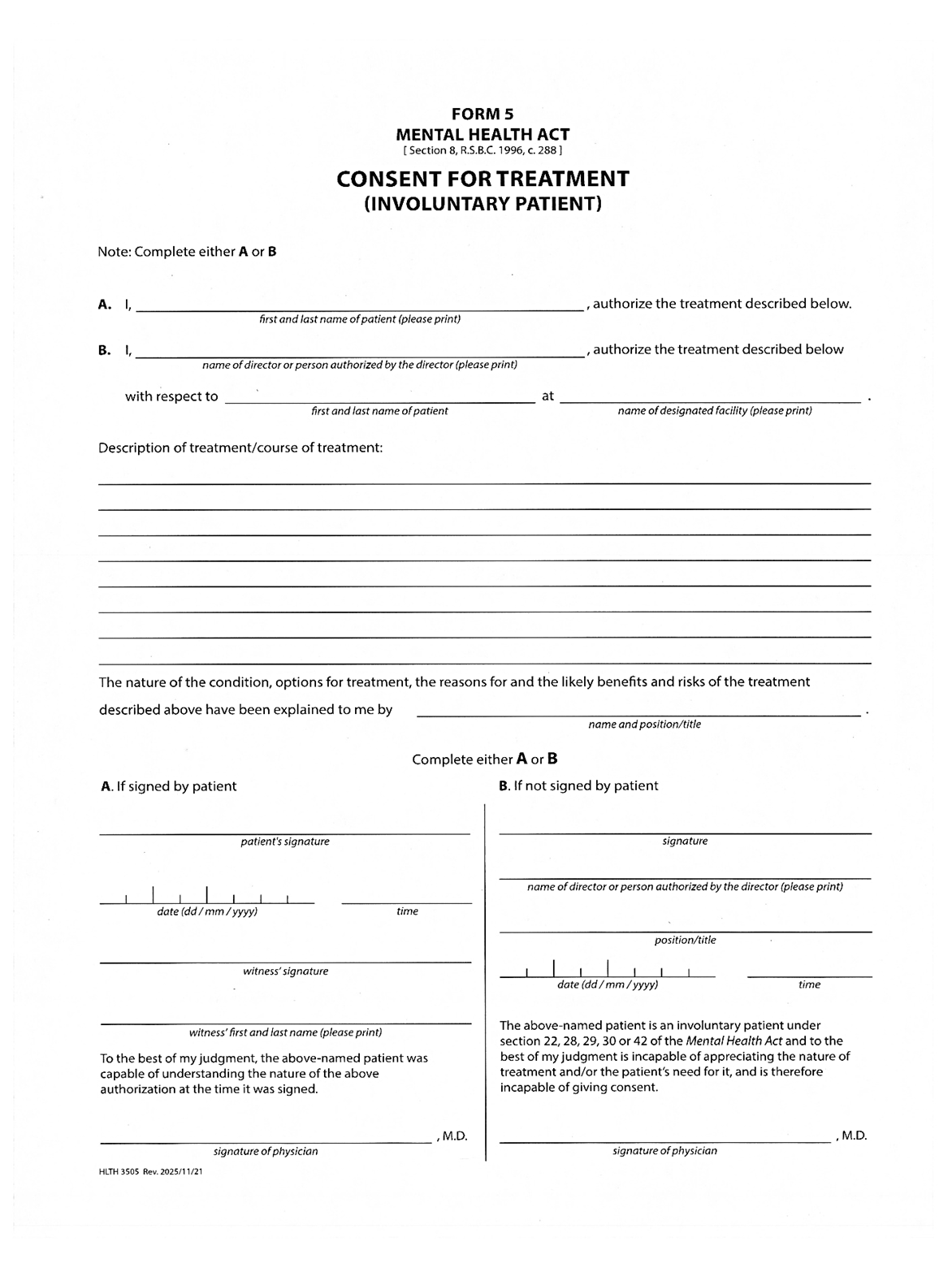
C. Schedule III: Cross Canada Comparison of Mental Health Legislation
|
Province |
When and how is treatment capacity assessed? |
Forced treatment of capable patients? |
Independent assessment or review of incapacity findings? |
Treatment pending review of incapacity finding? |
Who approves treatment for incapable patients? |
|
|
BC[1] |
No statutory requirement to assess capacity[2] |
Yes; detaining facility can unilaterally force treatment irrespective of treatment capacity[3] |
No independent assessment or review |
No ability to review incapacity findings |
Director[4] |
|
|
AB[5] |
Statutory requirement to assess capacity separately from admission criteria[6] |
No; |
Patient can apply for tribunal review of incapacity finding[8] |
No treatment pending tribunal review; legislation silent as to if treatment can proceed pending any subsequent court proceeding[9] |
SDM[10] |
|
|
SK[11] |
Capacity assessed as part of admission criteria; capable patients cannot be involuntarily admitted[12] |
No;
|
Patient can apply for tribunal review of admission criteria, including incapacity finding[14] |
Yes[15] |
Physician[16] |
|
|
MB[17] |
Capacity assessed as part of admission criteria[18] |
No[19] |
Patient (or person on a patient’s behalf) can apply for tribunal review of incapacity finding[20] |
Treatment can proceed pending board review with consent of SDM; but no treatment pending court proceeding, unless the court orders[21] |
SDM[22] |
|
|
ON[23] |
Box A (“Harm Criteria”)[24] |
Statutory requirement to assess capacity separately from admission criteria[25] |
No[26] |
Patient can apply for board review of incapacity finding[27] |
No treatment pending board review.[28] However, if a board or court authorized treatment and that decision is being appealed, treatment may proceed before final disposition of the appeal if the reviewing court so orders.[29] |
SDM[30] |
|
|
Box B (“Deterioration Criteria”)[31] |
Capacity assessed as part of admission criteria; capable patients cannot be involuntarily admitted[32] |
No; capable patients cannot be involuntarily admitted[33]
|
Patient can apply for board review of incapacity finding[34]
|
No treatment pending board review.[35] However, if a board or court authorized treatment and that decision is being appealed, treatment may proceed before final disposition of the appeal if the reviewing court so orders.[36] |
SDM[37] |
|
QC[38] |
Statutory requirement to assess capacity separately from admission criteria[39] |
No[40] |
Physician must apply for court order and prove incapacity if patient refusing treatment[41] |
No treatment pending court application if patient refusing treatment[42] |
SDM;[43] but court order required for treatment if patient is categorically refusing treatment[44] |
|
|
NB[45] |
Statutory requirement to assess capacity separately from admission criteria[46] |
No; unless physician obtains tribunal or review board order[47] |
Care provider must apply to tribunal for an order to treat incapable patient[48] |
Treatment can proceed as approved by physician[49] |
Tribunal or review board for routine clinical medical treatment[50]; SDM for other treatment[51] |
|
|
NS[52] |
Capacity assessed as part of admission criteria; capable patients cannot be involuntarily admitted[53] |
No; capable patients cannot be involuntarily admitted[54]
|
Patient can apply for tribunal review of admission criteria, including incapacity finding[55] |
Treatment can proceed with consent of SDM[56] |
SDM[57] |
|
|
PEI[58] |
Statutory requirement to assess capacity separately from admission criteria[59] |
No; unless physician obtains tribunal order[60] |
Patient can apply for tribunal review of incapacity finding[61] |
Treatment can proceed with consent of SDM[62] |
SDM[63] |
|
|
NFLD[64] |
Capacity assessed as part of admission criteria; capable patients cannot be involuntarily admitted[65]
|
No; capable patients cannot be involuntarily admitted[66]
|
Patient can apply for tribunal review of admission criteria, including incapacity finding[67] |
Treatment can proceed as approved by physician[68] |
Physician[69] |
|
|
YK[70] |
Statutory requirement to assess capacity separately from admission criteria[71] |
No; unless physician obtains tribunal order[72] |
Patient can apply for tribunal review of incapacity finding[73] |
No treatment pending tribunal review,[74] but treatment can proceed pending subsequent court proceedings[75] |
SDM[76] |
|
|
NWT[77] |
Statutory requirement to assess capacity separately from admission criteria[78] |
No; unless physician obtains tribunal order[79] |
Patient can apply for tribunal review of incapacity finding[80] |
Treatment can proceed with consent of SDM[81] |
SDM; or a review panel[82] |
|
|
NU[83] |
Statutory requirement to assess capacity separately from admission criteria[84] |
No[85] |
Patient can apply for tribunal review of incapacity finding[86] |
Treatment can proceed with consent of SDM[87] |
SDM[88] |
|
D. Schedule IV: Expert Witnesses: Qualifications and Brief Summaries of Their Evidence
PLAINTIFF’S EXPERTS
|
|
Name of Expert |
Certified Qualifications |
Summary of Evidence
|
|
1. |
Dr. Rachel Grimminck
Clinical Assistant Professor of Psychiatry; University of Calgary; University of British Columbia |
An expert in psychiatry, including emergency psychiatry, inpatient psychiatry, and electroconvulsive therapy. |
Dr. Grimminck opined on the process for the administration of involuntary psychiatric treatment under the MHA; the presence of capable involuntary psychiatric patients; the use of seclusion and restraint in involuntary psychiatric treatment in BC; and the negative consequences of forced coercive measures in involuntary treatment.
Two Reports:
February 27, 2025
Reply Report April 14, 2025 (response to reports of Dr. White; Dr. Vigo; Dr. O’Reilly and Dr. Sutherland) |
|
2. |
Dr. Marina Morrow
Professor of Community Psychology; School of Health Policy and Management York University |
An expert in mental health care policy and the risks and harms of involuntary treatment. |
Dr. Morrow opined on the history and evolution of involuntary psychiatric treatment in BC since 1960; and the potential risks or harms of such treatment.
Two Reports:
February 28, 2025
Reply Report April 16, 2025 (response to reports of Dr. Gray; Dr. O’Reilly; Dr. Sutherland; and Dr. White) |
|
3. |
Dr. Matthew Large
Psychiatrist; Prince of Wales Hospital; Professor of Psychiatry; University of New South Wales |
An expert in psychiatry and risk assessments involving persons with mental illnesses. |
Dr. Large opined on the effect of involuntary hospitalization for psychiatric treatment on suicide rates; and the accuracy of risk assessments in predicting whether someone with a mental disorder will either die by suicide or engage in violence against another person.
One Report:
February 14, 2025 |
|
4. |
Dr. Abraham Rudnick
Psychiatrist; Psychosocial Rehabilitation Canada; Professor of Psychiatry; Dalhousie University |
An expert in psychiatry and health-related bio-ethics. |
Dr. Rudnick opined on the potential mental health disorders that could cause a patient to meet the criteria of s.22 of the MHA; the common types of psychiatric treatment; the principles of health care ethics that apply with respect to informed consent for health care treatment and the concept of capacity; and the harms associated with the administration of psychiatric treatment involuntarily.
One Report:
February 21, 2025 |
|
5. |
Dr. Heather Stuart
Professor of Social Epidemiology; Queen’s University |
An expert in the stigma facing people with mental disorders in Canada. |
Dr. Stuart opined on the history of stigma faced by individuals with mental disorders in Canada; the stigma related to accessing health care; and the relationship between stigma faced by individuals with mental disorders and forced or coercive treatment within the health care system.
One Report:
February 19, 2025 |
|
6. |
Dr. Daniel Werb
Epidemiologist; St. Michael’s Hospital; Associate Professor at the University of Toronto; University of California San Diego |
An expert in the treatment of substance use disorders and the impact of policy and public health interventions on drug-using populations. |
Dr. Werb opined on whether involuntary treatment is effective at treating substance use disorders; the risks or harms caused by involuntary treatment for substance use disorders; and the health policy implications of allocating resources to involuntary treatment for substance use disorders.
Two Reports:
February 28, 2025
Reply Report April 6, 2025 (response to report of Dr. Vigo) |
DEFENDANT’S EXPERTS
|
|
Name of Expert |
Certified Qualifications |
Summary of Evidence
|
|
1. |
Dr. Richard O’Reilly
Psychiatrist; Professor emeritus Western University; Consultant Psychiatrist St. Joseph’s Health Care; Professor of Psychiatry; Northern Ontario School of Medicine |
An expert specializing in the treatment of all psychiatric conditions, mental health legislation and policies, assessment of efficacy of psychiatric treatment, and training of new psychiatrists. |
Dr. O’Reilly opined on mental illness (as opposed to mental disorder); the Ontario mental health system; violence and mental illness; the benefits of early treatment for psychosis and other serious mental illnesses; the effect of psychosis or severe mental illness on capacity; the risks of delayed treatment; and the advantages and disadvantages of using substitute decision-makers, or medical professionals, to make treatment decisions on behalf in involuntarily detained patients.
Two Reports:
February 10, 2025
Reply Report April 15, 2025 (response to reports of Dr. Rudnick, Dr. Large and Dr. Morrow) |
|
2. |
Dr. Daniel Vigo
Psychiatrist, clinical psychologist,
and public health specialist Associate Professor of Psychiatry; University of British Columbia
Chief Scientific Advisor for Psychiatry, Toxic Drugs, and Concurrent Disorders for BC
Advisor; Pan American Health Organization and the World Health Organization |
An expert in mental health care systems and services; prediction of risk and adverse mental health and substance use outcomes; treatment of concurrent mental health and substance use disorders; planning, development and design of public healthcare policy and needs based planning for mental health and substance use services; psychiatric epidemiology, psychopharmacology, psychotherapy, and global mental health. |
Dr. Vigo explained the purpose and mandate of the Office of the Chief Scientific Advisor for Psychiatry, Toxic Drugs and Concurrent Disorders, and the policy recommendations he has made in that capacity. He opined on the concept of “concurrent disorders”, and the clinical guidance he has issued for treating concurrent disorders. He also opined on the existence of a new “clinical triad” (patients with severe mental disorders, substance disorders and acquired brain injury) and his recommendations for improved services for those patients.
Two Reports:
February 28, 2025
Reply Report April 15, 2025 (response to reports of Dr. Large and Dr. Werb) |
|
3. |
Dr. John Gray
Clinical psychologist; John Gray PhD, |
An expert in mental health policy and legislation and health care reports administration; the history, design and development of mental health policies and the administration of public mental health care across Canada, including BC.
|
Dr. Gray opined on the history and evolution of mental health laws in Canada and BC, and compared mental health laws and services across Canada. He also opined on the negative effects of allowing treatment refusal by involuntary patients.
Two Reports:
February 27, 2025
Reply Report April 16, 2025 (response to reports of Dr. Morrow and Dr. Grimminck) |
|
4. |
Dr. Jason Sutherland
Mathematician and statistician; Professor; University of British Columbia |
An expert in healthcare policy, health services and outcomes and public health economics, as well as analyzing and interpreting health systems’ utilization, healthcare spending, healthcare costs, administrative data, and measuring health outcomes. |
Dr. Sutherland opined on the benefits to the public health care system of early treatment for psychosis and other serious mental illnesses; and the impacts of mandatory treatment for involuntarily detained patients on health care costs and utilization.
Two Reports:
February 27, 2025
Reply Report April 16, 2025 (response to report of Dr. Large) |
|
5. |
Dr. Randall White
Psychiatrist; Clinical Professor of Psychiatry; University of British Columbia |
An expert in both clinical practice and academic aspects of psychiatry, with expertise in both clinical practice and the academic aspects of psychiatry, specializing in medical education and training (including training in cultural safety and ethical care) as well as expertise in treatment-resistant psychosis, cognitive behavioural therapy, schizophrenia, and psychopharmacology.
|
Dr. White opined on the process through which a patient in BC is admitted on an involuntary basis under the MHA; the concept and assessment of capacity to make a psychiatric treatment decision; how the criteria for admission as an involuntary patient are assessed; and the frequency of refusal of treatment. He also opined on the potential consequences of delayed psychiatric treatment for involuntary patients and the implications of severing involuntary admission from involuntary treatment.
Two Reports:
February 25, 2025
Reply Report April 11, 2025 (response to reports of Dr. Rudnick and Dr. Large) |
|
6. |
Dr. Lacresha Hall
Psychiatrist; Private Practice |
An expert in psychiatry and neurology, especially in general adult psychiatry, child and adolescent psychiatry and forensic psychiatry, with specialization in the treatment of adolescents and adults with addiction, eating disorders, trauma-related conditions, and personality disorders. |
Dr. Hall opined on the treatment of patients with eating disorders in BC; how the criteria for involuntary admission in the MHA are applied to psychiatric patients with eating disorders; and the benefits of mandatory treatment for patients who have been involuntarily admitted due to an eating disorder.
One Report:
April 8, 2025 |
|
7. |
Dr. Jhilam Biswas
Psychiatrist; Psych Expertise, LLC.; Brigham and Women’s Hospital; Faculty at Harvard Medical School |
An expert (in both clinical and academic areas) in treatment of patients of all ages in both emergency and non-emergency settings, mental health legislation and ethical care in Massachusetts, and the effects of delayed psychiatric treatment.
|
Dr. Biswas was a reply expert. She opined in response to Dr. Stuart’s Report and Dr. Large’s Report, on the issue of stigma in situations of serious mental illness, the impact of the duration of untreated serious mental illness, and the consequences of untreated mental illness.
Reply Report April 11, 2025 (responding to reports of Dr. Large and Dr. Stuart) |
|
8. |
Dr. Barbara Kane
Psychiatrist; Mental Health Program, Northern Health Authority, BC |
An expert in administration of psychiatric units and development of mental health services in BC, especially in northern BC, including community based care and Assertive Community Treatment (“ACT”).
|
Dr. Kane was a reply
expert. She opined in response to Dr. Grimminck’s Report, and discussed
current practices related to involuntary admission and treatment, and the
potential problems associated with changing the current approach, including
allowing for treatment refusal and the use of substitute decision makers. She
also opined on the use of involuntary ECT. Reply Report April 16, 2025 (responding to report of Dr. Grimminck) |